The Hotel Chelsea, on west 23rd Street, tucked between Seventh and Eighth Avenue in Manhattan’s Chelsea, is the stuff of legend. Playwright Arthur Miller lived here for six years and said, “This hotel does not belong to America; there are no vacuum cleaners, no rules and no shame.”
An elderly tenant, seen in the new documentary “Dreaming Walls: Inside the Chelsea Hotel,” now playing in theatres, says, “It’s a fantasy land where people go to get away from reality.”
Opened in 1884, for more than a century it was a stand-alone example of bohemianism, immortalized in songs by Bob Dylan (“Sara”), Jefferson Airplane (“Third Week in the Chelsea”) and most famously, Leonard Cohen’s “Chelsea Hotel #2.” It’s featured in films like Andy Warhol’s “Chelsea Girls” and the sensual “9½ Weeks.
Punk goddess Patti Smith lived there with photographer Robert Mapplethorpe. Abstract painter Mark Rothko had a studio in the dining room. Warhol superstar Edie Sedgwick almost accidentally burned it down and Nancy Spungen died there, allegedly (but probably not) at the hand of her boyfriend, Sex Pistol’s bass player Sid Vicious. Arthur C. Clarke wrote “2001: A Space Odyssey” while in residence and Jack Kerouac had a one-night stand there with Gore Vidal.
It is legendary, but the days of wild abandon, avant garde art and artists who traded apartments for paintings are long gone, a victim of changing times and gentrification. “Dreaming Walls: Inside the Chelsea Hotel” is a document of the dying days of a cultural legend and the birth of another boho-chic New York City hotel.
Directed by Belgian filmmakers Amélie van Elmbt and Maya Duverdiert, this is a fly-on-the-wall, impressionistic film that ignores the Chelsea’s rock n’ roll legacy, the scandals and notable sex acts. Instead, it contemplatively documents the (mostly) elderly residents of the Chelsea, who, in the words of Dylan Thomas, another former resident, refuse to “go gentle into that good night.”
A look at the hotel through the eyes of the people who lived there, who created their art there and raised their families there, paints a different picture of the storied building than we usually see. Strip away the sensationalism and a melancholy portrait of a bygone era emerges, framed by architect Philip Hubert’s ornate Victorian Gothic stained glass and wrought iron stairway designs. As construction of the Chelsea Mach 2 tears away at the memories of the remaining residents, they recollect the heart and soul of a place that, for decades, gave shelter to dreamers of all sorts.
Those days are gone now. The few remaining old timers, those who didn’t take the buyouts offered by developers, now must use service elevators to avoid upsetting the upscale, paying hotel guests. However, in this film at least, they keep the bohemian flame alive, even as the winds of change are try to extinguish it.
On this episode of “Last Call with Richard Crouse” we visit Sardi’s, located at 234 West 44th Street, between Broadway and Eighth Avenue, in the Theater District of Manhattan, New York City. It is Broadway’s most famous restaurant, and you may recognize it as the place where Kramer falsely accepts a Tony Award on “Seinfeld,” or where Finn and Rachel met Patti LuPone in an episode of “Glee” or perhaps you know it as the place where Don Draper and Bobbie Barrett celebrated the sale of a television pilot on “Mad Men.” The walls of celebrity caricatures are iconic and unmistakable.
Listen to the whole story of the “Clubhouse to the Stars” where the Tony Awards were born HERE!
On this episode of “Last Call with Richard Crouse” we visit McSorley’s Old Ale House on Seventh Street in New York’s East Village. McSorley’s may not be New York’s oldest bar, the Bridge Café (dates to 1794), Ear Inn (circa 1817) and Chumley’s (established 1830s) all predate John McSorley’s business, but it is one of the most colourful. It’s sometimes hard to sort between the fact and fiction that swirls around the bar’s legend, but one thing is for sure, there is no arguing with their motto, “We were here before you were born.”
At the afterparty Rafe Bartholomew stops by to talk about the bar where Abraham Lincoln once had a beer and its history. Rafe’s father Bart worked there for 45 years, the family lived upstairs for a time and on the weekends he’d help his dad get the place up and running and later, in his twenties, he continued the family tradition and worked behind the bar. His book, “Two and Two: McSorley’s, My Dad, and Me,” is a great read about fathers, sons and one great bar.
“In the Heights” (in theatres and on PVOD) is a crowd pleaser that offers heart and uplift in almost every frame. HERE’S Richard’s interview with stars Jimmy Smits and Olga Merediz! HERE’S a a shorter version OF “Vax for Joy!”
“In the Heights,” now playing in theatres, is a joyful movie based on Lin-Manuel Miranda’s Tony award-winning musical, that will make you feel better by the end of the movie than you did when it began. Energetic, exultant and empathetic, it feels like a long weekend away from real life.
A series of connected stories, “In the Heights” transcends its Broadway bound beginnings with a production cut loose from the confines of the stage. Shot on the streets of Washington Heights, New York, the story of a bodega, gentrification, a winning lottery ticket, love, community and the dreams of its characters is lovingly painted in big, bright colors by director John M. Chu.
The spider-web of a story weaves in and out of its character’s lives, centering around bodega owner Usnavi, played by the charismatic Anthony Ramos. Like almost everyone in the film Usnavi has a dream of a life beyond his neighborhood, and, in a sentiment borrowed from another famous musical, soon, most everyone discovers there’s no place like home.
“In the Heights” is a story of the immigrant experience that touches on the DREAM Act and fear of deportation, but is more concerned with its characters and their day dreams of creating better lives for themselves. It’s a story of resilience, of hope and it’s a tonic during these pandemic times when it seems the media, both social and mainstream, are incapable of delivering anything but unsettling news.
In an eager cast, Olga Merediz, who reprises her Broadway role as the neighborhood’s grandmother Abuela Claudia, and Melissa Barrera as Usnavi’s love interest Vanessa, are standouts.
The sheer spectacle of it all, however, may be the real star. Chu’s camera is in constant motion, capturing the many ensemble dance numbers that accompany the soundtrack’s hip-hop, salsa, merengue, soul and R&B, in an eye-popping manner. The Busby Berkeley-style “96,000” number, shot at a public swimming pool is a total throwback to Hollywood’s Golden Age, as is a terrifically staged gravity-defying dance on the side of a building.
It doesn’t all work, however. A framing device that sees Usnavi tell his story to a group of kids is clunky and the opening number, “In the Heights,” an almost eight-minute set-up to the story, is stylish but overstays its welcome.
Still, those are small issues in an invigorating crowd pleaser that offers heart and uplift in almost every frame.
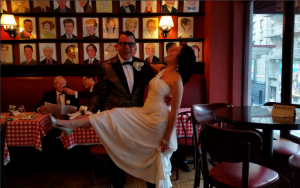
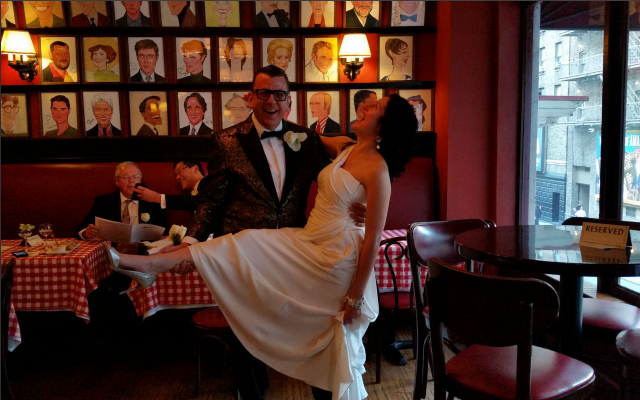
As many of you know Andrea and I officially hitched up this week in a small, private ceremony at Sardis on 44th Street in New York City. The “I do’s” took place under the knowing gaze of dozens of Broadway caricatures in “The Little Bar,” the small room on the main floor where we first sat many years ago on our first visit to Sardis. It’s our favourite watering hole in NYC and we were thrilled when Andrea’s parents Ron and Angela joined old friends of mine, John and Gina for the actual tying of the knot in the space where we have shared so many memorable moments.
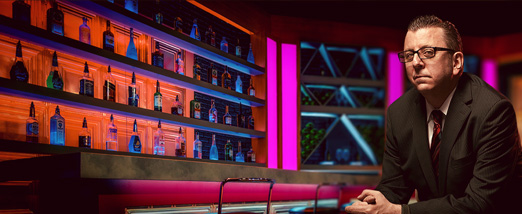
Want to go to Sardis but not get married? Do it. It’s like walking into an episode of Mad Men without the cigarette smoke and Don Draper’s bad attitude. Ask Jeremy for a Bloody Mary. They’re fantastic, and so is he. He’s Jeremy Wagner, King of the Bartenders and our much-loved mixologist (although Sardis is WAY too old school to use such a term) who graciously took a break from pouring cocktails to be our witness.
It truly was everything we hoped for despite Andrea whispering in my ear, “This is weird,” about one second before our officiant Alice Solway started the vows. It was weird. I guess after fourteen years it felt strange to stand up in front of everyone and verbalize what everyone already knows about us, but that is part of what makes it important and special. And weird.
The day went by in a blur. Andrea looked beautiful in a Vera Wang dress. My shoes were so shiny you could see them from space. We took pictures with a slightly tipsy Elmo in Times Square and an epic photo with Chewbacca, Iron Man and Cat Woman. My shiny gold brocade jacket—it can only properly be described as a relic from the Sammy David Jr. 1968 Comeback Special—and Andrea’s bejewelled pumps sparkled in the neon glow of 44th Street.
Thanks to John and Gina who drove many, many miles to share the day with us. It was so special to have them there. John and I have known one another since we were foetuses and no matter how many years pass we still behave like kids. Gina took over 1600 photographs! She was both the official documentarian and spreader of the most delicious pub cheese in the world. They helped make an already special time even more special. Isn’t that special?
Ron and Angela have literally known Andrea since she was a foetus and the day would not have been complete or as extraordinary without them there.
It was a big day. I discovered that when you parade a beautiful woman around in a wedding dress in any of the five boroughs it is impossible to pay for a drink. I also discovered how gracious and wonderful all my Facebook friends are. You guys showered us with good wishes and it really meant a great deal to us to know that people, worldwide, were sending good vibes our way. You know what? It worked. We had a perfect week in New York, topped by a day I will never forget.
The day after the wedding we went to the Comedy Cellar. It’s a legendary room and almost every time we go someone cool stops by to do an impromptu set. This time Ray Romano, who has an apartment down the block, stopped by. During his set he asked me if we were married. I said, “Yes, for about 26 hours.” He looked at us and said, “The first 12 hours is the best.”
He’s not entirely wrong. The first twelve hours was great… but I anticipate many more great hours, days, weeks, months and years.
It would be easy to mistake “Fading Gigolo” for a Woody Allen film. First there’s the obvious stuff—it’s set in New York, has a jazz score, younger women flirt with older men and, of course, Woody is in the center of it all cracking wise.
But it’s not a Woody Allen film. It was written and directed by John Turturro, who is a formidably talented actor but as a director, suffers in comparison to his co-star and obvious inspiration.
Allen is Murray Schwartz, a New York bookseller—he sells “rare books for rare people”—is forced to close his store and let his single employee Fioravante (Turturro) go. Fioravante is a soulful jack-of-all trades, but master of none until he embarks in a new gig that suits him to a tee—gigolo. Murray becomes an unlikely pimp, setting Fioravante up with older, bored rich women (Sharon Stone and Sofía Vergara) who become smitten with his puppy dog eyes and sweltering sensuality. Trouble is, although his bank account is full, Fioravante finds the job personally unfulfilling. That changes when he falls for Avigal (Vanessa Paradis), the demure widow of a rabbi.
“Fading Gigolo” attempts to find the balance of humour, pathos and romance that seems to come so easily to Allen, but is more “The Curse of the Jade Scorpion” than “Annie Hall.” From the sexual shenanigans of the gigolo scenes to the more repressed romance of the Avigal storyline, the muddled story fails to generate any real heat. Add to that a subplot involving Liev Schreiber as a neighborhood ranger with feelings for the widow who reports Murray for breaking Jewish law and you have enough stories for two movies crammed into one.
Performance wise, Turturro is so stoic it’s as if he’s planning the next shot in his head while also trying to act in the film, but Stone, Vergara, Paradis and Schreiber each have a moment to shine. Stone, playing a doctor with a philandering husband, becomes more than a stereotype as she quietly cries, from trepidation and nervousness the first time Fioravante stops by to ply his trade. It’s a revealing moment in a movie that could have used a few more of them.
Since this is a de facto Woody Allen movie it shouldn’t come as a surprise that Allen walks away with the whole thing. There is a thrill that goes along when he describes Fioravante as “disgusting, but in a very positive way.” It’s a Woody-ism that provides a whiff of nostalgia that makes the audience long for the good Woody Allen movies, not imitations like this one.
Long before I saw the Statue of Liberty in person I felt like a New Yorker. Woody Allen’s movies were my initiation and his romantic, idealized view of the Big Apple planted the seed for my longtime love of the city.
His latest film, Whatever Works, is the first of Allen’s films to be set in Manhattan in four years, and you get the sense he’s glad to be home. It’s his love letter to the city, showcasing only-in-New-York locations like Chinatown’s fish markets and the Yonah Schimmel Knishery (137 E. Houston St. near 1st Ave., 212-477-2858).
The movie will make you want to jump on a NYC-bound plane ASAP, which is exactly what I did.
There are no official Woody Allen tours of Manhattan, so I created my own daytrip to see Allen’s New York with my own eyes. With a good pair of runners, a map, a Metrocard (get a 1-Day Fun Pass for $7.50 US at MetroCard Vending Machines and neighborhood stores) and some determination you should be able to do this tour in about six hours.
The first stop serves a double purpose. The Dean & Deluca Café (560 Broadway at Prince St. in SoHo, 212-226-6800) is the perfect place to fuel up on coffee to get the day started — it’s also where Mia Farrow has lunch with the newly-single Judy Davis in Husbands and Wives.
Now that you’re in a caffeinated, New York state of mind, exit Soho for the funkier streets of Greenwich Village.
You’ll pass the former home of The Bleecker Street Cinema (144 Bleecker St.) — where Allen’s character takes his niece to see movies that will improve her mind in Crimes and Misdemeanors — on your way to his favorite pizza joint, John’s Pizzeria (278 Bleecker St. in Greenwich Village, 212-243-1680).
John’s Pizzeria is also the place where Allen and his much younger girlfriend, played by Mariel Hemingway, have the “in six months you’ll be a completely different person” conversation in 1979’s Manhattan.
Moving north, our next stop is in midtown. The Carnegie Deli (854 Seventh Ave. between 54th and 55th streets, 212-757-9889) is virtually unchanged since Woody shot much of Broadway Danny Rose here in 1984.
In fact it hasn’t changed much since it opened in 1937 and Henny Youngman was a regular.
Take some time to check out the autographed pictures of celebrities have eaten there, and if you have the appetite of three people order The Woody Allen — “Lotsa corned beef plus lotsa pastrami; for the dedicated fresser only!” says the menu, and it’s not kidding. There’s over a pound of meat between two slices of rye.
Next, walk off the sandwich with a jaunt to the The St. Regis-Sheraton Hotel (2 E. 55th St., 212-753-4500). Woody has used this location twice. This is where Michael Caine and Barbara Hershey carried on their covert love affair in Hannah and Her Sisters and, in Radio Days, the hotel’s King Cole Room (with its Maxfield Parrish Art Nouveau mural behind the bar) was the site of the swanky New Year’s celebration Joe Needleman listened to on the wireless.
The next stop is the location of one of Allen’s most iconic New York images. The poster for Manhattan showing Woody and Diane Keaton sitting in silhouette on a bench was shot at Riverview Terrace on Sutton Square, just beneath the 59th Street Bridge.
It looks a little different than it did in 1979. The bench is gone (stolen by Woody fans perhaps?) and the landscape is a little different but the view is still spectacular.
You’ve seen the movies and the sights, now catch a glimpse of the Wood-man in person. Allen and his clarinet have been blowing up a Dixieland storm on Monday nights (from September to June) at the Café Carlyle (35 E. 76th St. on the northeast corner of Madison Avenue, 212-744-1600) since 1996. Reservations and jackets are required and tickets ($100 for the show, dinner is extra) go quickly so book ahead for the toe-tapping fun.
Not quite as exclusive or as pricey is Elaine’s (1703 Second Ave. between E. 88th and E. 89th St., 212-534-8103), which restaurant writer A. E. Hotchner summed up with the words, “What Rick’s place was to Casablanca, Elaine’s is to New York.”
On film it’s the location of one of Allen’s most famous one-liners: In Manhattan, he’s at Elaine’s complaining about the difficulties of seeing a 17-year-old. “I’m dating a girl who does homework,” he says.
Off-screen, it’s one of his favorite restaurants. “I ate at Elaine’s every night for about 10 years,” he said. “I’ve eaten alongside everyone from Don King to Simone de Beauvoir. There was no celebrity that didn’t show up there.”
One of the celebrities who ate there was Mia Farrow, who asked Michael Caine to introduce her to Woody one night at the restaurant, thus beginning their long and tumultuous affair. Soak in that storied atmosphere for the price of an entrée.
The tour finishes up with a trip to Pomander Walk, (260-266 W. 95th St. through to 94th Street between Broadway and West End Avenue). This beautiful village — built to resemble the London stage set from a romantic 1910 play — is made up of 27 Tudor-style houses and is the location of the architectural tour Sam Waterston gives Dianne Wiest and Carrie Fisher in Hannah and Her Sisters.
You’ll have to peek through the gate (it’s locked to the public) but its Alice in Wonderland aura and the fact that Humphrey Bogart used to live there make it a must-see for movie fans.
By the tour’s end you’ll see why Isaac Davis, Woody Allen’s character in Manhattan, famously said, “This is really a great city. I don’t care what anybody says, it’s really a knockout, you know?”