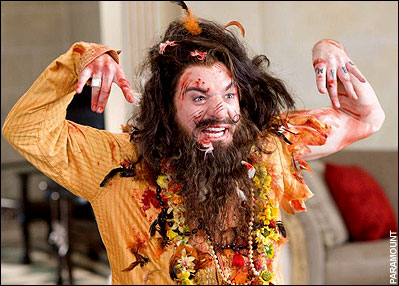
Comedies don’t usually come with the kind of baggage that is dogging The Love Guru. It hits theatres cursed with a trailer only a mother could love, negative babble from bloggers and fighting against the strong reactions of Hindus, who, in India called for the film to be banned. Is the movie worth all the fuss? As the Guru Pitka himself might tell the naysayers, “To be enlightened you must first lighten up.”
The Love Guru is an extremely silly comedy that features jokes so old many were likely originally written in Sanskrit centuries ago, but it is so relentlessly upbeat, so good natured—and at 88 minutes, mercifully short—that it makes up in exuberance what it lacks in originality or actual laughs.
In the film self-help expert Guru Pitka (Mike Myers)—an orphaned American raised by gurus in an ashram in India—is hired by Toronto Maple Leafs owner Jane Bullard (Jessica Alba) and Coach Cherkov (Verne Troyer) to reunite star hockey player Darren Roanoke (Romany Malco) and his estranged wife (Meagan Good). It seems after their split Roanoke’s wife took up with a rival, L.A. Kings star goalie Jacques “Le Coq” Grande (Justin Timberlake), and the thought of the two of them together has sent the Maple Leaf into a tailspin both personally and professionally. Pitka must work his mojo on Roanoke and his wife before the beginning of the Stanley Cup Finals if the Leafs have a chance at breaking the 40-year-old “Bullard Curse” and winning the championship.
The Love Guru will bring a smile to your face from time to time, and maybe even a few laughs but the comedy world has changed since Myers last unveiled a new character. In a movie landscape populated by Judd Apatow comedies, movies based in the real world with real world situations and laughs, The Love Guru seems antiquated, like a relic from a different time. It’s broad, anything-for-a-laugh ethos has more to do with Benny Hill than Seth Rogen—another Canadian vying for the King of Comedy crown—and feels about as relevant as a Carry On movie.
The structure of the movie and many of the jokes and situations seem familiar, as though they have been borrowed from Austin Powers and retooled for Guru Pitka. That sense of familiarity with the jokes may be a comfort to some viewers who might see it as a “greatest hits” repackaging of their old favorite jokes, but I was left with a strange sense of déjà vu, as though I had seen it all before, and it was funnier the last time.
Myers is never any less than 100% committed to the role, and his devotion to the character is obvious. He’s in it to win it, but the outrageousness of the character is overwhelmed by an endless stream (no pun intended) of urination and bathroom humor, short gags at the expense of 32-inch co-star Verne Troyer and penis jokes. The humor here can only be described as shameless and juvenile, but if the idea of two elephants having very public sex amuses you, then The Love Guru may be perfect for you.
In an unusual marketing move The Love Guru is being released opposite Steve Carell in Get Smart. The big studios usually try and avoid opening two similar movies on the same weekend but here are two of comedy’s biggest stars going head-to-head. Both films have their virtues; both are retro—Get Smart is based on a 60s sitcom, The Love Guru’s jokes seem somehow, let’s say, traditional—and both stars have considerable audience goodwill. Which will win out? Perhaps it depends on how enlightened, or not, your comedy tastes are.
Once upon a time, in 2001, a green ogre named Shrek lumbered on to screens, bringing with him a different kind of animated story. The original “Shrek” was a fairy tale that mixed family friendly characters with a edgy sense of humor—like a Gingerbread Man tortured with a milk dunking. It was a monumental hit, so it wasn’t long before “Shrek 2” and “Shrek the Third” came along, each time with diminishing results. Luckily, the new “Shrek Forever After,” the fourth and final installment takes us off into that fairy tale happily-ever-after on a high note.
The 3D “Shrek Forever After” sees the giant green ogre (voiced by Mike Myers) in the midst of a mid-life crisis. He’s feeling bogged down by the responsibilities of marriage to Fiona (Cameron Diaz), raising his three kids and trapped by his newfound celebrity as the friendliest ogre on the block. “I used to be an ogre,” he says, “but now I’m a jolly green joke.” Longing for the days when life was simple he strikes a deal with an evil magician (voiced in an apparent tribute to Pee Wee Herman by story editor Walt Dohrn. In exchange for one day of freedom he will give the magician one day from his life. In a prime example of “be careful what you wish for because you just might get it” the unsuspecting Shrek signs the deal and begins a nightmarish “It’s a Wonderful Life” journey into a world completely different than any he could have imagined. Only the kiss of his true love—Fiona—can break the spell, but does she love him anymore?
Call this “Shrek the Metaphysical” if you like, one thing is for sure, it is darker than the preceding “Shreks”—although dark is still a relative term in the world of kid’s entertainment. The “you don’t know what you’ve got till it’s gone” message isn’t much different from anything you’d see in a regular children’s flick, but the journey to get there is.
In its opening moments this grim fairy features a tour-de-force sequence illustrating how snowed under Shrek feels by his new responsibilities. It’s a scene that will likely seem familiar to some of the parents in the audience, what follows—the well worn puns both vocal and visual, classic rock music cues and pop culture references—will seem familiar to anyone else who’s seen “Shrek” one through three. Even the bodily function jokes make an appearance—Shrek is described as “a lovable lug who showed that you don’t have to change your undies to change the world”—but instead of the been there, done that feel of “Shrek the Third” the new film weaves the familiar elements together into something resembling a large helping of comfort food. It doesn’t have the sparkling freshness of the first installment, but it has heart, some good jokes for both kids and adults and is a fitting send off to the series.
Three is a very popular number in the entertainment world. There were three Stooges; the Schoolhouse Rock folks did a song called Three is a Magic Number and even William Shakespeare favoured the number, giving King Lear three daughters, and writing about the three witches in Macbeth. This summer there seems to be a revival in the importance of the number three at the movies, with no less than six threequels hitting the screens.
We’ve already seen Spider-Man 3 clean up, making $148 million on its opening weekend, with Pirates of the Caribbean: At World’s End, Ocean’s Thirteen, The Bourne Ultimatum and Rush Hour 3 soon to come. By August we really will know once and for all whether “three times is a charm” or not.
The latest franchise to come back for a third time is Shrek. The giant green ogre, voiced by Toronto’s Mike Myers, is now happily married to his ogre bride, the Princess Fiona (Cameron Diaz). When her father, the frog king of Far Far Away dies he anoints Shrek as the next king. The trouble is Shrek doesn’t want the responsibility that comes along with the job. He sets off, with his companions Puss ‘N’ Boots (Antonio Banderas) and Donkey (Eddie Murphy), on a quest to find the other living heir to the throne, Arthur (Justin Timberlake). Arthur, or Artie as he prefers to be called isn’t exactly king material, but reluctantly agrees to become the leader. In the meantime the exiled Prince Charming (Rupert Everett) has returned with an army of fairy tale villains to forcibly take the throne. Shrek and his pals—Pinocchio, the Ginger Bread Man and the Three Little Pigs—must save the kingdom and ensure that the rightful king sits on the throne.
Shrek the Third doesn’t do anything that we haven’t already seen in the first two instalments. More fart jokes, more of Puss ‘N’ Boots dewy cat eyes and more pop culture references and even more recycled pop songs from the likes of Smashmouth. What we don’t get is enough funny lines from the two characters who really carried the first two movies—Shrek and Donkey. Their roles this time has been watered down, perhaps to make way for the flood of new characters.
There are laughs here, but with those laughs comes a sense of déjà vu, like we’ve seen all this before. Call it the curse of the threequel. The first Shrek was magical—funny, fresh and memorable. The second instalment less so, and, because familiarity breeds contempt, (well, maybe not contempt, but at least tedium) the third even less.
Not that the sameness of Shrek the Third to its predecessors will matter to young kids who tend to enjoy watching the same thing over and over. For adults though, Shrek the Third may seem like that third helping of desert you had at Christmas dinner. It tasted good while you ate it, but in retrospect perhaps you wish you had stopped at two.
TORONTO — Mike Myers was a big fan of the buffoonish Insp. Clouseau of the “Pink Panther” films as a child, introduced to the rip-roaringly funny but politically incorrect movies by his beloved father, a comedy junkie himself.
But is the brand of cultural humour that has infused the Toronto-born Myers’s work – from the “Austin Powers” franchise to the upcoming “The Love Guru” – becoming a relic of the past?
“The Love Guru,” about a goofy Hindu self-help coach who tries to solve the marital woes of a Toronto Maple Leafs player, doesn’t arrive in theatres until June 20, but it’s already controversial as Hindu groups around the world complain that Myers is lampooning their faith.
Hindus in India have even called for the film to be banned, while North American Hindus – led by the man who has been called America’s most savvy Hindu priest, Rajan Zed – are actively trying to block the film’s release by appealing to distributors and theatre chains.
In Canada, one Hindu leader is calling for edits to the film and is planning to contact Paramount Pictures to demand them.
“It should not be released in Canada without editing,” said Kanayalal Raina, executive director of the Canada Hindu Heritage Centre in Mississauga, Ont. “There are only some portions that are offensive, not all, so it doesn’t mean that we should completely ban the picture, but it should not be released until it’s edited properly.”
Paramount Pictures is apparently so nervous about the controversy, they’ve decided to screen the movie for Hindu leaders before its release.
The film, starring Myers, Jessica Alba, Ben Kingsley and Justin Timberlake – who plays a Speedo-clad Quebecois hockey player – is “a satire created in the same spirit as ‘Austin Powers,”‘ says Paramount’s Jessica Rovins.
But Zed, the Nevada-based head of the Universal Society of Hinduism, has seen the trailer and isn’t impressed.
“The movie appeared to be lampooning Hinduism and Hindus and using Hindu terms frivolously,” he told the Times of India.
Richard Crouse, the film critic for CTV’s “Canada AM,” says it’s tough to successfully make movies based on racial stereotypes anymore, with the possible exception of the recent “Borat” film.
Some of the biggest comedies of the past have featured scenes, language and jokes that would likely make audiences squirm today – from Mel Brooks’s “Blazing Saddles” to Peter Sellers’s “The Party” and even the 1980s teen flick “Sixteen Candles,” in which a gong mysteriously sounded every time the film’s Chinese exchange student walked into a scene.
“‘Borat’ did it, but look at Borat’s choice of locale – Kazakhstan,” Crouse said Thursday. “It doesn’t have a real international voice and it’s a country that no one had really ever heard of before the movie came out.”
“Borat,” in fact, was skewering the ignorance of some Americans far more than it was ridiculing people from Kazakhstan, and that’s why the film was such a critical success, said Charles Keil, director of the Cinema Studies Institute at the University of Toronto.
But the buzz about the “The Love Guru,” he notes, isn’t positive.
“You can negotiate any of these potential landmines if you handle the publicity and the marketing properly, and if the film gets a warm critical reception,” Keil said.
“If, on the other hand, the film gets bad reviews and you don’t have the critics in your corner, than you’re left defending it on your own. Nobody wants to see a dumb movie that also offends people, whereas you can defend a smart movie that offends people.”
Like Myers, Sacha Baron Cohen has long cited Sellers as an influence, but the late British comic’s memorable portrayal of a boneheaded Indian in “The Party” would not fly today without engendering the same kind of outrage confronting “The Love Guru,” Crouse says.
“Look at ‘The Party’ – it’s a classic, but you simply could not make it today in the way that it was presented then. You just couldn’t.”
But Crouse says he finds it hard to imagine that the brains at Paramount did not anticipate the controversy that has reared up over “The Love Guru.”
“I haven’t seen the film yet, but there must be some cultural sensitivity – there has to be,” Crouse says. “I just can’t believe that a major release from a major movie star is going to drop the ball completely. There must have been some work done behind the scenes beforehand to make sure this movie is not going to get swept away in a sea of controversy.”
If you were a fan of the first two Austin Powers movies you’re going to love Goldmember. It’s a continuation of the over-the-top silliness that made the first two so popular. Many of the same elements are in place from picture to picture – the forced perspective sight gags, the rapid fire banter between Dr. Evil and his son Scott, elaborate dance numbers – but somehow instead of feeling like we’ve seen it before it seems fresh. For the most part it is Mike Myers (in four, count ‘em, four roles this time) and his unerring sense of “the silly” that makes this material so watchable. Myers can push the envelope further than almost any other comic, and still come off as cute. Myers has elevated bathroom humour to high art. He’s Benny Hill, not Tom Green. Destiny’s Child lead singer Beyonce Knowles is Foxxy Cleopatra, Austin’s love interest in Goldmember. This is her feature film debut, and she handles herself nicely. She doesn’t have a great deal to do, but she has a lot of charisma and looks great on screen. The full Austin Powers’ repertory company is back, Michael York, Robert Wagner, Verne “Mini-Me” Troyer and Seth Green, with some new faces added. I won’t spoil the movie by giving away the cameos, but I will advise you to be on time and not miss the first 15 minutes of the movie.