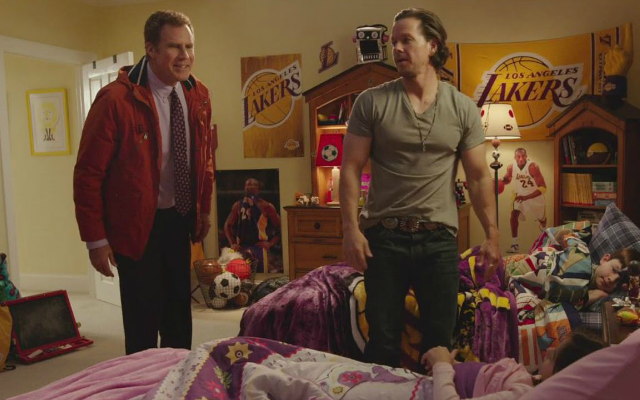
“Daddy’s Home,” a new comedy starring Will Ferrell and Mark Wahlberg asks a very simple question, What do kids need more, a father or a dad? Anyone can be a father, the opening narration tells us, but it takes real work to be a dad.
Brad desperately wants to be a dad to his step-kids Megan and Dylan (Scarlett Estevez and Owen Vaccaro), but instead of hugs they greet him with hand drawn family pictures featuring him with a knife through his head. After being pushed away and being treated like an outsider for months, he becomes a real dad to the kids… until Dusty (Mark Wahlberg), their real father, re-enters the picture.
What’s Dusty like? “Imagine if Jesse James and Mick Jagger had a baby,” says his ex-wife Sarah (Linda Cardellini). “He sounds like a rascal,” says Brad.
A rascal to be sure. The muscle-bound ex-husband manipulates the once-happy family, slowly drives a wedge between Brad and the kids. “I’m here to defeat you and take your family,” he tells Brad.
All out war breaks out between the two men as they compete for the affection of Sarah and the kids.
“Daddy’s Home” shows a different side of Will Ferrell’s finely tuned comedic persona. Typically we see him in the role of an incompetent but arrogant man. Here he’s incompetent but he’s the über-everyman, a guy who blends into the crowd. There is no “yazz flute” in “Daddy’s Home.” Instead he is the brunt of the joke, a punch line in this comedy of humiliation and a little less fun than usual. He’s a comfortable presence in movies like this, but more often than not I had the feeling that I should be laughing instead of actually laughing.
Dusty, on the other hand, is a macho man of mystery skilled in ways Brad could only dream of. He has charisma to burn, has an answer for everything and quickly wins over the kids who look at him like he’s a superhero. When he does CPR and Brad the kids cheer, “My dad brings people back from the dead!” Wahlberg is probably that guy in real life, so he’s believable and occasionally funny but the situation is predictable—you don’t need to be gifted with ESP to see the end of this movie coming—and by the book.
As Brad’s boss Leo, Thomas Haden Church tries to inject some surreal stream of consciousness humour but falls flat. Only Hannibal Buress’s deadpan delivery of lines like, “You can’t build a tree house with a tampon, Brad,” consistently draws laughs.
“Daddy’s Home” has its giddy moments but by-and-large but doesn’t contain enough “dad jokes” to make it worthwhile.
When John Bennett (Mark Walhberg) was a small, lonely child he wished for just one thing—a best friend. His wish came true and Ted (voice of Seth MacFarlane), his trusty teddy bear, came to life. The pair became “Thunder Buddies” for life and the subject of two movies, Ted and this weekend’s Ted 2.
Ted isn’t your usual teddy bear. He smokes pot, swears—imagine rooming with Tommy Chong and Charles Bukowski—and has trouble holding down a job.
In the new film Ted is married to a human woman but under the eyes of the law he is seen as property and not a person. When the couple decide to adopt a child he faces a court battle helmed by a young lawyer (Amanda Seyfried) and a renowned, civil-rights attorney (Morgan Freeman).
Ted may be the rudest and crudest teddy bear to ever star in a movie, but there are loads of other talking teddies that are cool bears and not Teddy Bores. Remember Lancelot from Labyrinth, or the bear in AI: Artificial Intelligence who tells the young robot that 50 years is not such a long time and Winnie the Pooh? Here are three more cinematic bear necessities:
“I’ll never be like other people, but that’s alright,” says the star of the delightful Paddington, based on the much-loved children’s books by Michael Bond, “because I’m a bear. A bear called Paddington.”
The story of Paddington (voiced by Ben Whishaw) the cuddly, orphaned Peruvian bear picks up when he, armed only with a “worrying marmalade problem” and his distinctive red hat, lands at Paddington Station in London. There, a family adopts him and learns to love the little bear, even though chaos follows his every step. The film’s co-star Hugh Bonneville says the Paddington character is so popular he is, “part of the DNA of the UK.”
The movie presents Paddington in his iconic blue duffel coat and red hat but not the usual Wellington Boots because they were not part of the bear’s original design. Manufacturers added his red Welly’s so the toy teddies were able to stand upright.
As voiced by Ned Beatty, Lots-o’-Huggin’ Bear is a Southern accented, strawberry scented teddy who looks cuddly, but is anything but. When a misunderstanding threatens to separate the toys, Woody (Tom Hanks), Buzz (Tim Allen), Jesse (Joan Cusack) and the gang take matters into their own tiny hands but when they meet the huggable but evil Lotso the garbage dump or the attic begin to look good.
“The guy may seem plush and huggable on the outside,” says Buttercup the Unicorn, “but inside he’s a monster.” His habit of throwing toys that don’t please him into “the box” is so evil he’s even been compared to the wicked Governor on The Walking Dead.
Unlike Ted Fozzie the Bear doesn’t work blue. The fuzzy brown jokester has been a big screen star since 1979’s The Muppet Movie where he was discovered by Kermit the Frog doing stand-up comedy in a dive bar. In the film Fozzie drives a Studebaker, but how, exactly, does a puppet manoeuvre a car? The film answers the question—“Where did you learn to drive?” Kermit asks. “I took a correspondence course!”—but the real answer is that the real driver hid in the trunk and drove the car by remote control, using a television monitor to guide his steering.
In the first five minutes of “Ted 2,” Seth Macfarlane’s sequel to the 2012 stoner-potty-mouth-teddy-bear movie starring Mark Wahlberg, there’s a wedding between a stuffed bear and a human, drug use, Flash Gordon, bear porn and a dance number.
Then it gets weird.
To understand how weird it gets, you have to know the history. When John Bennett (Wahlberg) was a small, lonely child he wished for just one thing—a best friend. His wish came true and Ted (voice of MacFarlane), his trusty teddy bear, came to life. The pair became “Thunder Buddies” for life and room and soul mates. Ted isn’t your usual teddy bear. He smokes pot, swears—imagine bunking with Tommy Chong and Charles Bukowski and you get the idea.—and likes to drive and text at the same time.
In the new film Ted is married to Tami-Lynn (Jessica Barth) but when the couple decide to adopt a child it’s discovered that in the eyes of the law Ted is considered property and not a person. John and Ted hatch a plan to fight for the bear’s civil rights in court. “We’ll take it all the way to Judge Judy if we have to,” says John. The only lawyer they can afford is a young attorney on her first case, Samantha L. Jackson (Amanda Seyfried) who shares the guy’s affection for pot (she smokes a strain called Help Me Get Home) and agrees to work pro bono.
Add to that court cases, a wild kidnapping plot, a renowned, civil-rights attorney (Morgan Freeman) and a nutty battle at Comic Con.
Ted journey to personhood begins with as laugh a minute. Maybe even every thirty seconds. Full belly laughs, that go well beyond politically correct to a land where very few comedians fear to tread. There are jokes about race, sexuality, the Kardashians, mental illness and a whole host of “That’s too soon” gags. You will laugh even though you’ll feel bad about some of the things you are laughing at. MacFarlane and his “Family Guy” co-writers (Alec Sulkin and Wellesley Wild) have hit a sweet spot whereby they can use animation and cute teddy bears to push the envelope in very extreme ways. This is not a movie for the easily offended.
Then comes the court case and the movie shifts. The jokes thin out and the subtext about the civil rights of any oppressed people comes front and center. Or at least threatens to for a moment. There are definitely some serious matters afloat here and MacFarlane allows the absurdity of the situation to take a backseat to the issue of basic rights for all people—even if they are bears.
The jokes still come hard and fast, but fewer of them land in the second hour. Perhaps two hours is too long for dirty-mouth stoner bear jokes, or maybe it’s that Wahlberg has less to do here than he did in number one, or that Mila Kunis, so charming in “Ted” is gone, replaced by Seyfried. Seyfried is fine, BTW, and can deliver a joke but Kunis’s relationship with John in the first film provided much of that film’s heart, something part two could use a bit more of.
“Ted 2” has more very funny, very off colour jokes than most movies. Too bad they’re concentrated in the first hour and not spread throughout.
In Mark Wahlberg’s updated version of “The Gambler,” the unrelenting grimness of the 1974 original has been replaced with unrelenting grimness brush with a dab of Hollywood hopefulness.
University English professor Jim Bennett (Wahlberg) is an all or nothing guy. He gave up writing after his critically acclaimed novel failed to light the literary world on fire. “Unless you’re a genius,” he says, “don’t bother.” If you can’t be the best, don’t bother. Why bet some of your money when you can bet it all. That attitude is exactly what gets I him into trouble, setting him on an journey that will cross paths with vicious loan sharks, gambling barons and two students who may or may not be able to help him as he scrambles to pay off a $240,000 debt to some very bad people in just seven days.
“The Gambler” plays like a throwback to the golden age of gritty American drama but blunts the seedy 1970s feel with an ending that pushes past the point of existential dread (VERY MILD SPOILER ALERT) and betrays the movie’s central theme—the dark examination of the life of a man with nothing to live for.
(CAREFUL!ANOTHERVERY MILD SPOILER ALERT!) I won’t say anymore about the film’s final reel, other than to note that if it ended five minutes before it does, with a spinning roulette wheel, the movie would be something you’d be arguing about over a drink in a seedy bar afterwards. As it is, it’s more of a Starbucks frappuccino flick.
Up until that point though, it’s a pretty good study of a man out of control. Unable to curb his appetite for gambling Bennett brings his motto of, “Total victory or death,” into the real world when he has a spectacularly bad night at an illegal gambling club, loses a fortune and puts himself in hock. With no regard for his safety or future he plunges deeper and deeper into the dark side. When the movie sticks to he soft underbelly of the story, it is effective.
The gambling and the money search scenes work, unfortunately the existential English professor routine, which eats up a good chunk of the film’s middle section, doesn’t. Bennett schools his students on the vagaries of life, literature and love but it sounds like barroom bravado sifted through an eloquent filter. The while the words spill out of Wahlberg’s mouth easily, but they sound hollow.
Some of Bennett’s situational angst is airy—his dialogue, while overblown, is often poetic—but much of it is too on the nose—a choir sings Radiohead’s “Creep” during an unpleasant confrontation with his star pupil and sorta-kinda love interest Amy (Brie Larson)—as if director Rupert Wyatt doesn’t trust the audience to understand what’s going on in the scene.
On the seedy side of things, John Goodman as a loan shark who asks Bennett if having all the advantages life could offer up—birth, good looks, moneyed family, education etc—has been such a burden to him, knocks it out of the park. He’s almost like a Shakespearean tough guy in his tone and demeanor and the rich dialogue sounds natural tumbling from his lips. Ditto Michael K. Williams as a violent money lender named Neville, who would like nothing more than to rid himself of “low company.”
“The Gambler” wants to be a philosophical look at life’s big issues, using Bennett’s fall from grace as a backdrop, but in the end delivers Hollywood cynicism.
The release of The Hobbit: The Battle of the Five Armies brings Peter Jackson’s trilogy to a close, and marks the end of a life immersed in Middle Earth for the actors. For several of the cast it was a years-long journey, and like any trip it’s nice to pick up a souvenir as a keepsake.
According to director Peter Jackson the actor who played the exiled dwarf king Thorin stole “the most boring thing in the world to steal,” from the set of the penultimate film, The Desolation of Smaug, socks.
“I did steal every single pair of costume socks,” said Richard Armitage, “because we were given a brand new pair every day.”
As production on The Battle of the Five Armies wrapped Armitage was gifted with some more interesting props including the deadly goblin cleaver Orcrist, which he keeps in an umbrella stand, “cause I want to be able to pick it up.”
Martin Freeman, who plays head Hobbit Bilbo Baggins, says he doesn’t miss making the films—“I’m really proud to have done it,” he says, “and I’m really glad to have done it, but I rarely miss jobs.”—but kept his sword and prosthetic ears as mementos.
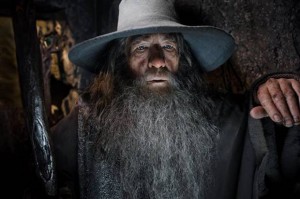
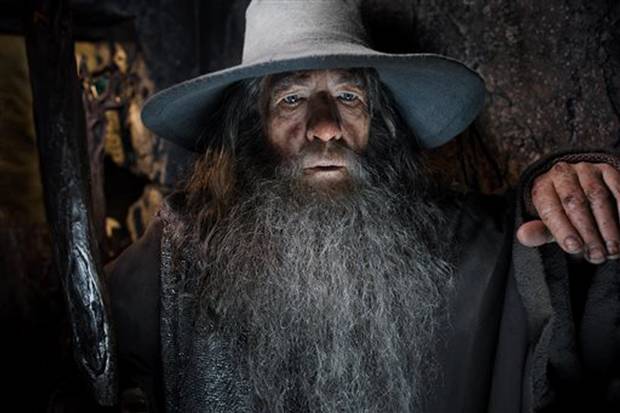
Unlike Freeman, Sir Ian McKellen does get sentimental when he reflects on making the movies because, “a lot of the audience seeing The Hobbit part three wouldn’t have been born when we started filming it.” After spending thirteen years playing wise wizard Gandalf the Grey he took two priceless props from the set, “Gandalf’s staff, which I keep with umbrellas and walking sticks, and Gandalf’s hat, which I keep in the basement.”
Many actors have pilfered props from their movies. Keira Knightley walked off with Elizabeth Bennet’s striped socks from Pride & Prejudice. Elijah Wood has the One Ring from Lord of the Rings and Daniel Radcliffe liberated two pairs of Harry Potter’s famous round glasses, even though there was a strict policy about taking props from the set.
‘The ones from the first film are absolutely tiny now,” he says, “but they are very sweet.”
Kristen Stewart kept the engagement ring Edward Cullen gave her at the end of Twilight: Eclipse and Zachary Quinto took the ears he wore as Spock in Star Trek: Into Darkness but the strangest cinematic souvenir may belong to Mark Wahlberg.
The Academy Award nominee kept the prosthetic penis he wore as Dirk Diggler in Boogie Nights. “I used to keep it in my desk drawer,” he said, “and I’d take it out and slap my friends in the face with it. I don’t keep many things from my movies, but that just seemed to have personal significance.”
The advertising tagline for “Transformers: Age of Extinction” is “This is not war, it’s extinction,” which is catchy enough, I suppose, but having seen it I couldn’t help but think that “Cum on Feel the Noize,” a song lyric by either Slade or Quiet Riot, depending on your age, would have been more appropriate.
Michael Bay’s latest is eardrum shatteringly loud, guaranteed to leave you with ringing ears and a rumbling theatre seat. Visually, expect scorched eyes. Bay has made a movie for three of your five senses—only smell and taste are exempt—but will it entertain your brain while launching an all out assault on your senses?
Picking up four years after the invasion of Chicago seen in the last Transformers film, “Dark of the Moon,” the action begins when unemployed robotic engineer Cade Yeager (Mark Wahlberg) and daughter Tessa (Nicola Peltz) uncover deactivated Autobot, Optimus Prime (Peter Cullen) hidden under a pile of junk. Their discovery puts them in the crosshairs of CIA agent Harold Attinger (Kelsey Grammer) and tech tycoon Joshua Joyce (Stanley Tucci). The two are hatching a plan, fueled by equal parts paranoia and genius, to build man made second generation Transformers to seek out and destroy the Autobots. “A new era has begun,” says Attinger, “and the age of Transformers is over.”
Everybody loves spectacle. The Romans had the Coliseum and we have the “Transformers” movies. Like the gladiatorial shows of yore, in Michael Bay’s movies it doesn’t matter who lives or dies—the films don’t care about their human characters and neither do we—all that matters is the spectacle of the whole thing and at almost frenetic three hours “Age of Extinction” certainly delivers on that score. Like the old Roman emperors many moviegoers will give this movie a thumbs up simply because of the value per minute the film offers.
No one can accuse Bay of skimping on… well anything. “Age of Extinction” is a wide ranging action orgy that plays off of Bush era Homeland Security paranoia and also explains why dinosaurs became extinct. It comments on the ethics of unarmed warfare and blows up most of Hong Kong.
Bay doesn’t do anything by half measures but I found myself wishing the movie was about half as long as it is with half the bombast. It’s stylish—“Why run when you can run in slow motion,” Bay seems to be asking—not unlike a car commercial, but is excessive on almost every level. I don’t expect or want “My Dinner with Optimus Prime,” but in this case I think less would have been more.
Wahlberg brings loads of personality and humor with his over-protective father routine, Tucci is reliable as ever and Grammer is in full-on Dick Cheney mode but who cares? We’re not paying to see them, we’re paying to see Optimus Prime play bucking bronco with a giant dinobot.
Is “Transformers: Age of Extinction” a good movie? Not really. Does it deliver on its promise? Yes, but almost too much so. Either way I doubt Michael Bay much cares what the critics think. He’s built a joke into the movie suggesting that if you don’t like sequels you’re senile.
“We were happy to do whatever was asked of us whenever it was asked of us,” says Transformers: Age of Extinction star Jack Reynor.
The Colorado-born, Irish-raised actor proved he was game for anything when he was given just twenty minutes to prepare for a wild scene that brought him face-to-face with real explosions.
“It is an incredibly intimidating experience in many ways,” he said, “but at the end of the day you have to trust the people around you, that they know what they’re doing that they’re prepared and that you’re safe. We had a great stunt team who worked on this film with us. Those guys really put us at ease.”
Sharing the explosive scene with Reynor were his co-stars Nicola Peltz and Mark Wahlberg.
“They worked so hard to make this huge explosion,” says Peltz, best known for her role as Bradley Martin on Bates Motel. “I think it took a week but we didn’t know about it. We were kind of confused when we got on set and saw ten cameras. (Director) Michael (Bay) told us a few minutes before, ‘You’re going to do this huge stunt. It’s not going to be stunt doubles, it’s going to be you guys and you have to run from here to here in 4.6 seconds.’
“There’s not much acting when there are real explosions behind you,” she says. “You just have to run.”
The experience of sprinting away from live blasts wasn’t exactly what Peltz expected when she signed on for the role in the fourth Transformers film.
“I thought there was going to be more green screen than there actually was but Michael wants everything to be as real as possible so the car chases and the explosions are all real.”
“You can really tell the difference,” says Reynor. “You can tell when a movie is really heavy on CG. It doesn’t really look real. As far as we’ve come with effects and all the advancements we’ve made—some of them are really great—at the end of the day to do it practically and do it for real always looks best on screen. That’s why Michael tries to make it that way. On top of that it makes everything more tangible for us; a lot easier to relate to and react off. That’s why I think these movies have been as incredibly successful as they have because the audience really does feel it.”
Director Michael Bay once said he doesn’t make movies for critics. The auteur behind such hits as The Rock, Armageddon, Bad Boys 1 and 2 and the Transformers movies is best known for making big, loud films that rake it in at the box office but leave critics reaching for the Advil.
Bay acknowledged the adversarial relationship in a 2005 article by Rene Rodriguez.
“They castrate me,” he told Rodriguez. “They call me the devil and all that crap.”
It’s not hard to see why reviewers have a hard time with his films. He never met a building or car or city he didn’t want to blow up in spectacular fashion and critics often feel like they have to slather on SPF 70 to avoid getting get a tan from the glare off the giant fireballs that light up screen in Bay’s films.
Audiences, however, have flocked to his flicks. According to boxofficemojo.com his ten features have grossed $1,898,048,525, or an average of $189,804,853. That’s a lot of beans.
The release this weekend of Transformers: Age of Extinction promises to add to those totals. The fourth installment of the franchise stars Mark Wahlberg as a single father and struggling inventor who discovers the deactivated Autobots leader Optimus Prime.
The movie promises a whole new raft of Transformers, including bounty hunter Lockdown and the rough and tumble Dinobot Grimlock. Bay promises we’ll also see an “angry Optimus Prime.”
Will the critics like Age of Extinction? Who knows? It probably won’t matter, the Transformers movies are as close to guaranteed hits as Hollywood has these days, so reviews most likely won’t matter to the box office.
Not all of Bay’s films have been critically reviled. “The critics were very nice to me when I first began with Bad Boys,” he says and his last movie, the crime drama Pain and Gain was called “the best movie Michael Bay’s ever made,” by the Newark Star-Ledger.
It has a few things going for it. First, there isn’t a robot in sight. Secondly, a great cast—including Wahlberg, Dwayne ‘The Rock’ Johnson and Anthony Mackie—who bring serious star power and third, it doesn’t really feel like a Michael Bay film. And by that I mean there’s only one shot of the three leads walking away from a slow motion explosion.
Years ago I wrote this about his trademarked aural and optical onslaught: “The former commercial director has a knack for making everything look shiny but having great taste doesn’t make a great film director any more than great taste makes a Snicker’s bar a gourmet meal.” I even coined a word for his style: Hullabayloo, but nothing that any critic or I write matters to the director.
“I’ve actually stopped reading (reviews),” he told Rodriguez.
“Lone Survivor” provides further proof that war is, indeed, hell.
The battle scene that takes up much of the film’s running time is a Hieronymus Bosch style glimpse into the very heart of battle. Grisly and gory, it is about pushing the limits of endurance as far as possible.
But “Lone Survivor” isn’t simply a shoot ‘em up.
Between the bullets is a complex story about morality and the men who put themselves in harm’s way.
The film is based on the real-life SEAL Team 10’s Operation Red Wings, a failed 2005—the movie’s title in itself is a spoiler—War in Afghanistan mission to locate, capture (or eliminate) Taliban leader Ahmad Shah (Yousuf Azami).
The carefully planned operation goes wrong almost as soon as the team—SO2 Marcus Luttrell (Mark Wahlberg), LT Michael P. Murphy (Taylor Kitsch), SO2 Danny Dietz (Emile Hirsch) and SO2 Matthew Axelson (Ben Foster)—touch ground in the Kush Mountains. Their job is hindered by faulty a communication radio, but the mission is undone when they are discovered by an older man and two boys.
The commandoes make the decision to let the four unarmed shepherds go, but their kindness comes back to haunt them when shortly afterwards a Taliban army descends on their position and they are hopelessly outnumbered.
There’s no gunfire in the first hour of “Lone Survivor.” The time is spent getting to know the characters, their situation and absorbing the gravity of the mission at hand. Then, sixty minutes in, it turns into a bullet ballet. But it is those opening minutes that make the payoff of the last hour so potent.
Without getting to know the brotherhood the characters share we won’t buy in later on when their bond and training are the only things that will decide their fate.
The acting is uniformly good. Walhberg is understated but undeniably powerful as the Luttrell. His character is the glue that holds the movie together, and he delivers.
As the sharp-tongued and direct Axelson Ben Foster is, well, Ben Foster. He’s one of the best actors working today and his portrayal is passionate, patriotic but grounded in truth. It takes some doing to deliver a line like, “Did they really shoot me in the ******* head?” with any measure of believability, but Foster manages.
Perhaps the biggest surprise is Taylor Kitsch. He had a bad couple of years after becoming a small screen star on “Friday Night Lights.” The promise of a big screen career seemed to evaporate in the trifecta of failure—big budget flops “John Carter,” “Battleship,” “Savages”—but here he finds his groove and reminds us of the charisma that made him a name in the first place.
“Lone Survivor” is a visceral experience. Not since “Saving Private Ryan” has a battle scene been so effectively rendered but at its core it isn’t a propaganda film or a slice of patriotism; instead it’s a stark reminder of the camaraderie of soldiers in the field.
 “Daddy’s Home,” a new comedy starring Will Ferrell and Mark Wahlberg asks a very simple question, What do kids need more, a father or a dad? Anyone can be a father, the opening narration tells us, but it takes real work to be a dad.