As the calendar moves ahead to 2016 I’m taking a moment to think back to the great people I met, wrote about or chatted with on television in 2015. I shared Tim Bits with Liev Schreiber—he liked the chocolate, I preferred the glazed—inhaled Johnny Depp’s vape fumes, had a “Sock Battle Supreme” with Anthony Daniels—Mr. C-3PO—and was embarrassed to order a Chai Tea Latte while standing next to Chris Cooper at a coffee bar. On stages, in hotel rooms, on phones and even in the back of taxis, they spoke and I listened. Here’s some of the best stuff I heard this year:
GEORGE MILLER: “I don’t think I’d be the filmmaker I am unless I had that medical education, in two very direct ways. Both of them have a lot of problem-solving in there. But the most important way is that as a doctor you are looking at people in extremis from many points of view. You look inside of people. You see people during birth and death and so on. Through microscopes — a lens. So you’re looking from many, many points of view. That’s exactly what you do in cin ema. Huge wide shots with massive crowds or you’re looking right down inside someone’s brain, someone’s head.”
AMY SCHUMER: “I never thought about being famous. That was never part of my thing, but once it was on the horizon as a possibility, it seemed like a real bummer. I could see there’s no upside. The upside is I sometimes get free appetizers and I can get a reservation at a restaurant. I only go to one place in New York, it’s a tea place, the Tea Cup, and they don’t take reservations but I can make a reservation there. I swear I don’t see another upside. It sucks.”
PHYLLIS SMITH: “I worked for JC Penny in the warehouse tagging the merchandise,” she remembers. “I used to stand there and tag thousands of fishing lures or bowling balls or roller shades, which were heavy as heck to lift around. The people were great to work with but the merchandise was a little challenging.
“I used to stand there, thinking about life, wondering what it is we all have in common because we’re not all given the same opportunity. Some people’s health is impaired when they’re born while others are charmed with intelligence or looks. I thought, ‘There has to be something that we all have. A commonality.’ I figured out that it’s the ability to love. We all, in some form or another, want to love and be loved. That was my big revelation. My lightbulb moment. Also, if you’re standing on a concrete floor, make sure you’re wearing comfortable shoes or you’ll pay for it later.”
CAROLL SPINNEY: Caroll is President Obama’s ninth cousin, but Big Bird isn’t political in the least. “Big Bird, I’m told by the owners of him, does not have political opinions. I thought of an idea that would get around that problem if someone (ever asked about it). ‘I don’t know who that is,’ he says in Big’s voice. ‘I thought we had a king.’ In most fairy tales, lands are run by kings or queens.”
DEBORAH ANN WOLL: A quick Internet search turns up many adjectives used to describe Daredevil star Deborah Ann Woll; gorgeous, talented and cute to name just a few.
The redheaded actress uses other terms to describe herself.
“There’s nerd, geek, all those words,” she says. “I am settling closer and closer to dork. I am a very proud dork.”
The former True Blood star — she played fierce teenage vampire Jessica Hamby for seven seasons on the hit show — embraces her inner dork — “I’m Dungeons and Dragons player, a Mystery Science Theatre buff. I like board games.”
She says the role playing games have benefits beyond entertainment value.
“Something like Dungeons and Dragons or a board game is a way for me to be social but it takes some of the responsibility off of me myself. If I don’t feel impressive as myself, I can feel impressive as Mistress Pyrona, the Genosi Sword Maiden. Like my acting, it gives me a little bit of support.”
JAKE GYLLENHAAL: “I think the people I admire as artists are the people who really listen to themselves even if it is to the detriment of what people might consider success. I’d rather be myself and do what I love than listen to someone else and follow that role and be unhappy.”
CHRISTOPHER PLUMMER: My favourite line from any interview? Christopher Plummer talking about the dog in “Remember”: “We had two dogs on set. One to do the stunts and the other just making money.”
BRYAN CRANSTON: “I don’t want to portray this idea that I’m just about the art. I’ve been poor and I’ve been rich and rich is better.” Also: Bryan Cranston told me he likes to go up to people wearing the Heisenberg t-shirts they wore on the show Breaking Bad and talk like Walter White… “Nice t-shirt,” and I whisper if to them and their eyes go wide and I put my finger to my lips, like ‘Don’t tell anyone… if you tell people, they won’t believe you.’
SAOIRSE RONAN: Saoirse is an Irish or Scottish name meaning freedom roughly pronounced SEER-shə. “I get very confused about my name all the time,” she said in a recent sit-down. “Sometimes I look at it when I’m writing it down for people and I go, ‘This is actually a ridiculous spelling of a name.’”
ADAM MCKAY: “We wanted to be the first Wall Street movie that took you behind the curtain, that really said, All these confusing terms you hear, all the ways the banks make you feel stupid or bored … it’s actually not that hard. If the guy who did Step Brothers can understand it you can too.”
RYAN COOGLAR: “Whenever I had a big test at school or a football game (my father would) say, ‘Take 10 minutes and watch this scene from Rocky. That’ll get you fired up. That’ll give you the juice to score five touchdowns. Or get an A on that test.’ I’d look over and think, ‘Are we watching this for me or for you?’”
ANTHONY DANIELS: Having one of the most recognizable voices in movie history can lead to some surreal moments. Just ask Anthony Daniels. He’s played C-3PO in all seven Star Wars films, including this weekend’s Star Wars: The Force Awakens and once rented a car with a very familiar voice on the GPS.
“I felt uncomfortable with me —very clearly — giving me instruction for something I didn’t know. I found it quite bizarre. I was driving thinking, ‘This is unnatural.’”
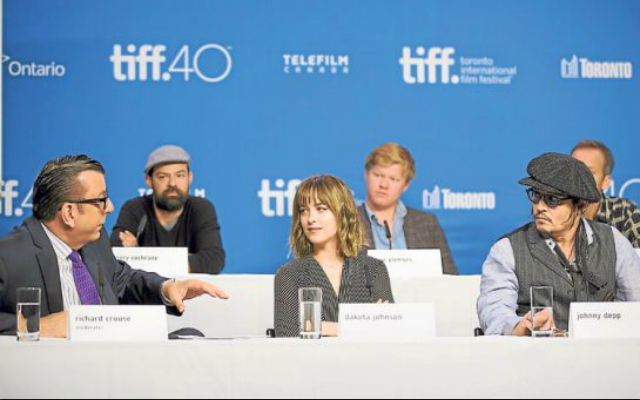
TIFF: The Toronto International Film Festival is only ten days but it looms large on my schedule every year. This year, in addition to watching dozens of movies and doing interviews for Metro, “Canada AM,” “NewsTalk 1010” and others, I hosted a bunch of press conferences, including, “The Martian” – with Ridley Scott, Matt Damon, Jessica Chastain, Demolition with Jake Gyllenhaal (#JakeQuake), Our Brand is Crisis with George Clooney and Sandra Bullock and Black Mass with Johnny Depp. They were some of the highlights of the fest for me… and unfortunately provided one of the low points. Read on… and once again Sean Bean, I’m REALLY sorry.
METRO: An insider’s look at TIFF: Behind the scenes with Richard Crouse
Ever wondered what it’s like to rub shoulders with celebs?
The backstage room at the TIFF Bell Lightbox’s press conference area is a beehive of activity.
“Is George here yet?”
“Is that Johnny vaping in the corner?”
It’s a place where no last names are necessary and the star wattage is blinding. Actors, directors, publicists and gofers mingle while air kisses, handshakes and Hollywood hugs are exchanged.
This year the Toronto International Film Festival is mounting 11 press conferences featuring everyone from Matt Damon and Sandra Bullock to George Clooney and Keith Richards.
I’m hosting four of them — Demolition, The Martian, Our Brand is Crisis and Black Mass — with, as MGM used to brag, “More stars than are in the heavens.”
Despite the buzzy nature of the events, backstage is a casually chaotic place where actors get caught up with one another before taking the stage.
Matt Damon made the rounds, glad-handing with his The Martian cast mates, many of whom he hadn’t met because he spent 90 per cent of his of screen time alone, stranded on Mars.
The business of the press conferences happens on stage. Moderating these things provides a fascinating glimpse into both sides of the publicity machine.
Ideally the press conferences are a reciprocal event: Reporters ask questions to actors and filmmakers they might not otherwise have access to, and in return the stars get publicity for their films. It’s a pretty simple but often unpredictable transaction.
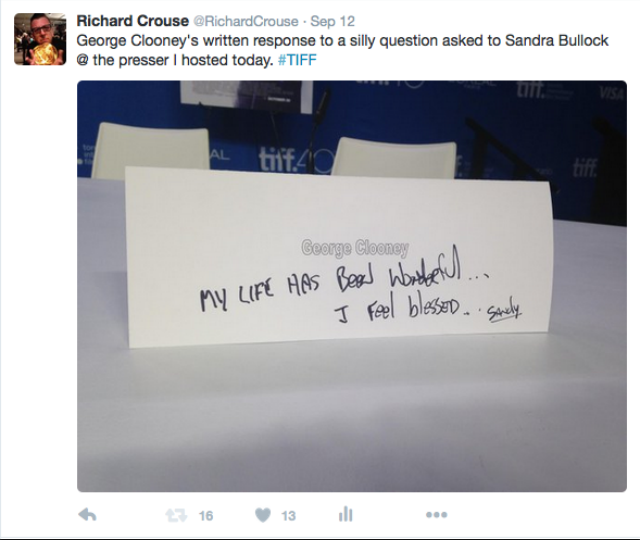
Gone are the days of the legendary “journalist” who asked all her questions in rhyme, but for every sensible inquiry about the movie, there is inevitably another off-the-wall query that leaves panel lists either annoyed or scratching their heads.
At the Our Brand is Crisis conference someone asked Bullock about her character’s grown-out roots. The Oscar winner replied as best she could and when she finished, Clooney chimed in, “Aren’t you glad you asked that question?”
Later she shut down a silly query regarding how she keeps her bum as toned as it is in the film. “It’s so sad that you just want to talk about the butt,” she said, before tersely adding that leg lifts are the secret to posterior pertness.
Not that the attendees are the only ones to pull a gaffe or two. During the Demolition conference, I asked Chris Cooper a long, rambling question about his character. He seemed genuinely perplexed, and you know what? I was, too. Sometimes you can overthink these things.
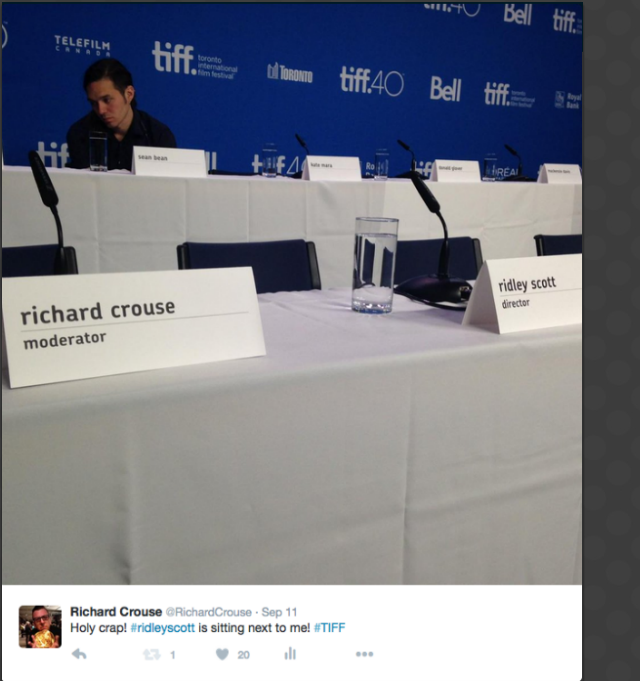
Later at The Martian presser, there were 13 people on the stage, everyone from Michael Pena to Damon, Scott, Chiwetel Ejiofor and Jessica Chastain, and in the shuffle I made the horrifying mistake of forgetting to ask the great Sean Bean a question and didn’t realize it until we were out of time.
Who doesn’t acknowledge Lord Eddard Stark?
Me, idiotically. Next year I promise to go to him first and frequently.
The summer movie season began amid doom and gloom. I don’t mean George Miller’s filling screens with his dystopian vision of the future in Mad Max: Fury Road or the career ending fallout from the Sony hack. No, I mean the sky-is-falling predictions that circulated about the movie business.
Box office is down! No one goes to the movies anymore! And best of all: Movies are dead!
To paraphrase Mark Twain, I’m happy to say the reports of the death of cinema have been greatly exaggerated. The summer box office of 2015 will go down in the record books as the second-biggest in history with almost seven billion dollars generated by Minions, Ant-Man, Mad Max, dinosaurs and a sad little girl named Riley.
Superheroes helped put bums in seats, but 2015 won’t be remembered as the Year of Ultron. Now that the summer silly season is over, a definite trend toward female-driven movies like Trainwreck, Pitch Perfect 2 and Spy showed that, as Amy Schumer told me, Hollywood has finally realized “our money works, too. Our banks also accept the female dollar.”
But it wasn’t just women going to the movies. With Jurassic World pulling in 1.6 billion samolians worldwide, it seems everyone put down the remote and went to the cinema.
We didn’t rush out to everything — cash grabs like Ted 2 and Terminator: Genisys flopped — but the naysayers, the folks who, in January, were declaring movies to be a thing of the past, an old outmoded form of entertainment in the digital age, missed the point.
People flocked to the movies in huge numbers this summer, filling seats and studio bank accounts, not simply to sit in air conditioning for a few hours as relief from the summer heat or to dine out on popcorn and Twizzlers, but to engage in an age-old ritual.
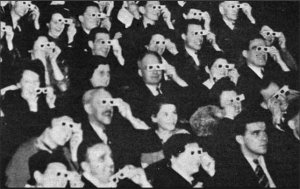
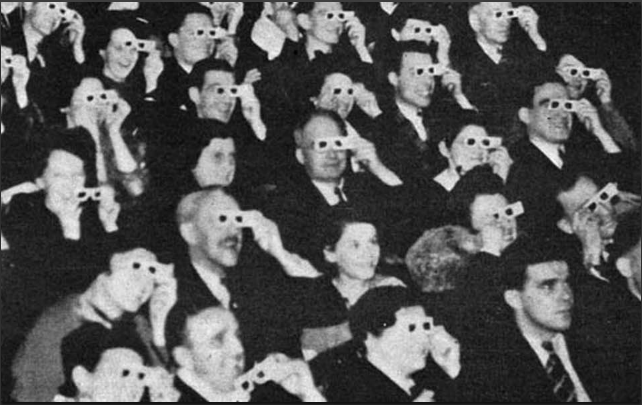
Of course, you can watch movies at home or on your phone. New technology has made it easier than ever to enjoy a film from the comfort of your coach on a 60-inch screen with surround sound and healthy, homemade snacks, but no matter what set-up you may have in your living room, the thing missing is the ancient practice of sharing entertainment with a large group of strangers. It’s a primal thing, hard-wired into our DNA, that dates back to when tribes of cave dwellers would sit around fires and tell stories through to the Globe Theatre, vaudeville, the talkies and right up to today’s IMAX and AUX screenings.
People have gathered to be entertained since there were tales to be told because there is no better way to enjoy the storytelling experience than surrounded by strangers who are laughing, crying, gasping— whatever — in response to a shared event.
No matter how large your TV or comfortable your sofa, home viewing misses the magical element of community. In the theatre you’re getting the sound and the picture the director intended, but more than that the experience brings people together, inspires conversation, respect and triggers actual physical interaction with others. Try that as you stream a movie on your iPhone.
Of course, as in any other community there are a few troublemakers — texters, seat kickers — but I spend more time in theatres than most and find the pros far outweigh any negatives.
In the era of home entertainment the idea of going to the movies may sound old fashioned or quaint but I like the way English novelist Angela Carter described watching a film in a theatre. She called it “dreaming the same dream in unison” and that, for me will never go out of style.
George Miller has made pigs talk and penguins tap dance. He’s been a doctor and a film director. Among the bold faced names on his resume are the titles Babe: A Pig in the City, The Witches of Eastwood, Happy Feet 1 and 2 and Lorenzo’s Oil. One name, however, looms larger than the rest.
Mad Max. Over the course of three films—Mad Max, Mad Max 2: The Road Warrior and Beyond Thunderdome—he introduced the world to post apocalyptic warrior Max Rockatansky, made Mel Gibson a superstar, defined dystopian cinema for a generation or two and created the phrase, “Two men enter, one man leaves.”
This weekend, thirty years after the release of the last Mad Max movie, Miller revisits the character in Mad Max: Fury Road, a reboot starring Tom Hardy and Charlize Theron.
The seventy-year-old director, who raised money to make the first film by working as an Emergency Room Doctor, says the goal of the new movie was to make it “uniquely familiar.”
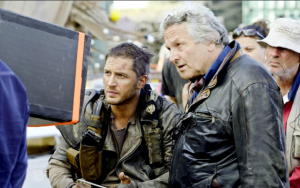
After years of “following the CG evolution,” using computer generated images to create beautiful animated films, he was keen to go back to “old school” filmmaking “with real cars and real people and real desert.” That means, unlike the Avengers and their ilk, respecting the laws of physics by using practical effects and keeping the action earthbound. In other words, in a call back to the original films, when a car blows up it doesn’t rocket into space. Instead it explodes spectacularly but organically. The wild action you see in Fury Road are actual stunts performed by stunt men and women and not generated by a clever computer operator in a studio.
“It was like going back to your old home town and looking at it anew,” he says.
Miller reveals he originally created Max’s wasteland world while practising medicine.
“I worked for two and half years in a big city hospital. I stayed registered right up past Mad Max 2: Road Warrior. I never even thought there’d be a career. I stayed as a doctor on the first Mad Max because we kept running out of money in postproduction. Then I stayed through to the second Mad Max because if you are doing stunts you are obliged to have a doctor on set. There weren’t big budgets so I ended up running a clinic during lunch time tending to cuts, sunburns, scrapes and all that.”
His two careers have much in common, he says, adding he was “was privileged with a unique point of view as a doctor.”
“I don’t think I’d be the filmmaker I am unless I had that medical education, in two very direct ways. Both of them have a lot of problem solving in there. But the most important way is that as a doctor you are looking at people in extremis from many points of view. You look inside of people. You see people during birth and death and so on. Through microscopes; a lens. So you’re looking from many, many points of view. That’s exactly what you do in cinema. Huge wide shots with massive crowds or you’re looking right down inside someone’s brain, someone’s head.”
As for plans to make another Mad Max right away, he says, “That’s a bit like asking a woman who’s just given birth if she’s going to have another baby.”
The ghostly War Boys of “Mad Max: Fury Road” have a catchy mantra they recite as they go into battle. “I live. I die. I live again!” In some ways it could be the refrain for the series. Begun as a down-and-dirty punk rock vision of a post-apocalyptic Australia, the 1979 no-budget movie made a star out of Mel Gibson and spawned a mini-franchise of two more films, “The Road Warrior” and “Beyond Thunderdome.”
The George Miller films lived, died and now live again courtesy of “Mad Max: Fury Road,” an out-of-control reboot that recreates Max Rockatansky’s dystopian world and then races like hell through it, laying rubber all the way.
Set in an arid, inhospitable world where a snack of raw lizard constitutes a meal, Max (Tom Hardy) is a man who has lost everything, Haunted by “those he could not protect” he is now “a man reduced to a single instinct—survival.” Captured by henchmen of Immortan Joe (Hugh Keays-Byrne, who played Toecutter in the original “Mad Max”), a despot who hoards precious natural resources and only sparingly shares water with his subjects—Don’t take too much water, he says, you will only come to resent it when it isn’t there.—Max is turned into a blood bank for an ailing war boy named Nux (Nicholas Hoult). Subjected to a life of confinement and drained of his own natural resources, Max sees a chance for freedom when Nux and others do battle against Imperator Furiosa (Charlize Theron), a former warrior turned rogue. She’s driving the imposing War Rig—imagine a Monster Truck with an attitude—across the wasteland. With her are Immortan Joe’s five wives—Splendid (Rosie Huntington-Whiteley), Capable (Riley Keough), Toast (Zoë Kravitz), The Dag (Abbey Lee Kershaw) and Fragile (Courtney Eaton)—a natural resource he desperately wants back. Max and Furiosa form an uncomfortable alliance to battle the forces of evil and make it across the desert to Furiosa’s childhood home, a green oasis.
It’s been thirty years since there was a new “Mad Max” movie but “Fury Road” was worth the wait. The years have not stilled Miller’s restless camera or his outrageous way with steampunk influenced design or character names. If Imperator Furiosa isn’t the best character name of the year, I don’t know what is. Her title, however, might as well have been Mad Maxine as she is more the focus of the story than the titular character.
It is a chase movie where characters chase immortality, a new life in a better place, love and one another across a vivid landscape. Gone are the grey tones of dystopian movies like “The Road.” In its place is a dusty but vibrant backdrop that frames the non-stop action. Miller keeps the pedal to the metal but unlike the recent “Avengers: Age of Ultron,” which had a similar angle of attack, he keeps the action earthbound. The laws of physics are respected—when a car blows up it doesn’t rocket into space for instance—by the director’s use of practical effects. Most everything you see on screen are actual stunts performed by real people and not generated by a clever computer operator in a studio later on. The organic nature of most of (but not quite all) the visuals gives the movie extra torque, adding a sense of danger and realism (no matter how unreal the situation) to the large set pieces that make up the bulk of the film.
Hardy pulls his weight as Max. His powerful physicality mixed with a haunted look—maybe we should call him Passive Aggressive Max—and gearbox permanently shifted to survival makes him an imposing center of the film, but it is Theron who dominates.
As Furiosa she lives up to her name as a force to be reckoned with. She’s a one-armed bandit (literally) who not only provides much of the action in the film, but its heart as well.
The real star, however, is Miller. Thirty years after he last played in Mad Max’s world he revisits it with a film that doesn’t feel like a sequel or a reboot, but a fresh look at an familiar character. His off-the-wall sensibility and demented Hot Wheels style designs give the movie a look and feel that no other director could replicate.
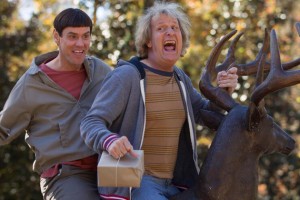
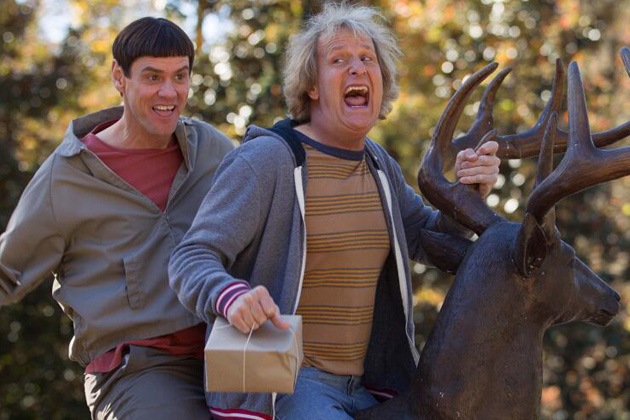
Twenty years ago Roger Ebert wrote that a moment in Dumb and Dumber, “made me laugh so loudly I embarrassed myself.”
The movie, starring Jim Carrey and Jeff Daniels as the chicken-brained Lloyd and Harry, made 250 million dollars at the box office and seemed likely to spawn a sequel but nothing happened for almost twenty years. There was a prequel, Dumb and Dumberer: When Harry Met Lloyd, but it was a Carrey-and-Daniel-less exercise in futility I called, “one of the least funny and ineptly made movies to ever play at your local multi-plex,” on its 2003 release.
So why did it take 19 years and 333 days to release a Dumb and Dumber follow-up? Carrey says he wasn’t into doing sequels but softened because everyone kept hounding him, he joked, “even dead people.”
Fans had to wait ages for Dumb and Dumber’s return, but two decades is a mere drop in the bucket when compared to the gap between the 1942 Disney classic Bambi and it’s sequel Bambi II. A ten-year-old who saw the original would have been old enough to send their grandkids to get popcorn refills when the sequel hit theatres overseas (it went direct to DVD in North America) almost sixty-four years later.
Thirty years after Alfred Hitchcock made seagulls menacing in The Birds a made-for television-movie called The Birds II: Land’s End revisited the killer avian story. Tippi Hedren, star of the original, signed on and it was shot in the house from the first film, but that’s where the similarities between the two end. The New York Times called the film “feeble,” and Hedren said, “It’s absolutely horrible, it embarrasses me horribly.”
29 years and 343 days after 1968’s The Odd Couple hit the big screen, writer Neil Simon and stars Jack Lemmon and Walter Matthau reunited for The Odd Couple II. “We always had bad chemistry,” says Oscar Madison (Matthau). “We mix like oil and frozen yogurt.” It marked the last starring roles for each of its leads and the final collaboration between Lemmon and Matthau after making ten movies together.
These days Hollywood seems obsessed with sequels and next year will be no different. Mad Max: Fury Road, starring Tom Hardy in the role that made Mel Gibson famous, returns thirty years after Mad Max Beyond Thunderdome and Jurassic World revisits Jurassic Park III thirteen years later. The biggest sequel news of the year—maybe of the decade—is the December 2015 release of Star Wars: The Force Awakens. In the official Starr Wars chronology the new film follows 1983’s Return of the Jedi after a space of 32 years and 207 days.
 As the calendar moves ahead to 2016 I’m taking a moment to think back to the great people I met, wrote about or chatted with on television in 2015. I shared Tim Bits with Liev Schreiber—he liked the chocolate, I preferred the glazed—inhaled Johnny Depp’s vape fumes, had a “Sock Battle Supreme” with Anthony Daniels—Mr. C-3PO—and was embarrassed to order a Chai Tea Latte while standing next to Chris Cooper at a coffee bar. On stages, in hotel rooms, on phones and even in the back of taxis, they spoke and I listened. Here’s some of the best stuff I heard this year:
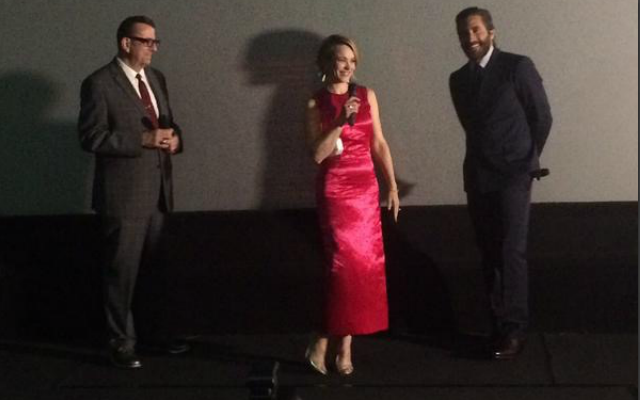 JAKE GYLLENHAAL: “I think the people I admire as artists are the people who really listen to themselves even if it is to the detriment of what people might consider success. I’d rather be myself and do what I love than listen to someone else and follow that role and be unhappy.”
 Ever wondered what it’s like to rub shoulders with celebs?
 At the Our Brand is Crisis conference someone asked Bullock about her character’s grown-out roots. The Oscar winner replied as best she could and when she finished, Clooney chimed in, “Aren’t you glad you asked that question?”
 Who doesn’t acknowledge Lord Eddard Stark?