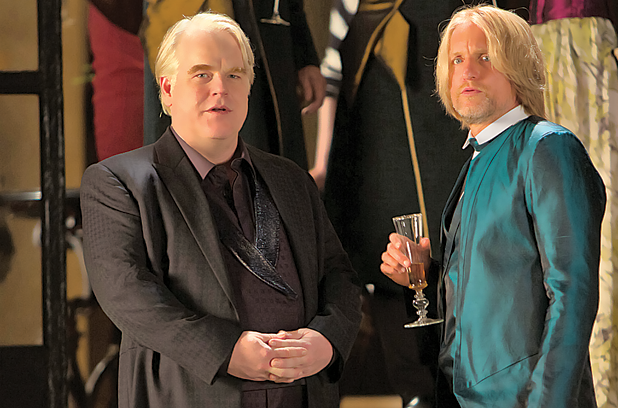
“Everything old can be made new again,” says tribute escort Effie Trinket (Elizabeth Banks) in “The Hunger Games: MockingJay – Part 1,” “even democracy.” So, apparently, is the “Harry Potter” model of cleaving the final book in a popular series into two moneymaking movies.
A better, catchier title for the third part of the Hunger Games tetralogy might be “You Say You Want a Revolution.” “MockingJay – Part 1” takes the action off the playing field and into the realm of rebellion.
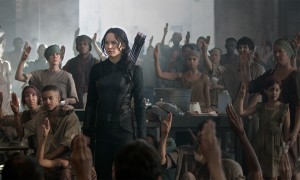
With one arrow Katniss Everdeen (Jennifer Lawrence) changed the barbaric Hunger Games forever, opening the door to rebellion. In the surrounding turmoil, her love Peeta (Josh Hutcherson), was left behind in the Capitol and has become a pawn in the propaganda game being played by the totalitarian President Snow (Donald Sutherland) and District 13 rebel leader Alma Coin (Julianne Moore). The revolution to unify the districts against the capitol has begun with Katniss cast as the MockingJay, a reluctant hero but a symbol of hope to the oppressed masses.
“The Hunger Games: MockingJay – Part 1” ups the stakes considerably from the last film, putting several big ideas into motion. The cinematic world created in the first two movies is about to change in very dramatic ways and this movie prepares viewers for the revolution. Katniss looks suitably concerned throughout and there are several effectively staged action scenes, but despite the fine performances and lessons in mass produced anarchy, it’s hard to shake the feeling that this is a place holder for next year’s series finale.
Scenes stating the obvious—“He’s punishing me because I’m the MockingJay!” Katniss reveals in one, “Duh, yeah” scene—feel added in to stretch the movie to its two hour running time.
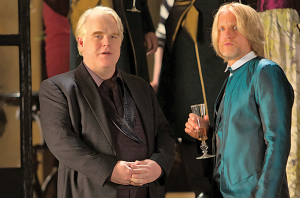
That’s not to say there isn’t entertainment value here. Far from it. Lawrence takes a role that could have been buried under layers of teen ennui or steely-eyed determination and gives Katniss some real depth and it is a blast to see Moore and Seymour-Hoffman back on screen together again. Sutherland is at his serpentine best and Harrelson and Banks struggle with their new surroundings in entertaining ways; he with sobriety, her with a lack of haute couture.
Most entertaining is the film’s take on the building of a social movement. Katniss is manufactured into the people’s hero. She’s given line readings and a fan to blow her hair around in sexy and stirring propaganda videos and dressed in stylish warrior gear. “Everyone is going to want to kiss you, be you or kill you,” coos Trinket. It’s a handbook to do-it-yourself social unrest and it is smart, funny and on the nose. In the end, however, it’s discovered that Katniss is more effective in her natural state, without meddling hands shaping her. One can’t help but think the same of the movie. Perhaps it might have been satisfying if it too had been left alone and presented in its natural state, as one movie instead of two.
Since the release of the first Hunger Games novel in 2008, literary sleuths have picked it apart, searching for connections to other books and films.
The scrutiny increased when the first film in the tetralogy set records for the biggest opening weekend for a non-sequel in 2012, and continues unabated with the release of this weekend’s The Hunger Games: Mockingjay, Part 1.
Based on Suzanne Collins’s mega-successful series, the movies are set in a dystopian world ruled by a fascist-style president (Donald Sutherland) who presides over The Hunger Games, a televised battle-to-the-death between 24 young players, two from each of the country’s districts, including Katniss Everdeen (Jennifer Lawrence) and Peeta Mellark (Josh Hutcherson).
The series draws on things we’ve seen before, in everything from the human sacrifices of Greek mythology or Survivor-style television shows to news stories of government corruption to create a world with its own rules, style and customs.
The most often-cited influence is Battle Royale, a 2000 Japanese movie based on a book by Koushun Takami. Like The Hunger Games, it’s a story of school kids in a televised government-sanctioned death match.
Battle Royale’s DVD box set even included a quote from a critic suggesting there’d be no Hunger Games without the Japanese film. “This is the movie that started it all,” it reads.
Hunger fans were quick to point out differences in the two films. The Japanese movie is about survival, they said, while Collins wrote about revolution. The author revealed her main influences were reality television and the Iraq war.
“I had never heard of that book or that author until my book was turned in,” she told the New York Times.
It’s worth noting that the idea of humans being preyed upon for the entertainment of the upper classes dates back at least as far as 1932’s The Most Dangerous Game. The story of a big-game hunter who tracks humans for sport on an isolated island is based on a Richard Connell short story that also loosely inspired episodes of everything from Gilligan’s Island to Lost in Space. Since then, Norman Jewison’s Rollerball, Roger Corman’s Deathrace 2000 (and its 2008 Jason Statham remake) and The Running Man have mined similar territory.
As for the author who wrote Battle Royale, he gave ABC News a very diplomatic answer when asked about the similarities between the two stories. “I think every novel has something to offer,” he said. “If readers find value in either book, that’s all an author can ask for.”
The news of Philip Seymour Hoffman’s sudden passing was met with a heartfelt outpouring of grief from fans and those who worked with him.
“Philip Seymour Hoffman was a singular talent and one of the most gifted actors of our generation,” Lionsgate, the studio behind the upcoming Hunger Games: Mockingjay Part 1 and 2, said in a written statement. “We’re very fortunate that he graced our Hunger Games family. Losing him in his prime is a tragedy, and we send our deepest condolences to Philip’s family.”
Hoffman played head -games-maker-turned-rebel leader Plutarch Heavensbee in the successful series. It is a pivotal role.
In the wake of the actor’s death, questions arose as to whether the uncompleted blockbusters-in-waiting would be completed in time for their scheduled November 21, 2014 for Part 1 and November 20, 2015 for Part 2 release dates.
Hollywood studios have handled the sudden death of cast members in many different ways. In some cases, films are even abandoned.
Production on Something’s Got to Give was shut down permanently after Marilyn Monroe’s August 1962 barbiturate overdose.
Dark Blood, River Phoenix’s final film, was put into cold storage when the young actor died before filming several crucial scenes. But both movies were eventually resurrected. The documentary Marilyn: The Final Days used footage from Monroe’s aborted film while Dark Blood sat for 19 years before being finished and shown at film festivals.
Father and son Bruce and Brandon Lee both died early, leaving behind unfinished films. The elder martial arts legend had completed 100 minutes of The Game of Death when a cerebral edema took his life.
Even more tragically, Brandon was killed on the set of The Crow in an accident involving a prop handgun.
Both films were salvaged with the use of stand-ins.
When Oliver Reed collapsed of a heart attack at a Malta pub after out-drinking a group of Royal Navy sailors, the editing crew of Gladiator replaced him digitally in the remaining scenes of the film.
More recently, Heath Ledger unexpectedly died during the production of The Imaginarium of Dr. Parnassus. He was replaced in the surreal story by three actors.
“I just started calling friends of Heath,” director Terry Gilliam said. “It’s as simple as that.”
“Johnny (Depp), Colin (Farrell) and Jude (Law) turned up. It was important that they were friends, because I wanted to keep it in the family. I wanted people who were close to him because, as Colin said when he was doing his part, he was channelling Heath part of the time, so Heath was very much still alive in some sense.
“Contractually, it was supposed to be a Terry Gilliam Film,” said Gilliam. “That’s what the lawyers said, but I said, ‘No way it’s going to be that. It’s going to be a film from Heath Ledger and friends.’ The cast sat around one night and that idea came up and I said, ‘This is it. Perfect. That’s how we do it.’”
As for the upcoming Hunger Games films, reports now confirm that Hoffman completed work on Part 1 and had just seven days left of shooting on Part 2.
His absence will not require any recasting, just a rewrite of one scene. And so Mockingjay Part 2 becomes the final film in Hoffman’s remarkable career.
“Words cannot convey the devastating loss we are all feeling right now. Philip was a wonderful person and an exceptional talent, and our hearts are breaking,” reads a statement released by The Hunger Games author Suzanne Collins, the films’ director Francis Lawrence, producers Nina Jacobson and Jon Kilik and star Jennifer Lawrence.
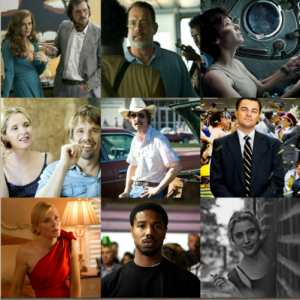
TOP THIRTEEN HITS (click on the title to see trailer)
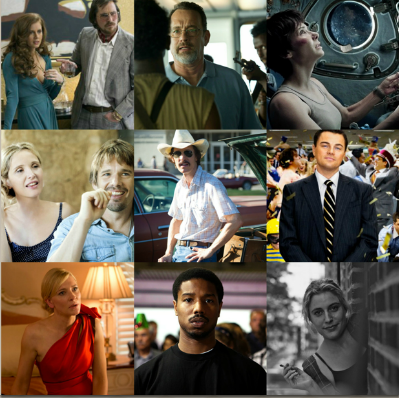
1. 12 Years a Slave. There’s a key line near the beginning of “12 Years a Slave, “ the new drama from “Shame” director Steve McQueen. Shortly after being shanghaied from his comfortable life as a freeman into a life of slavery Solomon Northup (Chiwetel Ejiofor) declares, “I don’t want to survive. I want to live.” Based on Northup’s 1853 memoir the movie is an uncompromising story about will, suffering and injustice.
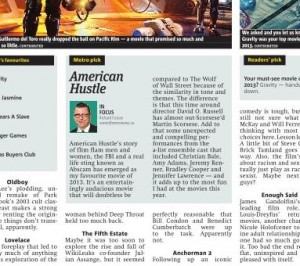
2. American Hustle. “American Hustle” is one of the year’s best. It’s an entertainingly audacious movie that will doubtless be compared to “The Wolf of Wall Street” because of the similarity in tone and themes, but this time around David O. Russell has almost out-Scorsese’d Scorsese.
3. Before Midnight. “Before Midnight” is beautifully real stuff that fully explores the doubts and regrets that characterize Jesse and Celine’s (Ethan Hawke and Julie Delpy) love affair. Done with humor, heart and pathos, often in the same scene, it is a poignant farewell to two characters who grew up in front of us.
4. Blue Jasmine. Darker than most of Woody Allen’s recent output, “Blue Jasmine” doesn’t go for laughs—very often anyway—but is an astutely crafted psychological character study. Jasmine is a modern day Blanche Du Bois, a faded bright light now forced to depend on the kindness of strangers. Getting in her way are delusions of grandeur and a continued sense of denial—likely the same sense that kept her guilt free during the years the illegal cash was flowing—that eventually conspire to fracture her psyche. “There’s only so many traumas one can take,” she says, “ before you end up in the street, screaming.”
5. Captain Phillips. I don’t think it’s fair to charge audiences full price for screenings of “Captain Phillips.” While watching this exciting new Tom Hanks thriller I was reminded of the old Monster Trucks ads that bellowed, “You Pay for the Whole Seat but You’ll Only Need the Edge!”It a film about piracy and I don’t mean the sleazy guys who bootleg movies but the real pirates who were responsible for the first hijacking of an American cargo ship in two hundred years.
6. Dallas Buyer’s Club. In “Dallas Buyer’s Club” Canadian director Jean-Marc Vallée has made an emotional drama that never stoops to melodrama. Instead it’s an inspirational film about standing up for what you believe in.
7. Frances Ha. The seventh film from “Greenberg” director Noah Baumbach isn’t so much a traditional narrative as it is a character study of Frances (Greta Gerwig), an underemployed dancer struggling to find herself in New York City. It plays like a cleaned up black-and-white version of “Girls”; an emotionally rich and funny portrait of twenty-something ennui. “Frances Ha” is a collection of details. There is an engaging story, but it’s not exactly laid out in three acts. It feels more intimate and raw than the usual twenty-ish crisis flick and with each detail we get another piece of the puzzle that makes up Frances’ life.
8. Fruitvale Station. It’s important to remember that “Fruitvale Station” isn’t a documentary. Director Ryan Coogler has shaped the movie for maximum heartrending effect, and by the time the devastating last half hour plays out it’s hard to imagine any other movie this year packing such a emotional wallop.
9. Gravity. “Gravity” isn’t an epic like “2001: A Space Odyssey” or an outright horror film like “Alien.” There are no monsters or face hugging ETs. It’s not even a movie about life or death. Instead it is a life-affirming movie about the will to survive.
10. Her. “Her” is an oddball story, but it’s not an oddball film. It is ripe with real human emotion and commentary on a generation’s reliance on technology at the cost of social interaction.
11. Inside Llewyn Davis. “Inside Llewyn Davis” is a fictional look at the vibrant Greenwich Village folk scene. Imagine the cover of “The Freewheelin’ Bob Dylan” come to life. Sharp-eyed folkies will note not-so-coincidental similarities between the people Llewyn meets and real-life types like Tom Paxton, Alert Grossman and Mary Travers, but this isn’t a history, it’s a feel. It gives us an under-the-covers look at struggles and naked ambition it takes to get noticed.
12. Nebraska. The humour doesn’t come in the set-up-punch-line format but arises out of the situations. A scene of Woody’s gathered family—his elderly brothers and grown sons—watching a football game redefines the word taciturn but the subject of the sparse conversation, a 1974 Buick, is bang on, hilarious and will likely sound familiar to anyone with a large family.
13. Wolf of Wall Street. “Wolf of Wall Street” makes for entertaining viewing, mostly because DiCaprio and Jonah Hill are able to ride the line between the outrageous comedy on display and the human drama that takes over the movie’s final minutes. Both are terrific, buoyed by the throbbing pulse of Scorsese’s camera. With its fourth wall breaking narration, scandalous set pieces and absurd antics “The Wolf of Wall Street” is an experience. At three hours it’s almost as excessive as Balfort’s $26,000 dinners. It feels a bit long, but like the spoiled brats it portrays, it will not, and cannot, be ignored.
TOP FIVE MISSES
TREND: Big stars don’t guarantee box office!
1. The Fifth Estate – Budget: $28 million, Global box office: $6 million, Return: 21% Late into “The Fifth Estate” Guardian investigative journalist Nick Davies (David Thewlis) says, “most good stories start at the beginning.” I argue that he’s right– about 99% of the time. Unfortunately this look at WikiLeaks and hacker-turned-whistleblower Julian Assange falls into the 1%.
2. Bullet to the Head – Budget: $25 million, Global box office: $9 million, Return: 36% With a name like Bullet to the Head you know the new Sylvester Stallone movie isn’t a romantic comedy. Although he paraphrases the most famous rom com line of all time, “You had be at BLEEP BLEEP!” the movie is nothing but an ode to testosterone.
3. Getaway – Budget: R180-million, Global box office: R105-million, Return: 58 percent. On a scale of zero to stupid, ”Getaway” ranks an eleven. It is what we call in the film criticism business a S.D.M. (Silly Damn Movie). OK, I made that last part up, but I couldn’t really think of any other category to place this movie under. Maybe E.S.D.M. (Extremely Silly Damn Movie).
“American Hustle, ” the new film from “Silver Linings Playbook” director David O. Russell, bristles with energy.
Imagine the love child of “The Sting” and “Ocean’s Eleven” infused with the verve of the frenetic last thirty minutes of “Goodfellas” and you get the idea.
Branded with the disclaimer, “Some of this actually happened,” “American Hustle” is a fictionalized retelling of the Abscam scandal, an elaborate FBI takedown of corrupt government officials.
Christian Bale plays Irv Rosenfeld, a low level con man with a paunch and Trump-esque comb over. He makes a comfortable living, enough to support his wife Rosalyn (Jennifer Lawrence), their son and his mistress and partner-in-crime Sydney (Amy Adams).
His life goes sideways when Richie DiMaso (Bradley Cooper), an ambitious FBI agent, threatens them with arrest unless they help him run a complicated corruption investigation involving New Jersey mayor Carmen Polito (Jeremy Renner) and other high ranking officials.
There’s a zany tone to “American Hustle.” It plays like a heightened version of real life. Perhaps it is the outrageous 1970s styles—all big hair, wide collars and flared pants—or the edgy, slightly larger-than-life performances from the top-notch cast, but the film feels one step removed from reality. Settle into “American Hustle’s” world and the darkly humorous ride is an enjoyable journey.
Bale leads the cast, but it is very much an ensemble. As the dumpy Irving he is a mass of contradictions. He’s a confidence man with a conscience; a man who feels it’s wrong to entrap politicians so soon after the public cynicism about elected officials after Watergate and Vietnam. Trapped in a loveless marriage, he’s a philanderer who is reluctant to leave Rosalyn because he wants to do the right thing for his son. He genuinely likes Carmine even though he’s about to set him up to do some real jail time.
Bale brings some real complexity to a character who could easily have been a stunt. Some actors might have relied on the weight gain and the bad hair to do the work, but Bale brings him to life and even makes you feel sorry for him.
The standout, in a smaller role, is Lawrence. Realistically she may be too young for the part, but as “the Picasso of passive-aggressive karate,” she’s perfectly cast. With a thick Long Island and perfectly lacquered lips, she plays Rosalyn as a creature of pure emotion, passionate one second, needy the next, driven by jealousy and dysfunction and one too many self-help books.
Adams, Renner and Cooper also distinguish themselves playing preposterous characters with one thing in common—they aspire to be something they are not. Everyone on display is on the hustle, looking to reinvent themselves, and that desperation is what gives the movie its dynamism.
As a backdrop Russell hits all the right period notes, particularly with the music. He uses archival music from the likes of Elton John, Electric Light Orchestra and The Bee Gees to set the mood, but instead of acting as a greatest hits collection of the Me Decade through clever editing it sounds like a soundtrack.
“American Hustle” is one of the year’s best. It’s an entertainingly audacious movie that will doubtless be compared to “The Wolf of Wall Street” because of the similarity in tone and themes, but this time around David O. Russell has almost out-Scorsese’d Scorsese.
I’m glad I saw the first “Hunger Games” movie because I’m not sure if I would have a clue as to what was going on if I didn’t have that background. I may have been taken in by the beautiful art direction, or Jennifer Lawrence’s intense performance, but I don’t think I would have been able to connect all the dots. Plot points become more obvious in the second hour, but for non-Hungerites it might be confusing.
If you haven’t seen the first movie, or read one of the 26 million copies of the book that are currently in print, here’s a glossary of terms to get you up to speed.
Katniss Everdeen: Sixteen year-old protagonist and citizen of District 12, a poor mining area in the dystopian nation of Panem.
Peeta Mellark: A baker’s son, who, according to Wikipedia has “extensive strength and cake decorating skills that contributed to the art of camouflage.”
Both are “tributes” chosen from the young people of District 12 and forced to participate in an annual Hunger Games, The Hunger Games, an annual televised event in which one teenaged boy and girl from each districts surrounding the Capitol are chosen by lottery to fight to the death until only one remains.
There’s more, but you’ll figure it out.
In the new film combatants and sweethearts Katniss (Jennifer Lawrence) and Peeta (Josh Hutcherson) have returned from the 74th Annual Hunger Games victorious to become the toast of the nation. While on a Victory Tour to Panem’s various downtrodden districts, revolution is in the air. They see Katniss as a symbol of freedom, which, of course, doesn’t sit well with President Snow (Donald Sutherland), the country’s autocratic leader. To quell the revolution he and his head gamesmaker (Philip Seymour Hoffman) devise the trickiest Hunger Games yet, the Quarter Quell that will pit former winners against one another in the battle to the death. If Snow gets his way Katniss will be killed and the revolution squashed.
“Hunger Games: Catching Fire” is a better movie than the first installment.
Set decorated and costumed (as played by Elizabeth Banks, District 12 minder Effie Trinket has the most elaborate futurist art deco costumes since “Metropolis”) to within an inch of its life, but has nonetheless has a gritty edge. It doesn’t feel like a budget big franchise movie and that’s a good thing,
Visually as well as thematically it has more edge than any of the recent Marvel movies. And it skirts around the thing that upset many people about the first movie—the idea of kids killing kids—by setting the action between former victors ranging in age from 20s to 70s.
It creates a world with it’s own rules, style and customs and does so convincingly. In part it’s comprised of things we’ve seen before in everything from the human sacrifices of Greek Mythology to reality television to stories of government corruption on the news, but author Suzanne Collins and director Francis “I Am legend” Lawrence tie it together to create something new.
In many ways it breaks the mold of what we expect from a young adult a blockbuster. The focus is on the characters and the underpinning of romance that snakes throughout the story. The action sequences are few and far between and it takes almost an hour before any of Katniss’s trademark bow-and-arrow dexterity comes into play. (Silly complaint: the number of arrows in her quiver changes from shot to shot! Just when you think she’s out, arrows magically appear.)
Sure there’s poison fog, angry animals and vicious victors but it’s about survival and relationships not the wholesale slaughter of the characters. It’s grim, shot in hues of grey with a perpetually overcast sky, which lends it a classic feel, more like 1970s sci fi than the brightly couloured eye catchers Hollywood makes these days.
“Hunger Games: Catching Fire” has a who’s who of a cast—Woody Harrelson, Lenny Kravitz, Jeffrey Wright, Stanley Tucci, Jena Malone, Brit heartthrob Sam Claflin and Amanda Plummer—who all perform well, lending some gravitas to the story, but it is carried by Lawrence whose vision for Katniss is as straight as an arrow.
Jennifer Lawrence follows up the mega success of “The Hunger Games” with “The House at the End of the Street,” a creepy-house-next-door flick featuring good looking teens, a double murder and one pretty good Norman Bates impression.
Lawrence is Elissa, a seventeen-year-old from Chicago transplanted with her single mom (Elisabeth Shue) to a small town in search of a better life. They find a comfortable home in a nice neighborhood. The only drawback is that it is next door to the scene of a gruesome double murder. Years before little Carrie Anne bludgeoned her parents to death before disappearing off into the woods, where it is rumored she still lives today. When Elissa befriends Ryan (Max Thieriot), the only surviving family member, she discovers there’s more to the story than she had heard.
Much of the plot sounds like a campfire ghost story—“And the crazed killer lives in the woods to this VERY DAY!!”—and is about as scary as that story can be without someone holding a flashlight under their chin and yelling “Boo!” at the end.
There are some good atmospherics near the beginning and some tension of the “don’t you open that door!” kind, followed by the “don’t you go down those stairs” type which leads to a predictable ending. You won’t be on the edge of your seat, but you might move closer to the middle.
There are a few too many red herrings for “The House at the End of the Street’s” payoff to feel genuine, and some of the dialogue is unintentionally hilarious, (“At that hour,” says early riser Ryan,” when everyone is asleep it’s like all the best thoughts haven’t been taken yet.”) but Lawrence’s charisma is in effect and if they ever decide to remake “Psycho” again they should give Thieriot a call.