“Dawn of the Planet of the Apes” is a different kind of blockbuster. It has all the elements of the usual summer fare— it’s a sequel, things blow up and, if that wasn’t enough, also features an ape on horseback —but it takes more risks than Optimus Prime could shake Michael Bay at. About half of it is done in ape sign language (with subtitles) and it’s not chock-a-block with action. Instead it takes time building characters and motivations so when the wild ape-on-human action begins it feels earned and it feels epic.
Set ten years after Rise of the Planet of the Apes saw Caesar (Andy Serkis) break free from a San Fransisco primate sanctuary and start an ape uprising, the middle-aged chimpanzee is the leader of a large population of genetically evolved apes. Most of humankind was wiped out by a pandemic of ALZ-113—a “simian flu” virus that speeds up the rebuilding of brain cells in apes but is deadly to humans—but when a small band of humans scout a water source near the ape camp a monkey wrench is thrown into the fragile peace between homo sapiens and simians is threatened. “Apes do not want war,” says Caesar, but a battle—gorilla warfare?—for control is inevitable.
To riff off of the old Superman tagline, “You will believe an ape can speak.” The special effects are amazing, but beyond the pixel manipulation that brings Caesar and company to vivid life, there are remarkable performances that, for lack of a better phrase, humanize the apes. These aren’t the erudite apes of the Roddy McDowell era, with vocabularies that would impress even Conrad Black, but simian characters that behave somewhere midway between pure instinct and higher intelligence.
Gary Oldman, as a human protectionist, Jason Clarke as the human who reaches out to Caesar in the spirit of friendship and cooperation and Keri Russell as his resourceful wife are all terrific, but I went bananas for these apes.
Beyond the flashy special effects and Serkis’s understated but powerful performance—this is the kind of performance that could convince the Academy to consider “motion capture” acting for inclusion in the Oscar acting categories—is a smart movie about race, gun usage and xenophobia. Its masked in allegory and, well, a story about talking apes, but it doesn’t shy away from big ideas and that is the thing that transforms it from a run-of-the-mill air conditioner flick to a thought provoking night and exciting at the movies.
“Homefront,” a new actioner starring Jason Statham and James Franco emoting from a script written by Sylvester Stallone, is the kind of movie that probably plays best on VHS. It feels like an old-school action flick, one that might have starred Stallone in the early nineties, that might be best seen through a haze of snowy grain.
But the real advantage to watching this on video would be the chance to fast forward through all the slow bits.
Statham plays Phil Broker, a former undercover cop who left law-and-order behind after a sting went bad and a biker drug lord’s son was executed. Now he leads a quiet life with his ten-year-old daughter Maddy (Izabela Vidovic) in Rayville, Louisiana, a backwoods town one resident ominously describes as, “a bit like Appalachia… feuds can happen here.”
Sure enough Broker and his daughter become the talk of the town when Maddy punches a bully at recess. What should have been a schoolyard scrap escalates when the bully’s mom (an emaciated Kate Bosworth) asks her meth-dealing brother Gator (Franco) to pay Broker a visit and even the score.
Before you can say Hatfields and McCoys, Gator is causing trouble. He discovers the truth about Broker’s past and in addition to fueling some good old fashioned feudin’ he hatches a plan with his “meth whore” girlfriend Sheryl (Winona Ryder) to hand over Broker to the bikers he double crossed in return for a meth distribution deal.
It sounds exciting—it hits all the b-movie b’s, bikers, babes and bullies—but Statham is at his best when he’s busting heads and the movie provides relatively little of that. Sure he nails a guy to a post with a knife and pushes another dude’s head through a car window but he spends most of the movie in family guy mode.
He cares for his daughter, her stuffed bunny and cat Luther, and the movie really wants us to know it but endless scenes of Broker mooning over his daughter grind the story to a halt. Too bad there’s no fast forward button at the theatre.
In other words, I liked it when Statham was punching people. I liked it less when he wasn’t.
Cormac McCarthy may not be a household name around your place, unless you live with the Coen Brothers or maybe with the Pitt’s.
Literary critic Harold Bloom called the writer one of the four major American novelists of his time, and he has two all-star movies set for release, which may make his name a little more commonplace.
Later in 2013 James Franco directs, scripts and stars in Child of God, an adaptation of Cormac’s 1973 novel about, “a dispossessed, violent man whose life is a disastrous attempt to exist outside the social order.”
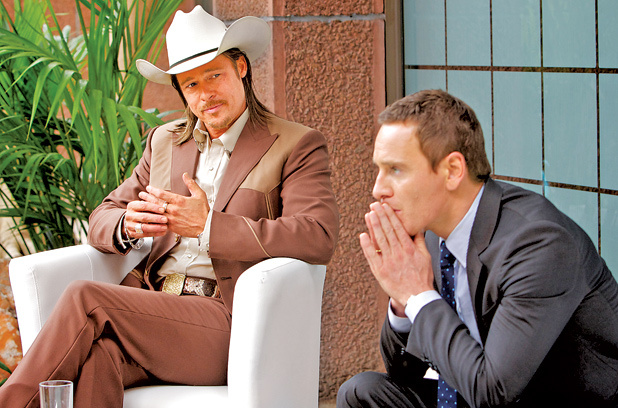
This weekend a star-studded cast lead by Brad Pitt, Cameron Diaz and Michael Fassbender headline The Counselor, directed by Ridley Scott.
Producer Steve Schwartz says the story of a lawyer in over his head after dipping his toe into the drug trade, “may be one of McCarthy’s most disturbing and powerful works.”
And that’s saying something about the writer who gave us a character like No Country for Old Men’s killing machine Anton Chigurh. Empire.com warned that when, “McCarthy throws “a dark character at you, it’s a safe assumption that you’re not going to be able to get them out of your head for a good, long while—if ever.”
As written by McCarthy and played by Javier Bardem, who earned an Academy Award for Best Supporting Actor for the part, Chigurh is merciless, a murderer who makes life and death decisions with the flip of a coin.
The Road—a 2007 Pulitzer Prize winner for fiction—is another disturbing McCarthy novel adapted for the big screen.
The story is simple. A man and his son (Viggo Mortenson and Kodi Smit-McPhee) try to survive in a dystopian world. Armed with only a gun and two bullets they must scavenge for food amid the ruins and protect themselves from cannibals who roam the desolate land.
The Road is a movie based on small moments set against a big backdrop. No parent will be able to forget the stark image of seeing a young boy who doesn’t know what a can of Coke is or a father teaching his son how to commit suicide.
It’s tough, no nonsense work from a writer who says he’s “not that big a fan of exotic foreign films,” especially movie with magical realism. “You know, it’s hard enough to get people to believe what you’re telling them without making it impossible,” he says. “It has to be vaguely plausible.”
James Franco is quickly becoming Hollywood’s King of the Prequels. First came “Rise of the Planet of the Apes,” which provided the backstory to how a monkey named Cornelius took over the world. Now he stars in a mega-budget, all-star prequel to one of the most beloved films of all time.
“Oz the Great and Powerful” aims to let you know everything you always wanted to know about “The Wizard of Oz” but were afraid to ask—how the wizard became the wizard, why the wicked witch is so wicked and what was up with the giant projected head.
Set decades before the original film, Franco dons a tattered top hat to play Oscar Diggs, an egotistical traveling circus magician. According to his inflated sense of self he should be playing the Orpheum circuit making big bucks instead of amazing the yokels with parlor tricks. He has ambitions–“Kansas is full of good men,” he says. “I don’t want to be a good one, I want to be a great one—Harry Houdini and Thomas Alva Edison role into one.”–but an ill advised dalliance with the circus strongman’s wife causes him to put his ambitions on hold.
Jumping into a hot air balloon to escape the big man’s wrath, Oscar drifts into the eye of a tornado and into the heart of Oz, a magical land in search of a leader. A good witch named Theodora (Mila Kunis) rescues him from the toothy water fairies, and convinced he is the savior her people have been looking for, takes him to the Emerald City to meet her sister Evanora (Rachel Weisz) and claim his throne. Enter a third witch, Glinda and Oscar’s ascension to the throne becomes very complicated. He must prove he isn’t “weak, selfish, slightly egotistical and a fibber,” as Glinda says, and worthy of the title Oz the Great and Powerful.
Oz’s journey echoes Dorothy’s in “The Wizard of Oz.” Both begin in black and white until a tornado transports them to a luminous, beautiful color world where they learn about themselves. Dotty learns about the importance of home and what she left behind. Oz rediscovers a sense of self, lost to years of conning audiences with his cut-rate magic and smarmy charm.
Both are large-scale epics for children, but “Oz the Great and Powerful” doesn’t have the magic of the original. There’s no shortage of imagination on screen—just a deficiency of star power to equal the high voltage images.
Franco and Kunis are a-listers with Oscar nominations and big hits on their collective resumes, but they seem out of their league here, like two hipsters cast back in time to a more formal era. Franco plays Oz like some kind of stoner wizard, and despite his habit of yelling, “Simsalabim,” his performance isn’t nearly flamboyant enough to carry the magic of the movie.
Kunis, as the wannabe wicked witch, hands in a performance that relies on cackling and the limpid pools that sit where you and I have eyes. None of her crack comic timing is required because she isn’t given any laugh lines. Pity.
Some of the fanciful creatures are more interesting than the human ones. A broken ceramic doll that gets a second lease on life courtesy of the Wizard’s glue pot is the kind of character needed to bring this material to life. Ditto the wise cracking Finley, a monkey butler voiced by Zack Braff.
“Oz the Great and Powerful” will suffer in the inevitable comparison to “The Wizard of Oz,” but movie wouldn’t? It’ll make your eyeballs dance but, but no amount of ruby red shoe clicking could fix the central casting problems.
David Gordon Green’s resume wouldn’t suggest that he has a light touch. His first film, George Washington, told a story about group of children in a depressed small town who band together to cover up a tragic mistake. Next came the slow paced All the Pretty Girls followed by two films that can only be described as domestic tragedies, Undertow and Snow Angels. The four films contained a total of 1.5 laughs spread out over a combined running time of 411 minutes. He’s one Gloomy Gus. So it was with a bit of amazement that I noticed his name on the credits of the new Seth Rogen stoner comedy Pineapple Express.
Rogen, Hollywood’s latest Canadian-born comedy prodigy, plays stoner Dale Denton. Dale’s slacker life becomes complicated after he witnesses a murder perpetrated by a crooked cop (Rosie Perez) and the city’s most dangerous drug lord (Gary Cole). Freaked out, he drops a roach containing a super rare strain of weed called Pineapple Express—it’s the apex of the vortex they say—at the crime scene. Fearing that the dope is traceable back to him Dale and drug dealer Saul (James Franco) go on the lam with the blood thirsty killers hot on their heels.
Luckily for audiences looking for a midsummer laugh Pineapple Express has less to do with Green’s previous films and a whole lot in common with the kind of politically incorrect R-rated comedies Rogen specializes in like Superbad and Knocked Up. It’s a strange genre flick that falls somewhere between the Cheech and Chong oeuvre and Scarface. It’s funny in a goofy kind of way, but also has a bloody climax that rivals the latter movie’s famous “Say hello to my little friend” scene.
Rogen is a bit more manic here than usual, but brings his everyman appeal to a role that could easily have turned sugarless in the hands of a less likeable actor, but it is James Franco who really surprises. Best known as the bland Harry Osborn / New Goblin in the Spider-Man franchise he shows a completely untapped side here. He’s really funny. As the permanently high drug dealer Saul Silver he delivers many of the film’s best lines and his bleary-eyed charm reveals an engaging comedic presence.
On the comedy scale Pineapple Express doesn’t quite rank up there with some of Rogen’s previous work—I’m thinking the sublime Superbad here—but has enough goofy charisma combined with super charged action to make it an unusual but likable summer distraction.
Earlier this year a documentary called “Project Nim” detailed the life and sad times of Nim Chimpsky, who was taken from his mother and taught sign language before being abandoned once he outlived his usefulness as a laboratory experiment. It would make a good double bill with “Rise of the Planet of the Apes,” a big budget prequel to the famous sci fi films. Man does ape wrong in “Project Nim,” and in “Rise of the Planet of the Apes” the chimps get even.
The time is modern day San Francisco. James Franco plays Will Rodman, a scientist working to create a drug that will slow, or even reverse the effects of Alzheimer’s disease. When one of his chimp test subjects goes berserk the project is shut down and the remaining apes are ordered euthanized “in the most cost effective way possible” by Rodman’s boss, the ruthless CEO Steven Jacobs (David Oyelowo). The scientist rescues a baby chimp, the son of one of his test subjects. Soon he discovers that the drug given to the baby’s mother has filtered through his system, giving him extraordinary intelligence. Raised completely by humans the chimp, named Caesar (after the emperor, not the salad), doesn’t realize he has simian cousins until he is removed from his comfortable home and placed in an ape sanctuary. Soon Caesar becomes like Chimp Guevara, organizing a revolution against his human captors. This ape is mad as hell and he’s not going to take it anymore.
The original “Planet of the Apes” movie was an allegory for racism and nuclear war topped off with Charlton Heston’s hairy chest and some cool monkey masks. “Rise,” on the other hand is a generic action movie with state-of-the-art primates and the occasional moment that elevates it above Tim Burton’s remake, but it doesn’t come close to the emotional realism that made the first movie a classic.
Andy Serkis’s performance-capture work as alpha ape Ceasar is one of the movie’s strengths and weaknesses. There is no doubt that his facial expressions, particularly the use of his eyes, add much to the character of the chimp but the computer generated imagery used to bring Caesar to life, while impressive, lacks an organic feel. It seems fake even though much has been done to ensure a lifelike visage. The Roddy McDowell era apes were obviously fake—sometimes painfully so—but somehow they had more soul.
Emotional apes aside, the movie plays it a bit too cute in the beginning, but when the revolution begins—Caesar uses cookies to bribe his fellow apes into joining him, proving once and for all that an army does indeed march on its stomach—the movie kicks into gear. Some of the action is a bit too showy—since when can apes do martial arts?—but the scene of Caesar on horseback leading the charge against the heavily fortified cops is a real crowd pleaser.
“Rise of the Planet of the Apes” plays fast and loose with the mythology established in the previous movies and takes a bit too long to get to the movie’s exciting monkey business, but delivers an exciting finale that would make Nim proud.
Spider-Man 3 contains elements that every fan-boy has been hoping for, and several they haven’t. It takes the best and worst elements from the first two outings, combining them into one over-long movie that relies too heavily on CGI magic and not enough on pacing and story.
The new film picks up where the last one wrapped up. All is right in the world of Peter Parker. His heroic exploits as Spider-Man are being trumpeted in the press and his soon-to-be-fiancé MJ (Kirsten Dunst) has landed a starring role in a Broadway play. Soon, though, things turn sour. MJ has trouble dealing with Spider-Man’s newfound fame; his old friend (and son of the Green Goblin) Harry (James Franco) tries to kill him; he must battle a new foe, a molecularly challenged escaped convict known as the Sandman (Thomas Hayden Church) while, on a more mortal plane, fighting to keep his job. On top of this a black, gooey creature from outer space has attached itself to his DNA, changing him from super hero to super heel.
Director Sam Raimi has created a tangled web; a slick but sluggish movie that brings the wow factor with several impressive action sequences, but fails when it focuses on the characters. Raimi pads the 2 ½ hour movie with long shots of MJ and Peter staring soulfully at one another with dewy eyes. He loves those shots like Pete Doherty loves cocaine, but they slow the movie’s momentum to a crawl.
The section of the movie that deals with Peter Parker’s dark side almost feels like it was dropped in from another, rather silly, film. Spurned by MJ, unemployed and profoundly bitter, Parker—like Superman and Batman before him—explores the flip side of his do-gooder personality. This amounts to flicking his hair across his forehead in a way that makes him look more like Garth Brooks’ faux rock singer Chris Gaines than a badass and ogling at women, a la John Travolta in Saturday Night Fever. Playing his transformation into a cad for laughs diminishes the importance of Parker’s examination of his dark side.
Fans can look forward to state-of-the-art action sequences—one in which an office building is destroyed by an out-of-control crane is spectacular—but may find some other aspects of the story—MJ’s two musical numbers, Parker’s ridiculous bad boy nightclub behavior and Aunt May’ (Rosemary Harris) matronly presence—harder to swallow.
To decipher what’s wrong with Spider-Man 3 all we have to do is look back at movie history. Sequels with the number 3 in the title rarely hold up, particularly when their predecessors are highly regarded.
Godfather 1 and 2. Yes please. Number 3? Not so much.
Batman, Batman Returns and Batman Forever? Yes, yes and no thanks.
X-Men 3? I hope it is their last stand.
In movie terms the third time often isn’t a charm. By the third time around expectations are often impossibly high, so filmmakers feel the need to kick it up a notch. In most cases it doesn’t work—less really is more—and you end up with something like Spider-Man 3, a movie that feels bloated by too many subplots, too many villains and too many characters.
“This is the End,” a new apocalyptic comedy starring a who’s who of millennial stars, is the most meta movie of the year. Maybe of the decade. Possibly ever.
The story begins when best friends Jay Baruchel and Seth Rogen attend a party at James Franco’s house in the Hollywood Hills. The “How to Train Your Dragon” isn’t happy at the crowded get together. He’s uncomfortable with phoniness of it all and Jonah Hill’s “I loved you in ‘Million Dollar Baby’” pandering.
Jay and Seth get some air on a smoke and snack run to a nearby convenience store, but before they can pay for the Marlboroughs and Munchos, something strange—really odd—happens. Flames fill the sky. The earth opens, swallowing people, places and things. Blue lights from the heavens beam blessed people skyward, leaving the damned to stay put.
It’s the end of times, but back at Franco’s mansion it’s business as usual. Michael Cera is snorting cocaine, Jason Segal is mingling and Craig Robinson is leading a singsong of a song called “Take Off Your Panties.”
The shaky town partygoers are nonplussed as the earth rumbles—it’s earthquake territory after all—until a giant sinkhole in the front yard gobbles up many of the guests, (MILD SPOILER) including Cera, Aziz Ansari, Rhianna and Christopher Mintz-Plasse.
Inside the survivors—the broken social scene of frenemies Baruchel, Rogen Hill, Franco, Robinson and Danny McBride—ration what few supplies they have and try and figure out what the hell is going on.
“When disaster strikes,” says Franco, trying to maintain calm, “who do they rescue first? The actors!”
Thus begins a story of survival of the famous and a lesson on how to get on the right side of the Rapture.
Each member of the scruffy core ensemble—including two Oscar nominees!—play heightened versions of their screen personas. For Rogen’s fans there’s the easygoing stoner. Franco plays it pretentious and edgy while Hill actually refers to himself as “America’s Sweetheart.”
Dynamics develop.
Franco is fixated on Rogen, Hill hates Baruchel and McBride is the wildest card in the deck.
As an experiment in insider tomfoolery bordering on narcissism, it’s a hilariously unhinged look into celebrity that takes no prisoners. They poke fun at their own work—particularly “Your Highness” and “The Green Hornet”—careers and personas. It’s a brazen mega meta idea that works well, more so if you’re already fans of the guys.
Emma Watson buffs will also be treated to a different, axe wielding side of Hermione and Channing Tatum’s cameo must be seen to be believed.
The biblical aspects of the story are played remarkably straight for a pedal-to-the-metal frat boy comedy. Anatomically correct Harryhausen-esque demons wreak havoc and a moral message about sacrifice and a “do unto others” sentiment is somewhat unexpected given the tone of the rest of the film.
Not unexpected from this bunch is a reliance on juvenile barf and bodily fluid gags. Kicking a dismembered head around like a soccer ball is one thing in a funny movie about earth and destruction, but screenwriters Rogen and Evan Goldberg play up the low brow aspects just a bit to much.
“This is the End” packs a great deal into its one hour and forty-five minute running time. Not all the jokes land—in fact quite a few don’t—but when it is clicking on all cylinders it is the funniest and most inventive comedy of the summer.
Wikipedia defines survival as “the struggle to remain alive and living.” Next to that definition should be a picture of Aron Ralston, the poster boy for survival at any cost.
His name may not ring a bell, but his remarkable story will make you wonder how far you would go to stay alive. You see, Ralston is the American mountain climber who was trapped by a boulder for five days in May 2003 and was only able to free himself by amputating his own arm.
His story is told in unflinching detail in 127 Hours, starring James Franco. The film is so intense some audience members have suffered panic attacks and lightheadedness.
The same can’t be said of Alive, the 1993 film about a Uruguayan rugby team stranded in the Andes, who, once their rations of wine and chocolate ran out, were forced to eat their deceased teammates to stay alive.
Based on real events, the facts of the story are gut-wrenching, but as New Yorker critic Anthony Lane pointed out “most people know the story already; everyone began to titter with anticipation whenever one of the characters said he felt hungry.”
The ghoulish humour some audiences found in the film’s story of survival was echoed in Lane’s review when he wrote that the film, “solemnly wring(s) a message of togetherness from the horror. Come closer to your friends than ever before, the movie says: have them for lunch.”
Less known than Alive’s cannibalistic rugby players but just as compelling is Touching the Void, another true-life endurance drama.
The movie’s lesson?
Never go mountain climbing.
Roger Ebert called the story of Joe Simpson’s slow, painful climb from the bottom of a crevice to rescue “the most harrowing movie about mountain climbing I have seen, or can imagine.”
Most of these movies have happy (or at least happy-ish) endings, but not all stories of survival end in triumph.
The anti-survival movie genre is alive and well, even if the characters usually aren’t by the end of these films.
Into the Wild, the Oscar-nominated story of an idealistic dreamer not up to the challenges of living on his own in the wilderness of Alaska, and Open Water, the tale of a pair of swimmers who become shark bait, don‘t have the inspirational uplift of some of the other movies I’ve mentioned, but can be essays in courage (or stupidity, depending on your viewpoint).