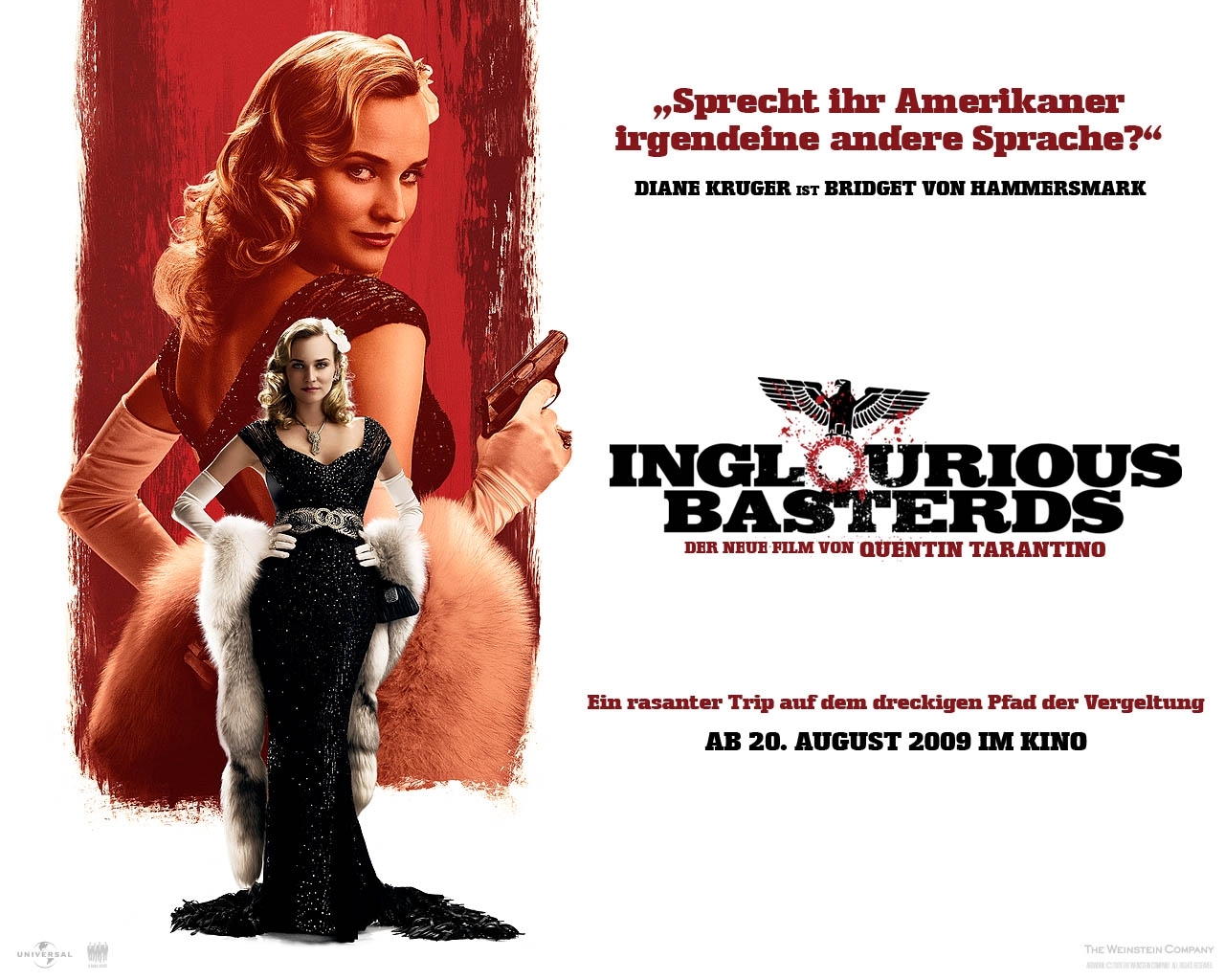
Diane Kruger almost didn’t win the part of German movie-star-turned- Mata-Hari Bridget von Hammersmark in Inglourious Basterds because Quentin Tarantino’s didn’t think she was German enough. He was familiar with her from National Treasure, Wicker Park and Troy, but assumed she was American and would have trouble with the German dialogue and accent.
“It’s a testament to my dialect coaches throughout the years,” says the actress, born Diane Heidkrüger thirty-four years ago in Algermissen, Germany. “They eventually convinced him I was actually German,” she says, but unfortunately Tarantino wanted Natasha Kinski for the role.
When Kinski backed out Kruger saw her chance. “I can be really obnoxious when I want something badly,” she says. For the audition she flew herself to Berlin and learned thirty pages of dialogue in German and in English. “I knew if I got my chance he couldn’t hire anyone else.”
The Berlin set of Inglourious Basterds was a long way from Algermissen. “I come from the middle of nowhere,” she says. “No one in my family knows anyone in the business.”
Her first taste of “the business” was at the Royal Ballet in London before an injury sidelined her dancing career. Returning to Germany she pursued modeling and became a top model. After starring in campaigns for Chanel and Giorgio Armani it was time for a change.
“You can only care so much about free clothes and posing. I wanted to be intellectually engaged.
At the suggestion of The Fifth Element filmmaker Luc Besson she left the runway to try acting. Working internationally—she’s fluent in three languages—she made an impression in a series of French films like Mon idole before Wolfgang Petersen cast her as Helen of Troy opposite Brad Pitt in the big budget epic Troy.
Admitting to being “inexperienced and completely overwhelmed” while making the movie, it nonetheless put her “on the map” in Hollywood. Soon she was starring opposite Nicolas Cage in National Treasure and its sequel while still finding time to make challenging films like Frankie and the Oscar nominated Joyeux Noël.
Inglourious Basterds is another jewel in her crown, but don’t expect her to return to that kind of role again anytime soon.
“Every movie has to be a different challenge,” she says. “I don’t want to play the same part that I’ve played in a different movie. I have to be scared of it to want to do it.”
The last words of “Inglourious Basterds”, the new film from director Quentin Tarantino, are “I think this just might be my masterpiece.” The words aren’t spoken by Tarantino (I’m not going to give away anything and tell you who says them), but they did flow from his pen and it isn’t hard to imagine him claiming them as a comment on his own work. After all he did spend more than a decade working on the script, so long, in fact that “The Irish Times” wrote that the film “has been predicted more often than the second coming of the Lord.” It’s meant to be the director’s magnum opus; a sprawling film that has been gestating inside him for years. I’d like to be able to report that it is his masterpiece, but it’s not, that’s the impossible to better “Pulp Fiction”, but it is as combustible a movie as will be released this year.
Borrowing the title from a little seen 1978 Enzo Castellari film, (the second word is spelled differently, inserting an “e” where the “a” usually sits), Tarantino has created a violent WWII fantasy that rewrites history.
The Basterds are a group of Jewish-American Allied soldiers led by Lt. Aldo Raine (Brad Pitt). Think of them as the Dirty Half Dozen. Their mission is to hunt down, kill and scalp at least one hundred Nazis. The rare Nazi who escapes a nasty death at their hands—left alive to tell others of the Basterd’s ruthless tactics—is marked for life by a swastika carved deep into his forehead. Running parallel is a story thread about movie theatre proprietor Shosanna Dreyfus (Mélanie Laurent), a young Jewish woman, aching for revenge against SS colonel Hans Landa (Christoph Waltz) A.K.A. the Jew Hunter. In Tarantino’s bloodthirsty world it’s inevitable that Raine’s band of brothers, Shosanna and Col. Landa will cross paths.
The films of Quentin Tarantino deeply polarize people. For every person who quivers at the thought of a new film from the “Reservoir Dogs” director there is another who thinks his movies are too long, too self indulgent and too derivative. Despite those criticisms, fair or not, there is almost no argument that of all the brand name directors working today, Tarantino is the most audacious. His films are a singular vision and “Inglorious Basterds” is no exception.
It opens with an almost unbelievably tense scene, spanning the first twenty five minutes of the movie. It is a tour de force of razor’s edge filmmaking, sadistic and twisted, all without a drop of blood or a raised voice on display. It’s pure cinema, and as a set piece is the best filmmaking I’ve seen this year.
The opening sets a high standard and Tarantino does his best to live up to it, taking his time unfurling the story in chapter form. Unlike bombastic directors like Michael Bay, Tarantino understands the ebb and flow of the storyline. His movies don’t clobber you over the head with every frame, instead he calibrates the story to include deliberately paced scenes which create a sense of anticipation for the next crescendo of violence or plot.
The movie is, as I said, deliberately paced, but never feels slow. Tarantino weaves together the disparate storylines, and styles—everything from spaghetti westerns to 70’s exploitation and über violence—into one seamless package.
The bow on top of the package has to be the performance of the Austrian-born Christoph Waltz. As SS colonel Hans Landa he is pure evil; a slimy villain for the ages.
“Inglourious Basterds” won’t be for everyone, it’s too extreme for casual viewers, but the film lover in me is tickled that the heroine is a cinema owner who literally uses film to bring down the Third Reich. Love him or not, you can never accuse Tarantino of being boring.
Earlier this year Quentin Tarantino’s unconventional war film Inglourious Basterds played fast and loose with historical facts and raked in over $100 million US at the box office.
Now is looking for the same kind of success with his offbeat look at modern warfare, The Men Who Stare at Goats. These films join the list of quirky genres like military sci fi, war comedies and musicals like M*A*S*H and South Pacific and even Nazi zombie films, that use war as a backdrop for the main story.
Most war movies focus on men but 1944’s musical comedy Rosie the Riveter is a lighthearted romp about the women who stayed behind, doing shift work at munitions factories.
Better known in the all-singing-all-dancing war field is South Pacific. Inspired by James Michener’s Tales of the South Pacific, the film’s love story is set amid the conflict in the Pacific islands between American and Japanese soldiers. Buoyed by the popularity of songs like Some Enchanted Evening, South Pacific ran for almost five years at the Dominion Theatre in London.
Five for Hell is a cockeyed look at American GIs during the Second World War. The story of infiltrating enemy lines to steal documents that could end the war is by-the-book, but the film certainly isn’t.
It’s probably the only war film to feature miniature trampolines as tools to storm a Nazi base, a scene, one critic wrote, that resembles “a glorious circus act.” Rent it for the trampolines; watch it for Klaus Kinski’s portrayal of the evil Nazi officer.
Speaking of evil Nazis how about Dead Snow, a Norwegian flick about Nazi zombies? Love the advertising tagline: “Ein! Zwei! Die!”
Even stranger than undead Nazis is the Nazisploitation subgenre. There are, alarmingly, lots of these films, but the most famous is Ilsa, She Wolf of the SS. Filmed on the set of Hogan’s Heroes this is one polarizing movie. Fans of 1970s exploitation fare love the lurid storyline about Commandant Ilsa’s vicious attempts to prove that women can withstand more pain than men.
Most people don’t. One writer said, “Despite a lot of competition, this is perhaps the most poisonous thing passing itself off as a movie that I’ve ever seen.”
And finally, more traditional than Ilsa or Dead Snow, but still on the fringe, is La Grande Illusion, a 1937 French film starring Erich von Stroheim, often credited as the first anti-war movie.
 Diane Kruger almost didn’t win the part of German movie-star-turned- Mata-Hari Bridget von Hammersmark in Inglourious Basterds because Quentin Tarantino’s didn’t think she was German enough. He was familiar with her from National Treasure, Wicker Park and Troy, but assumed she was American and would have trouble with the German dialogue and accent.