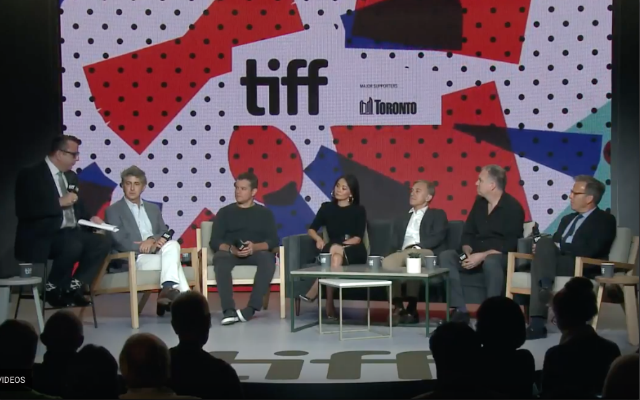
Richard hosted the TIFF press conference for “Downsizing” with director Alexander Payne, stars Matt Damon, Hong Chau, Christoph Waltz, screenwriter Jim Taylor and producer Mark Johnson.
The script by Payne and Jim Taylor opens with a Norwegian scientist making a breakthrough he thinks will save humanity: a technique that can shrink people to 5 inches (12 centimeters) tall. That means they use a tiny fraction of the resources they once did — and need to pay less, allowing people of modest means to grow instantly rich by becoming small.
If you are not a Roald Dahl fan the term The BFG almost sounds like something you might call someone you don’t like.
If you’re familiar with the Dahl’s work, stories like James and the Giant Peach, Charlie and the Chocolate Factory, Matilda and Fantastic Mr Fox, you’ll already know The BFG stands for The Big Friendly Giant.
Just in time for the 100th anniversary of Dahl’s birth, Steven Spielberg brings the towering tale of an orphan girl who befriends a taller-than-tall giant to the big screen.
Mark Ryland, last year’s best supporting Oscar winner for Bridge of Spies, plays the BFG but he’s not the film’s only leviathan. Giant Country is filled with “cannybully and murderful” goliaths with fanciful names like The Childchewer and The Gizzardgulper.
They are the BFG’s brothers, behemoths so huge if six-foot eight-inch Cleveland Cavaliers forward Lebron James stood next to them he’d only come up to their ankle. They’re fearsome but Meatdripper portrayer Paul Moniz de Sa is quick mention, “There’s still a lot of joy in the giants.”
“We were going more for goose bumps,” says Michael Adamthwaite who plays the Butcher Boy. “The film does a good job of showing [kids] how to overcome that fear and finding confidence and being brave and standing up for what you believe in.”
Creating a world for the giants to inhabit involved groundbreaking technology to blend the live-action elements with performance-capture techniques. The richly detailed Giant Country, where swords are used as sewing needles and sailing ships double as beds, was brought to vivid life on soundstages in Vancouver last year.
“It was a big empty space and you had to use your imagination to feel the different elements,” says Daniel Bacon who plays Bonecruncher. “There was tape on the floor and it was explained that something would be here, and something would be there. We relied on Steven telling us and being very descriptive about what it would look like.”
“We also had the wonderful concept art to fall back on,” says Adamthwaite. “For all the locations there was a big concept art poster and then there was the virtual camera which is technologically way beyond my brain power, but it is so crisp and the technology has advanced so quickly that now we are at a point that even though we were in a carpeted room with tape on the floor we had the benefit of being able to look over to a large screen monitor and see these almost real time, almost full renderings of our characters.”
The result of the high tech work is a film that has so little to do with today’s kid’s entertainment it feels as though it’s a relic from another time, a singular holdover from a day before Minions gurgled and everything was awesome. Adamthwaite credits Spielberg for finding the right tone.
“While some directors may be pushing the boundaries of being cutting edge. He always sees the film through the audience’s eyes. He’s very aware and astute of what will work in terms of what the audience appreciates.”
The Tarzan yell, a familiar sound to anyone who grew up watching Johnny Weissmuller movies on Saturday morning television. Created by Edgar Rice Burroughs in 1912 as a feral child raised in the jungle by Mangani Great Apes, he has inspired dozens of films, radio and television shows, comic books, Baltimora’s hit song Tarzan Boy and even appeared on a GEICO TV commercial. When The Lord of the Jungle wasn’t doing the famous yell Carol Burnett would often close her variety show with the jungle holler.
That was then. Those Saturday morning matinees are a thing of the past and it’s been some time since Tarzan made any kind of rumble in the jungle. “True Blood’s” Alexander Skarsgård and his finely honed abdominal muscles hope to change that with “The Legend of Tarzan,” a revamped look at the chest-thumping hero.
The story begins with a history lesson. It’s 1862 and King Leopold of Belgium has gone broke trying to sap the Congo’s considerable resources. In a last ditch effort to find a valuable diamond mine, Belgian envoy, the vain and ruthless Captain Rom, (Christoph Waltz) has left a trail of carnage across the land.
To access the gems Rom must make a deal with Chief Mbonga (Djimon Hounsou). “There is one thing I despise above all else,” says the chief. “Bring him to me and you shall have your diamonds.” That “him,” of course, is Tarzan ak.a. John Clayton, Earl of Greystoke, a fella raised by apes when his aristocratic parents perished in the jungle. (Luckily there were no trigger-happy zookeepers nearby so the apes could safely take the child.) Mbongo wants revenge, Rom wants the jewels and a plan is hatched to lure Tarzan, who now lives the life of a lord in London with his wife Jane (Margot Robbie), back to Africa.
US trade ambassador George Washington Williams (Samuel L. Jackson) convinces Greystoke to accept Rom’s “goodwill” invitation but he has an ulterior motive. “How does a bankrupt monarch keep the Congo in business?” he asks. “Slavery?”
And that’s just the first half hour. In short order Jane is kidnapped from the warm embrace of her African family so Tarzan must not only rescue her and stay away from Mbonga but also stop Rom and the king from enslaving all of the Congo. It’s a tall order, but he’s a big guy. “A normal man can do the impossible to save the woman he loves,” says Jane. “My husband is no normal man.”
Not content to simply introduce a franchise-able Tarzan to millennials, “The Legend of Tarzan” is also a treatise against man’s injustice to man. Slavery, colonialism and the slaughter of America’s native people are all covered but the political and historical subtext tends to be outshone by the shiny-as-a-new-dime leads. In the tradition of the great Tarzan and Janes of the past Skarsgård and Robbie bring otherworldly abs and cheekbones and some sexual tension—she apparently really likes it when he imitates animal mating calls—to a movie that jam packs in story but works best when it sticks to the basics. Beautiful cinematography, exciting jungle chase scenes and cliff jumps are the stuff Tarzan movies are made of and the new films has those in spades. When it embraces its ape man legacy it swings on all vines. When it steps outside those lines its less successful.
Director David Yates, best known for helming the last four “Harry Potter” movies, seems to have a sense of campy humour regarding his characters—why else would he have Rom sneer cartoon villain lines like, “Your husband’s wildness disturbs me”?—but the emotional moments seem just out of his reach.
Absent any real feelings “The Legend of Tarzan” relies on snazzy filmmaking—lots of flashbacks and highflying action—and fetching leads to keep things interesting. Even then it feels as if Yates is holding back to ensure a young demographic friendly PG rating. There are fights and some violence but much of the actual action happens just off screen. It’s less graphic, I suppose, but takes away the visceral thrills that could have amped this story up.
Will “The Legend of Tarzan” ingratiate the Lord of the Jungle to a new audience? As one character in the film says, “I don’t think so, wild man.”
Daniel Craig suits up again in the latest Bond flick, taking his fourth spin as the super spy in Spectre. The film’s overseas reviews have been very strong and it will likely dominate the weekend’s box office but who among us would call Craig the best Bond?
I have a theory that the Bond nearest and dearest to your heart is the first 007 you saw projected on the big screen.
Popular consensus tells us that Sean Connery, who played the role in six films spanning 1962 To 1971 and then once again in 1983’s non-officially sanctioned Never Say Never Again, is the best Bond. As cool as Connery was he isn’t my top of the pops. Dr. No, the first 007 movie, came out before I was born and Connery more or less permanently parked his Aston Martin around the time I entered grade two.
The Bond that made the biggest impression on me was Roger Moore. I know critically speaking he wasn’t the most beloved Bond. Pauline Kael once wrote about him, “Roger Moore is dutiful and passive as Bond; his clothes are neatly pressed and he shows up for work, like an office manager who is turning into dead wood but hanging on to collect his pension.”
I also know that hardcore spy fans considered Moore too well-mannered and pleasant to be effective, but he was my first, and I guess the first cut is the deepest because I still have a fondness for his breezy take on the super agent.
But that’s just me.
To get a broader picture I did a highly scientific Double-Blind Bond Peer Reviewed In House Clinical Trial (in other words I asked my Facebook and Twitter friends) to determine the world’s favourite 007 portrayer.
The contenders were Connery, George Lazenby, Moore, Timothy Dalton, Pierce Brosnan and Craig — everyone who has played Bond in one of the 24 officially sanctioned 007 movies.
Several contributors brought up others like Barry Nelson, who played James Bond in a 1954 television adaptation of Casino Royale. Also mentioned were David Niven’s turn as Bond in 1967’s Casino Royale and another actor who has never played 007. “Clive Owen,” suggested one poster, “once they get around to casting him in the next one.”
After eliminating the unofficial 007s and non-Bonds a team of experts (OK, it was just me reading through the posts as Live and Let Die played on the TV behind me) sifted through the results.
Pollsters said Brosnan Is Not Enough to ’90s Bond Pierce Brosnan who came in dead last with just 1.9 per cent of the vote.
“I liked Pierce Brosnan because he embodied all the others combined,” wrote one positive poster. “Charm, humour, ruthlessness, cunning.”
Timothy Dalton earned 3.9 per cent with one respondent saying, “If there really was an agent who was an assassin with a licence to kill … it would be him.”
At 9.8 per cent, George Lazenby fared better than Brosnan and Dalton even though he only made one 007 film.
My favourite Bond came in third with 15.6 per cent, just behind Daniel Craig’s 21.5 per cent. “Craig gets me wanting to watch whereas the others are placeholders,” wrote a Facebook friend, “Sorry.”
By far and away, Sean Connery was the winner with a whopping 39.2 per cent of the vote. This comment seems to sum up the reason why people like him. “Sean Connery because Sean Connery!”
Who is your favourite Bond? Chime in at @metropicks.
For many of us James Bond has been a constant. For more than 50 years a series of actors have taken on the role over the course of twenty-four officially sanctioned movies. He has been, by times a killer, a clown, a lover, a sinner and a saint. In “Spectre,” the latest edition of the Bond Follies, he is all those things and more.
The new film opens just days after the events of “Skyfall.” M (Judy Dench), Bond’s boss and confident, has been killed and 007 (Daniel Craig) is fulfilling her last request. He’s in Mexico City (just the first of many exotic locations in “Spectre’s” travelogue) to assassinate an Italian mobster through a crowded Dia De Los Muertos parade. It’s a wild scene—involving thousands of extras, helicopters, exploding building and a serious fall broken by a well-placed sofa—that sets the tone for the rest of the film; Big, loud and slightly silly.
Information gathered from the mobster’s widow (Monica Bellucci) leads Bond to Rome and a meeting of the super-duper, top-secret terrorist organization SPECTRE (Special Executive for Counter-intelligence, Terrorism, Revenge and Extortion) led by evil genius Oberhauser (Christoph Waltz).
Back in London the new M (Ralph Fiennes) is defending the 007 program from C (Andrew Scott), a bureaucrat who snidely says, “We’re going to bring British intelligence out of the dark ages and into the light.” In other words, on-the-ground agents and their licences to kill are about to be replaced with drones and high tech surveillance and security. The plan is to unite the defence systems of the world and dispense with Bond’s human touch.
Meanwhile Bond is still globetrotting, now with Madeleine Swann (Léa Seydoux) on his handsomely tailored arm. She’s the daughter of a former SPECTRE member and just might hold the key to infiltrating the organization.
“Spectre” is worth a look for the scenery alone, and no, I don’t just mean Daniel Craig’s Tom Ford suits or Monica Bellucci’s jewels. From Rome to Tangiers to Mexico City and beyond the movie is a parade of beautifully shot tourism brochure-ready landscapes.
The stuff that happens in front of those landscapes is worth a look too. Director Sam Mendes keeps the pedal to the metal, tossing out implausible plot twists and action scenes with great regularity. City blocks blow up, airplanes chase automobiles and, of course, the classic ticking bomb makes an appearance. As usual the body count is high and there’s even a wild areal fight sequence before no more than four lines of dialogue have been spoken.
There’s all that and a lighter tone then the other Craig Bonds. The grim-faced 007 has been replaced by a slightly-less grim faced Bond. Craig isn’t channelling Roger Moore or anything quite so broad, but there are laugh out loud moments as “Spectre” simultaneously plays up to and satirizes Bond stereotypes. In one scene Dr. Swann and Bond fall into a surprise embrace. In any other Bond movie they would kiss and tumble into bed. Here she says, “Don’t think for a moment this is where I fall into your arms,” effectively satirizing the Bond as lady-killer stereotype and making strides for Bond Girls everywhere.
Too bad there’s no such reinvention of the Bond villain. As Oberhauser Christoph Waltz is a bit of a dud. His backstory is interesting and he certainly has evil intent, but he comes across here more as a bully than a supervillain. Waltz doesn’t come close to the menace he brought to “Inglourious Basterds’” Col. Hans Landa. He’s barely in the film but casts a long shadow… a long shadow that could have been much darker.
If there is a message in “Spectre” it has to do with new versus old. C represents a dangerous future where drones and surveillance put enemies at arm’s length. M and Bond represent tradition, a more gentlemanly form of killing where you have to look into the eyes of the person you’re about to off. It seems to be asking if James Bond is of the past, a dinosaur. I’d say no, not as long as the 007 movies are as entertaining as this one.
Tim Burton likes strange stories. From the razor sharp fingers of “Edward Scissorhands” to “Pee Wee’s Big Adventure,” he has made his trade on stranger-than-life stories.
Now, with “Big Eyes,” starring Amy Adams and Christoph Waltz as Margaret and Walter Keane, he has found a true-life tale that is stranger than fiction.
There was a time when Walter Keane was the top selling painter in the world. Original paintings of his big-eyed waifs commanded thousands of dollars but if that was too high end for you, a print could be purchased for the price of a breakfast at Dennys. And sell they did, like hotcakes. Keane became rich and famous and even though gallery owners, like the one played by Jason Schwartzman in the movie, thought the “taste police” should be called wherever the paintings were displayed and a critic (Terrence Stamp) called them grotesque and “an infinity of kitsch,” the morose portraits were very popular.
“I think what Keane has done is just terrific,” said Andy Warhol. “It has to be good. If it were bad, so many people wouldn’t like it.”
Trouble was, Walter couldn’t paint. He was an artist wannabe with a talent for promotion of other people’s work. In this case it was the work of his wife Margaret. For her the paintings were a personal expression, for him they were a personal cheque to fame and fortune. From selling the paintings at street fairs to the walls of jazz clubs to their own gallery and finally department stores all over the world, Walter became the public face of the phenomenon while Margaret sat at home, tucked away in a small garret cranking out big eyes and keeping her mouth shut.
Eventually Margaret sought out the credit she and share of the money she had rightly earned in a dramatic courtroom battle that was settled with easels and brushes instead of lawyers and writs.
Like Burton’s look at the life of Hollywood hack Ed Wood, “Big Eyes” once again proves that beauty is in the eye of the beholder and sometimes fact is stranger than fiction. The love and generosity Burton slathered on Woods’ eventful life and subpar work is once again on display.
The big-eyed paintings are an acquired taste, a kitschy look at another time when outsider art took center stage but Burton uses them not just as an artifact form another time but to present a story of an artist’s quest for recognition and recompense. It’s a trip back in time to the early to mid Sixties when women’s art was not taken seriously—“Your husband is quite a talent. Do you paint too?” she’s asked—and while we never really learn why the paintings become so popular, we know that through some savvy promotion they did.
What’s more important is the how and why of Margaret’s story. Why did she let her husband steal the spotlight and the money?
That’s the heart of it all and through Waltz’s flamboyant performance as the charmingly vile Walter and Adams’s soulful take on the shy and pliable Margaret we’re given a glimpse into a one-sided and unhealthy relationship with a very public face.
If the eyes are the window to the soul, “Big Eyes” is a skillful, if a little thin look at an artist’s soul and the soulless shark who tried to steal it from her.
At one time or another everyone has fantasized about, if not killing, then at least doing grievous bodily harm to an employer. The guys in Horrible Bosses, the 2011 comedy starring Jason Bateman, Charlie Day and Jason Sudeikis, actually tried to make their fantasies reality.
The idea of squaring off against the boss man struck a chord with a lot of people and the movie raked in more than $100 million. So the inevitable sequel, Horrible Bosses 2, hit theatres earlier this week.
They’ll have to go some ways to top the last trio of bad bosses: Jennifer Aniston as a foul-mouthed sexual predator with a bad habit of using laughing gas as foreplay; a manic boss with no scruples in the form of Kevin Spacey; and a drug-addled loser with a penchant for cocaine and masseuses who inherits a business from his papa, played by Colin Farrell, who berates his employees for coming in late after attending his dad’s and their old boss’s funeral.
“Well, maybe that excuse would have flown when my dad was here, but I’m in charge now.”
But even that terrible trio pales in comparison to the worst movie bosses of all time.
One of the worst is Working Girl’s Katharine Parker (Sigourney Weaver). Parker is two-faced, and attempts to pass off her trusted secretary Tess McGill’s (Melanie Griffith) ideas as her own. Roger Ebert said of Weaver’s performance, “From her first frame on the screen, she has to say all the right things while subtly suggesting that she may not mean any of them.”
In the end, Tess teaches her a lesson about honesty and gets Katharine fired.
Katharine looks like a pussycat compared to Buddy Ackerman (Kevin Spacey), the tyrannical Hollywood producer in Swimming with Sharks.
“You are nothing!” he says to his new assistant Guy (Frank Whaley). “If you were in my toilet I wouldn’t bother flushing it. My bathmat means more to me than you!”
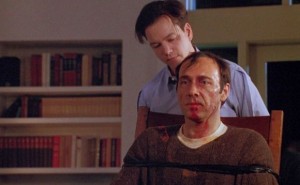
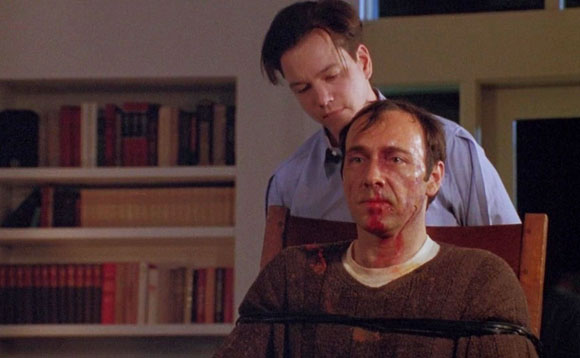
Guy finally snaps, kidnaps Buddy and tortures him. But in an unexpected twist, the extreme behaviour earns Buddy’s respect and Guy gets a promotion.
Finally, if you mix the swooping white hair and bad attitude of Cruella DeVille with the people skills of Vlad the Impaler, you will come up with Miranda Priestly, the worst boss in all of moviedom. Played by Meryl Streep in The Devil Wears Prada, Priestly is the editrix of a fictional fashion magazine called Runway who never met an assistant she couldn’t humiliate with a withering glance and a few choice words. “By all means, move at a glacial pace,” she says to newbie Andy Sachs (Anne Hathaway). “You know how that thrills me.”
“Horrible Bosses 2” is being billed as a comedy and stars people—like the Jasons, Bateman and Sudeikis, Charlie Day and Jennifer Aniston—usually associated with making people laugh, but does the almost complete absence of anything giggle worthy preclude us from labeling it a comedy? Discuss.
In the second peek at the pitiful employment record of Nick (Bateman), Kurt (Sudeikis) and Dale (Day), the guys go into business for themselves. Their product, the Shower Buddy—a shower nozzle that shoots shampoo and conditioner as well as water—seems like a sure fire As-Seen-On-TV hit but when a shady billionaire (Christoph Waltz) tries to swindle them out of their livelihood they decide to get even by kidnapping his son (Chris Pine). “If we’ve learned one thing about ourselves,” says Nick, “it’s that we’re not murderers.”
Off the top it has to be said that Bateman, Sudeikis and Day have great chemistry together. They joke, jostle and jape like brothers, giggling their way through the movie as if they are in on a fantastic gag that only they get. The trio seems to be having fun, and judging by the outtake reel that plays over the credits, the set was filled with laughter every time someone blew a line. If only the audience could have as much fun watching the movie as the cast did making it.
“Horrible Bosses 2” is a demotion from the original film. There are more laughs on the average job application than in this workplace “comedy.” It’s misogyny masquerading as humour, with unlikeable characters and an inane premise that diminishes in interest as the running time increases.
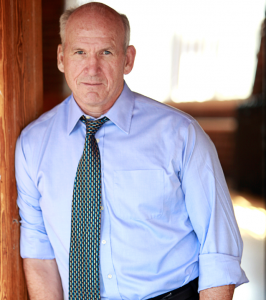
“It was the idea of connecting with another human being at a deep level,” that attracted John Bourgeois to acting. “I think that is what all artists try to do. We try to penetrate and get through to other people. To feel connected,” says the veteran mainstay of stage and screen.
“I came from a loving but troubled family that experienced the usual catastrophes (drugs, alcohol, adultery, divorce, debt) so there’s wasn’t a lot of support for higher education or culture.”
“That said, when I told them I was going to be an actor they encouraged me to go for it. Both my mother and my father had searing regrets for the roads not taken so they didn’t want me to have the same experience.”
He came across his love of acting quite by accident while studying journalism at Concordia in Montreal.
“It wasn’t until I was in second year university and honestly I needed to do a course where I didn’t need to write a paper,” he says. “So I took an acting course on a Monday night. That was it. I was bitten. I did a scene from Death of a Salesman and it was transformational.
Around the same time he worked as a production assistant on a film called Blood Relatives and for the first time saw how a performance was created.
“I had been around actors in my younger life and I didn’t know what they did until I saw a specific performance. I saw it being created and I went, ‘I see what this person is doing and it is really quite a craft they have going there.’ It wasn’t just showing off.”
That actor was Donald Sutherland. “I was his driver on the movie. Sutherland is a very thoughtful person and his approach to his work was very thoughtful. That changed my view of the craft.”
Despite booking three plays in his final year of university and thinking, ‘How hard can it be to make a living at this?’ he says, “the struggle, at the start, it’s mostly a financial one. There’s always a danger that the hustle will distort your character. That very nearly happened but I was fortunate to meet some very honest and good people along the way who kept me from self-destructing. So yes, I would do it again.
“Being an actor means being a great observer and that’s a great angle from which to experience life. Besides, resistance sharpens the senses and makes us keenly aware of the passing moment. And surely being present and connecting with others is what it’s all about.”
That passion for acting and relating to audiences hasn’t dimmed over the course of 100 plus film, television and stage roles—“You have to wear a lot of different hats in order to make a decent living,” he says—but recently, in addition to co-starring with Whoopi Goldberg in the TV movie A Day Late and Dollar Short, he has discovered a new way to practice his craft.
“I came to teaching relatively late,’ he says of his job as program director of Acting for Film and Television at Humber College. “The biggest revelation to me is that it is as much a craft as any other you can think of. It is a form of performance. You’re standing in front of people, talking. What I have discovered, when you teach you discover stuff about your craft.
“It puts your own relationship to your craft under a magnifying glass and you become fascinated by what it is that frees up creativity in an actor, how you can equip them with the right toolbox to give them that sense of liberation in their work. It is immensely gratifying.”
With a lifetime of experience under his belt he has some great advice for his students.
“Don’t ever wait for the phone to ring,” he says, “That’s a waste of time and energy. Instead act. Anywhere and everywhere. Make your own work. Love the craft and above all protect your talent from the harsh realities of the business. Find ways to practice it. Train with leading practitioners like at Humber. Produce a play. Make a web series. Act. Do. Everything else is gossip.”
SIDEBAR:
In his latest gig Ottawa-born actor John Bourgeois is stepping into some very big shoes. In the dramedy God of Carnage, now playing until December 15 at the Panasonic Theatre in Toronto, he’s lawyer Alan Cowan, previously played by Jeff Daniels on Broadway and Christoph Waltz on film.
He’s seen both productions but says neither inspired him. “I’ve been doing this for so long so I don’t find myself as easily influenced as I was when I was a young actor,” he says, his booming voice echoing down the line on a break from rehearsal. “I think young actors are more susceptible to those iconic influences.”
Instead, he drew on personal experience to build the character.
“I’ve known quite a few lawyers who are A type, personality driven, really competitive, hyper focused but sometimes they are a little socially tone deaf and that’s where I picked up Alan.”
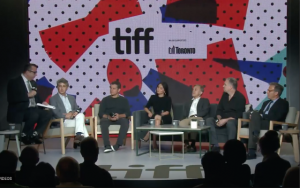 Richard hosted the TIFF press conference for “Downsizing” with director Alexander Payne, stars Matt Damon, Hong Chau, Christoph Waltz, screenwriter Jim Taylor and producer Mark Johnson.