If nothing g else “Foxcatcher,” a true-life crime drama from Bennett Miller, director of “Moneyball,” is an exercise in the transformative nature of an under bite. Jutting out his jaw changes Channing Tatum from movie star handsome to thick-necked gym rat Mark Schultz, one third of a story of murder and America’s wealthiest family.
Based on true events, the story begins with Schultz, a gold medal-winning wrestler at the 1984 Olympics, training with his brother David (Mark Ruffalo) to regain the glory of his past achievements. Out of the blue he is contacted by John du Pont (Steve Carell), multi-millionaire and sports enthusiast with a simple but grand offer. The patriotic du Pont asks Schultz to put together a team of wrestlers, who would train at a special facility at Foxcatcher Farms and establish America’s dominance at the upcoming Seoul Olympics. Schultz signs for $25,000 a year–“I just said the highest number in my head.”—beginning a journey that will end in world championship glory and murder.
Even though this is a true story that more or less follows the public record of events I’ve left the synopsis vague so as not to spoil the film’s climax. In doing so I also failed to mention the growing sense of alienation and the slow burn of psychological dysfunction. A pall hangs over the entire film, building toward the culmination of the action that is shocking not only in its randomness, but in its volume. Miller has made a quiet, restrained film, one that demands the viewer to lean forward to appreciate, so when three loud gunshots ring out they shatter the quiet in a jarringly effective depiction of violence.
But for as effective as that scene is, the build-up is demands patience. The leads are uniformly great—particularly Carell who, as a repressed man used to getting what he wants and winning, whether it is a world championship title or play wrestling at a party, hands in a career re-defining performance—but the studied precision of the direction bogs down the pacing. If Miller edited the VERY long pauses in the conversations between Mark and John he could have trimmed half-an-hour from the running time. Some will find the start-and-stop delivery adds to the film’s surreal feel, other will simply find it tedious.
“Foxcatcher” is buoyed by interesting, unexpected performances and an unnerving tone but adds little to the examination of the complex issues that lie at the center of the story. Unchecked privilege and moral decadence are on display but the underlying pathology of the piece remains a mystery.
What is it with Mexicans and death?” asks a youngster in the new kid flick from producer Guillermo Del Toro.
It’s a legit question in light of the content of a film that takes place in and around the Day of the Dead, a national bank holiday in Mexico. “Is that National Zombie Day?” asks the same kid.
No it isn’t. Instead its refreshingly dark but delightful story based on folklore with sumptuous visuals and good messages about family, fate and gender dynamics.
The story begins with a bet between spirits La Muerte (Kate del Castillo) and Xibalba (Ron Perlman) on who will win the heart of the beautiful Maria (Zoe Saldana), warrior Joaquin (Channing Tatum) or bullfighting musician Manolo (Diego Luna). The stakes are high. If she marries Joaquin the devious Xibalba will rule in the Land of the Remembered, while La Muerte will be banished to the Land of the Forgotten. As part of a double cross Manolo is plunged into the underworld, only to have to fight his way back to his hometown and the woman he loves.
“Finding Nemo” and “Bambi” aside, mortality is not a big topic in children’s movies. “Book of Life,” however, embraces it; weaving an entrancing story that toggles back-and-forth between the land of the living and dead. It celebrates the vibrancy of the Day of the Dead celebrations, complete with skeletons in dazzlingly costumes and a character with a disembodied head. “The Walking Dead” this ain’t.
For some children the demonic bulls and Xibalba’s grandly goth appearance might be the stuff of nightmares, but the fanciful creations are for the most part kid friendly in a “Nightmare Before Christmas” kind of way.
For parents the scariest thing about the movie may be the appropriation of songs by Mumford & Sons and Radiohead for a kid’s movie.
Director Jorge R. Gutierrez updates traditional mythology with modern storytelling, making sure that the movie moves along at the speed of light. It occasionally feels a bit too jam-packed, with a noisy finale that isn’t nearly as interesting or inventive as the unconventional stuff that came before it, but the pandering to predictability in the final moments doesn’t diminish “Book of Life’s” impact as a beautifully crafted fantasy.
Jonah Hill and Channing Tatum are producers on “22 Jump Street,” which, I guess, explains the large number of jokes about how much everything cost. At one point Hill actually says, “It’s way more expensive for no reason at all.”
I don’t know how much the movie cost to make, but the self-aware jokes did make me laugh even though “22” is essentially a remake of the first film, with a few more Laurel and Hardy slapstick gags and amped up explosions.
The “21 Jump Street” high school undercover cops Schmidt and Jenko (Hill and Tatum) are back, but this time they’re narco cops. That is until they botch an investigation into drug lord Ghost’s (Peter Stormare) operation. Their failure gets them demoted back to the 22 Jump Street (they moved across the road) program.
Jump Street’s Captain Dickson (Ice Cube) sends them undercover as unlikely brothers Brad and Doug McQuaid, to college to arrest the supplier of a drug named WHYPHY (WiFi). The bumbling, but self-confident duo infiltrates the college, but campus life—frat house parties, football and girls—threaten to blow apart their partnership. “Maybe we should investigate other people,” says Jenko, “sow our cop oats.”
“22 Jump Street’s” end credit sequence, which maps out the next sequels from number 3 to installment 43—they go to Beauty and Magic School among other places of higher learning— is probably the funniest part of the movie. Co-directors Phil Lord and Christopher Miller—they also made “The Lego Movie”—expertly parody Hollywood’s obsession with grinding a good thing into the ground and grab a few laughs while they do it.
The stuff that comes before is amiable, relying on the Mutt and Jeff chemistry of the neurotic Hill and all-American Tatum for laughs. It’s boisterous and aims to please, but best of all are the self-referential jokes. By clowning around about the difficulty in making the sequel better than the original they’re winking at the audience, acknowledging that this is basically a spoof of Hollywood sequels. It’s meta and kind of brilliant.
It isn’t, however, a laugh a minute. Ill-timed jokes about Maya Angelou and Tracy Morgan are sore thumbs, while the bromance between Schmidt and Jenko is played out until it begins to feel like the punch line to a bad, politically incorrect gag.
Better are Tatum’s malapropisms. The dim-witted cop says, “I thought we had Cate Blanchett on this assignment,” when he means “carte blanche,” and confuses “anal” and “annal.” They’re easy jokes, but Channing milks laughs out of them.
There will likely be a “23 Jump Street”—the film shows us an under-construction condo at that address—which will hopefully have the same subversive sense of fun, but more actual jokes.
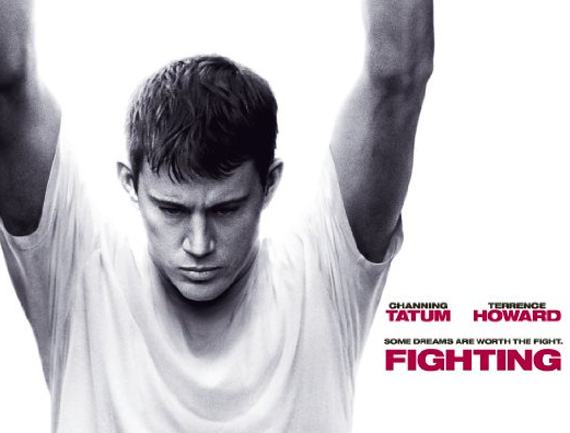
If you don’t know who Channing Tatum is you’re probably older than sixteen. If you’re curious go look in your daughter’s bedroom right now. To the left of the Zac Efron shrine is very likely a poster of the buff young actor. Compared to Johnny Depp and Efron Tatum is a minor deity, a good looking guy whose main claim to fame has been a couple of teen dance movies and a guest spot on CSI: Miami. At twenty-nine-years-old the chiseled actor is now straddling the line between teen fare and adults roles. He’s had a couple of stabs at adult fame in films that failed, but his new one, Fighting, co-starring Terence Howard, is a good transitional movie for him; a film with enough action for the kids and enough grit for the adults.
Story wise Fighting doesn’t break any new ground. It’s a classic underdog story. It’s Billy Elliot with choke holds or Rocky without the gloves. Tatum is Shawn MacArthur a scrappy New York City street kid with a troubled past. When he crosses paths with small time hustler Harvey Boarden (Terrence Howard) the two go into bare knuckle fight business—Harvey has the contacts, Shawn has the fists of fury. Shawn becomes a street fighting champion but his success and money don’t ease his troubled mind.
Set in the down-and-dirty NYC unseen since movies like Across 110th Street, Fighting is the New York Rudy Giuliani tried so hard to sanitize. Hustlers are everywhere, underground fighting is big business and nothing good ever happens after 10 pm. It’s a nice, unsentimental backdrop to the story, and with handheld camera in hand director Dito Montiel takes pains to use the cityscape to create a volatile and exciting atmosphere.
In terms of volatile Fighting certainly lives up to its name. The ouch-inducing fight scenes are brutal in their realism, with every smack and punch lovingly recorded in bone splitting surround sound. They are the film’s center pieces, but the fight scenes don’t get in the way of the story or vice versa. There’s a nice balance between the action and narrative, although a love story slows the momentum in the second half.
The film is jam packed with naturalistic performances. Nicely cast supporting roles like Roger Guenveur Smith who seems to be channeling Christopher Walken as the sleazy bookie Jack Dancing and the scene stealing Alba Guzmán as the nosy grandmother are complimented by effective background actors (like Loud Club Wannabe and Flawless Woman Number 1) who effectively add to the film’s realistic mood.
Tatum isn’t likely to win any trophies for his work unless the Elliptical Trainers of America bring back their Buff Awards this year but he brings his character to life, even giving him a few unexpected dimensions. Who knew street fighters were so polite?
The one to watch is Terrence Howard, who after a disappointing run of average work in films like August Rush and even Iron Man, hands in an edgy performance that mixes street smarts with some effeminate mannerisms to create his most memorable character since Hustle and Flow.
Fighting is a better than expected drama, that, while somewhat predictable, hooks the viewer with interesting characters and UFC-style flying fists.
Pretty much all you need to know to understand the labyrinthine plot of “G.I. Joe: Retaliation” is that “Joes” rhymes with “heroes.” Everything else is window dressing. Well, window dressing that explodes, but you know what I mean.
Based on Hasbro’s G.I. Joe toys and comics, “Retaliation” sees the GI Joe squad—Duke (Channing Tatum). Roadblock (Dwayne Johnson), Flint (D.J. Cotrona) and Lady Jaye (Adrianne Palicki)—framed for treason. Shut down by order of the President (Jonathan Pryce) they team with a retired general, Joseph Colton (Bruce Willis), to battle venomous international terrorist organization Cobra and super villain Zartan (Arnold Vosloo).
There are bombastic fireworks galore in “GI Joe: Retaliation,”—which you expect from a movie about G.I. Joes and power hungry madmen—but it isn’t the movie you might expect from the people who wrote “Zombieland.” With that pedigree you’d expect a high laugh to body count ratio; maybe not “Zero Dark Funny” or anything, but every now and again it teases with a line like, “They call it a water board, but I never got bored,” that’ll make you wish for more belly laughs and fewer bullets.
The tone of the film feels skewed. It’s all about the action, although the fighting scenes, while plentiful, are shot so that it is often difficult to tell who was beating the tar out of whom.
There are laughs buried amid the bombs but more often than not the action gets in the way of the giggles and the plot.
It’s not a complicated story, exactly, but the movie makes the assumption that the audience has read the comics and knows the mythology surrounding the Joes (Navy Seals on steroids with an extra dose of attitude), Cobra (the bad guys) and the various ninjas.
That’s where this movie wanders.
You’ll be glad the ninjas are there—there’s a wild ninja chase in the middle of the movie—but their backstory and shifting alliances muddy things up. Remind me again, is Storm Shadow a good guy or a bad guy?
If you are content to sit back and allow explosions to scorch your eyeballs—the little flying bug bombs are cool—and watch The Rock flex his muscles, then “G.I. Joe: Retaliation” may hit the sweet spot for you. But if it’s a good mix of action, laughs and story you’re after, maybe skip this one and cross your fingers that the inevitable sequel finds a better balance.
Here’s the answer to the first question most people have asked me about “Magic Mike”: Yes, Channing Tatum appears naked but not nekkid. In movie terms naked means posterior shots, nekkid is when he turns around. Channing is now too big a star to turn around, but rest assured, within a minute of appearing on screen he leaves little to the imagination.
Directed by Steven Soderbergh, “Magic Mike” is a loosely biographical account of Tatum’s time spent dancing for money in a Tampa strip club. He plays the title character, a thirty-year-old entrepreneur and stripper with one foot on the stage and one in the business world. When he recruits the hot-headed Adam (Alex Pettyfer) to dance at the club he gets drawn deeper into the dark side of the art of selling sex.
Let me first say “Magic Mike” is abtastic.
There haven’t been this many finely sculpted stomach muscles in one place since the Dr. Ho infomercials of the late 1990s. The genetic blessings of stars Tatum, Matthew McConaughey, Joe Manganiello, Matt Bomer and Adam Rodriguez as Chippendales stereotypes like cowboys, firemen and construction workers, mixed with the little details–how Mike smoothes out the sweaty, rumpled bills that get shoved down his G-string and then presses them under a large book–and moves that redefines dirty dancing, paint an effective portrait of the dancers who liberate the sexual passions of the giddy girls in their audiences.
That part the story gets right. When the movie is showing some skin it works, it’s when it gets to the stuff underneath–the heart and soul–that it falters. Up until the final half-hour it’s all about, as Mike says, “women, money and good times,” but the inevitable turn toward the dark side isn’t nearly as interesting as everything that came before it. “Boogie Nights” did it first and did it better.
By the time “Magic Mike” reaches its redemptive moment, with the classic rock anthem of rebirth “Feels Like the First Time,” blaring in the soundtrack, the movie feels like something we’ve seen before.
But for those who stopped reading after the words “Channing Tatum” and “naked” “Magic Mike” offers the pleasures of an endearingly charming performance from the titular character, an unhinged one from McConaughey and lots of buff, hairless men doing things that would make your grandmother blush.
“The Eagle,” a new “Gladiator-lite” movie from Academy Award winner Kevin MacDonald, plays more like a B.C. buddy picture than a brutal Roman centurion drama.
Based on the legend of the Legio IX Hispana (Ninth Spanish Legion)—a group of 5000 warriors thought to have disappeared in Britain in AD 117—the film sees emotive former fashion model Channing Tatum as centurion Marcus Aquila, the son of the leader of the Ninth Legion. His mission is to discover what really happened to his father’s battalion and recover the lost golden Eagle statue. Along for the ride is his slave Esca (Jamie Bell), who helps navigate the treacherous lands beyond Hadrian’s Wall (modern day Scotland).
Channing Tatum, an actor poised on the edge of becoming the next big thing, is the central character here. He’s in 99% of the film, and it is his story that drives the action. It’s too bad then, that he is so wildly miscast. Channing is not without his physical charms—think Brad Pitt in “Thelma and Louise”—and is a credible movie star but perhaps a modern day setting would better suit him. Frankly, he’s more San Diego than sword and sandal. In short, even though he gives the role a heroic try, “The Eagle” will not be his “Gladiator.”
Tatum aside, the movie feels lackluster despite its beautiful photography and interesting design. It’s a well made but poorly paced film that puts WAY too much emphasis on the retrieval of the golden eagle, a small statue we’re told is the symbol of Rome. For much of the movie the golden idol is a McGuffin, little more than a device to get the action started, but by the time the story really gets underway we’re supposed to care whether or not Aquila recovers it.
Unfortunately we don’t. It’s a central premise that doesn’t engage the viewer. Also, wouldn’t a large golden eagle weigh at least 100 pounds? The way these actors toss the thing around it seems lighter than a real life sparrow.
Better is the connection between Aquila and Esca. Their slave vs. master bond doesn’t hold much promise as a warm and fuzzy relationship and yet the movie demonstrates how friendship can slice through political divides.
“The Eagle” is a strange hybrid of history and pop culture—a mix of period and anachronistic dialogue with a modern buddy story grafted onto a Roman backdrop—that, despite its title, never really takes flight.
Steven Soderbergh, the Oscar winning director of “Traffic” and nominee for “Erin Brockovich” is one of the most versatile filmmakers working today. From the art house pleasures of “Che: Parts 1 & 2” to the blockbuster business he did with “Ocean’s 11, 12 & 13” to the introspection of “The Girlfriend Experience,” he’s a master of all genres.
Add to that list “Side Effects,” a new pharmaceutical thriller starring Rooney Mara and Jude Law, which brings the immaculate filmmaking of the above mentioned titles to a potboiler plot that feels like its been sitting on Soderbergh’s to-do list since 1985.
When we first meet Emily Taylor (Rooney Mara) it’s just days before her husband (Channing Tatum) is to be released from a four-year-prison stint for insider trading. Their life is about to go back to normal, but it soon becomes clear that Emily is troubled. A suicide attempt brings her to the attention of psychiatrist Dr. Jonathan Banks (Jude Law). She tells him of her lifelong struggle with depression—“a poisonous fog bank that rolls over her mind”—and he prescribes a new drug to help her find equilibrium.
“It doesn’t make you anything you aren’t,” he tells her. “It just makes it easier to be yourself.”
The side effects of the drug, however, include nausea and vomiting, allergic reactions, drowsiness, sleepwalking and criminal behavior. Emily’s erratic conduct while on the drug not only turns her life upside down, but Dr. Banks’s as well.
Saying any more than that would take some of the pleasure away from letting the plot unfold. Besides, detailing the ins-and-outs of the twisty-turny script by Scott Z. Burns would take up the rest of the space I have allotted for this review. You can’t accuse Soderbergh of scrimping on dramatic plot developments, but is it too much?
It all feels very much like the thrillers that used to pack ‘em in at the local bijou in the mid-eighties. Movies like “Jagged Edge” that featured unpredictable plots and elaborate confession montages.
So while it is true that Soderbergh can’t be faulted for not including enough texture in the story, it must also be noted that layers for the sake of layers isn’t always a good thing. The story, which could have been an interesting comment on a broken medical system, or professional misconduct, instead becomes unnecessarily cluttered.
The performances, howevre, are uniformly great. Quick! Somebody buy Mara some Gatorade because she sheds a river of tears—no, make that an ocean—in a performance that is understated but chillingly effective.
Law is terrific as a man whose life is almost torn apart. Luckily he’s left the horrible fake teeth of “Contagion,” his last outing with Soderbergh, at home, replacing them with serious chops playing a man racked with paranoia and anger.
“Side Effects” is a confounding movie because it is beautifully made. Soderbergh strings us along so well in the first hour only to allow the melodrama to win out in the last reel.
In “White House Down,” the new Roland Emmerich scorchfest, the director, who last blew up the White House in 1996’s “Independence Day,” lives up to his big budget blow ‘em up reputation. Nicknamed “Master of Disaster” he’s never met a monument he didn’t want to destroy.
Whether it be bad weather à la “The Day After Tomorrow” or a worldwide cataclysm as in his global warming epic “2012,” the director can’t seem to stop himself from trashing beloved landmarks.
The White House is in his sights in the new film. Channing Tatum plays John Cale, a divorced father of one who desperately wants to impress his brainiac daughter Emily (Joey King) by getting a job as security for the President of the United States (Jamie Fox).
On the day of his Secret Service job interview—daughter in tow—some very bad men (there will be no spoilers here!) invade the White House, disabling the security forces and gaining control of the president’s home.
Separated from his daughter, John gets some on the job the job training as he becomes POTUS’ defacto guard while shooting, stabbing and fisticuffing his way to his daughter’s rescue.
Unlike the virtually identical “Olympus Has Fallen,” the Gerard Butler White House disaster flick that opened earlier this year, “White House Down” spends a lot of time introducing its characters. There’s half-an-hour or so of setup in the sprawling hundred-and-thirty-seven minute movie, which is twenty-nine minutes more than we got in Butler’s film.
People talk—like the overworked secret service agent (Maggie Gyllenhaal) to her high-ranking boss (James Woods) on his last day—and talk—like the ex-wife (Rachelle Lefevre) to John who says things like, “I can’t think of a more important job than protecting the president.”—and talk—like the White House tour guide (Nicolas Wright) on the history of the building—and talk—like the Speaker of the House (Richard Jenkins) to his guards (Mat Craven) and anyone else who will listen. It goes on for a while and none of it is terribly interesting.
Then the dome blows off the White House and Emmerich’s genius for making things go boom comes into play.
From this point on it’s an action movie, although a talkier one than usual–characters say awesome things like, “That’s President Sawyer, and he has a rocket launcher!”–and millions of bullets are expended.
Once the going gets wild the pace picks up which makes the first half an hour feel even more superfluous. The characters are standard action movie types so the prologue doesn’t do much except add half-an-hour to the running time. Going in we know pretty much how all these characters are going to behave so we don’t need the protracted introduction.
Foxx brings a few laughs to his impression of Obama and shares good chemistry with Tatum, who flexes and fights like a true action star. Emmerick tosses in a few other character arcs–like a Fox News reporter who turns into a crybaby when the going gets tough–but by and large the folks in the film are straight out of the director’s usual playbook.
“White House Down” is bigger in scale than “Olympus Has Fallen,” but sometimes less is more. This is enjoyable enough, like a presidential “Die Hard,” but a streamlined approach, as in Butler’s film, might have been more fun.