In the new movie The Other Woman Mark King (Game of Thrones’s Nikolaj Coster-Waldau) tries to push infidelity to Tiger Woodsian heights by cheating on his wife (Leslie Mann) with multiple mistresses, including Carly and Amber (Cameron Diaz and Kate Upton). “We got played by the same guy,” says Carly.
“Getting played” in Hollywood movies dates back further than the invention of the ashleymadison website.
In 1960 the Jack Lemmon movie The Apartment tackled the subject of adultery. The film, about a lonely insurance company lackey who allows his bosses to use his apartment as a trysting spot in hopes that they will promote him, was a big hit, but also a controversial one. The Saturday Review called it “a dirty fairy tale” and co-star Fred McMurray says a woman on the street hit him with her purse, taking to him to task for making “a dirty, filthy movie.”
2005’s Derailed, stars Clive Owen as a married man who hooks up with Lucinda (Jennifer Aniston) after meeting her on a commuter train. In a hormone induced rush they decide to consummate their illicit affair at a seedy hotel, only to be interrupted by a burglar who robs them and sexually assaults Lucinda. Things spiral out of control as the robber blackmails the couple and seems to have an unquenchable thirst for Owen’s money.
Derailed is a cautionary tale about staying faithful to your spouse and never, ever renting rooms in sleazy hotels. Part Fatal Attraction, part Hitchcock thriller the movie stays on track through the set-up of the story, but as soon as the going gets rough the story, well… derails.
The most famous infidelity movie has to be 1987’s Fatal Attraction. It begins with Michael “I’m a married man!” Douglas having a fling with Glenn “I’m not gonna be ignored!” Close. When he tries to break off their affair, she becomes a lesson in why not to cheat on your wife.
The film was a sensation on release, inspiring a number of imitators including The Crush, Single White Female and a spoof called Fatal Instinct, and its most famous clip, the rabbit boiling on the stove, even inspired a phrase in the Urban Dictionary. According to the website, cook your rabbit “refers to the moment when someone goes over the edge in their obsession with another person.”
In an interview twenty year after the film’s release Close said, “”Men still come up to me and say, ‘You scared the [crap] out of me.’ Sometimes they say, ‘You saved my marriage.'”
Cormac McCarthy may not be a household name around your place, unless you live with the Coen Brothers or maybe with the Pitt’s.
Literary critic Harold Bloom called the writer one of the four major American novelists of his time, and he has two all-star movies set for release, which may make his name a little more commonplace.
Later in 2013 James Franco directs, scripts and stars in Child of God, an adaptation of Cormac’s 1973 novel about, “a dispossessed, violent man whose life is a disastrous attempt to exist outside the social order.”
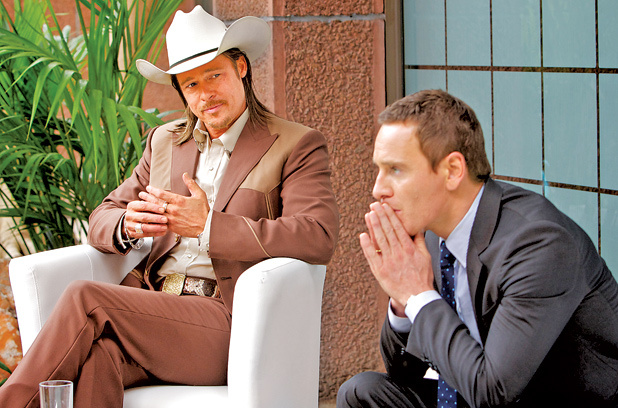
This weekend a star-studded cast lead by Brad Pitt, Cameron Diaz and Michael Fassbender headline The Counselor, directed by Ridley Scott.
Producer Steve Schwartz says the story of a lawyer in over his head after dipping his toe into the drug trade, “may be one of McCarthy’s most disturbing and powerful works.”
And that’s saying something about the writer who gave us a character like No Country for Old Men’s killing machine Anton Chigurh. Empire.com warned that when, “McCarthy throws “a dark character at you, it’s a safe assumption that you’re not going to be able to get them out of your head for a good, long while—if ever.”
As written by McCarthy and played by Javier Bardem, who earned an Academy Award for Best Supporting Actor for the part, Chigurh is merciless, a murderer who makes life and death decisions with the flip of a coin.
The Road—a 2007 Pulitzer Prize winner for fiction—is another disturbing McCarthy novel adapted for the big screen.
The story is simple. A man and his son (Viggo Mortenson and Kodi Smit-McPhee) try to survive in a dystopian world. Armed with only a gun and two bullets they must scavenge for food amid the ruins and protect themselves from cannibals who roam the desolate land.
The Road is a movie based on small moments set against a big backdrop. No parent will be able to forget the stark image of seeing a young boy who doesn’t know what a can of Coke is or a father teaching his son how to commit suicide.
It’s tough, no nonsense work from a writer who says he’s “not that big a fan of exotic foreign films,” especially movie with magical realism. “You know, it’s hard enough to get people to believe what you’re telling them without making it impossible,” he says. “It has to be vaguely plausible.”
Superhero movies don’t generally get January releases. Typically they’re summer fare, warm weather entertainments catering to teens looking for something cool to pass the school break. But “The Green Hornet” isn’t a typical superhero movie. Directed by French art house favourite Michel Gondry and starring Canadian comedian Seth Rogen, it adds something new to the masked crime fighter genre — whimsy.
An all-star cast, including Rogen, Oscar winner Christoph Waltz, Cameron Diaz and Taiwanese superstar Jay Chou, headline the updated adventures of the Green Hornet. In this version Britt Reid (Rogen), heir to his late father’s publishing company, enlists martial arts wiz Kato (Jay Chou) to form a masked crime fighting duo. Together they hatch an unusual strategy to help Britt get over his serious daddy issues and take on the leader of the city’s underworld, Russian criminal Benjamin Chudnofsky (Waltz).
“The Green Hornet” has all the elements usually associated with superhero movies — cool gadgets like a car that would make “Knight Rider’s” Kit green with envy, wild action and a dastardly villain — but it also, for better and for worse, has Seth Rogen. Rogen fans will likely take to his slacker party-boy interpretation of Britt Reid — imagine Paris Hilton with chest hair and you get the idea — but I’ll guess there will be more than one “Green Hornet” purist who will find his take on the character somewhat sacrilegious.
He neither really looks like or behaves like the crime fighters we’ve become used to in “Batman” and the like, and if you can get past that there is much to enjoy here. If not, maybe stay home and rent “The Dark Knight.” Again.
On the other hand Jay Chou over-compensates in the hero department. As sidekick and chauffer Kato he’s a cool character with great moves and some of the movie’s best lines, and even pays sly tribute to Bruce Lee, who played the role in the TV series.
Christoph Waltz, the very definition of evil in “Inglorious Basterds,” is suitably evil and seems to be having some fun, but seems to be calibrating his performance more toward the cartoony “Batman” television series villains than his finely crafted (and award winning) Colonel Landa.
Cameron Diaz is fine in the Gwyneth Paltrow “Iron Man” role but is given little to do.
“The Green Hornet” is a more a comedy than action movie — although there are some nice action sequences — brave enough to pay tribute to the original while bringing the story and the characters into Rogen and Gondry’s strange universe.
Shivers go up and down my spine when holiday movies use words like “heartwarming” in their ads. I’ve seen enough of them to know what that really means. Usually “heartwarming” actually translates to saccharine. Now combine heartwarming AKA saccharine, with a romantic comedy set during the holidays; Add in one dancing for joy scene, usually in a kitchen or just after receiving some good news on the phone, and you have The Holiday, the latest romantic comedy from evil genius Nancy Meyers.
The Holiday combines all manner of romantic comedy stereotypes. There is the fish-out-of-water routine as English Rose Kate Winslett and California cutie Cameron Diaz decide to trade homes (and countries) for the holidays to help themselves heal from failed relationships. There’s the above-mentioned dancing, the odd pairings—could it ever really work out between Winslett and Jack Black?—the predictable pairings—why wouldn’t it work out between Diaz and Jude Law?—and lots of beautiful homes, great scenery and even some cute kids.
Why then did this movie bug me so much? I think it probably has something to do with its inherent misogyny. At the heart of The Holiday, lurking just under the glitzy surface is the idea that a woman isn’t complete unless she has a man in her life. Both female leads are successful women with careers and lives and yet both only really feel complete in the company of men.
The Holiday is formulaic, too long by half an hour and if all holidays were like this I would never leave my house again.
In this film Eight Mile director Curtis Hansen delves into the troubled relationship of two sisters. Toni Colette plays a repressed lawyer who comforts herself by buying expensive shoes. Her sister, played by Cameron Diaz is a drunken party girl, destined to become, as her sister says, “a middle aged tramp.” The kind of girl who is fun to hang out with, but you wouldn’t necessarily take home to mother. She’s cut adrift from the conventions of a “normal life,” and only surfaces when she needs money, or wants to borrow one of the expensive pairs of shoes. After one particularly nasty sexcapade the Diaz character flees to Florida and the not so open arms of a grandmother who was absent during her formative years.
This is Hansen’s third film following Wonder Boys, LA Confidential and Eight Mile. Each of those films was an exploration of life with surprises that lifted the story beyond the average. The surprise here is that there is no surprise. In Her Shoes is a conventional film buoyed by strong performances by Toni Collette and Shirley MacLaine (as the grandmother) but one that plays out exactly as you might expect. I won’t provide spoilers, but in a movie with such a predictable plot there aren’t many spoilers to give.
“Knight and Day,” the new couple-on-the-run movie starring Tom Cruise and Cameron Diaz, borrows elements from “North by Northwest,” “Mr. and Mrs. Smith” and even “There’s Something About Mary” to form one whole that is slightly less than the sum of it’s parts.
If this was “North by Northwest” Diaz would have the Cary Grant role. Here she plays June Havens, a single woman who gets sucked into a very dangerous situation. A routine flight from Wichita, Kansas to Boston becomes not so routine when she meets Roy Miller (Tom Cruise), a handsome but deadly spy whose world is divided into two kinds of people—“bad guys” and “worse guys.” Following a crash landing, a some globetrotting and briefings and de-briefings by good guys and bad, June must learn who to trust and more importantly, who not to trust. At stake is a tiny battery that could power an entire city, a nerdy inventor and possibly, just possibly, June’s romantic future.
“Knight and Day” attempts to combine the specialties of its two stars—romantic comedy and action—but it’s not exactly a seamless package. Diaz has years of rom com experience under her stylish Gucci belt and Cruise adds a comedic edge to his standard issue action hero but the two never quite gel. The movie can’t decide whether it is screwball spy movie like “Get Smart” with bigger guns or a romantic comedy with explosions. It is weighted heavier toward the action, but I couldn’t help but think it would have worked better as a straight up spy drama without the punch lines or the romantic yuks.
It’s a movie that wants us to care more about the characters than we actually do. Cruise and Diaz are working it here, dodging bullets, exchanging the odd kiss and trying to create some heat, but every time we start to get to know the characters the movie slams the pedal to the metal and kicks into action movie mode. Much of the action is fun, some of it inventive, but none of it is really exciting, perhaps because the stakes are so low. When you don’t really care about the characters who cares if they get blown to bits by Spanish terrorists?
It could be that the on-screen personas of Cruise and Diaz are so firmly etched in our minds—he’s the heroic man of action, she’s going to end up with the guy in the end—that it’s hard to build excitement when you know how it’s likely to end. That’s not a spoiler… just an observation.
Not that the whole thing is a flat line. Far from it. It’s a slickly made movie that shies away from the new norm of action photography. Here you can actually see what is happening as things blow up and Cruise catches some air on his motorcycle, unlike the recent “A-Team” movie that confused frenetic camera work with exciting action.
“Knight and Day” tries to use the star wattage of Cruise and Diaz to sell a story that tries to be an action movie that will appeal to the rom com set, or a romantic comedy that action fans will like. Unfortunately it falls somewhere down the middle.
The synopsis for My Sister’s Keeper sounds a bit like a tearjerker episode of LA Law with a sci fi twist. It begins when Kate, the two-year-old daughter (Sofia Vassilieva) of Sara and Brian Fitzgerald (Cameron Diaz and Jason Patric), is stricken with leukemia. In an effort to provide for her and prolong her life the couple conceive Anna (Abigail Breslin), a designer baby, specifically to provide genetically matched organs, blood and bone marrow for Kate’s treatment. She is, literally, a donor child; a spare parts warehouse for Kate. All goes well until, at age 11, Anna refuses to have any more medical procedures and seeks medical emancipation from Sara and Brian. Hiring her own lawyer (Alec Baldwin) she sues her parents for the right to decide how her body is used. “Sometimes I wonder what would have happened if Kate had been born healthy,” says Anna.
There’s a lot going on here but the movie isn’t about the court case, or the test tube baby debate or even the medical ethics. Director Nick Cassavetes (son of indie legend John) wisely keeps the focus on the family, uncovering ideas of love, loyalty and how one person’s sickness can touch everyone in the household.
It’s touching, if occasionally calculating stuff. Cassavetes draws out the ending, pumping up the emotion with a heart tugging score, but despite my feelings of being manipulated My Sister’s Keeper works.
I think it works because of the honesty of the performances. Cameron Diaz as the mother in the fight of her life, for her daughter’s life, sometimes dips into shrill territory, but otherwise hands in the best dramatic performance of her career. Jason Patric, a fine, underrated actor, brings strength and warmth to the role of the father. There’s also nice supporting work from Alec Baldwin as Anna’s slyly humorous lawyer and Joan Cusack as the conflicted judge, but the two stand outs here are the young actresses Sofia Vassilieva and Abigail Breslin.
Vassilieva (she’s Patricia Arquette’s daughter on Medium) is heartbreaking as the young girl who will likely not live to see her prom and gives old pro Breslin, (she’s 13 with 15 movies to her credit!), usually the scene stealer, a run for her money.
Based on a bestselling novel of the same name from Jodi Picoult My Sister’s Keeper is the tearjerker of the year. At the screening I was at people were sobbing so loudly it was hard to hear some of the dialogue in the last twenty minutes or so. Trust me; bring a towel to wrap around your neck so you don’t have to sit in a puddle of your own tears.
In What Happens in Vegas a young successful woman marries an unemployed guy after a night of drinking. No, it’s not the Britney Spears story, it’s a new romantic comedy starring Cameron Diaz and Ashton Kutcher.
The premise is right out of Rom Com 101. Kutcher is Jack, a good looking womanizer who can’t hold down a job. Diaz is the beautiful but controlling Joy. In other words they are stereotypes: he’s a slob; she’s a controlling harridan. One drunken night they hook up in Vegas, and despite their differences they wind up getting hitched. In the cold light of day they both realize they don’t really like one another and need to get an annulment, pronto. That is until Kutcher puts her quarter in a slot machine and wins three million dollars. Her quarter, his pull. Back home a judge (Dennis Miller) rules that neither gets a dime of the cash or an annulment unless they try and make their marriage work for six months. Wacky hi-jinks ensue.
Anyone who’s read the Rom Com Handbook knows it’s only a matter of time until the best friend says, “Oh my God, you’re falling for her…” and we discover, once and for all, that opposites truly do attract.
What Happens in Vegas has four solid laughs and 95 minutes of clichés provided by a script that appears to have been written by the Rom Com Automatic Script Generator. It plays to the worst kind of stereotypes, the type of gender humor that should have gone out with Lucy and Desi. Worse than the old fashioned “men and women cannot coexist” approach is an painfully unfunny scene makes fun of domestic abuse.
Diaz and Kutcher, both romantic comedy veterans, are the above the title stars but it is the supporting cast that squeezes the laughs out of this battle of sexes material. Rob Corddry and Lake Bell are the best friends—known in the Rom Com Handbook as “wacky sidekicks”—and have all the best lines. Bell has the same kind of appeal as her co-star Cameron Diaz showed in There’s Something About Mary—she’s beautiful and goofy—and it’s the first time Corddry, who was always so great on The Daily Show, has been funny in a movie. He can take a throw away line like, “She’s awfully hostile for a girl named Joy,” and turn it into one of the funniest things in the whole movie.
The famous Vegas tourist board slogan should be the headline for this review: What Happens in Vegas, despite two funny supporting performances, really should have stayed in Vegas.
It’s hard not to like a movie that features scantily-dressed fun-lovin’ women kicking butt and having a good time, but Charlie’s Angels: Full Throttle rings so hollow I can’t muster much enthusiasm for it.
The first film, 2000’s Charlie’s Angels was empty-headed, but at least had a sense of fun. This instalment ups the hip quotient, taking all the elements that worked well in the previous one and amplifying them – the actions scenes are louder, the kicks (and the skirts) a little higher, Cameron Diaz has not one, but two dance sequences and story is even more confusing than the first – jamming maximum eye candy into every frame. It has everything that summer audiences crave, everything that is, except soul. The MTV reared director McG moves the action along at the speed of light, proving that he has an attention span only as long as his name.
Last time around McG and producer Drew Barrymore (who also starred as Dylan Sanders) created a movie that paid homage to, but winked at the original 70s television series. In that daftly subversive movie the trio were at the beck and call of the mysterious Charlie, but were in no way enslaved by him, which was the uncomfortable reality of the television show. The movie Angels were playful and powerful.
This time out the film tries to hard. The fun, what little of it there is seems forced and uninspired. Instead of empowered women, Full Throttle offers up high kicking Barbies devoid of the charm that made them so winning the first time. In lieu of an actual character Cameron Diaz (look for her to earn multiple nominations when the next Golden Booty Awards are announced) simply flashes her toothy smile and underpants around, while Lucy Liu is still trading off the same hard-core dominatrix pose she perfected on Ally McBeal. Only Barrymore’s character seems rooted in reality, but even that sense of humanity evaporates the first time we see her fly through the air, kicking the stuffing out of the bad guys.
As the villainous ex-Angel Madison Lee, Demi Moore looks fabulous in her barely-there wardrobe. Apparently she has spent a good deal of time since we last saw her on the big screen at the gym. Too bad she didn’t skip the weights and take an acting course or two. Never a brilliant actress, I believe this is the first time Moore has actually been upstaged by her own abs.
Other supporting cast members fare only slightly better. Demi’s ex Bruce Willis is seen for under a minute, while the teenage Olsen Twins barely muster ten seconds of screen time. Other star cameos include Pink, Robert Forster, Carrie Fisher, Eric Bogosian and television Angel Jaclyn Smith. Director McG should be fully throttled for his mishandling of John Cleese as Lucy Liu’s father. It’s a funny idea to have a tall gawky Brit playing the diminutive Liu’s father, but his talent is utterly wasted. He’s given nothing to do except react with bulging eyes to a string of cheap double entendres. On the plus side Crispen Glover reprises his role from the first film as The Thin Man, delivering a delightfully unhinged performance as the hair fetishist assassin.
In the end big and bloated are two words I’d never use to describe the Angels (for fear of bring pummelled) but would use to describe the movie.
 By Richard Crouse – Metro Canada In Focus