I am a fan of Cameron Crowe. Not only did he live out my childhood dream of being a teenage rock journalist and touring with Led Zeppelin but he also wrote “Fast Times at Ridgemont High” and gave us the sublime “Almost Famous.” So when it comes to his new film, “Aloha,” it gives me no pleasure to report, in a paraphrase of one of the master’s greatest lines, it didn’t have me at hello. Or goodbye for that matter.
Bradley Cooper plays Brian Gilcrest, a disgraced defense military contractor hired by his old boss, billionaire Carson Welch (Bill Murray), to supervise the launch of a satellite in Hawaii. He’s a brilliant but troubled guy—he’s described as a “sad city coyote”—with a history who is immediately confronted with his romantic past in the form of his former flame Tracy (Rachel McAdams). At his side is the stern Air Force watchdog (Emma Stone) assigned to keep him out of trouble. Romance blooms as international intrigue brews with Gilcrest at the center of each scenario.
“Aloha” is part rom com, part industrial thriller and part redemption tale. Crowe covers a lot of ground here but the story elements are as flavourless as a Virgin Mai Tai and just about as potent. The director attempts to mix the various components together under the soft sheen of Hawaiian mythology and spiritualism but the film still feels disjointed as though it’s two different stories mashed into one.
Crowe’s dialogue occasionally sparkles—“You’ve sold your soul so many times nobody’s buying anymore,” is a great line—but it’s not enough to connect us to the situation or the characters. As a result it’s a film with good actors who feel disconnected from one another.
“Aloha” is a sweet natured misfire, a movie that, to once again paraphrase Crowe, does not show us the money.
Bill Murray became a big screen superstar on the back of loose-limbed performances in comedies like Caddyshack, Stripes and Ghostbusters. By 1984, however, he was tiring of playing the clown and looking to do something with a bit more edge.
When director John Byrum gave him a copy of W. Somerset Maugham’s 1944 novel The Razor’s Edge, Murray responded the very next day. Calling the director at 4 am he said, “This is Larry, Larry Darrell,” dropping the name of the novel’s main character, an enigmatic man on a quest for spiritual fulfillment.
The resulting film bombed, with Roger Ebert suggesting Murray played “the hero as if fate is a comedian and he is the straight man.” Of course Murray has gone on to become a credible and in demand dramatic actor, but the story of a comedian’s rocky leap from farce to drama still rings true today.
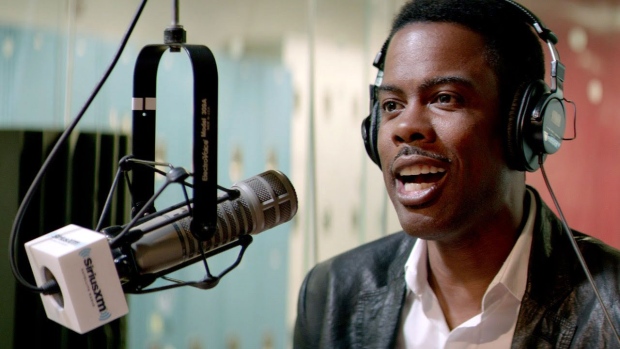
This weekend Chris Rock’s new comedy Top Five tells the story of Andre Allen, a fictional megastar trying to jump from silly comedies to Uprize, a serious drama about the slave revolt in Haiti.
Top Five is a new twist on an old story. Many comedians have tried to flick the switch from comedy to drama.
The late Robin Williams effortlessly hopped between genres. In 2002 alone he made three films, the lowbrow laffer Death to Smoochy, bookended by the psychodrama One Hour Photo and Christopher Nolan’s thriller Insomnia.
Will Ferrell, Steve Carell and Jonah Hill are best known for funny movies like Blades of Glory, The 40 Year-Old Virgin and Superbad, but each have stretched their dramatic muscles. Ferrell’s Stranger Than Fiction earned a good review from Roger Ebert who said Ferrell “has dramatic gifts to equal his comedic talent.” Carell’s new drama Foxcatcher looks poised to earn him notice at awards time and Jonah Hill is a two time Oscar nominee for heavyweights Moneyball and The Wolf of Wall Street.
Finally, think Jim Carrey and visions of talking butts and rubber-faced features come to mind but he made a serious run at being a serious actor. Perhaps he was pushed into more thoughtful work when his Batman Forever co-star Tommy Lee Jones told him, ‘I cannot sanction your buffoonery,” but whatever the case in movies like Man on the Moon, The Majestic and Eternal Sunshine of the Spotless Mind played it straight. “It’s going to be so hard to talk out of my ass after this,” he said when he won the Golden Globe for Best Actor award for The Truman Show, “but I’ll manage.”
What kind of goodwill does Bill Murray bring to “St. Vincent”? In the opening scene of the dramatic comedy from director Theodore Melfi, he tells the world’s worst joke—punchline, “That’s not a porch, it’s a BMW”—and still gets a giggle out of the audience.
Murray plays Vincent, a Sheep’s Head, New York guy whose life is in as bad a shape as his jokes. He’s usually drunk or trying to get drunk. His house is second mortgaged to the hilt, his bank account in overdraft and his only friends are a Himalayan cat and the pregnant working girl he pays for company. His new neighbors, single mom Maggie (Melissa McCarthy) and ten year old Oliver (Jaeden Lieberher) are a nuisance to him, until he discovers he can make a few extra bucks babysitting the boy. “Is that our new neighbor,” says Oliver when he first spies Vincent. “It’s going to be a long life.” The pair, however, form a bond. Vinnie passes along valuable life experience, like how to fight, bet on horses and order a drink in a bar, but when Oliver’s dad sues for co-custody it turns out Vinnie’s life lessons may have been ill advised.
There is a scene early on in “St. Vincent” showing Vinnie, head awash in booze, dancing, blissed out to “White Rabbit” on the jukebox in the back room of a seedy bar. It’s a great Murray-esque character study. With just a few drunken gyrations we figure out that Vincent does as he pleases. He always danced like no one was watching.
That’s the essence of the character, and those moments elevate “St. Vincent” from wacky-old-man movie to interesting character study. Murray is always watchable, interesting and reaching for the unexpected even in a movie as by-the-book as this. The story hits all the inspirational notes you’d expect from a movie about building an unconventional family and occasionally falters on the side of sentimentality but overrides the syrupy tone of the old man genre with a series of stand put performances.
Noami Watts is almost unrecognizable as Daka, a plainspoken, pregnant hooker with an impenetrable accent and, if not exactly a heart of gold, an affection for things made of gold. It’s a rare comedic role for her and she nails it, physically and emotionally.
As Maggie McCarthy takes a refreshing step away from her well established comedic persona to deliver a supporting role that has laughs but shows more of her range than we’re used to.
The film’s secret weapon, however, is the pairing of Jaeden Lieberher and Murray. Like Mutt and Jeff–although it’s not clear who is Mutt and who is Jeff, who is the child and who is the adult–they are a matched and balanced pair, with chemistry to burn. Their scenes together are the heart of the film and when they are separated the movie loses some of its appeal.
“St. Vincent” is more predictable than you might want from a Bill Murray movie. He usually makes left-of-centre choices, or at least puts a spin on the regular. The latter is true here, but Murray’s blissed-out dancing reverie and bad jokes are still worth the price of admission.
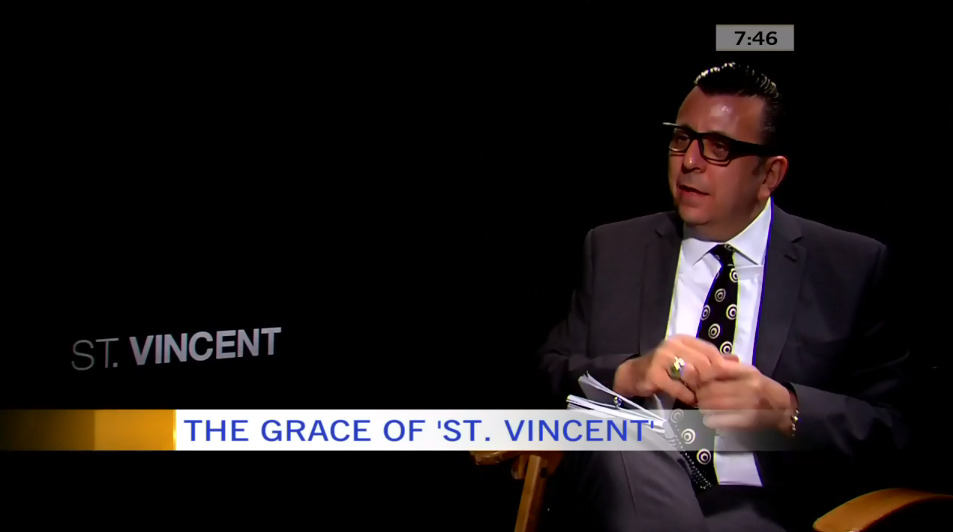
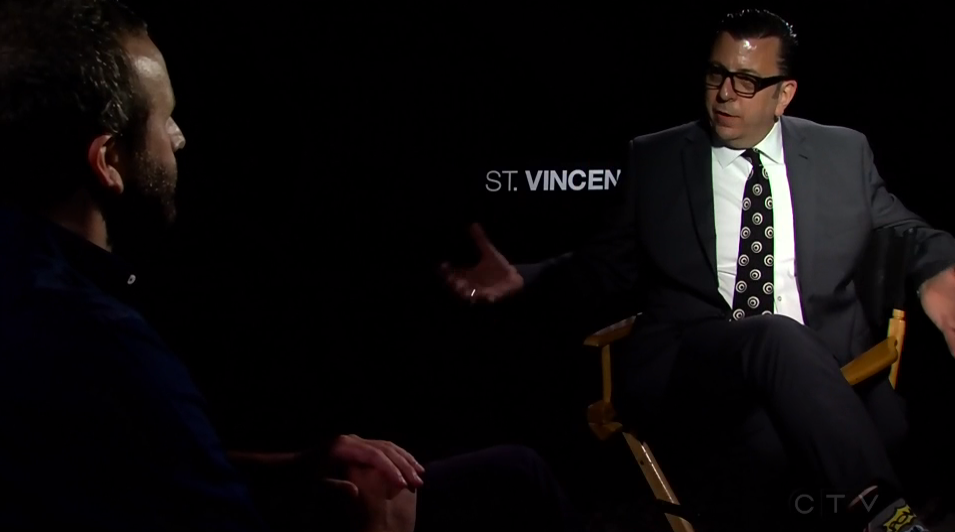
“Canada AM” Web Exclusive: Richard’s interview with “St. Vincent” star Chris O’Dowd.
A synopsis: Bill Murray plays Vincent, a Sheep’s Head, New York guy whose life is in as bad a shape as his jokes. He’s usually drunk or trying to get drunk. His house is second mortgaged to the hilt, his bank account in overdraft and his only friends are a Himalayan cat and the pregnant working girl he pays for company. His new neighbors, single mom Maggie (Melissa McCarthy) and ten year old Oliver (Jaeden Lieberher) are a nuisance to him, until he discovers he can make a few extra bucks babysitting the boy. “Is that our new neighbor,” says Oliver when he first spies Vincent. “It’s going to be a long life.” The pair, however, form a bond. Vinnie passes along valuable life experience, like how to fight, bet on horses and order a drink in a bar, but when Oliver’s dad sues for co-custody it turns out Vinnie’s life lessons may have been ill advised.
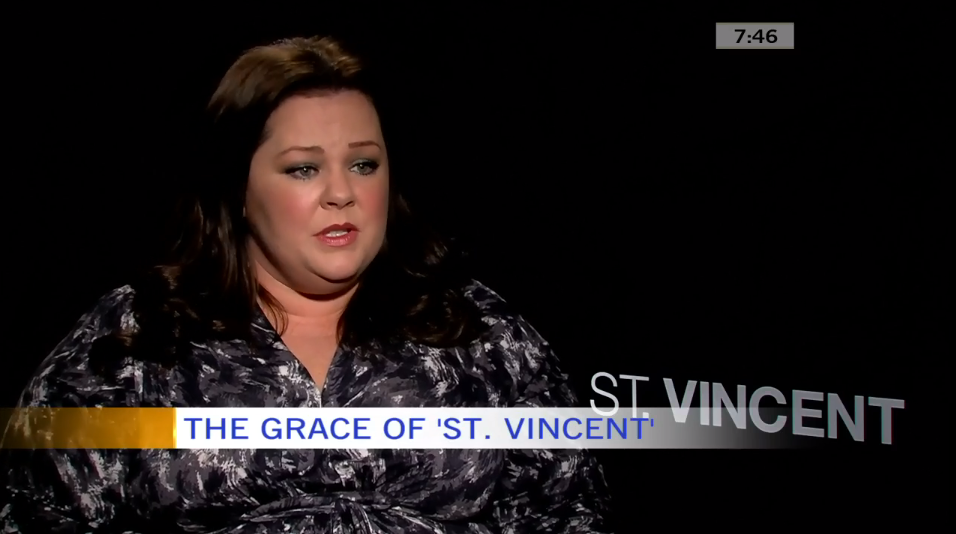
Richard’s “Canada AM” interview with “ST. Vincent” star Melissa McCarthy!
“[Bill Murray] is an icon. It’s less about him being one of the funniest human beings, and more about that he’s such a good actor. I thought this role was right in his wheelhouse because I knew he wasn’t going to overplay it. Then to see him do it so subtly and so underplayed, makes you love that character so much. It was a master class for me.”
Melissa McCarthy admits she was nervous to work opposite Bill Murray in St. Vincent.
“Is that not true for every human being?” she asks rhetorically, before adding she was intimidated, “in every possible way.
“He’s an icon. It’s less about him being one of the funniest human beings, and more about that he’s such a good actor. I thought this role was right in his wheelhouse because I knew he wasn’t going to overplay it. Then to see him do it so subtly and so underplayed, makes you love that character so much. It was a master class for me.”
The Bridesmaids star plays Maggie, a recent divorcee and mother of 10-year-old Oliver (Jaeden Lieberher). Her nursing job requires long hours and without daycare she is forced to leave the boy with her neighbour, the hard-drinking reprobate Vincent (Murray).
“I liked that she was stripped down,” she says. “There are no more tricks. She’s out of tricks. She’s just trying to survive.”
As Maggie, McCarthy takes a step away from her well established comedic persona to deliver a supporting role that has laughs but shows more of her range than we’re used to.
“I’ve played a lot of characters who are very vocal, very aggressive. It’s been what the character has called for, but even within those bombastic parts you still have to let that character touch down. Even in a bigger, straight comedy you always have that moment where something’s got to break. You see why they’re so loud. At least for the women I’ve played there is a reason why they are so ballsy and it is nice when you see the crack in the veneer and you realize, ‘It’s part of their insecurity. They stay loud so nobody yells at them.’ I think the same applies to this one, except that the character wasn’t putting on much of a facade. She was falling apart more openly and she had to buckle down and keep moving forward.”
St. Vincent is a character piece that showcases the actors — like co-star Naomi Watts as a plainspoken, pregnant hooker with an impenetrable accent and, if not exactly a heart of gold, an affection for things made of gold — but makes the point that families can be formed anywhere by anyone, even if one is a prostitute, one drinks too much and one spends too much time at work.
“It’s a lovely message that (director) Ted (Melfi) handled so beautifully, because it doesn’t feel sentimental,” says McCarthy. “It’s not like, ‘And now the message is …’ You just get the feeling in the pit of your stomach that you shouldn’t judge a book by its cover.”
Appearing in one of the movies! I was in Red Alert, a short that played before the movie Wet Bum. IT’s not enough that I cover 100 movies during the fest, now I have to be in them too! I even got a review. “@richardcrouse is great in Red Alert…” Mike Bullard wrote on twitter. “I’d like to tell you I didn’t know he was a redhead but I knew… I just knew ok.”
In person Benedict Cumberbatch’s voice sounds like hot melting wax. I liked Sherlock well enough and have seen him in several movies, but for me, and I know I’m the last to get it, his performance in The Imitation Game is a game changer. He plays real-life character Alan Turing, a Cambridge mathematician who volunteers to help break Germany’s most devastating WWII weapon of war, the Enigma machine. It was a top-secret operation, classified for more than 50 years, but that wasn’t Turing’s only secret. Gay at a time when homosexuality was illegal, punishable by jail or chemical castration, he was forced to live a world of secrets, both personal and professional.
Robert Pattinson telling me about how Hollywood was before camera phones: “When I first started going to LA everyone was underage and if you were a famous actor the rules did not apply. You could be a sixteen-year-old and go into a club but now that there are camera phones everywhere that doesn’t exist anymore. That period was so weird. You’d see a fourteen-year-old actor wasted, doing lines of blow on the table. It was crazy. Now they just do it at their parent’s house.”
Julie Taymore telling me that A Midsummer Night’s Dream “It was the first play I ever saw. I saw it here in Canada at the Stratford Festival…”
Michael Moore’s answer to my question about his reaction to all the celebrity he gained after appearing at TIFF 25 years ago with Roger and Me: Asked what was going through his head while all this was swirling around him, Moore says: “Why didn’t I go to Jenny Craig three months ago?”
“I don’t know where they are,” Kingsley says about his characters, “if they’re inside me waiting to come out or whether they are outside of me. Are they hunting me or am I hunting them? I don’t know.”
Repairing Dustin Hoffman’s watch. During a roundtable interview the alarm on his watch went off several times. He gave it to me and I looked up the instructions on how to fix it on Google. “How did it you look it up on line? They have instructions to fix Timexes on line? I don’t automatically go to those things,” he said. During the interview he said: “I was told to take acting. Nobody flunks acting.” Later he said that it wasn’t such a bad choice because, for instance, “No one ever says, ‘I want to be a critic when I grow up.’”
Lowlight… waiting for BIll Murray for seven hours. (Although I love this from @ZeitchikLAT: Bill Murray, offering implicit proof on the merits of Bill Murray Day: “If this is really my day, why do I have to do so much work?”)
Sitting next to next to Boo Radley, Bill Kilgore and Tom Hagan. (Robert Duvall!)
Most quotable actors of the festival? Robert Duvall who said, about acting, “There’s no right or wrong just truthful or untruthful.” He calls Billy Bob Thornton “The hillbilly Orson Welles…” and said “Brando used to watch Candid Camera.” Jane Fonda was a close second when she said acting is great for the heart but terrible for the nerves… “Butts have become more in fashion… (since Barbarella) and “Television is forgiving to older women and making it possible for us to have longer careers.”
“I have distilled socialism in this box and am taking it back to America.” – Robert Downey Jr in my roundtable interview.
#TIFF14 socks day 3. Chris O’Dowd called them “powerful.” and Rosamund Pike said, “I’m enjoying your socks. They make me happy.”
Watching “Whiplash” knock the socks off an audience at an IMAX P&! screening. It is part musical—the big band jazz numbers are exhilarating—and part psychological study of the tense dynamics between mentor and protégée in the pursuit of excellence. The pair is a match made in hell. Teacher Fletcher, played by J.K. Simmons is a vain, driven man given to throwing chairs at his students if they dare hit a wring note. He’s an exacting hardliner who teaches by humiliation and fear. This movie doesn’t miss a beat.
Love this quote: “Being in the military,” said Adam Driver of This Is Where I Leave You, “believe it or not, is very different than being in an acting school.”
The Toronto International Film Festival premieres some of the best movies across the globe and attracts some of the biggest names in Hollywood. This year is certainly no exception with expected appearances from Reese Witherspoon, Robert Downey Jr., Kristen Wiig, Bill Murray and more.
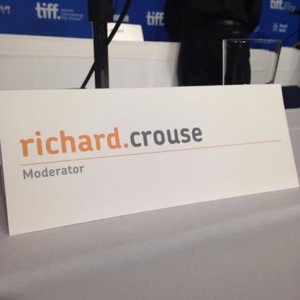
Each year we get the inside scoop on the hottest TIFF movie premieres from renowned Canadian critic Richard Crouse, an expert in what films to see…and what films to skip…
The tagline for Tom Cruise’s latest film is “Live. Die. Repeat.”
“How many times have we been here,” asks Rita (Emily Blunt). “For me, it’s been an eternity,” replies William (Cruise) as he relives the same day of an alien invasion over and over.
Edge of Tomorrow is a time-loop movie that can best be described as War of the Worlds meets Groundhog Day.
In Groundhog Day, Bill Murray says, “Every morning I wake up without a scratch on me, not a dent in the fender. I am an immortal.” His take on a drunk, suicide-prone weatherman who discovers the beauty of life by living the same day endlessly may be the granddaddy of all
Hollywood déjà vu stories, but many other movie characters have been caught in cinematic time circles.
The DVD cover for 2006’s Salvage asks the question, “What if every day you relived your own murder?” Originally called Gruesome for the festival circuit, the movie is as grim as Bill Murray’s film is life-affirming. Called a “digital video hell — spawn of Psycho, Eyes Without a Face and Groundhog Day,” by Variety, Salvage is the story of Claire (Lauren Currie Lewis), a convenience store worker who undergoes her murder over and over. Despite its extremely low budget — star Lewis doubled as the film’s make-up artist — Salvage was an official selection of the 2006 Sundance Festival.
The horror genre lends itself to time-bending tales. Camp Slaughter is a 2005 throwback to the slasher films of the 1980s. In this one, a group of modern teens stumble across Camp Hiawatha, a dangerous place where not-so-happy-campers are trapped in 1981 and forced to re-experience the night a maniacal murderer went on a killing spree. Labelled “Groundhog Day meets Friday the 13th (part 2,3,4,5,6,7,8… every one of them!),” by one critic, it’s gory good fun.
Not into gory? The Yuletide provides a less bloody backdrop for time-looping. The title Christmas Every Day is self-explanatory but 12 Dates of Christmas is better than the name suggests. Us Weekly called this Amy Smart romantic comedy about a woman stuck in an endless Christmas Eve, a sweet “nicely woven journey.”
Finally, the aptly named Repeaters is a Canadian film written by Arne Olsen, scribe of Power Rangers: The Movie. Repeaters is about a trio of recovering addicts who find themselves in “an impossible time labyrinth” after being electrocuted in a storm. Like most time-bending films, Repeaters is about learning from your mistakes. What sets it apart from some of the others are three unlikeable leads who use their situation to raise hell and break the law. It’s only when Kyle (Dustin Milligan) realizes they could be in big trouble if time suddenly unfreezes for them that familiar time-loop themes of redemption and self-reflection arise.