I join CP24 to talk about the reimagination of the classic gothic romance “Wuthering Heights,” the time travelling farce “Nirvanna: The Band The Show The Movie,” the nostalgic b-movie “Cold Storrage” and the drama “Sirāt.”
I join the CTV NewsChanel to talk about the reimagined “Wuthering Heights,” the time travelling farce “Nirvanna: The Band The Show The Movie” and the nostalgic b-movie “Cold Storage.”
I sit in with CKTB morning show host Steph Vivier to have a look at movies in theatres including the reimagined “Wuthering Heights,” the time travelling farce “Nirvanna: The Band The Show The Movie,” the nostalgic b-movie “Cold Storrage” and the drama “Sirāt.”
I sit in on the CFRA Ottawa morning show with host Bill Carroll to talk about the new movies coming to theatres including the reimagined “Wuthering Heights,” the time travelling farce “Nirvanna: The Band The Show The Movie,” the nostalgic b-movie “Cold Storrage” and the drama “Sirāt.”
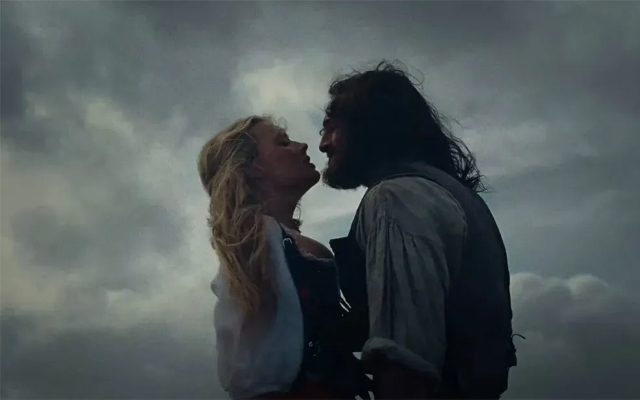
SYNOPSIS: “Moor, moor, moor. How do you like it?” “Wuthering Heights,” a reimagined take on Emily Brontë’s grand gothic tale of bodice-ripping and obsessive love, stars Margot Robbie and Jacob Elordi as lovers with an unbreakable bond. “Love twisted by time. Desire that won’t die.”
CAST: Margot Robbie, Jacob Elordi, Hong Chau, Shazad Latif, Alison Oliver, Martin Clunes, Ewan Mitchell. Directed by Emerald Fennell.
REVIEW: More (or should that be “moor”) explicit than previous iterations of the Brontë classic, Emerald Fennell’s take on the story is a study in how obsessive love can lead to ruin.
Set in the late 1700s, Charlotte Mellington plays Catherine Earnshaw, the young, free-spirited daughter of Mr. Earnshaw (Martin Clunes), a booze-hound who brings home an illiterate, orphaned boy (“Adolescence” star Owen Cooper) from the city to the family’s decaying Yorkshire estate. She names him Heathcliff, after her dead brother, and they form a fast bond.
Cut to years later. Catherine and Heathcliff, now played by Margot Robbie and Jacob Elordi, are head over heels but Cathy desires the kind of social standing Heathcliff cannot provide.
Despite Heathcliff’s promise to “follow you like a dog to the end of the world,” she marries the refined gentleman Edgar Linton (Shazad Latif), a handsome rich man but without the intensity that defined her relationship with Heathcliff.
Rejected and devastated, Heathcliff leaves the only home and real love he has ever known, only to return five years later, wealthy and with revenge on this mind. “Why did you leave me?” she asks. “Why did you betray your own heart?” he replies.
Simply put, Emerald Fennell, the director of “Promising Young Woman” and “Saltburn,” has turned “Wuthering Heights” into something best described as a light “Fifty Shades of Bridgerton.”
Despite a reputation for pushing the envelope, Fennell seems restrained here, save for a brief scene of bizarre doggie-style degradation and the worst consent scene ever committed to film. Those moments are memorable for the kind of provocation and boundary-pushing we expect from the director. For much of the film’s runtime, however, she’s on a low simmer, stuck somewhere between the Brontë’s melancholic passion and the director’s usual decadent discomfort.
As the young Catherine and Heathcliffe, Charlotte Mellington and Owen Cooper provide a proper setup for the soul-deep connection to come. When the characters grow up Robbie and Elordi bring intensity but the heartfelt spark that lit the flame of passion years before is replaced by a romantic appetite that manifests itself in cruelty and muddled motivations.
At its most basic, Catherine and Heathcliffe straddle the thin line between love and hate, not an uncommon romantic position, but Fennell confusingly blurs the line into a gaping incoherent hole.
Robbie and Elordi look the part of impossibly beautiful star-crossed lovers, and they share chemistry, but their thirst for one another feels skin deep, even as it grows obsessive and destructive.
Like its stars, “Wuthering Heights” looks lovely—opulent interiors, moody moors—but the reimagination of Brontë’s novel feels lackluster, unable to truly grasp the passion or the tragedy inherent to the original story.
SYNOPSIS: Based on a real event, “The Order,” a new true-crime drama starring Jude Law and now streaming on Prime Video, gruff Idaho-based FBI agent Terry Husk (Law) identifies crime activity in the Pacific Northwest that could be related to Bob Mathews and The Order, his white supremacist militant group.
CAST: Jude Law, Nicholas Hoult, Tye Sheridan, Jurnee Smollett, Alison Oliver, Odessa Young, Marc Maron, Huxley Fisher, Sebastian Pigott, Phillip Forest Lewitski, George Tchortov, Victor Slezak, Philip Granger, Daniel Doheny. Directed by Justin Kurzel.
REVIEW: Set in the early 1980s “The Order” is an unsettling film, made all the more chilling in our time of rising white nationalism and extremist militant groups.
Jude Law is firmly in character actor mode as the disheartened Husk. Still stinging from a broken marriage and stationed in a town where, as the local sheriff says, “the only crime around here is catching trout without a licence,” he’s paunchy and world weary, but while he may be burnt-out, he still has a burning desire to find justice.
He is a standard issue rumpled cop with a past and a depressing present. Even more standard is his sidekick squeaky-clean cop Jamie Bowen (Tye Sheridan). Both are terrific, but how many times have we seen an older, dishevelled cop paired with a younger go-getter?
Their match up may be conventional, but director Justin Kurzel keeps the action taut enough, and the violence visceral enough, to make up for the more familiar elements.
As Matthews, Nicolas Hoult is the disturbing face of extremism. In his reckless pursuit of a racial revolution, he stages risky robberies, bombs synagogues and kills at will. The robberies are meant to finance his plans for an uprising and his followers, who, like him, don’t think the Aryan Nations are hardcore enough in their beliefs, would follow him into hell.
His motives aren’t political as much as they are ideological, and as such, he is more a cult leader than a soldier but Hoult’s cool demeanour and chiseled good looks give his portrayal of the controlling but charismatic Matthews a terrifying edge.
In many ways “The Order” is a run-of-the-mill police procedural about two men, one good guy, one bad guy, who are willing to do anything for their cause. We’ve seen that before, but the way Kurzel builds tension and shines a light on the dark underbelly of white nationalism elevates the traditional plotting.
“Saltburn,” a dark comedy of manners starring “Priscilla’s” Jacob Elordi and Academy Award nominee Barry Keoghan and now playing in theatres, is a titillating “Talented Mr. Ripley” style tale of class, position and desire that is not afraid to get weird.
Keoghan is Oliver Quick, a shy “scholarship kid” at Oxford University who doesn’t quite fit in with his classmates. His jackets aren’t from Saville Row, he lacks their social graces and most notably, doesn’t come from oodles of cash.
When the handsome, gregarious and monied Felix Catton’s (Elordi) bicycle get s flat tire on the way to a tutorial, Oliver comes to the rescue and the odd couple become fast friends. Ollie isn’t exactly embraced by Felix’s well-heeled inner circle, who find him coarse, but they become tight, hanging out at the pub when they aren’t studying.
At the end of the term Felix asks if Oliver will go home for the summer.
“Honestly, home doesn’t mean the same thing for me as it does for you Felix,” Oliver says. “I don’t think I’ll ever go home again.“
His tale of woe, of growing up as the only child to a drunken father, moves Felix who invites him to spend the summer at Saltburn, his family’s palatial estate.
“Just be yourself,” Felix says. “They’ll love you. It’s relaxed. I promise.”
Except it’s not. It’s the kind of English country home that makes Downton Abbey look like a shack. Priceless art lines the walls, there are butlers and footmen, mandatory jackets at dinner and an oddball collection of aristocratic family members including Felix’s eccentric, self-absorbed father Sir James (Richard E. Grant), casually cruel mother Elspeth (Rosamund Pike) and troubled sister Venetia (Alison Oliver), who tells the newcomer, “You’re just another one of his toys.”
He may be a novelty, out of his depth, but Oliver is drawn to shiny things, the lives of the rich and famous, and will do anything to stay in that privileged world.
“Saltburn” isn’t just a study of the haves and the have nots, it’s a tale of the haves and unchained aspiration. Obsessed with the good life, Oliver will do bad things to get a taste of it.
Keoghan takes risks as the chameleonic Oliver. Whether he is vulnerable, hapless, or a menacing manipulator, the “The Banshees of Inisherin” actor chooses interesting ways to manifest Oliver’s state of mind. There may not be much beneath the surface, other than danger and avarice, but Keoghan, whether he is dancing naked through the grand home or lapping up bath water, keeps the performance and the audience off kilter.
Elordi allows just enough of Felix’s heart of gold to shine through his charming veneer to make the filthy rich character feel a little less dirty and Grant is perfection as the repressed upper-class twit at the head of the family, but it is Pike who steals every scene she’s in. Blessed with the film’s best lines, Elspeth has an off-hand, casual way with a barb that cuts like a knife. When she hears about a friend who has taken her own life, she snorts, “She’d do anything for attention.” These lines are often asides, not central to the action, but Pike makes them memorable.
Unfortunately, director Emerald Fennell, who also wrote the script, doesn’t mine the class satire for answers. She’s content with the black comedy, Oliver’s coldhearted desire and little else. The result is an entertaining film, but a mixed bag. It’s diverting, filled with over-the-top moments and plot twists, but at the end it feels less than the sum of its parts.
 I join CP24 to talk about the reimagination of the classic gothic romance “Wuthering Heights,” the time travelling farce “Nirvanna: The Band The Show The Movie,” the nostalgic b-movie “Cold Storrage” and the drama “Sirāt.”