Big monsters are back. Movies like “The Host” and “Cloverfield” have reintroduced audiences to that rarest, but biggest of beasts, the giant out-of-control monster. Who needs vampires and zombies when you could have a ninety foot tall squid with a bad attitude and a Christmas bulb for a head?
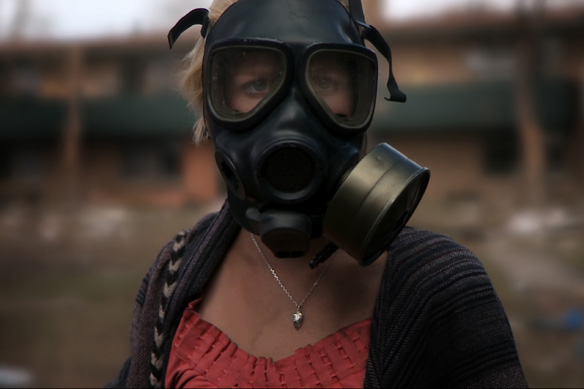
The latest addition to the big monster genre is “Monsters,” an indie movie that reportedly only cost $15,000. Part road trip, part romance and all atmosphere, the story of Andrew (Scoot McNairy), an opportunistic photojournalist, who must escort his boss’s daughter, Sam (Whitney Able), back to the U.S. border through the treacherous quarantine area inhabited by… you guessed it, giant creatures left there when a NASA space craft carrying samples of extraterrestrial life crashed.
It’s a pure b-movie premise and for the first fifteen minutes or so promises to be little more than a Roger Corman film with better CGI. Then something happens. The movie becomes about the relationship between total opposites Andrew and Sam as they bond over their trip’s hardships and the strangeness of their surroundings. It’s a giant monster movie that focuses on the characters and despite some wild plot contrivances, it works.
The character study is a slow burn that leads up to the big reveal, the unveiling of the creatures. For most of the film they are seen and not heard but director Gareth Edwards paces the film carefully building up suspense through use of sound effects to climax with a wild mating dance between two of the Lovecraftian beasts. It’s a strangely beautiful and eerie sequence that brings the movie to a close.
“Monsters” isn’t as effective as “District 9” or “Cloverfield,” two other recent movies that introduced us to new creatures, but it is a complex film with timely messages about immigration (the US is protected by a giant fence to keep the monsters out) and our reactions in times of danger.
Horror fans must have an almost permanent feeling of deja vu these days. It seems that the horror films that we grew up with in the 1960s and 70s, like The Amityville Horror, Dawn of the Dead, The Fog and The Texas Chainsaw Massacre, are all being re-made, which makes the new releases list in the newspaper occasionally seem like it came from the Twilight Zone.
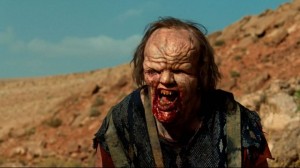
The latest cult horror film to find a new life in 2006 is The Hills Have Eyes, the 1977 Wes Craven film that gave us the immortal line, “We’re going to be French fries! Human French fries!”
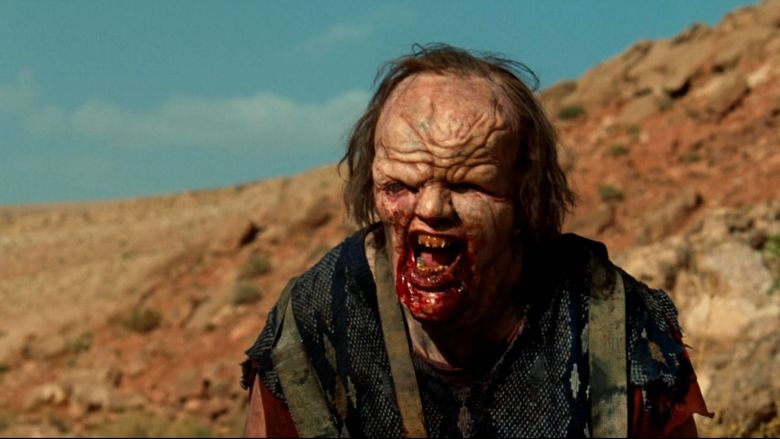
The 2006 version is directed by the French director Alexandre Aja who gave us the deeply unpleasant, but rather effective thriller High Tension last year. For the most part Aja takes his lead from the original film about an unfortunate family of vacationers who get stranded in desert of New Mexico, falling prey to mutant cannibalistic hillbillies. The bad guys are descendents of miners who worked in this remote location and continued to live there even after the government started testing nuclear bombs in their backyard. A generation later they have mutated into some very unpleasant creatures with bad tempers and a taste for human flesh.
Aja’s version takes one major liberty with the source material. In the original Craven established that the mutants, although they were evil, were a family. In fact they mirrored the poor family they were terrorizing—all American verses Americans all messed up by their own country’s experiments. I thought the contrast was one of the strong points of that film and lent a tone of social commentary about nuclear testing to the piece.
Aja forgoes social comment for shocks, and although he takes his time getting to the hard-core action, once the thrills arrive they’re worth the wait. This movie is not for the easily disturbed or the faint of heart, but if you like your scares gruesome and fast paced the Hills Have Eyes is for you.
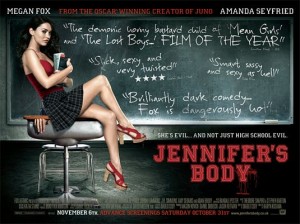
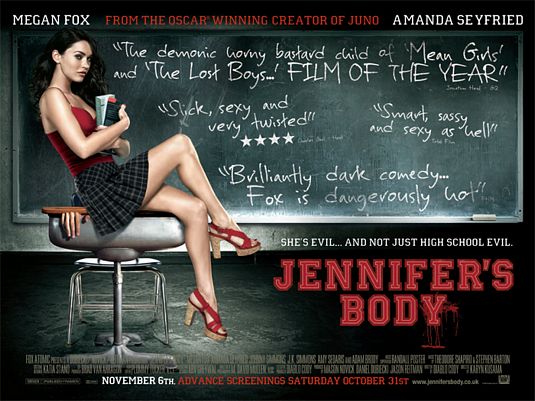
The pitch for “Jennifer’s Body” is certainly attention-grabbing. Mix “Transfomer’s” sexpot Megan Fox and “Juno” screenwriter and all round “it’ girl Diablo Cody and the result should be pure gold. Well, pure gore splattered gold in this case. “Jennifer’s Body” leaves behind the world of giant robots and pregnant teens for a bloody story about demonic transference and a cheerleading succubus who feeds on the intestines of teenage boys.
Despite its name the town of Devil’s Kettle, Minnesota is not a demonic hot spot. Not at least until a rock band named Low Shoulder plays at a local bar. At the concert are Jennifer Check (Fox) and Needy Lesnicky (Amanda Seyfried). Best friends since they were kids the underage girls are there to check out the band, and in Jennifer’s case, specifically the lead singer. When a fire breaks out in the bar, chaos ensues and as most of the concert goers are trapped inside, Jennifer and Needy make it out, but something is isn’t right. Jennifer is glassy eyed and unresponsive, and when Needy last sees her, in the band’s van. Later, when Jennifer comes back to visit Needy she isn’t so pretty anymore—unless blood covered, tar vomiting girls turn you on. Something has happened to Jennifer, but what? When boys from school start to go missing Needy thinks she might know…
“Jennifer’s Body” breathes the same air as the great Canadian horror film “Ginger Snaps.” Both are inventive takes on established horror mythology—in Ginger’s case it was the werewolf legend here it is demonic possession—both feature humor and lots of blood and guts. But—you had to know there was a “but” coming—where “Ginger Snaps” had effortless dialogue that sounded like real teenagers talking to one another, “Jennifer’s Body” is weighed down by the overly cute pen of Diablo Cody.
In Cody’s world teens talk as though they have Hollywood screenwriters feeding them lines. Oh wait! They do. They drop sparkling bon mots as easily as Dorothy Parker after her fifth martini in the Oak Room. Cody’s characters don’t get jealous, they get “jello;” they don’t feel ill they feel “boo hoo,” and when they curse they say things like “cheese and fries.” I’m all for inventive language but much of the dialogue here seems to be trying a bit too hard.
Cudos to Cody though for coming up with an inventive story and peppering the script with laughs. When she describes one of the creature’s victims resembling “lasgna with teeth,” when they found him it’s funny. It’s dark humor reminiscent of the horror comedies of the 1980s like “An American Werewolf in London” and “The Toxic Avenger” that covered the laughs with lots of red stuff.
At the heart of “Jennifer’s Body”—or should that be soul?—is Megan Fox. As the victim of a botched satanic ritual—they apparently don’t work if the sacrifice isn’t a virgin—she seems to be having more fun here than in either of the “Transformers” movies, but despite being this year’s Zeitgeist grabber she’s upstaged by Amanda Seyfried. Only in a movie like this could Seyfried be portrayed as the “dorky, plain girl.” I guess it’s because she wears glasses, but there is nothing dorky or plain about Seyfried or her character.
“Jennifer’s Body” is bound to grab a teenage audience—the gratuitous kissing scene between Fox and Seyfried alone is bound to sell tickets to many a seventeen-year-old boy—but despite being an enjoyable bit of fun, likely won’t have the same impact as Cody’s attention grabbing work on “Juno.”
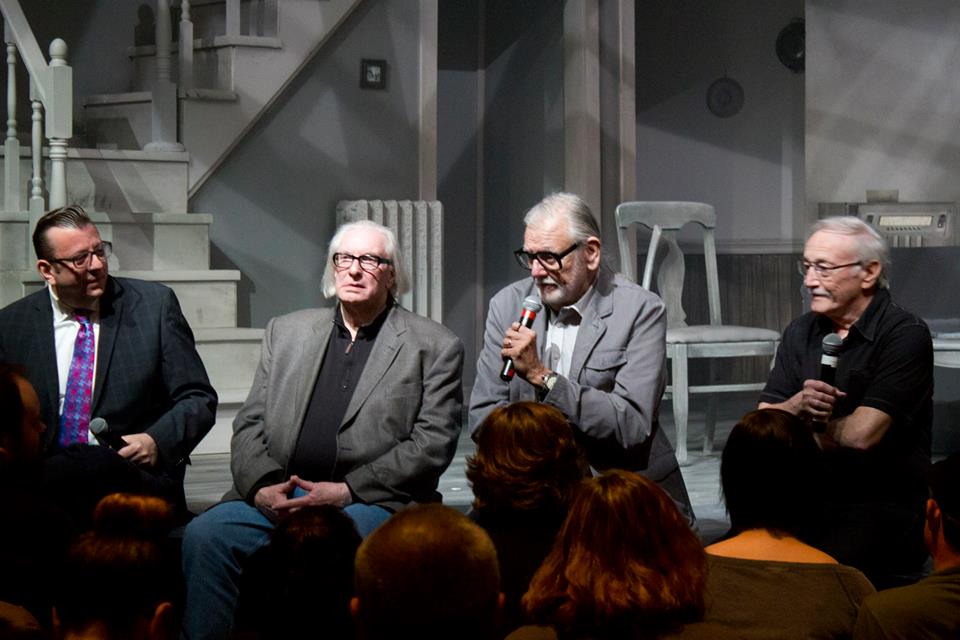
Here’s a shot from the Q&A Richard hosted with the “Knights” of the Living Dead (from left to right) Russ Streiner, George A. Romero, and John Russo after the October 19, 2013 performance of “Night of the Living Dead Live”! Thanks to John Migliore for the photo!
Here’s a shot from the Q&A Richard hosted with the “Knights” of the Living Dead Russ Streiner, George A. Romero, and John Russo after the Oct 19, 2013 performance of “Night of the Living Dead Live”! Thanks to John Migliore for the photo!
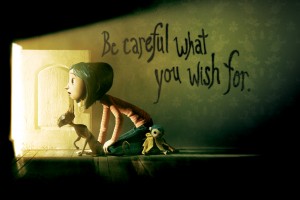
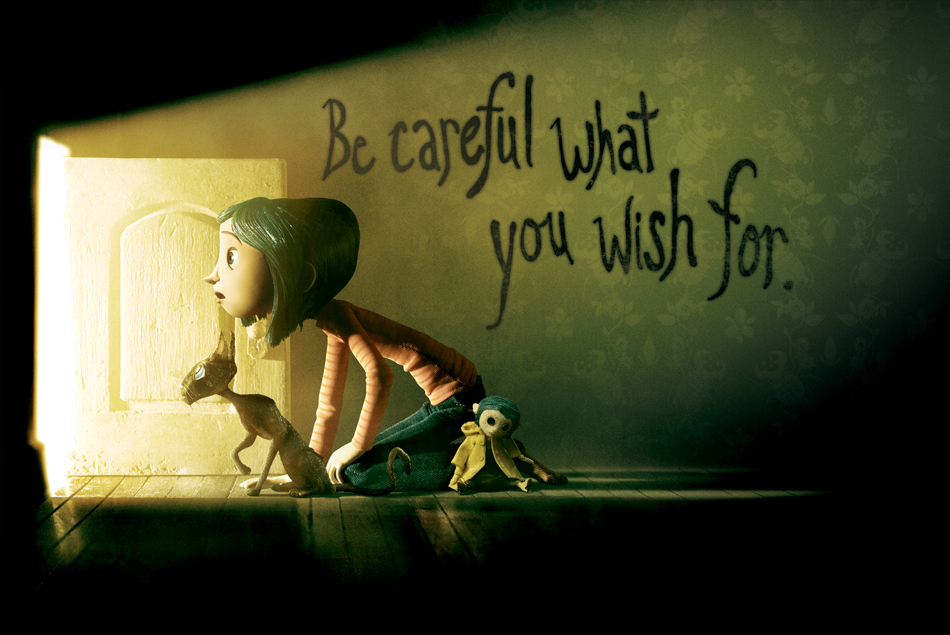
In olden days fairy tales were not meant for children. Until The Brothers Grimm came along, and despite their ominous sounding name, cleaned up folkloric tales like Snow White and Sleeping Beauty by removing all the sex and most of the violence, fairy tales were best told after the kids went to bed. So it is with Coraline, a new animated movie based on the Hugo Award-winning book by Neil Gaiman. On the surface it looks like a kid’s movie with stop motion animation and a young central character, but make no mistake this is a PG13 movie filled with creepy images that could send the little ones straight from the theater to the psychiatrist’s couch.
Coraline’s (the voice of Dakota Fanning) journey into a strange and scary new world begins when her parents (Teri Hatcher and John Hodgman) rent an apartment in a peculiar house called The Pink Palace. Upstairs in the attic is circus performer Mr. Bobinski (Ian McShane) and his troupe of musical mice. Downstairs are a pair of retired actresses, Miss Forcible (Jennifer Saunders) and Miss Spink (Dawn French), who share their apartment ith a menagerie of Scottie dogs, some alive, some stuffed. Despite the colorful neighbors Coraline is bored. Her parents neglect her and the only other kid in the neighborhood is the weeby Wybie Lovat. Things get more interesting when she discovers a mysterious door hat leads to a mirror reality, an eccentric Alice Through the Looking Glass world, where er parents pay attention to her and life is interesting. It isn’t until things take a dark turn hat Coraline realizes she may never escape the eerie Other World and return home to her eal parents.
I’ll say it again, despite Coraline’s storyline about a young girl trying to find her way back to her parents and the animation, (it’s the first stop-motion animated feature to be originally filmed in 3D), this is not a movie for little kids. The New York Times called the novel “one of the most truly frightening books ever written” and while the movie tones down some of the scares for the big screen, it is still a chilling ride.
Visually it’s a cross between Pee Wee’s Playhouse and the gonzo caricatures of Ralph Steadman. Director Henry Selick, the brains behind James and the Giant Peach and The Nightmare Before Christmas, has created two unique worlds: Coraline’s mundane day-to-day world and the heightened existence she has behind the mysterious door. Both are flights of fancy, from a garden that recreates Coraline’s face to the marching mouse band. Rendered with great imagination and beauty by Selick and his team the film is pure cinematic eye candy.
Luckily the story equals the surreal imagery. Coraline’s journey to the dark mirror image of her life is effectively scary not because it offers a thrill a minute but because it plays on primal fears, the dread of being abandoned, the unknown and claustrophobia. These basic feelings form the backbone of the story and the inventive visuals and nice voice work from Dakota Fanning and the supporting cast do the rest.
Coraline is the rare animated film that succeeds both as mainstream entertainment and art
“One is always considered mad, if one discovers something that others cannot grasp.” — Dr. Eric Vornoff (Bela Lugosi)
Ed D. Wood Jr.’s legacy as the Holy Grail of cinematically challenged is unfair. Writing in the 1980 book The Golden Turkey Awards film critics Michael and Harry Medved singled out his movie Plan 9 from Outer Space in the Worst Movie Ever Made category while also hanging the title of Worst Director around his neck. Since then his name has been synonymous with failure and ridicule.
To be sure Mr. Wood was no Cecil B. DeMille, but he doesn’t deserve the critical sneers leveled at his work. Certainly movies like Glen or Glenda and Jail Bait were restricted by their über-low budgets and appear hopelessly amateurish, littered by ridiculous special effects and melodramatic acting, but they are entertaining and isn’t that what it’s all about? Many directors have spent a lot more money and not come close to delivering the same kind of giddy fun that The Sinister Urge pulsates with.
Take Michael Bay for instance. His movies make loads of money at the box office, but never fail to put me to sleep. Visually his films are spectacular feasts for the eyes. The former commercial director has a knack for making everything look shiny but having great taste doesn’t make a great film director any more than great taste makes a Snicker’s bar a gourmet meal.
To my mind the difference between Ed D. Wood Jr. and Michael Bay is simple. Wood’s films are inexpertly but lovingly made by someone who is desperate to share his vision. Bay’s big glitzy movies feel like cynical money grabs more concerned with the bottom line than personal expression. I’m quite sure that if Bay had to undergo the trials and tribulations Wood had to suffer to get his movies made he would run to the hills, or maybe just back to his big house in the Hollywood Hills.
Even though his enthusiasm usually trumped his capabilities Wood was a true artist, a true pioneer of the indie spirit; someone who fought tooth and nail to present his vision and no matter how cockeyed that vision may have been he believed in it and his ability to capture it on film. In time this Hollywood-outsider developed a unique Do-It-Yourself style akin to folk art; crudely crafted pieces that radiate with the passion of the artist.
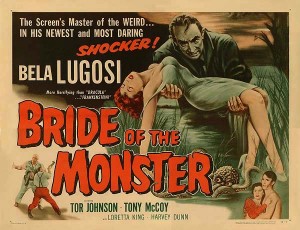
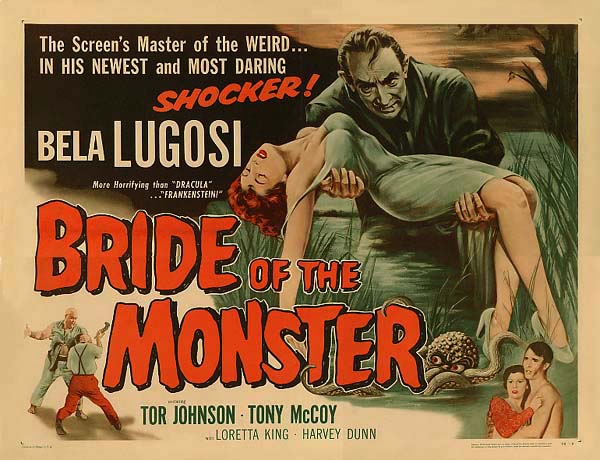
One of his lesser known films, 1955’s Bride of the Monster, predates Plan 9 from Outer Space, but is cut from the same cloth.
Wood claimed the idea for the film came to him in a dream. “I keep a pencil and pad beside my bed at night because many a dream turns out to be a good plot,” he said. “That’s where Bride of the Monster came from, although it was first called Bride of the Atom.”
The story is credited to Wood and producer Alex Gordon, who disputes Wood’s dream-state inspiration for the film, claiming it was his script and he “got Eddie involved to polish” to make it more appealing to its star Bela Lugosi. Whatever the case, it contains all the earmarks of a Wood production, the strange stream-of-consciousness dialogue, bizarre editing, inappropriate use of stock footage and a story that almost, but doesn’t quite make sense.
Lugosi, in his last speaking role, plays Dr. Eric Vornoff, a mad scientist trying to create a race of atomic supermen. With his beefy assistant Lobo (Swedish wrestler Tor Johnson, who at 6’3’’ and 300 pounds was so large that when he was on the road he frequently stole toilet seats from hotels to replace the ones he broke at home) the doctor has been terrorizing the woods around Lake Marsh, kidnapping people to use as guinea pigs in his twisted experiments. He needs a steady supply of victims because the high dose of radiation needed to transform them into mutants usually kills them. (His success rate might have something to do with the equipment he’s using. His “high-tech” radiation zapper looks suspiciously like a photographic enlarger hanging from a mike stand and topped with a salad bowl.)
There’s a twist when an old colleague of Vornoff’s shows up to kidnap him and take him to the USSR. It seems Vornoff first hatched his plan to raise an army of nuclear giants while he was working for the Russian government. They thought the plan was outlandish and ran the mad scientist out of the country. Now they want him back and he doesn’t want to go. When the Russian pulls a gun Lobo saves his master’s life by subduing the agent and feeding him to a giant octopus.
The Russian isn’t the only unwelcome visitor. Janet (Loretta King) a cub reporter has been snooping around. Worse, she’s the girlfriend of Lt. Craig (Tony McCoy). Lobo finds her and brings her to Vornoff who prepares to experiment on her. He’s interrupted by Craig who has been searching for his lost girlfriend. Once again Lobo uses his muscle to diffuse the situation when he grabs Craig from behind and chains him to a wall.
Vornoff continues his evil experiment on Janet, but something has changed. Lobo has developed a crush on the girl and just as the scientist is about to pull the switch that may well kill Janet, Lobo pounces on him and straps him to the table and zaps him with the lethal juice. Instead of killing the doctor the rays work and he is turned into an atomic superman. The experiment is finally a success! The doctor overpowers Lobo, grabs Janet and makes a break for the woods. With the police in hot pursuit he must avoid capture, but he really should be more worried about that giant octopus.
Like all of Wood’s movies Bride of the Monster seems a little disjointed. Continuity is non-existent, the editing is peculiar and the ending is a bizarre non sequitur that involves a massive nuclear explosion. All of these shortcomings can be explained away, however, by Wood’s budgetary problems — one colleague said that Ed Wood made Roger Corman look like a big spender — and fractured production schedule.
The movie, which should have taken the director no more than 20 days to shoot, actually became a sprawling start-and-stop marathon which dragged on for just over a year. Wood would raise enough cash to shoot ten or fifteen minutes of film, run through that money and shut the production down. Every few weeks he’d move to a new studio leaving behind a trail of burned investors. Finally, a man named Donald McCoy stepped in with enough funds to complete the film. McCoy’s money, however, came with two caveats. First he wanted his son Tony, an actor Wood later called “the worst I ever had,” to play one of the leads and he insisted that the movie literally end with a bang.
The money man convinced Wood to include the from-out-of-the-blue nuclear blast ending as a message against the American-Russian Nuclear Arms Race. Wood, desperate to finish the movie, agreed on both counts.
Despite the film’s weaknesses the presence of Bela Lugosi elevates the proceedings. Lugosi, who, in 1931 had become a major movie star — it was rumored that after the release of Dracula he received more fan mail from females than Clark Gable — was on the skids. Drug addicted, near broke and frail he was working for $750 a day, a sum, Wood pointed out, that was more than he made for Dracula. He may have been in poor health, but the 73-year-old came alive when the camera rolled.
Wood utilizes some of the classic Lugosi moves from past movies — the tight hypnotic close-ups of his eyes and the sinister double-jointed finger movements are pure Dracula — and takes full advantage of Lugosi’s menacing aura. Parts of the performance are, of course, ridiculous. For instance, the platform shoe–wearing body double who battles Lobo clearly isn’t Lugosi.
The famous octopus battle scene, Lugosi’s final scene in the film, has become the stuff of indie film legend. According to legend Wood “borrowed” the cephalopod (originally seen in the John Wayne film Wake of the Red Witch) from the props storage vault at Republic Studios. Trouble is he forgot to liberate the motor which operated the giant beast’s tentacles. When it came time to shoot Lugosi was simply lowered down on top of the creature in freezing cold water and told to wave the tentacles in the air, simulating a life-or-death struggle. Lugosi heroically thrashes about with the gigantic beast, but the limitations of a 73-year-old man trying to manipulate the octopus puppet are painfully obvious. “When we got through with the scene, he drank a whole bottle of Jack Daniels just to get warm,” said Wood.
Another often cited gaffe, however, is unfounded. It’s been widely suggested that Lugosi, saying his lines through a haze of alcohol and drugs, says in one scene that Lobo is as gentle as “a kitchen.” Actually, the line is “gentle as a kitten” and that’s exactly what he says, though filtered through his heavy Romanian accent.
Lugosi’s legacy suffered over the years. His low rent work with Wood and others tarnished his reputation, but it was a film made after his death that may have left the most lasting and erroneous impression about the man.
Tim Burton’s 1994 film Ed Wood sees Martin Landau play Lugosi as a bitter, foul mouthed man with a grudge against Boris Karloff. In the film he calls Karloff a variety of names, including “limey cocksucker.” Never happened, according to Forrest J. Ackerman. The founder of the Famous Monsters of Filmland magazine and a friend of Lugosi told me in 1995 that “he was a real European gentleman. I never heard him say so much as a hell or a damn and they [Ed Wood filmmakers] had him uttering these scatological things about Boris Karloff that he never would have uttered in real life. I don’t think he even knew the term ‘limey’.”
Bride of the Monster isn’t as well known as Wood’s masterpiece Plan 9 from Outer Space, but is equally enjoyable. Michael Bay fans may not get it, but connoisseurs of outsider art certainly will.
They grow up so quickly, don’t they? One day they are slimy bipedal creatures who look like a cross between Yul Brenner and a slug, the next they are flesh eating, underwater breathing alien looking supermodel types. At least that’s the way it is in “Splice,” a new sci fi thriller starring Sarah Polley and Oscar winner Adrien Brody, about a creature who goes from newborn to troubled teen in a matter of weeks.
Clive (Brody) and Elsa (Polley) are bio chemists (and boyfriend and girlfriend) who develop a splicing technology which binds the DNA from multiple animals to create new life and, possibly, cures for everything from Parkinson’s to cancer. It’s the medical breakthrough of the century. The next logical step is to fuse human and animal DNA but despite their success in the lab, their employers, the evil conglomerate Newstead Pharma, is wary of the publicity such a radical step would incur. Secretly the pair go rogue, continue their experiments, and give “birth” to a new life form they dub Dren (that’s “nerd” backwards), a tailed creature resembling a bald dinosaur. Clive, conflicted by the ethical and moral issues of cloning, wants to kill the creature but Elsa won’t have it. “Human cloning is illegal,” she says, “but this won’t be entirely human.” Dren develops at a rapid pace, changing from unrecognizable organism to something akin to a humanoid kangaroo. Soon though problems arise. The creature becomes Daddy’s little… whatever, leaving Elsa to deal with Dren’s difficult puberty.
Like the hybrid creature at the center of the action “Splice” is a cross of genres—part b-movie sci fi and part body horror à la David Cronenberg. Liberally mixing “The Island of Dr. Moreau,” “Frankenstein” and “The Brood,” “Splice” examines ideas of life and death, of playing God, of what is human (and what is not) and even touches on Woody Allen style relationships. There are plenty of moral concepts to chew on, many ruminations to be had on what it is to be human, but only if you look past the b-movie thrills director Vincenzo Natali slathers on with a trowel.
Splice goes places that bigger budget science fiction wouldn’t dare to tread. This isn’t the enviro-friendly sci fi of James Cameron or the space opera of George Lucas. No, this has more in common with the exploitation films of Roger Corman. There’s an icky creature, some scientist sexy time and loads of crazy science. Corman might not have been as successful at layering in the love, jealousy and real human emotions Natali heaps on his characters but I think the b-movie king would approve of “Splice’s” overall tone. It’s doesn’t skimp on the blood and guts but it’s funnier than you think it is going to be, wilder than expected—Sarah Polley’s maternal instincts towards Dren are right out of “Mommie Dearest”—and takes several unexpected twists and turns.
“Splice” is giddy good fun, the rare sci fi flick that revels in its b-movie roots while also offering up something to think about over a beaker of coffee afterward.
Richard Crouse interviews Liisa Ladouceur author of How to Kill a Vampire: Fangs in Folklore, Film and Fiction.
Citing examples from folklore, as well as horror films, TV shows, and works of fiction, this book details all known ways to prevent vampirism, including how to protect oneself against attacks and how to destroy vampires. While offering explanations on the origins and uses of most commonly known tactics in fending off vampirism, the book also delves much deeper by collecting historical accounts of unusual burial rites and shocking superstitions from European history, from the “real” Serbian vampire Arnold Paole to the unique Bulgarian Djadadjii, a professional vampire “bottler.” It traces the evolution of how to kill the fictional vampire—from Bram Stoker’s Dracula and the Hammer horror films beginning in the 1950s to Anne Rice’s Lestat and the dreamy vamps of Twilight, True Blood, and The Vampire Diaries—and also celebrates the most important slayers, including Van Helsing, Buffy, and Blade. In exploring how and why these monsters have been created and the increasingly complex ways in which they are destroyed, the book not only serves as a handy guide to the history and modern role of the vampire, it reveals much about the changing nature of human fears.
 Big monsters are back. Movies like “The Host” and “Cloverfield” have reintroduced audiences to that rarest, but biggest of beasts, the giant out-of-control monster. Who needs vampires and zombies when you could have a ninety foot tall squid with a bad attitude and a Christmas bulb for a head?