Jack Brooks: Monster Slayer provides a welcome break from horror’s gorno trend—that’s gore-porn for the uninitiated—of the last few years. This Canadian made chiller has more to do with the bloody fun of Sam Raimi’s Evil Dead and Stuart Gordon’s Re-Animator than the recent movies which used saws or thrill seeking torture tourists as major plot points.
When we first meet Jack Brooks he is a small child enjoying a camping trip with his parents and sister. As Bobby Darin’s Beyond the Sea plays on the radio the family dances and enjoys the great outdoors… until a monster attacks and brutally kills everyone but Jack.
Flash forward to Jack’s (Trevor Matthews in what can best be described as the Bruce Campbell role) early twenties. He’s a plumber with a bad relationship, repressed memories and an anger management problem that makes Adam Sandler look well adjusted. His life changes forever when he tries to fix his college professor’s (Robert Englund) old, rusted pipes and accidentally unleashes a demonic power.
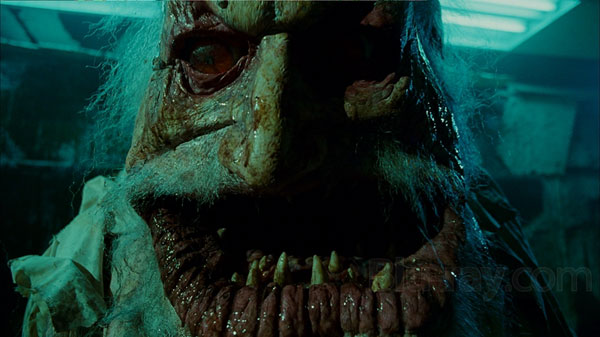
The kindly old professor is the first victim of the Jack’s discovery when he becomes possessed by the evil force and transforms into Professor-zilla. While battling with his former professor’s monstrous makeover Jack comes to grips with his troubled past and puts down his wrench and roto-rooter to pursue his true calling—monster slayer.
Jack Brooks: Monster Slayer has cult hit written all over it. Breathing the same fetid air as genre classics Dead Alive and Demons, it has all the earmarks of a midnight movie in the making—humor, a tormented anti-hero, crazy creatures, gallons of guts and goo crowned by an over-the-top performance from horror legend Robert ‘Freddy Krueger’ Englund.
The film takes a tad too long to really kick into gear but compensates for its slow start with good performances, fun old-school latex monster effects—no CGI!—and an energetic twenty-minute coda featuring Jack’s hand-to-hand combat with a variety of metamorphosed monsters. It’s a wild ride that should have audiences whooping along as Jack whoops the bad guys.
Jack Brooks: Monster Slayer is a throw back to the creature features of the 1980s that served up the scares with a smile.
“Rubber” is an odd movie. It’s become fanboy-fashionable to rave about the story of a killer tire—yes, you read that right—with psychokinetic powers—think “Carrie” with treads—who terrorizes the American southwest and I’ll throw my hat in the ring, but only to a certain point. Writer/director Quentin Dupieux begins the film with an existential manifesto, an ode to the “no reason” element he says is crucial to the success of any movie.
“In the Steven Spielberg movie E.T, why is the alien brown? No reason,” says Lieutenant Chad (Stephen Spinella) in the film’s opening minutes. “I could go on for hours with more examples. The list is endless. You probably never gave it a thought… but all great films, without exception, contain an important element of no reason.
The speech, while entertaining, is a dodge that allows the director to present all the story’s bizarre twists with a straight face but it is kind of disingenuous. Of course there is a reason why the tire comes to life and kills people. Just like there is a reason why there is a group of people in the desert watching the tire’s killing spree through binoculars as though they are watching a movie. I could go on for hours with more examples, to quote Lieutenant Chad, but you get the point.
It’s an absurdist tract on how and why we watch movies, what entertainment is and the movie business, among other things. But frankly, mostly it’s about a tire rolling around the desert and while there is something kind of hypnotic about watching the tire on its murderous journey—think “Natural Born Killer” but round and rubbery—that doesn’t mean “Rubber” is a good movie. For all its subtext, style and audacious storytelling it is still essentially a cool short film idea stretched beyond comfort to 82 minutes (with credits).
“You may come and go, but you will not take people from the city. If I hear of it, a single time, I will destroy you without salvation.” — Tada Cuda (Lincoln Maazel)
Imagine George A. Romero going to a psychic early on in his career.
“There’s good news and bad news,” she might say, gazing into her crystal ball. “Which would you like first?”
“The good news,” the Dawn of the Dead director would reply.
“You will make many movies . . .”
“That’s great! What’s the bad news?”
“The only ones people will go see all have the words ‘of the Dead’ in the title.”
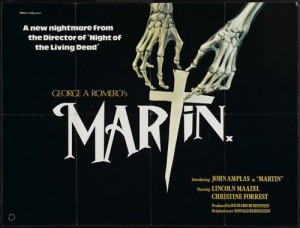
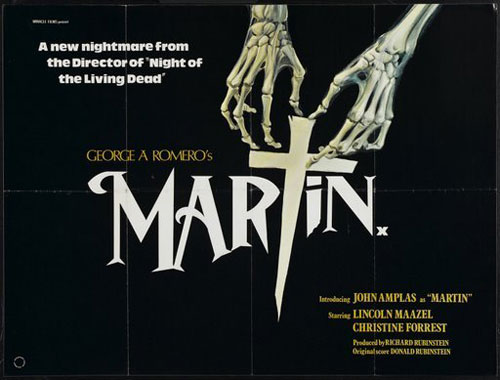
That didn’t happen of course, but the fact remains that zombie king Romero has had a rough time attracting audiences for his non-Living Dead efforts. Dig deep into the Romero bargain bin, though, and there are a number of films that deserve a second look. The Crazies is a spooky thriller about a manmade combat virus that causes death and permanent insanity in those infected while Knightriders is a wild romp that can best be described as The Legend of King Arthur meets Mad Max. Best of all is Martin, an arty 1977 movie about a young man who believes he is a vampire.
The eponymous creature of the night, Martin Matthias (played by Dawn of the Dead casting director John Amplas), is a shy suburban teenager with a blood lust, but none of the usual trappings of the Nosferatu. Instead of fangs he uses razorblades and needles to do the dirty work and he isn’t averse to garlic, sunlight or crucifixes. Despite no actual proof of his undead status, he is steadfast in his conviction.
Surprisingly he’s not alone in his belief. Cuda (Lincoln Maazel), an elderly old-world cousin believes that vampirism is a family “shame” and makes it his calling to save Martin’s soul by trying to arrange an exorcism with the local priest. He also takes the boy in and gives him a job at his neighborhood grocery store, but Martin can only control his cravings for so long.
Martin actually has more in common with Taxi Driver than it does with Dracula. Romero’s films have always brimmed with social commentary, but his 70s work is especially ripe with societal resonance. In Martin he filters the post-Vietnam ills of drug addiction and urban decay through the lens of a vampire film, focusing on the reasons why Martin behaves the way he does and not the behavior itself. Compared to other horror films this one barely qualifies as a shocker. There are just three violent scenes and while they are bloody, the gore is used more as a measure of Martin’s ineptness — his sloppy killing skills — than to scare.
Often labeled as horror, it’s more accurate to call Martin a psychological drama as Romero spends the entire film flirting with the question of whether Martin is really a vampire, or just a drug addict with a vivid imagination. Eerie black and white flashbacks portray him as an undead creature, but the reality is a much different story. With these black and white sequences Romero muddies the water, never settling on a definitive answer, preferring to let the viewers decide for themselves whether there are supernatural forces at work, or if this is all the product of a diseased mind.
In Romero’s world the notion that Martin might not be a vampire is scarier than if he was a certified bloodsucker. Romero uses the troubled mid-’70s and its products — drug-addicted youths, decaying cities and stultifying suburban life — as a catalyst for the kind of fantasy world Martin creates just to cope with his life. This reality, Romero seems to imply, is far more terrifying than a fanged man in a cape could ever be.
“I didn’t try to come down on one side or the other,” Romero said. “I like the lady or the tiger kind of thing. I tried to keep it ambiguous, but in my mind, he was a disturbed kid.”
Martin is dense with the kind of social subtext that Romero favors in his films. His zombie movies have been thinly veiled comments on consumerism and the media, and Martin is no less layered. On the surface it seems to be a simple story, but dig a little deeper past the garish lighting and Romero reveals a mixed bag of metaphors regarding drug addiction, mental illness and the evil that humans do to one another. It’s purposefully ambiguous. The director is asking the viewer to look inside themselves to decide what answer to Martin’s status they are comfortable with. Is he a vampire or disturbed young man? Drug addicted or mentally ill? The answer you come up with — what you chose to believe — Romero implies, says as much about you are as it does about Martin.
You might imagine that horror maestro George A. Romero’s favorite film is The Exorcist. Or maybe Cannibal Holocaust. Or even The Texas Chainsaw Massacre. It’s easy to picture the twisted mind behind Night of the Living Dead curled up in his Toronto home with the Saw marathon unspooling on his blood splattered DVD player. Easy to imagine, but far from the reality. Most nights you’ll find him rewatching a classic. Maybe The Brothers Karamazov, Casablanca or Dr. Strangelove. Nary a decapitated head or disembowelment in the bunch! He also loves The Quiet Man, High Noon and King Solomon’s Mines but his all time favorite is an obscure 1951 Michael Powell film called The Tales of Hoffman.
“It’s the movie that made me want to make movies,” he says.
“I was dragged kicking and screaming by an aunt and uncle. I wanted to go see the new Tarzan; the new Lex Barker movie to see how he stacked up against Weissmuller and they said, ‘No! We’re going to see this,’ and I fell in love with it. It’s just beautiful. Completley captivating. It’s all sung. It’s all opera. It’s not like The Red Shoes where there is a story running through it and then Léonide Massine does a ballet at the end. I just fell in love with it from the pop.
“He did it on a low budget. You could see the techniques he was using; he was reversing action, doing overprints, double exposures and it seemed accessible. I think at that age if I had seen Jurassic Park I would have said ‘Forget about it, I don’t know how to do this dinosaur thing’ but I could see how Powell made the film and it was accessible to me. It made me think that maybe someday I could do something like this.”
All these years later Hoffman and other films of that vintage still move him—“I’m a sucker for the old movies I loved as a kid,” he says. “I put them on and I get a tear in my eye when the overture starts.”—but don’t think he’s getting soft. The man known to fans as the “Grandfather of the Zombie” has a new gut wrenching (literally) movie called Survival of the Dead in theatres this weekend.
Like his previous movies it works on a couple of levels. “Goremets” will appreciate his signature style with the blood and guts but wipe away some of the red stuff and the social commentary of his work becomes clear. “I bring the zombies out of the closet when I have something I want to talk about,” he says.
His classic Night of the Living Dead touches on Cold War politics and domestic racism, while others in the Living Dead series shine a light on consumerism, the conflict between science and the military and class conflict. The new one, the sixth in the series, is a lesson in the futility of war. Inserting these ideas into the films is very important to Romero whether audiences get it or not. He says he knows most people are “there either to just take the ride or watch the gore, chuckle at the gore, and don’t care about the other stuff,” but his work has had a profound effect on a couple of generations of filmmakers.
Quentin Tarantino, who says the “A” in George A. Romero stands for “A f**king genius,” cites the director’s fierce independent style as an influence and Romero’s blend of speculative fiction and social comment is particularly apparent in the work of Guillermo del Toro.
When I mention this to Romero he says, “Guillermo is my man! He runs a close second to Michael Powell in my mind.”
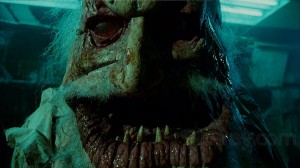 Jack Brooks: Monster Slayer provides a welcome break from horror’s gorno trend—that’s gore-porn for the uninitiated—of the last few years. This Canadian made chiller has more to do with the bloody fun of Sam Raimi’s Evil Dead and Stuart Gordon’s Re-Animator than the recent movies which used saws or thrill seeking torture tourists as major plot points.