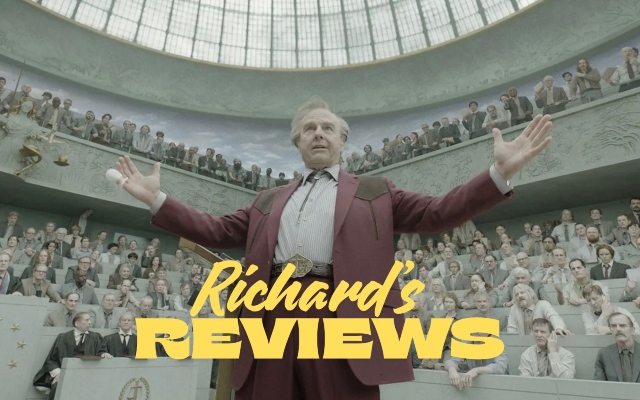
“You may come and go, but you will not take people from the city. If I hear of it, a single time, I will destroy you without salvation.” — Tada Cuda (Lincoln Maazel)
Imagine George A. Romero going to a psychic early on in his career.
“There’s good news and bad news,” she might say, gazing into her crystal ball. “Which would you like first?”
“The good news,” the Dawn of the Dead director would reply.
“You will make many movies . . .”
“That’s great! What’s the bad news?”
“The only ones people will go see all have the words ‘of the Dead’ in the title.”
That didn’t happen of course, but the fact remains that zombie king Romero has had a rough time attracting audiences for his non-Living Dead efforts. Dig deep into the Romero bargain bin, though, and there are a number of films that deserve a second look. The Crazies is a spooky thriller about a manmade combat virus that causes death and permanent insanity in those infected while Knightriders is a wild romp that can best be described as The Legend of King Arthur meets Mad Max. Best of all is Martin, an arty 1977 movie about a young man who believes he is a vampire.
The eponymous creature of the night, Martin Matthias (played by Dawn of the Dead casting director John Amplas), is a shy suburban teenager with a blood lust, but none of the usual trappings of the Nosferatu. Instead of fangs he uses razorblades and needles to do the dirty work and he isn’t averse to garlic, sunlight or crucifixes. Despite no actual proof of his undead status, he is steadfast in his conviction.
Surprisingly he’s not alone in his belief. Cuda (Lincoln Maazel), an elderly old-world cousin believes that vampirism is a family “shame” and makes it his calling to save Martin’s soul by trying to arrange an exorcism with the local priest. He also takes the boy in and gives him a job at his neighborhood grocery store, but Martin can only control his cravings for so long.
Martin actually has more in common with Taxi Driver than it does with Dracula. Romero’s films have always brimmed with social commentary, but his 70s work is especially ripe with societal resonance. In Martin he filters the post-Vietnam ills of drug addiction and urban decay through the lens of a vampire film, focusing on the reasons why Martin behaves the way he does and not the behavior itself. Compared to other horror films this one barely qualifies as a shocker. There are just three violent scenes and while they are bloody, the gore is used more as a measure of Martin’s ineptness — his sloppy killing skills — than to scare.
Often labeled as horror, it’s more accurate to call Martin a psychological drama as Romero spends the entire film flirting with the question of whether Martin is really a vampire, or just a drug addict with a vivid imagination. Eerie black and white flashbacks portray him as an undead creature, but the reality is a much different story. With these black and white sequences Romero muddies the water, never settling on a definitive answer, preferring to let the viewers decide for themselves whether there are supernatural forces at work, or if this is all the product of a diseased mind.
In Romero’s world the notion that Martin might not be a vampire is scarier than if he was a certified bloodsucker. Romero uses the troubled mid-’70s and its products — drug-addicted youths, decaying cities and stultifying suburban life — as a catalyst for the kind of fantasy world Martin creates just to cope with his life. This reality, Romero seems to imply, is far more terrifying than a fanged man in a cape could ever be.
“I didn’t try to come down on one side or the other,” Romero said. “I like the lady or the tiger kind of thing. I tried to keep it ambiguous, but in my mind, he was a disturbed kid.”
Martin is dense with the kind of social subtext that Romero favors in his films. His zombie movies have been thinly veiled comments on consumerism and the media, and Martin is no less layered. On the surface it seems to be a simple story, but dig a little deeper past the garish lighting and Romero reveals a mixed bag of metaphors regarding drug addiction, mental illness and the evil that humans do to one another. It’s purposefully ambiguous. The director is asking the viewer to look inside themselves to decide what answer to Martin’s status they are comfortable with. Is he a vampire or disturbed young man? Drug addicted or mentally ill? The answer you come up with — what you chose to believe — Romero implies, says as much about you are as it does about Martin.
I appear on “CTV News at 11:30” with anchor Andria Case to talk the wild Tom Cruise movie “Digger,” the meta Apple TV+ series “Brothers” and the true crime movie “Unabomber” on Netflix.
I join “CTV News Toronto at Five” with anchor Zuraidah Alman to talk about the absurdist environmental dramedy “Digger,” the suburban gothic “Verity” and the psychological thriller “Heel.”
I join CTV Atlantic’s Bruce Frisko to talk about the absurdist environmental dramedy “Digger,” the suburban gothic “Verity” and the psychological thriller “Heel.”
I sit in on the CFRA Ottawa morning show with host Bill Carroll to talk about the new movies coming to theatres including the absurdist environmental dramedy “Digger,” the suburban gothic “Verity,” the giant snake flick “Beware Boiúna” and the psychological thriller “Heel.”
Fast reviews for busy people! Watch as I review three movies in less time than it takes to wind your watch. Have a look as I race against the clock to tell you about the absurdist environmental dramedy “Digger,” the suburban gothic “Verity” and the psychological thriller “Heel.”
I join the Bell Media Radio Network national night time show “Shane Hewitt and the Night Shift” to talk about the return of Charlie Sheen to network television, the convenient Lady Gaga and Rick Wakeman’s concert for bears. On Booze & Reviews I talk about Tom Cruise in “Digger” and suggest some drinks to enjoy while watching the movie.
SYNOPSIS: In “Digger,” a new dark comedy now playing in theatres, Tom Cruise plays the title character, an oil tycoon who launches a campaign to become humanity’s savior before a disaster of his own making destroys the world. “If we can’t control the course of nature,” her says, “at least we can control the narrative.”
CAST: Tom Cruise, Riz Ahmed, John Goodman, Sandra Hüller, Michael Stuhlbarg, Jesse Plemons. Directed by Alejandro G. Iñárritu.
REVIEW: A study in justification of one’s actions, “Digger” is a dark satire, touched by farce, of narrative control in the face of crisis.
Tom Cruise, disguised by an inch of aging make-up, fake teeth and an elaborate comb-over, plays Digger Rockwell, the world’s most powerful oil tycoon. Eccentric, greedy and immoral—“Mr. Rockwell is a man who would roast our children alive if he thought he could sell them for a dime,” says scientist Ganesh (Riz Ahmed)—he does not like bad news.
When he gets bad news about the stability of one of his oil platforms, he ignores it and the resulting explosion causes havoc, creating aa ice shelf then size of Washington, D.C. on a collision course with Western Europe. “Digger here got us into this mess,” says the President of the United States (John Goodman), “and Digger’s gonna dig us out again.”
Rather than accept blame for the worldwide chaos Digger treats the situation not as a catastrophe but as a branding problem. “Panic is a resource,” he says. “When you’re running away from a house fire no one cares who left the toaster on.”
With the fate of the world hanging in the balance, Digger tries to save his company and himself by controlling the narrative. “They know the facts,” he says. “The story is yet to be told.”
Echoes of “Dr. Strangelove” reverberate throughout “Digger.” Both are absurdist nightmare comedies that skewer the egos and ideologies of powerful men, and both focus on managing the narrative of a crisis rather than dealing with it. But the cool, deadpan vibe of Stanley Kubrick’s film is replaced by a passionate, outlandish feel that will certainly divide audiences.
It’s a big movie, filled with big ideas, even if they sometimes get lost in the sheer grandiosity of the filmmaking. Director Alejandro G. Iñárritu, who co-wrote the script with Alexander Dinelaris, Nicolás Giacobone and Sabina Berman, presents a riff on the old saying, “power tends to corrupt, and absolute power corrupts absolutely,” but in Digger Rockwell’s world corruption goes hand in hand with control because that’s where the power is. Controlling the narrative is more important than solving the problem.
“They know the facts,” he says, “but the story has yet to be told.”
Digger’s a bad guy, ignorant, tacky and narcissistic, but he’s the hero of his own invented narrative and in an era of fake news and misinformation, it’s a timely and scary reality check.
The absurd and often jaundiced take on the machinery of power from Digger’s house to the White House and beyond is not subtle. Iñárritu takes big swings here narratively and stylistically. His ambition pays off in fits and starts. Some scenes, like a sequence of Digger, the President of the United States (John Goodman) and various generals, watching the iceberg collision with land is darkly hilarious, or Cruise’s ten-minute amphitheater monologue, fire on all cylinders.
But overall “Digger” values audacity, ambition and theatrics over narrative clarity. Not funny enough to be a satire, too outrageous to be straight drama, it lands in a tonal wasteland, wavering between silly and sincerity.
The parts of “Digger” that work, however, work very well. John Goodman lets his freak flag fly as the beleaguered POTUS and Riz Ahmed, as the pushed-to-the-brink climate scientist, hands in a career best performance. Cruise nails both the farcical elements of the character but lets the more intimate, realistic moments breathe in a performance that will likely draw attention from the Academy at Oscar time.
Digger Rockwell brags that the world is powered by his fossil fuels, but his movie is fueled by something else: audacity. It is a truly unique film, the kind that doesn’t usually feature such high-priced talent, but this audacious environmental drama is bordered self-indulgence and by times is a chore to sit through.
SYNOPSIS: Set deep in the Amazon rainforest along the Curuçá River, the survival horror film “Beware Boiúna,” now playing in theatres, a colossal, vicious serpent known as the Mother of the Waters attempts to reclaim her territory. “She decides who lives. She decides who dies.”
CAST: Kiana Madeira, Jessica Rothe, Logan Marshall-Green. Directed by Mike P. Nelson.
REVIEW: A mix of Amazonian folklore and giant snake movies like “Anaconda” and “Python,” “Beware Boiúna” sets nature against man in a movie that’ll make you root for the territorial snake.
The story begins with a medical team, including doctor Alli (Jessica Rothe) and mechanic Lena (Kiana Madeira), on a six-week humanitarian mission on the Amazon River to deliver aid.
Their presence, coupled with the disruptive surveyors led by Brennan (Logan Marshall-Green), upsets the natural balance of the rainforest, they awaken a behemoth named Boiúna, a giant serpent known as the Mother of the Waters. “When there is balance, she rests,” says Lena. “Imbalance, she defends.”
Boiúna spends much of the film’s overlong 104 minutes slithering in the background, seen only in quick glimpses amid the murky cinematography and jungle foliage.
In a riff on “Jaws,” director Mike P. Nelson keeps the creature mostly out of sight, à la Spielberg in “Jaws,” to allow the viewer’s imaginations to do the heavy lifting. What you can’t see should be more terrifying than Nelson can show you. But with this boatload of uninteresting characters, who lose whatever motivations and traits they may have started with on page one of the script once the snake starts to feed, all you’re left with is a big bad you barely get a look at and human snake food running through the jungle.
“Jaws” was effective because while the shark’s relentlessness was scary, you cared about the characters.
The colonizing bad guys are straight out of Central Casting’s Evil Invader Department, while the humanitarians seem to leave chaos in their wake. That they behave erratically doesn’t matter, because once Boiúna shows up all characterization and logic goes out the window. The characters have names, but they may as well be known as Snake Snack # 1 through #10 given the impact they leave behind.
It adds up to a giant snake movie without the camp appeal of “Anaconda” or the scares of a creature feature like “Jaws.”