“Snowpiercer” may be the oddest film of the year so far. The set up sounds like a standard dystopian world scenario… to a point.
Set just seventeen years from today, the movie, written and directed by Joon-ho Bong, takes place in a dystopian world where global warming has turned the planet into one giant snowball.
So far this could be “The Day After Tomorrow,” or “The Colony” or any number of icy thrillers set in a sub zero world.
All of humanity now lives on a train, owned and operated by a mysterious industrialist named Wilford, hurtling through what’s left of ice-covered planet. It’s an ecosystem with its own class system. In the front of the locomotive people live a life of luxury, dining on sushi, partying in nightclubs, tending orchids in greenhouses, while the folks in the back, “the freeloaders” are forced to live in atrocious conditions. Imagine the steerage section in “Titanic” only WAY worse.
Crammed in like sardines these “tail section” passengers are treated like prisoners, forced to eat “protean bars” of dubious quality and tortured for the slightest of infractions. “Know your place,” commands Minister Mason (Tilda Swinton). “Accept your place.”
It’s an atmosphere ripe for revolution, but can ringleaders Curtis (Chris Evans), Gilliam (John Hurt) and right hand man Edgar (Jamie Bell) fight their way through the train (and all of the story’s allegories) to the front and freedom?
Based on the French graphic novel “Le Transperceneige,” “Snowpiercer” is the nerviest actioner to come along in a season crowded with movies that go crash, boom, bang. It’s an environmental thriller—if you haven’t already seen Bong’s “The Host” do so now!—that is unapologetically weird, keeping the audience off balance for the entirety of its two-hour running time.
Tilda Swinton as the train’s Iron Lady, the minister of discipline, plays like a cross between a prison guard, Benny Hill and Margaret Thatcher. It’s a loopy performance that embraces and embodies the movie’s weird spirit.
In the world Bong creates surprises are around every corner, characters come and go, but it never feels odd for odd’s sake. The story rips along like a rocket (or thousand car train, if you like), sometimes in several directions at once, but Bong controls the chaos, keeping the story plausible (OK, plausible-ish) and above all, entertaining.
In a recent interview Mel Gibson said he’s out of the business of financing his own films because, “I’m not a fool.”
Neither is Zach Braff.
Both must be worth big bucks—Gibson from the movies, Braff from starring on 175 episodes of “Scrubs”—and could likely use some of their own capital to make their own movies but Gibson says he’s out of the game completely while Braff used the popular crowd sourcing site Kickstarter to raise money for his latest.
“Wish I Was Here” is part of the small—but growing—trend of celebrity driven films paid for by contributions from the general public. The almost-mid-life crisis story raised $2 million in just forty eight hours (ultimately procuring $3.1 million of a reported $5.5 million budget), attracted an all-star cast—Kate Hudson, “Frozen’s” Josh Gad, Mandy Patinkin and “The Big Bang Theory’s” Jim Parson—and some backlash from critics who felt that crowdsourcing should be left for artists who aren’t also starring in giant Disney movies.
Fact is, “Wish I Was Here’s” backstory is a bit more interesting than the story on the screen.
Braff plays Aidan, an underemployed actor whose life is unraveling. His kids are about to be kicked out of Hebrew school because his father (Patinkin), who has been paying the bills, has been diagnosed with cancer and can no longer afford the monthly payment. His wife Sarah (Hudson) is supportive of his acting dream but nearing the end of her tether. Brother Noah (Gadd) prefers cos play over actual emotions and his two kids (Joey King and Pierce Gagnon) are maturing faster than he is.
“Wish I Was Here” plays like two movies. The first forty-five minutes is a cleverly written comedic look at Aidan as a manboy with far more responsibility than he can handle. It’s ripe with gentle character based laughs that emerge from the situations and don’t feel forced.
It’s only in the second half when Braff (who co-wrote the script with his brother Adam) allows sentiment to get in the way of the movie’s momentum. Despite Patinkin’s line, “Eventually when things get tragic enough they circle back to comedy,” the final forty-five minutes, which deal with the loss of Aidan’s father, takes a darker tone. That’s OK, life sometimes changes on a dime, but the cleverness of the set-up is replaced with mawkishness.
Sometimes it works. Hudson’s heartfelt “tell your sons you love them” speech to her-father-in-law is shot simply with lingering close-ups on the actor’s faces. The scene has an intimate in-the-moment feel and is very moving.
Less so is Gadd’s big moment, (VERY MILD SPOILER ALERT), a Comic Con sequence that is a bit too quirky to fit the tone of the film that surrounds it.
By the end credits the movie worked for me more often than not, but I wished that there were fewer clunky moments. For every scene that rings emotionally true—and there are quite a few of them—there is another that feels forced. The beauty of “Wish I Was Here” lies in the former, and certainly not in the passages that feel left over from another, lesser quirky indie comedy.
Author appearance, Round table, Special Event: IFOA
Exhibition Place – Direct Energy Centre
210 Princes’ Blvd
Toronto M6K 3C3
IFOA returns to the CNE for an exciting panel with authors Crissy Calhoun, Richard Crouse, Adam Nayman and Richard Rosenbaum, who will take the stage to discuss their pop culture commentary.
For information about admission to the CNE, please click HERE.
Participants
Crissy Calhoun is the author of the Love You to Death series of Vampire Diaries companion guides and, under the pen name Liv Spencer, she’s co-authored books on topics like Pretty Little Liars and Taylor Swift. She lives in Toronto. Calhoun presents the fourth installment of her Vampire Diaries guides, Love You to Death: Season 4, which delves headlong into the twists and turns of each episode, exploring the layers of rich history, supernatural mythology, historical and pop culture references.
Richard Crouse is a regular film critic for CTV’s Canada AM. He is also the author of six books on pop culture history and writes two weekly columns forMetro newspaper. Crouse presents Raising Hell: Ken Russell and the Unmaking of The Devils, which examines Russell’s 1971 film about an oversexed priest and a group of sexually repressed nuns in 17th-century France. From the film’s inception through its headline-making production and controversial reception, Crouse explores what it is about Russell’s cult classic that makes it a cinematic treasure.
Adam Nayman is a film critic for TheGlobe and Mail, and a contributing editor to Cinema Scope. He is a lecturer at Ryerson and the University of Toronto, and programs for the Toronto Jewish Film Society. He lives in Toronto. Nayman presents It Doesn’t Suck: Showgirls, which examines and encourages a shift in cultural perspective on the box-office bomb Showgirls.
Richard Rosenbaum is a fiction editor at Broken Pencil and a regular contributor to OverthinkingIt.com. He has a Master’s degree in Communication and Culture, and lives in Toronto. Rosenbaum presents Raise Some Shell: Teenage Mutant Ninja Turtles, which examines the origins, evolution and impact of the Ninja Turtles phenomenon.
For many people, especially those who troll around in the more unsavoury corners of the Internet, the first exposure to celebs like Paris Hilton and Kim Kardashian came from that most modern form of celebrity introduction: the sex tape.
Paris and Kim’s videoed sexcapades weren’t the first tapes to become public — in 1988 Rob Lowe was embarrassed when VHS images of him and two women popped up on the news — and they weren’t the last.
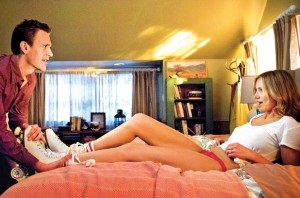
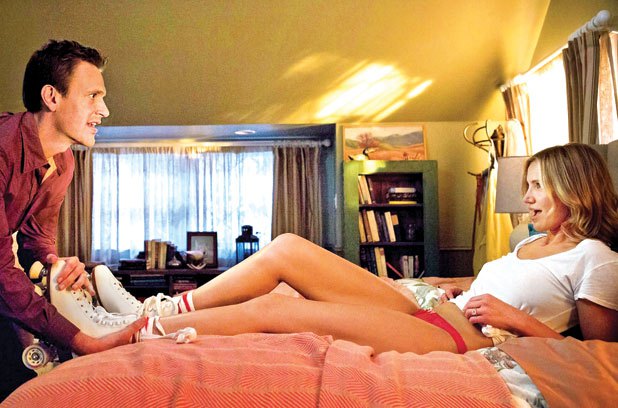
This week in Sex Tape, Jason Segel and Cameron Diaz are Jay and Annie, a married couple who try to spice things up in the bedroom by videotaping themselves. All goes well until Jay forgets to erase the tape and mistakenly stores it on the Internet. “Our sex tape has been synced to several devices,” he says, “all of which are in the possession of friends!”
Given how many actors have appeared in sex tapes it’s not surprising that several movies have used the raunchy videos as a plot point.
In Brüno, the titular Austrian fashion reporter (Sacha Baron Cohen) tries to make a name for himself in America by making a sex tape with another famous American, U.S. Congressman Ron Paul. Trouble was, Paul wasn’t in on the joke. “I was expecting an interview on Austrian economics,” said Paul. “But, by the time he started pulling his pants down, I was like ‘What is going on here?’ I ran out of the room. This interview has ended.”
The 2006 comedy Drop Box has production values not unlike that of an actual sex tape but despite its low budget it offers up the funny and often brutal story about Mindy (Rachel Sehl), a big-time bubblegum pop star (think Britney or Miley), who accidentally returns her homemade sex tape to her local video store instead of Glitter, the movie she rented. Realizing her mistake, she tries to re-rent the tape.
Clocking in at just 80 minutes, it’s a character study about a spoiled pop princess who butts heads with an unmovable force in the form of the uncooperative and inquisitive clerk (David Cormican).
Finally, Auto Focus exposes sex tapes’ dark side. Hogan’s Heroes star Bob Crane’s (Greg Kinnear) all-American public persona hid a secret obsession. “I’m a normal, red-blooded American man,” he says. “I like to look at naked women.” According to the film, he liked making sex tapes with women, usually without their knowledge. The movie speculates his 1978 murder may have been related to this unlawful pastime.
Check out Richard’s cineplex.com article on Monty Python as the Beatles of Comedy.
“’I’ve got two legs from my hips to the ground, and when I move them, they walk around,’ isn’t a line with the elegance of, ‘Yesterday, all my troubles seemed so far away,’ but it is a lot funnier.
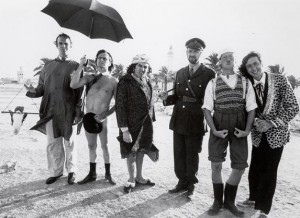
“Comparing the work of Monty Python and The Beatles might seem like equating apples to oranges, or guitars to crunchy frogs, but it really isn’t that much of a stretch. Eric (Idle), Graham (Chapman), Michael (Palin), John (Cleese) and a couple of Terrys (Gilliam and Jones) have a lot in common with John, Paul, George and Ringo.
“Monty Python has been called the most influential comedy troupe of all time. Their absurdist brand…” Read the whole thing HERE!
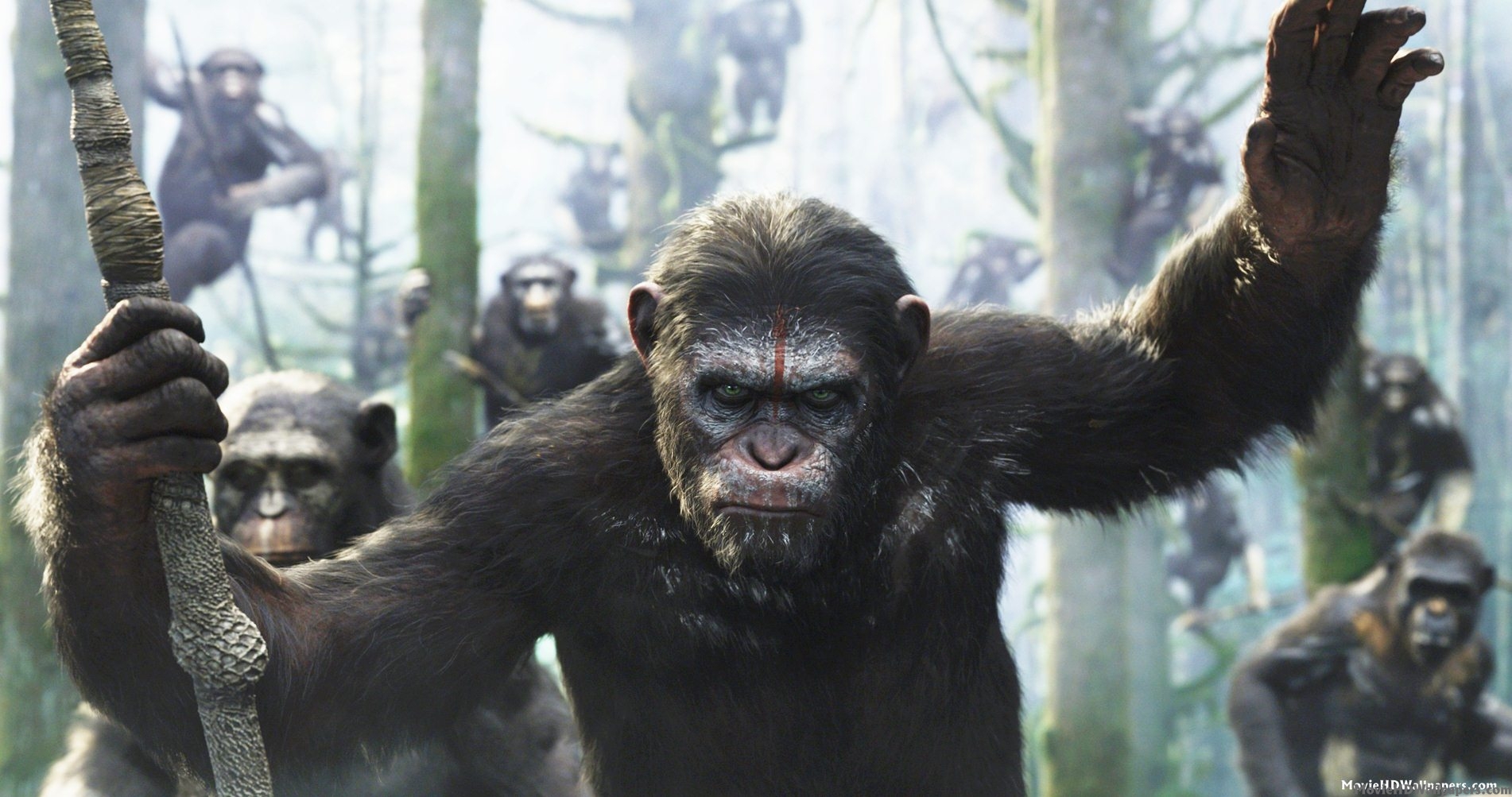
“Dawn of the Planet of the Apes” is a different kind of blockbuster. It has all the elements of the usual summer fare— it’s a sequel, things blow up and, if that wasn’t enough, also features an ape on horseback —but it takes more risks than Optimus Prime could shake Michael Bay at. About half of it is done in ape sign language (with subtitles) and it’s not chock-a-block with action. Instead it takes time building characters and motivations so when the wild ape-on-human action begins it feels earned and it feels epic.
Set ten years after Rise of the Planet of the Apes saw Caesar (Andy Serkis) break free from a San Fransisco primate sanctuary and start an ape uprising, the middle-aged chimpanzee is the leader of a large population of genetically evolved apes. Most of humankind was wiped out by a pandemic of ALZ-113—a “simian flu” virus that speeds up the rebuilding of brain cells in apes but is deadly to humans—but when a small band of humans scout a water source near the ape camp a monkey wrench is thrown into the fragile peace between homo sapiens and simians is threatened. “Apes do not want war,” says Caesar, but a battle—gorilla warfare?—for control is inevitable.
To riff off of the old Superman tagline, “You will believe an ape can speak.” The special effects are amazing, but beyond the pixel manipulation that brings Caesar and company to vivid life, there are remarkable performances that, for lack of a better phrase, humanize the apes. These aren’t the erudite apes of the Roddy McDowell era, with vocabularies that would impress even Conrad Black, but simian characters that behave somewhere midway between pure instinct and higher intelligence.
Gary Oldman, as a human protectionist, Jason Clarke as the human who reaches out to Caesar in the spirit of friendship and cooperation and Keri Russell as his resourceful wife are all terrific, but I went bananas for these apes.
Beyond the flashy special effects and Serkis’s understated but powerful performance—this is the kind of performance that could convince the Academy to consider “motion capture” acting for inclusion in the Oscar acting categories—is a smart movie about race, gun usage and xenophobia. Its masked in allegory and, well, a story about talking apes, but it doesn’t shy away from big ideas and that is the thing that transforms it from a run-of-the-mill air conditioner flick to a thought provoking night and exciting at the movies.
Near the end of “Begin Again,” the new musical romance from “Once” director John Carney, record producer Dan (Mark Ruffalo) instructs a guitar player, who is also his daughter (Hailee Steinfeld), to “keep it simple.” It seems director Carney took the advice as well, using the KISS principle—Keep It Simple Stupid—in the telling of this uncluttered story of redemption and pop songs.
When we first meet Dan he’s having a bad day. His estranged daughter is mouthing off to him, he gets fired from the label he helped create and even his car breaks down. The day—by this time it’s night, actually—improves when he stumbles into a bar to drink his blues away and hears Gretta (Keira Knightley) singing a sad song from the stage. In his mind’s eye he hears a hit, a song that could make her a star and give him another shot at relevancy.
Before he can begin again, however, he must help Gretta get over her ex-boyfriend, up-and-coming rock star Dave Kohl (Adam Levine)—he’s the kind of guy whose voicemail says, “It’s Dave. I’m probably doing something awesome so I won’t get back to you… ever.”—and her distrust of the trappings of fame.
“Begin Again” is as much about the love of music and it’s ability to heal as it is about the various relationships it essays. Carney is covering familiar ground here. His film “Once” breathed the same air, but it’s rarefied air, and he pulls it off with panache.
For instance, Gretta and Dan bond over a shared iPod filled with their favorite songs. Taken by the music they have a “we have to dance right now” moment, but it’s done with a twist when they go to a club and dance to their own music courtesy of their iPod earphones while everyone around them literally dances to the beat of a different drummer.
Ruffalo brings considerable passion to the role of Dan, an “I’ve-been-down-so-long it’s-looking-up-to-me” kind of guy. He’s a walking cliché, a record man who got eaten up by the business and a rough personal life, but Ruffalo gives him a soulfulness that’s very winning.
Knightley looks like an undiscovered indie darling, bringing a delicate but steely sensibility to her performance and the songs that help tell the story.
“The Voice” alum Levine and CeeLo Green (as a successful musician who owes Dan a favor or two) lend some music industry cred to their roles, but the heavy lifting, acting wise, is done by Ruffalo and Knightley.
“Begin Again” is a self contained story with a beginning, middle and satisfying end, but sets itself up for a sequel in the subtlest of ways. Dan comes up with the usual idea of recording Gretta’s album outdoors to get a real taste of New York in the grooves. After successfully setting up under the Brooklyn Bridge and in Central Park, Gretta suggests they could expand their horizons and make records on the streets of several other European cities. I’m not sure if that’s enough to build a franchise around, but I’d sure like to spend some more time with these characters.
Can there be any more daunting an assignment for a film critic than to review a documentary about the life of one of the greatest movie reviewers of all time? “Life Itself,” is an affectionate look at the life and death of Roger Ebert, the Pulitzer Prize winning writer and television host whose name has become synonymous with the film criticism.
Ebert lived a public life. Between television appearances—on his own show with Gene Siskel and hundreds of talk show visits—and countless words splayed across the pages of the Chicago Sun-Times, his books and later his website, it seems like there might not be much left that we don’t already know about Ebert.
Director Steve James, who also made “Hoop Dreams,” one of Ebert’s favorite films, digs deep to present something that is beyond a simple biography. We learn about how the critic wrote the screenplay for the Russ Meyer’s opus “Beyond the Valley of the Dolls,” the legendary ego clashes with his TV partner and that he met his wife at an AA meeting but that’s just trivia. Instead, using a mix of talking head interviews, archive footage, and most importantly, interviews with Roger and wife Chaz, James crafts an intimate, revealing and moving portrait of a complex man.
Ebert passed away on April 4, 2013 during the production of the documentary. Stricken with cancer, he knew he would likely not live to see the finished film, but communicated through his laptop (with voice translation) for as long as he was able. One of his last messages to James said simply and eloquently, “I’m fading.” It’s a heartbreaking and bittersweet moment in the movie that gives life to Ebert’s theory of movies being “a machine to generate empathy.”
“Life Itself” never shies away from the difficult parts of the story. Moments of frustration and pain are included but ultimately the doc is a wake for the late film critic. Stories are shared, secrets are told and a life is celebrated.
Roddy McDowell’s 1974 appearance on the Carol Burnett Show was something a little different. How often do you see a big TV star singing a love duet with an ape?
Burnett introduced McDowell as, “one of Hollywood’s most familiar faces,” then feigned shock when the actor came onstage in a tuxedo, but in full Planet of the Apes facial make-up. McDowell starred in four of the Planet of the Apes films and in the TV series.
For the next few minutes they engaged in some tomfoolery—McDowell says he’s been working on his tan in Palm Springs and when asked which of his movies has had the most profound effect on him he sidesteps the obvious and recites a soliloquy from Cleopatra—before launching into a spirited version of the Jerome Kern love ballad They Didn’t Believe Me. By the end of the tune the audience roars as Burnett warbles, “When I told them how wonderful you are, They didn’t believe me,” as she mimes picking a bug off his lapel.
Later she thanks Roddy for undergoing the three-and-a-half hours it took to put on the make-up for that bit of funny business.
It’s not likely you’ll see Andy Serkis, star of the latest slice of simian cinema, Dawn of the Planet of the Apes, partaking in the same kind of promotional monkey business.
Times have changed since McDowell had to endure untold hours in the make-up chair, then smoke using an extra long cigarette holder so as not to light his faux fur on fire. “It’s about a foot long and makes me look like the weirdest monkey you ever did see,” McDowell told Newsday.
These days Serkis, who is best known for his motion capture performance of Gollum in the Lord of the Rings films, performs on a soundstage in front of multiple cameras that film his performance from every angle. He wears a body suit dotted with spots that allow the computers to register even the slightest movement. Serkis calls this “a magic suit” that “allows you to play anything regardless of your size, your sex, your color, whatever you are.” Later, in post production the “digital make-up” adds in the costume and character details.
It saves hours in the make-up chair, but is no less a performance than McDowell’s more organic approach. “I’ve never drawn a distinction between live-action acting and performance-capture acting,” Serkis says. “It is purely a technology. It’s a bunch of cameras that can record the actor’s performance in a different way.”