Tweets of the week! “Give us the truth about the movies we pay an arm and a leg for!”

Follow Richard on twitter @RichardCrouse!
Follow Richard on twitter @RichardCrouse!
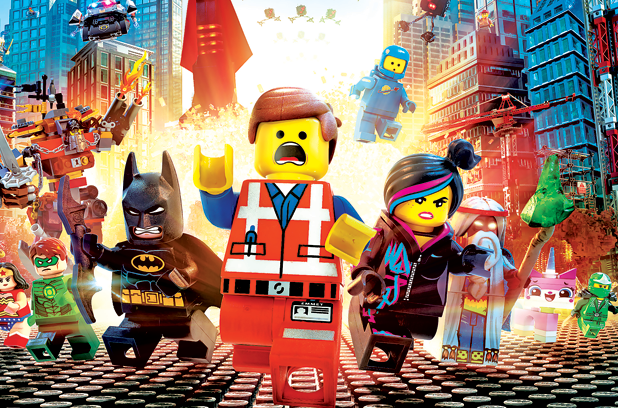
“The Lego Movie” is possibly the weirdest, most psychedelic kid’s entertainment since “H.R. Pufnstuf.”
Released by a big corporation—Warner Bros—and based on one of the world’s most popular toys, it manages to feel as though a kid who threw away his Lego kit’s instructions and snapped the blocks together in random, fun ways made it.
When we arrive at the Lego universe it is ruled by the evil Lord Business (Will Ferrell), a tyrant obsessed with perfection and conformity. In his world the radio pumps out perfect pop sings like “Everything is Awesome,” and a group of robotic “micro-managers” ensures that everything is just so.
To guarantee the world he has created from interlocking bricks stays just the way he wants it, he has a plan to spray the entire thing—Lego people and all—with Kraggle, a super glue that will permanently paste everything it touches into Lord Business’s idea of excellence.
When Emmet (Chris Pratt), a Lego figure who was invisible in life, stumbles across the “piece of resistance” he becomes The Special, the greatest Master Builder in the universe, jopining a group that includes Batman (Will Arnett), a pirate named Metalbeard (Nick Offerman), Abraham Lincoln (Will Forte), Shaq (Shaquille O’Neal) and Green Lantern (Jonah Hill).
With the help of the Master Builders, a loopy wizard named Vitruvius (Morgan Freeman) and Wyldstyle (Elizabeth Banks) a tough young woman with a sensitive side, Emmet must break free of the chains of conformity and defeat Lord Business.
The first thing you notice about “The Lego Movie” is the look. It’s computer-animated but looks like stop-motion. The film’s handmade composition isn’t slick, but it is playful, which is a perfect compliment to its Lego origins. (It should be noted, however, that the movie in no way plays like a commercial for the toys.) From the crude Lego flames to the awkward way the characters move, the movie is completely consistent in its vision of a Lego world.
The second thing you’ll notice is how off the wall the story is. It’s not just off-the-wall, it’s off-the-planet. Directors and co-writers Phil Lord and Christopher Miller have taken the movie’s credo of battling against conformity to heart and made a big budget studio movie that bends all the rules. At its heart it’s a simple hero journey, a primal story about good against evil, but frenetic storytelling and inventive twists in almost every scene add a richness that belies its humble toy story origins.
It may be a bit too hectic at times—blame video game influence for that—and a titch too long for little ones with short attention spans, but the overriding message of dancing to your own beat combined with an unexpected and touching live-action section make “The Lego Movie” far more than an exercise in nostalgia for parents who grew up creating worlds from little plastic blocks or a way to sell more toys to a new audience. Instead it’s a wildly entertaining movie that uses the toys as a muse, and does what the toys have always done, light imaginations on fire.
I root for George Clooney. He has a lot going for him; he’s good looking, has a villa in Italy and is good friends with Sandra Bullock. That’s a lot for anyone, but that’s not why I root for him. I’m on his side because even though he’s a superstar he takes chances.
As an actor he put nipples on Batman, starred in a remake of an obscure Russian sci fi film, played a fox in a Wes Anderson movie and has played the lead in a movie about paranormal goats.
As a director he’s just as edgy. He’s stood behind the camera for a black and white look at Edward R. Murrow’s battle with Senator Joseph McCarthy, an old school football movie set in 1925 and an exposé of backroom politics.
He’s an a-lister who takes chances, and I applaud that which makes me sad to report I didn’t find as much to applaud in his most recent film as actor and director “The Monuments Men.”
Based on the book “The Monuments Men: Allied Heroes, Nazi Thieves and the Greatest Treasure Hunt in History” by Robert M. Edsel, the movie stars Clooney, Matt Damon, Bill Murray, John Goodman, Jean Dujardin, Bob Balaban and Hugh Bonneville as a motley crew of art historians, engineers and museum directors recruited to locate and rescue priceless art works stolen by the Nazis. When two members of their team are killed they are no longer observers but active participants in the war.
Helping in the mission to return the plundered cultural artifacts is Rose Valland (Cate Blanchett), a French art historian and member of the French Resistance who not only aids the Allied art platoon but also tries to work her Parisian charms on Damon’s character.
“The Monuments Men” is a wartime comedy. Think “Hogan’s Heroes” by way of Leonardo Da Vinci and you’ll get the idea. It has some mild laughs (the biggest laugh, for Canadians anyway, comes from the Parisians who blame Matt Damon’s terrible French on having spent too much time in Montreal) but also a great deal of reverence for the art and the work of the real-life Monuments Men. ”People can come back but if you destroy their achievements, their history,” says George L. Stout (Clooney), “they can’t come back from that. That’s why Monuments Men was created.”
The reverential tone is reinforced by old school pacing that focuses on the character and art over action and a rousing soundtrack that sounds air-lifted in from a classic wartime era movie. The cast is uniformly fine and Bill Murray shows, once again in a brief scene in a shower (NO SPOILERS HERE), how his understated style can move an audience.
No problems there, but co-writers Clooney and longtime collaborator Grant Heslov appear to have taken a dose of sentimentality pills before putting pen to paper. What might have been an edgy, exciting look at an underreported slice of World War II history is reduced to an elegantly directed but somewhat dull film.
“The Monuments Men” is an earnestly told story but the lack of any real energy or surprises undermines its effectiveness.
 Tune into Richard’s “Extra Entertainment Extra” interview with “Sex After Kids” star Ennis Esmer and director / writer Jeremy LaLonde on Saturday, February 8, 2014 at 4:30 pm on NewsTalk 1010 in Toronto! (Check local listings for replays in your area.)
About Sex After Kids:
Sex After Kids is an edgy ensemble comedy that follows several couples in their post-child-coitus troubles. The newlyweds (Beckner, Ennis Esmer) with a newborn that can’t align their schedule and libidos. The aloof single mom (Zoie Palmer) whose deviant brother insists that she get back out into the world and satisfy herself sexually by any means necessary. The lesbians (Kate Hewlett, Mary Krohnert) who realize that they don’t share the same principles when it comes to child-rearing. A single dad (Kris Holden-Ried) tired of one-night stands and looking for something with substance. The empty nesters (Jay Brazeau, Mimi Kuzyk) who watch their last child leave home only to wonder if they can find that spark that brought them together all those decades ago. Their relationships and ideals will be put to the test as the question is asked: is it possible to have children and a sex life, and… is it worth it?
 Richard will host a special afternoon with Oscar winning Brokeback Mountain composer Gustavo Santaolalla at the TIFF Bell Lightbox on February 9, 2014.
From TIFF.net: The Grammy-winning singer, guitarist and composer joins us during the world premiere of the dance musical Arrabal (running Feb 4 to April 20 at Toronto’s Panasonic Theatre) for a special screening of Ang Lee’s Academy Award-winning drama, for which he received an Oscar for Best Original Score.
More info HERE!
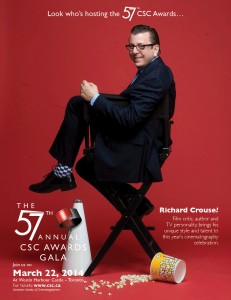 Richard will host the 57th Annual Canadian Society of Cinematographers Awards on March 22, 2014!
More info HERE!
 By Richard Crouse – Metro Canada
Alfred Hitchcock said, “Ideas come from everything,” and certainly Hollywood proves his point.
Just this year we’ve had films inspired by everything from Norse mythology by way of comic books (Thor: The Dark World), real life (Captain Phillips, American Hustle to name a couple) and literature (The Hobbit: The Desolation of Smaug to name one).
Like Hitch says, story ideas can come from anywhere. Even the board games and toys we played with as kids.
This weekend Hollywood has built a movie around a set of building blocks. The most famous building blocks in the world. The Lego Movie features the all-star voices of Will Ferrell, Liam Neeson, Elizabeth Banks and Morgan Freeman in a story about an ordinary Lego minifigure recruited to stop the evil tyrant Lord Business from gluing the universe together.
Lego’s colourful interlocking plastic blocks are the latest toy to inspire a movie, but they aren’t the first.
The 1977 animated film Raggedy Ann & Andy: A Musical Adventure has the distinction of being the first theatrical motion picture based on a consumer toy. In the movie the rag dolls go on a journey to rescue Babette, a beautiful French doll kidnapped by a pirate. Described as “tedious” and “lacking in pace and humor” by many critics, the movie has also been mentioned as an unofficial inspiration for the Toy Story series.
A few years later came an action figure that would inspire several movies. Roger Sweet, lead designer for Mattel’s Preliminary Design Department, says he wanted “a powerful figure that could be taken anywhere and dropped into any context because he had a generic name.” That character was He-Man, defender of the realm of Eternia from the evil forces of Skeletor.
The job of bringing that bigger-than-life character from the toy box to the screen fell to Dolph Lundgren in the 1987 film Masters of the Universe. The original story wasn’t a hit at the box office and isn’t one of Lundgren’s favourite films.
“How much could I do as an actor,” he asked, “when I was running around in swim trunks and chest armor?”
More successful was Clue, based on the crime mystery board game. Starring Eileen Brennan and Martin Mull as murder suspects Mrs. Peacock and Colonel Mustard, the movie was released with three possible endings. The various endings were split up between theatres, so no two prints were the same, but the DVD release features all three conclusions.
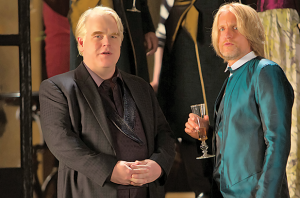 The news of Philip Seymour Hoffman’s sudden passing was met with a heartfelt outpouring of grief from fans and those who worked with him.
“Philip Seymour Hoffman was a singular talent and one of the most gifted actors of our generation,” Lionsgate, the studio behind the upcoming Hunger Games: Mockingjay Part 1 and 2, said in a written statement. “We’re very fortunate that he graced our Hunger Games family. Losing him in his prime is a tragedy, and we send our deepest condolences to Philip’s family.”
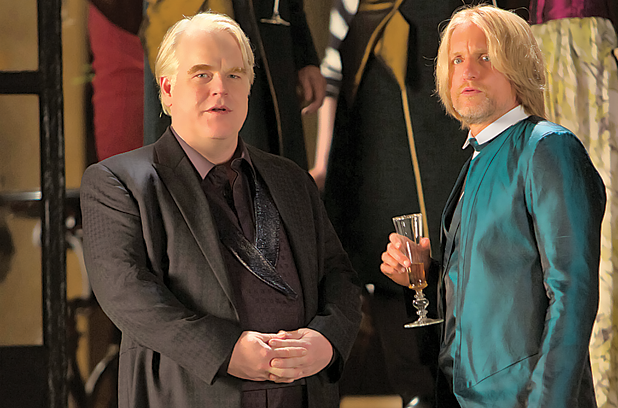
Hoffman played head -games-maker-turned-rebel leader Plutarch Heavensbee in the successful series. It is a pivotal role.
In the wake of the actor’s death, questions arose as to whether the uncompleted blockbusters-in-waiting would be completed in time for their scheduled November 21, 2014 for Part 1 and November 20, 2015 for Part 2 release dates.
Hollywood studios have handled the sudden death of cast members in many different ways. In some cases, films are even abandoned.
Production on Something’s Got to Give was shut down permanently after Marilyn Monroe’s August 1962 barbiturate overdose.
Dark Blood, River Phoenix’s final film, was put into cold storage when the young actor died before filming several crucial scenes. But both movies were eventually resurrected. The documentary Marilyn: The Final Days used footage from Monroe’s aborted film while Dark Blood sat for 19 years before being finished and shown at film festivals.
Father and son Bruce and Brandon Lee both died early, leaving behind unfinished films. The elder martial arts legend had completed 100 minutes of The Game of Death when a cerebral edema took his life.
Even more tragically, Brandon was killed on the set of The Crow in an accident involving a prop handgun.
Both films were salvaged with the use of stand-ins.
When Oliver Reed collapsed of a heart attack at a Malta pub after out-drinking a group of Royal Navy sailors, the editing crew of Gladiator replaced him digitally in the remaining scenes of the film.
More recently, Heath Ledger unexpectedly died during the production of The Imaginarium of Dr. Parnassus. He was replaced in the surreal story by three actors.
“I just started calling friends of Heath,” director Terry Gilliam said. “It’s as simple as that.”
“Johnny (Depp), Colin (Farrell) and Jude (Law) turned up. It was important that they were friends, because I wanted to keep it in the family. I wanted people who were close to him because, as Colin said when he was doing his part, he was channelling Heath part of the time, so Heath was very much still alive in some sense.
“Contractually, it was supposed to be a Terry Gilliam Film,” said Gilliam. “That’s what the lawyers said, but I said, ‘No way it’s going to be that. It’s going to be a film from Heath Ledger and friends.’ The cast sat around one night and that idea came up and I said, ‘This is it. Perfect. That’s how we do it.’”
As for the upcoming Hunger Games films, reports now confirm that Hoffman completed work on Part 1 and had just seven days left of shooting on Part 2.
His absence will not require any recasting, just a rewrite of one scene. And so Mockingjay Part 2 becomes the final film in Hoffman’s remarkable career.
“Words cannot convey the devastating loss we are all feeling right now. Philip was a wonderful person and an exceptional talent, and our hearts are breaking,” reads a statement released by The Hunger Games author Suzanne Collins, the films’ director Francis Lawrence, producers Nina Jacobson and Jon Kilik and star Jennifer Lawrence.
 Entertainment reporter Richard Crouse calls in to talk about Phillip Seymour Hoffman and Woody Allen. Humble and Fred discuss the Superbowl and Rob Ford. Super Fan Sarah Twomey records a song about Chairman Mow and Eileen does the news.
Listen to the whole thing HERE!