Richard’s “Canada AM” interview with “Delivery Man” co-star Cobie Smulders.
“It’s a blown up version of something that happens in real life,” she says. “You had a relationship when you were younger and all of a sudden a woman contacts the father and, ‘Oh, by the way, you have a seven year old.’ Obviously there is room for comedy there but everyone wants him to step up and be the hero and watch him do that journey.”
“We were so lucky to have [original director] Ken Scott. He did it so well the first time that he was able to do it a second time and have those same sentiments in it and spoken in English.”
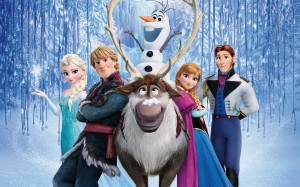
The new animated film Frozen features something unique — dueling Disney princesses.
“I think what was really important for this movie was to have the female perspective,” says co-director Chris Buck.
“We have two female leads and there are times that as a male director you can go to the stereotype of what a female character might do.”
That’s where co-director and writer Jennifer Lee came in. “Jen would always take it to a different place,” he says. “She would say, ‘Make her real. Make her believable.’ So I think that really helped. It was a good balance.”
Based on a Danish fairy tale by Hans Christian Andersen, Frozen is the story of two royal sisters, Anna, a spirited adventurer (Kristen Bell) and Elsa, a queen (Idina Menzel) with the awesome power to create ice and snow. Sibling is pitted against sibling when Elsa plunges her kingdom into an endless winter and Anna must act to save her sister and the empire. “You want to make these movies to last forever but we have to bring ourselves to it,” says Buck. “We have to bring today’s sense of entertainment and character to our characters.”
“We’re huge Disney fans and I grew up with Disney,” says Lee. “When you watch a Disney film you are constantly feeling it. It is a combination of comedy and drama but it is together in such a way that you feel you are in the world. That is something we both love more than anything because that, to me, is what makes them timeless and resonate. You feel the character and you feel the stakes. You relate to them. I think Disney does that better than anyone.”
Buck says that one of the big challenges in making Frozen was creating a movie for not “just the Disney family but also for the general audience, for everyone of all ages.
“I feel more than anything, a responsibility not to necessarily the company but to the audience,” says Buck. “To the audience who comes in expecting a Disney movie and giving them the best of that. What does that mean to them? It’s humour and emotion and beauty and all of that. For me, that’s the pressure.
“I was speaking to a live action director who does more movies in the PG-13 and R-rated realm and he said, ‘What you guys do is the hardest thing in the world because you try and reach everyone.’”
I’m glad I saw the first “Hunger Games” movie because I’m not sure if I would have a clue as to what was going on if I didn’t have that background. I may have been taken in by the beautiful art direction, or Jennifer Lawrence’s intense performance, but I don’t think I would have been able to connect all the dots. Plot points become more obvious in the second hour, but for non-Hungerites it might be confusing.
If you haven’t seen the first movie, or read one of the 26 million copies of the book that are currently in print, here’s a glossary of terms to get you up to speed.
Katniss Everdeen: Sixteen year-old protagonist and citizen of District 12, a poor mining area in the dystopian nation of Panem.
Peeta Mellark: A baker’s son, who, according to Wikipedia has “extensive strength and cake decorating skills that contributed to the art of camouflage.”
Both are “tributes” chosen from the young people of District 12 and forced to participate in an annual Hunger Games, The Hunger Games, an annual televised event in which one teenaged boy and girl from each districts surrounding the Capitol are chosen by lottery to fight to the death until only one remains.
There’s more, but you’ll figure it out.
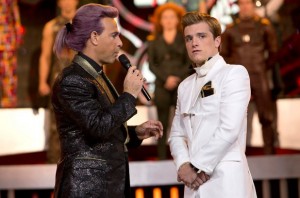
In the new film combatants and sweethearts Katniss (Jennifer Lawrence) and Peeta (Josh Hutcherson) have returned from the 74th Annual Hunger Games victorious to become the toast of the nation. While on a Victory Tour to Panem’s various downtrodden districts, revolution is in the air. They see Katniss as a symbol of freedom, which, of course, doesn’t sit well with President Snow (Donald Sutherland), the country’s autocratic leader. To quell the revolution he and his head gamesmaker (Philip Seymour Hoffman) devise the trickiest Hunger Games yet, the Quarter Quell that will pit former winners against one another in the battle to the death. If Snow gets his way Katniss will be killed and the revolution squashed.
“Hunger Games: Catching Fire” is a better movie than the first installment.
Set decorated and costumed (as played by Elizabeth Banks, District 12 minder Effie Trinket has the most elaborate futurist art deco costumes since “Metropolis”) to within an inch of its life, but has nonetheless has a gritty edge. It doesn’t feel like a budget big franchise movie and that’s a good thing,
Visually as well as thematically it has more edge than any of the recent Marvel movies. And it skirts around the thing that upset many people about the first movie—the idea of kids killing kids—by setting the action between former victors ranging in age from 20s to 70s.
It creates a world with it’s own rules, style and customs and does so convincingly. In part it’s comprised of things we’ve seen before in everything from the human sacrifices of Greek Mythology to reality television to stories of government corruption on the news, but author Suzanne Collins and director Francis “I Am legend” Lawrence tie it together to create something new.
In many ways it breaks the mold of what we expect from a young adult a blockbuster. The focus is on the characters and the underpinning of romance that snakes throughout the story. The action sequences are few and far between and it takes almost an hour before any of Katniss’s trademark bow-and-arrow dexterity comes into play. (Silly complaint: the number of arrows in her quiver changes from shot to shot! Just when you think she’s out, arrows magically appear.)
Sure there’s poison fog, angry animals and vicious victors but it’s about survival and relationships not the wholesale slaughter of the characters. It’s grim, shot in hues of grey with a perpetually overcast sky, which lends it a classic feel, more like 1970s sci fi than the brightly couloured eye catchers Hollywood makes these days.
“Hunger Games: Catching Fire” has a who’s who of a cast—Woody Harrelson, Lenny Kravitz, Jeffrey Wright, Stanley Tucci, Jena Malone, Brit heartthrob Sam Claflin and Amanda Plummer—who all perform well, lending some gravitas to the story, but it is carried by Lawrence whose vision for Katniss is as straight as an arrow.
At one point in “Delivery Man,” a remake of the much-loved French film “Starbuck,” David Wozniak’s (Vince Vaughn) father (Andrzej Blumenfeld) says, “If you can live with his countless faults you’ll have some marvelous times.”
David is a sweet tempered, kind oaf who never seems to make the right decision. That’s a fault that has landed him $80,000 in debt, desperate for cash and, as if that wasn’t enough, he’s also the biological father of over 500 children. To say he brings some baggage with his good nature is an understatement along the lines of calling Miley Cyrus show-offy.
Vaughn subs in for French star Patrick Huard in this almost shot-for-shot remake of the original film. He’s a man-child who, “everyday finds new ways to push the limits of incompetence,” but learns commitment and responsibility after discovering that his sperm bank donations unwittingly made him the father of 533 children, 142 of whom have filed a class action lawsuit to learn their biological father’s real identity.
“Delivery Man” features a much more low key Vaughn than we’ve seen lately, and that’s a good thing. His slick motor mouth act got tired around the same time the housing bubble burst but with very few exceptions—Into the Wild being one of them—he’s been coasting through movies like “Fred Claus,” “Couple’s Retreat” and (worst of all) “The Watch.”
But he’s not a one trick pony and “Delivery Man” reminds us that there is more to him than verbal dexterity and sardonic wit.
He hands in a charming performance with all the rough edges buffed away in a movie that is unabashedly sweet—some might say corny—but there is no cynicism here and that is the movie’s main strength.
Who wants to be a millionaire? Woody Grant (Bruce Dern) that’s who. He’s a Don Quixote character of “Nebraska,” tilting at windmills, clutching a worthless ticket he thinks is worth a million bucks.
When we first meet Woody he’s walking to Lincoln, Nebraska from Billings, Montana. There’s erasable and then there’s Woody, a cantankerous man who thinks the “You may already be a winner” notification he received in the mail is a ticket to a fortune. But at the rate he’s going it will take him months, if not years to make the journey to claim his prize in person in a city two states away. “I’m going to Lincoln if it is the last thing I do,” he says.
After several failed attempts to hoof it to Lincoln, Woody’s son David (former “SNL” star Will Forte) offers to drive him. He knows the ticket is of no value but sees the trip as a way of spending some time with his father.
As father and son travel across flyover country, through landscape as weathered as Woody’s face, David pieces together fragments of his father’s life to form a fully developed picture of who the man he calls Dad really is. The trip is both physical and emotional.
“Nebraska” is a plain spoken but lyrical black-and-white film about a man grasping at a last chance for a legacy and a son who understands the ticket is worth more than money, it is the thing that gives Woody something to live for.
Sounds serious, and its ideas about how children interact with their aging, ill parents certainly have weight to them, but director Alexander “Sideways” Payne ensures the film is nimble and very funny in places.
The humour doesn’t come in the set-up-punch-line format but arises out of the situations. A scene of Woody’s gathered family—his elderly brothers and grown sons—watching a football game redefines the word taciturn but the subject of the sparse conversation, a 1974 Buick, is bang on, hilarious and will likely sound familiar to anyone with a large family.
Dern hits all the right notes, adopting the blank stare of a man overwhelmed by life for most of the movie. It’s a simple but effective performance in which Dern strips away almost all the artifice and presents a raw, unfiltered take on aging.
Dern shares virtually all his scenes with Will Forte. On the surface Forte’s casting is a strange choice. He’s best known as a comedian and while he has the odd funny line in “Nebraska,” he is primarily required to do much of the dramatic heavy lifting. It took me some time to divorce his most famous character, MacGruber, from what I was seeing on screen but soon enough his straightforward performance drew me in.
Supporting actors are carefully cast. Stacy Keach, who does a mean Elvis Karaoke, is suitably menacing as a former business partner who tries to cash in on Woody’s alleged new wealth and Tim Driscoll and Devin Ratray as thick-headed cousins Bart and Cole will make you long for the heyday of Beavis and Butthead.
Near the end of “Nebraska” there is one shot that sums up the reflective feel of the film. Peg (Angela McEwan), one of Woody’s ex-girlfriends, sees him in town for the first time in decades. They don’t speak, but the wistful look that blossoms across her rugged face perfectly visualizes the movie’s contemplative examination of a life lived.
“It was the idea of connecting with another human being at a deep level,” that attracted John Bourgeois to acting. “I think that is what all artists try to do. We try to penetrate and get through to other people. To feel connected,” says the veteran mainstay of stage and screen.
“I came from a loving but troubled family that experienced the usual catastrophes (drugs, alcohol, adultery, divorce, debt) so there’s wasn’t a lot of support for higher education or culture.”
“That said, when I told them I was going to be an actor they encouraged me to go for it. Both my mother and my father had searing regrets for the roads not taken so they didn’t want me to have the same experience.”
He came across his love of acting quite by accident while studying journalism at Concordia in Montreal.
“It wasn’t until I was in second year university and honestly I needed to do a course where I didn’t need to write a paper,” he says. “So I took an acting course on a Monday night. That was it. I was bitten. I did a scene from Death of a Salesman and it was transformational.
Around the same time he worked as a production assistant on a film called Blood Relatives and for the first time saw how a performance was created.
“I had been around actors in my younger life and I didn’t know what they did until I saw a specific performance. I saw it being created and I went, ‘I see what this person is doing and it is really quite a craft they have going there.’ It wasn’t just showing off.”
That actor was Donald Sutherland. “I was his driver on the movie. Sutherland is a very thoughtful person and his approach to his work was very thoughtful. That changed my view of the craft.”
Despite booking three plays in his final year of university and thinking, ‘How hard can it be to make a living at this?’ he says, “the struggle, at the start, it’s mostly a financial one. There’s always a danger that the hustle will distort your character. That very nearly happened but I was fortunate to meet some very honest and good people along the way who kept me from self-destructing. So yes, I would do it again.
“Being an actor means being a great observer and that’s a great angle from which to experience life. Besides, resistance sharpens the senses and makes us keenly aware of the passing moment. And surely being present and connecting with others is what it’s all about.”
That passion for acting and relating to audiences hasn’t dimmed over the course of 100 plus film, television and stage roles—“You have to wear a lot of different hats in order to make a decent living,” he says—but recently, in addition to co-starring with Whoopi Goldberg in the TV movie A Day Late and Dollar Short, he has discovered a new way to practice his craft.
“I came to teaching relatively late,’ he says of his job as program director of Acting for Film and Television at Humber College. “The biggest revelation to me is that it is as much a craft as any other you can think of. It is a form of performance. You’re standing in front of people, talking. What I have discovered, when you teach you discover stuff about your craft.
“It puts your own relationship to your craft under a magnifying glass and you become fascinated by what it is that frees up creativity in an actor, how you can equip them with the right toolbox to give them that sense of liberation in their work. It is immensely gratifying.”
With a lifetime of experience under his belt he has some great advice for his students.
“Don’t ever wait for the phone to ring,” he says, “That’s a waste of time and energy. Instead act. Anywhere and everywhere. Make your own work. Love the craft and above all protect your talent from the harsh realities of the business. Find ways to practice it. Train with leading practitioners like at Humber. Produce a play. Make a web series. Act. Do. Everything else is gossip.”
SIDEBAR:
In his latest gig Ottawa-born actor John Bourgeois is stepping into some very big shoes. In the dramedy God of Carnage, now playing until December 15 at the Panasonic Theatre in Toronto, he’s lawyer Alan Cowan, previously played by Jeff Daniels on Broadway and Christoph Waltz on film.
He’s seen both productions but says neither inspired him. “I’ve been doing this for so long so I don’t find myself as easily influenced as I was when I was a young actor,” he says, his booming voice echoing down the line on a break from rehearsal. “I think young actors are more susceptible to those iconic influences.”
Instead, he drew on personal experience to build the character.
“I’ve known quite a few lawyers who are A type, personality driven, really competitive, hyper focused but sometimes they are a little socially tone deaf and that’s where I picked up Alan.”
In a recent tweet-a-thon to promote Delivery Man Cobie Smulders teased that people should go see the film because Chris Pratt gets naked.
“He doesn’t get naked,” she says a week later, admitting to the fib.
“That was very overwhelming. I had never done that before. There were 9000 tweets and I didn’t know what to do. It was crazy. I was trying to write and my phone was (shaking).”
The Canadian-born How I Met Your Mother actress stars opposite Vince Vaughn in a remake of Starbuck, a popular French-Canadian film about a man who finds personal redemption when he learns he is the father of 533 children.
“I went into watching Starbuck and then reading this script, like, ‘533 kids… from a sperm donor! What’s this going to be?’
“It’s still super funny, but I found myself affected by the way he connected with the children. The way they connected as human beings. Going out and doing a good deed and having it affect somebody in a positive way. I’ve always believed when you do good, you get good in return. That’s when I feel my best and there are many aspects of that in this film.”
The sweet, uplifting message of Delivery Man struck a chord with Smulders who says she “related to it on a parental level. I’m a mom myself and I think it touched upon so many themes of family and of being a parent.”
The story has also resonated with audiences.
The original film was 2011’s most successful homegrown film in Quebec. Smulders thinks the appeal of this very specific story has to do with its universality.
“It’s a blown up version of something that happens in real life,” she says. “You had a relationship when you were younger and all of a sudden a woman contacts the father and, ‘Oh, by the way, you have a seven year old.’ Obviously there is room for comedy there but everyone wants him to step up and be the hero and watch him do that journey.”
“We were so lucky to have [original director] Ken Scott. He did it so well the first time that he was able to do it a second time and have those same sentiments in it and spoken in English.”
Now there’s even talk of a Bollywood remake.
“We should have done a Bollywood song and dance at the end of our movie,” Smulders laughs.
Is Stanley Tucci the busiest actor in Hollywood? This year alone added five movies to his IMDB page with five more in the pipeline for 2014.
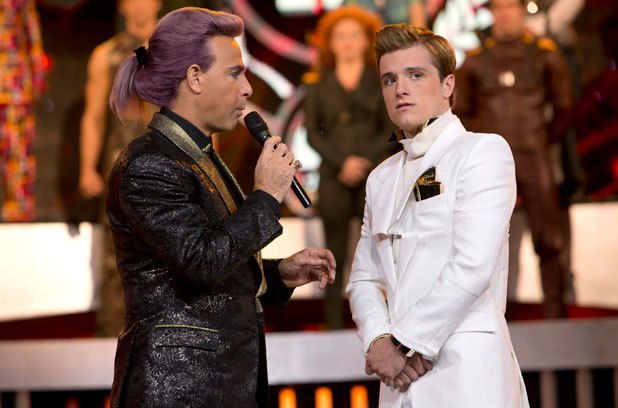
This weekend in Hunger Games: Catching Fire, he plays Caesar Flickerman, the elaborately coiffured host of The Hunger Games television broadcasts. Despite being disguised with wild wigs, fake teeth and plenty of bronzer, it is unmistakably Tucci, one of the most interesting actors working today.
He made his big screen debut in the 1985 gangster comedy Prizzi’s Honor followed by several years of dues-paying stage work and movie roles like Second Dock Worker in Who’s That Girl before landing recurring spots on Miami Vice and Wiseguy.
A succession of supporting roles lead to the one-two punch that made him a name actor. Producer Steven Bochco’s television drama Murder One cast Tucci as Richard Cross, a Machiavellian multi-millionaire accused of the strangulation of a 15-year-old girl.
The following year a much different part earned him an Independent Spirit Award nomination for best actor. In The Big Night he plays Secondo, owner of an Italian restaurant called Paradise. The place is slowly going broke but may get a boost from a visit by singer Louis Prima. If Prima shows up the restaurant will have a big night and be saved from bankruptcy.
It’s not only one of the greatest food movies ever made — you’ll want to go for risotto afterward — but it also features what Rolling Stone’s Peter Travers called “an unforgettable acting duet” between Tucci and Tony Shalhoub, who plays his temperamental chef brother, “that is as richly authentic as the food.”
Since then Tucci has played everything from villains — strangling a Supreme Court justice in The Pelican Brief — to a flamboyant nightclub manager in Burlesque, to the God of wine Dyonisius in Percy Jackson: Sea of Monsters to Puck in A Midsummer Night’s Dream. Opposite just Meryl Streep alone he’s played everything from a gay art director in The Devil Wears Prada to Julia Child’s loving diplomat husband Paul in Julie & Julia.
In 2010 he received his first (but probably not last) Oscar nomination for his work in The Lovely Bones. He played the murderous Mr. Harvey, all twitchy movements and squeaky voice; he was Norman Bates without the overbearing mom.
“I don’t like to watch things about serial killers or kids getting hurt,” he said, “but this was something beyond that. It was an exploration of loss and hope.”
 Richard’s “Canada AM” interview with “Delivery Man” co-star Cobie Smulders.