This is a ridiculous movie. First the casting of Ben Affleck as Jack Ryan just doesn’t make sense, chronologically (he’s already been played by the much older Harrison Ford and Alec Baldwin) or physically – Affleck just isn’t commanding enough for the role. Secondly the movie is simply capitalizing on North America’s new found fear of terrorism on home turf, and thirdly the screenwriter Paul Attanasio took huge liberties with the Tom Clancy novel, including, in a stroke of misguided political correctness, changing the bad guys from Middle Eastern to Nazis. Of course everyone hates Nazis, so the filmmakers are not going to offend anyone (Hollywood finds it so hard to get good hateful villains now that Russia is no longer communist) but are we to believe that there is a worldwide conspiracy by super-rich and powerful Nazis to pit two world powers against one another? And how, after the blast (yes, there is a huge atomic explosion), does Ben Affleck piece together this entire conspiracy using only a cell phone and a palm pilot? I’m willing to suspend disbelief in most movies, but this movie has holes big enough to fly a jet through.
In this era of product placement one very obvious bit of marketing was overlooked in The Omen, the remake of the spooky 1976 film starring Gregory Peck. It seems to me that Trojan condoms should have sponsored this movie because after seeing it if the prospect of giving birth to the anti-Christ isn’t an incentive for birth control I don’t know what is.
In the reworking Liev Schreiber plays Robert Thorn, aide to the American ambassador to Italy. His wife, Kate (Julia Stiles) is pregnant but there are complications. At the hospital he is told by a mysterious priest that their baby has been born dead, but another child, born at virtually the same time, whose mother died in childbirth is available. The priest convinces the grieving father not to tell his wife of the switch and the couple raise the child, named Damien, as their own. Five years later when Thorn is made ambassador to Great Britain strange things start to happen in their new mansion. The rest of the movie can be summed up thusly: Big creepy house, little creepy kid.
As the leads Schreiber brings a square-jawed determination to his role, while Stiles copes as best as one can when raising the child of the Devil. In a smallish supporting role Mia Farrow returns to the devil-child genre almost 40 years after Rosemary’s Baby made her a star, as Mrs. Blaylock, a demonic wet-nurse with the movie’s only funny lines.
With the multitude of sequels and remakes hitting the theatres this summer everything old is new again, but that saying is especially true in the case of The Omen, which is more than a remake, it’s a cover version of the old film. Line for line and shot for the shot this new version of the film simply replaces the original cast with current actors, updates the technology—e-mail replaces snail mail—and dismisses some of the outdated 70s mores of the first one to recycle the story for a new generation. The movie is hair-raising enough and the mysterious murders are a little more graphic and disturbing than the original, but the only reason I can see for remounting this movie is the once-in-a-century chance to open it on the demonic date June 6, 2006—6/6/06.
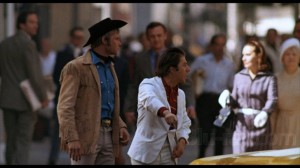
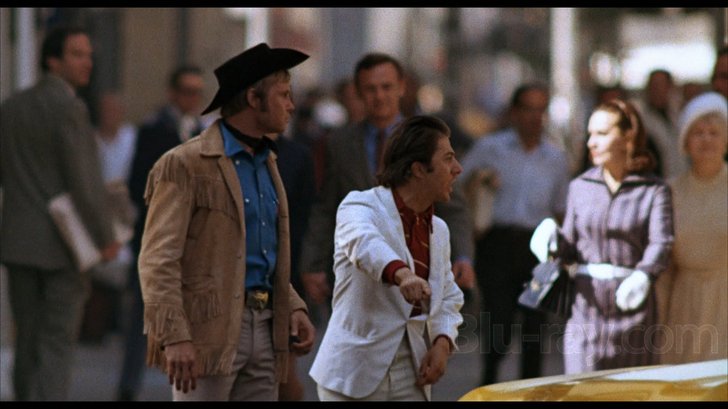
Vanity Fair called the scene in 1969’s Midnight Cowboy where street hustler Ratso Rizzo (Dustin Hoffman) slaps the hood of a taxi and yells, “I’m walkin’ here!” the movie’s most iconic scene. It is memorable and although it looks carefully planned, was completely improvised.
“They didn’t have the money to close down a New York street,” Hoffman told Peter Biskind in Vanity Fair, “so they were going to steal it [shoot guerrilla style, without permits]. The camera was in a van across the street. It was a difficult scene logistically because those were real pedestrians and there was real traffic, and [director John] Schlesinger wanted to do it in one shot—he didn’t want to cut. He wanted us to walk, like, half a block, and the first times we did it the signal turned red. We had to stand there, and it was killing us, because Schlesinger was getting very upset. He came rushing out of the van, saying, ‘Oh, oh you’ve got to keep walking.’ ‘We can’t, man. There’s fucking traffic.’ ‘Well, you’ve got to time it.’ ‘Well, we’re trying to time it.’ It’s the actors who always get the heat. It was many takes, and then the timing was right. Suddenly we were doing this take and we knew it was going to work. We got to the signal just as it was turning green, so we could keep walking. But it just happened—there was a real cab trying to beat the signal. Almost hit us. John, who couldn’t see anything in the van, came running out, saying, ‘What was that all about? Why did you ruin it by hitting the cab? Why were you yelling?’ I said, ‘You know, he almost hit us.’ I guess the brain works so quickly, it said, in a split of a second, ‘Don’t go out of character.’ So I said, ‘I’m walking here,’ meaning ‘We’re shooting a scene here, and this is the first time we ever got it right, and you have fucked us up.’ Schlesinger started laughing. He clapped his hands and said, ‘We must have that, we must have that,’ and re-did it two or three times because he loved it.”
Midnight Cowboy, the story of a green male prostitute (Voight) and his sickly friend’s (Hoffman) struggle for survival on New York City’s mean streets, was very controversial when it was released in 1969. The film—about which one studio exec laughably said, “If we could clean this up and add a few songs, it could be a great vehicle for Elvis Presley”—was originally rated X, before that rating became the domain of the porno industry, so there is a truckload of trivia about it. At the April 7, 1970 Oscar ceremony it was the first, and so far only X-rated film to win the Best Picture Oscar; Jimmy Carter requested it be shown in the White House screening room, making it the only X-rated film to be shown to a U.S. President while in office and it was the first X-rated film to be shown on television, although the film’s rating had been changed to R by the time of the film’s television premiere.
Co-stars Jon Voight and Hoffman—who kept pebbles in his shoe to ensure his limp would be consistent from shot to shot—were both nominated for Best Actor Oscars, but went away empty handed.
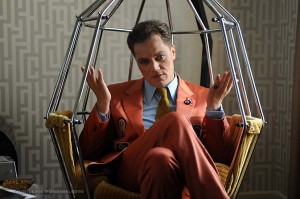
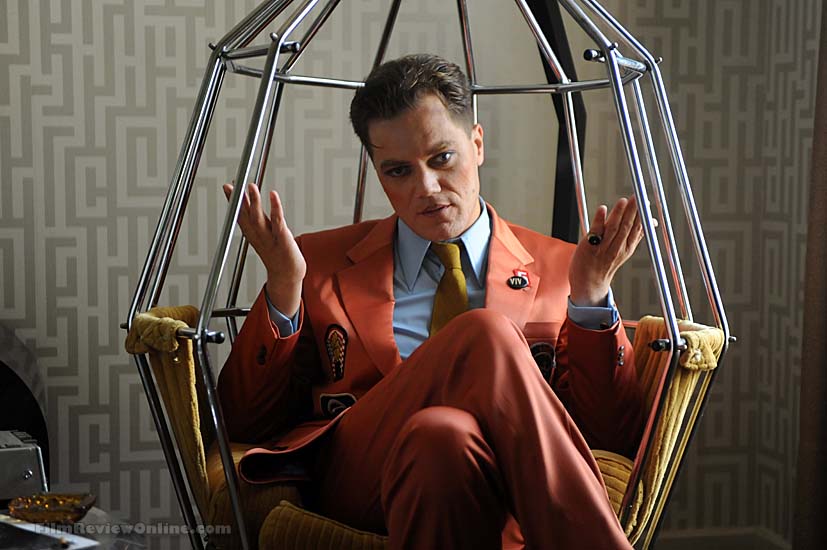
Set back when you could still drink a bottle of stolen booze in the shade of the Hollywood sign without being arrested for trespassing, The Runaways focuses on two glue sniffing, glam rock obsessed tough girls named Joan Jett (Kristen Stewart) and Cherie Currie (Dakota Fanning). Disaffected SoCal teens, they see an exit from their mundane suburban lives through rock ‘n’ roll. Unfortunately their ticket out comes in the form of impresario Kim Fowley, a record producer and self proclaimed “King Hysteria” played here by Michael Shannon.
Although twenty years older than the girls, he cobbles together the band, trains them to be rock stars, convinced that these “bitches are going to be bigger than the Beatles.” Before they can play Shea Stadium, however, the band breaks up—knee deep in ego, drug abuse and bad management.
It’s a gritty, down-and-dirty rock ‘n’ roll movie; a ninety minute ear blistering blast of feedback. Looking for depth? Won’t find it here; for that wait for the biopic of Emerson, Lake and Palmer. What you will find is a carefully crafted coming-of-age story anchored by remarkable performances and memorable dialogue.
The film’s showiest role belongs to Michael Shannon as Kim Fowley, one of the most colorful characters to ever slink off the Sunset Strip. He is the very personification of glam rock—campy, dangerous and slightly unhinged.
Kristen Stewart and Dakota Fanning have the lion’s share of screen time, but it is Shannon who handles most of the movie’s flamboyant dialogue. He’s over-the-top, describing their music as “the sound of hormones raging,” and rock and roll as being for “the people in the dark. Sex, violence, and revolt: that’s our product.” It’s a bravura performance that could have gone very wrong in the hands of a less committed actor, but Shannon pulls it off with wild aplomb.
In one pivotal scene, Fowley, confident to the point of being arrogance, introduces himself to the fifteen year old Cherie Currie in a dingy Sunset club with a line that completely sums up his character, “I’m Kim Fowley, record producer. You’ve heard of me.”
When asked about the line Shannon didn’t think it came from arrogance, however. “It seems like something someone would say,” the actor said. “I think the thing that is easy to forget is for an older man to talk to teenagers can be very intimidating. Teenagers are not always mindful or respectful of their elders—particularly teenagers going to hang out in a rock and roll club on Sunset Boulevard.
“So, I think Kim, to do what he did, needed to have a lot of confidence and exude a lot of confidence in order to get people to do what he wanted them to do. I think part of the reason he talks that way is because he’s nervous, because anytime anybody acts like they’re in control of the situation they always run the risk of actually not being in control of the situation; being revealed as screw up. I think a lot of his hubris is to cover up that nervousness.”
“I was a little bit nervous when I wrote [the script] because [Fowley] talks in such a mouthful but Michael Shannon really owned it,” said director Floria Sigismondi, “and he owned the darkness and the humor at the same time.”
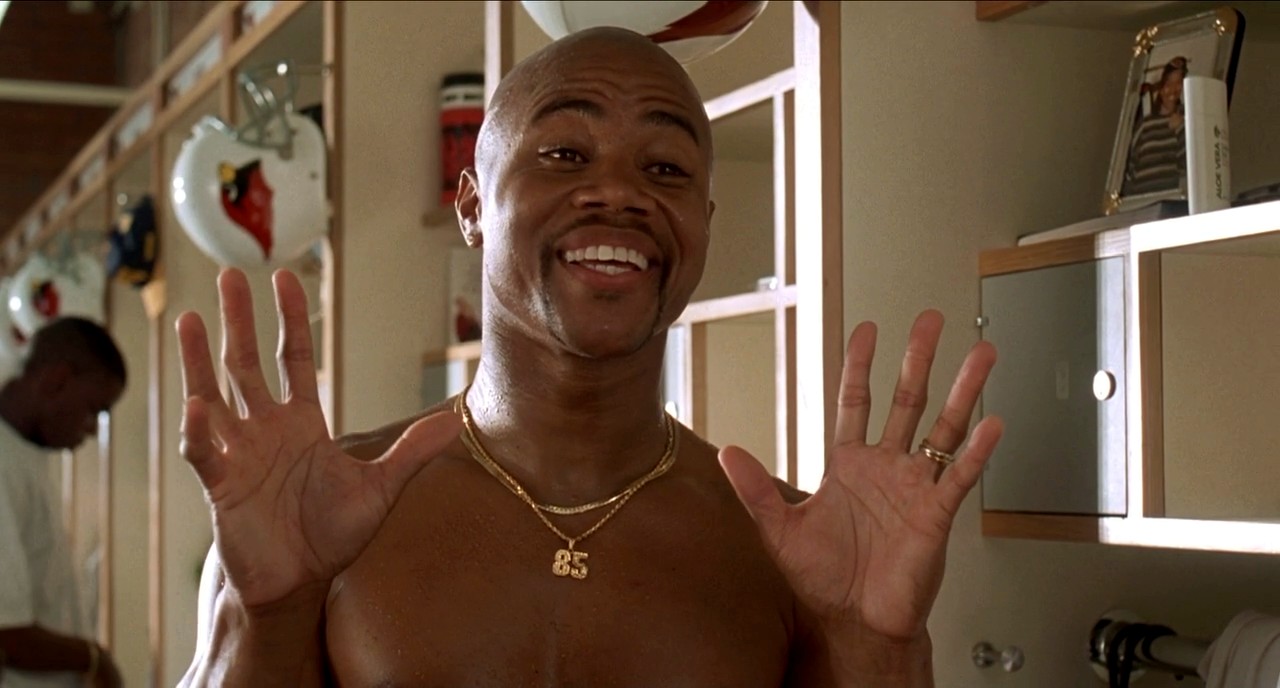
Cameron Crowe, writer and director of Jerry Maguire was surprised when people started quoting the “Show me the money” line from his movie.
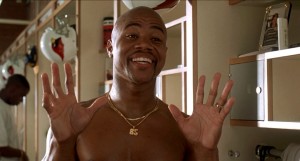
“The line I thought might resonate was not ‘Show me the money,’” Crowe told Premier. “It was Rod Tidwell (Cuba Gooding Jr.) talking about ‘the Kwan’—his own personal coinage for the combination of love, respect, and money. I like to think that Tidwell had been jealous of Dennis Rodman’s blend of pseudo-French trash-talk ‘inspirato.’ He wanted his own language, too, so ‘the Kwan’ was born. But once we began to show the movie, audiences were pleasant, at best, during Rod’s ‘Kwan’ speeches. It was the phrase that Cuba Gooding Jr., as Tidwell, forces the beaten-down Tom Cruise to scream that whipped them into a frenzy, ‘Show! Me! The! Money!’
“The line showed up in everything from a Bill Clinton speech to the Westminster Kennel Club dog show. Who knows exactly why? I suspect the high-octane chemistry between Gooding and Cruise ignited the words.
“The actual phrase was a mini-tribute to two people. One was Tim McDonald, the 49er defensive back, whom I’d interviewed during a negotiation period. ‘I work hard, I’ve served five years of my contract,’ he said to me. ‘Where’s the money? Where is the money?’ I’ve always remembered the confusion and desperation and need to support his family—all screwed up on his face as he waited for offers.
“Later, when writing, I turned McDonald’s yearning for financial self-worth into a war cry, with a little bit of my friend, producer, and coinage-king Art Linson thrown in for good luck. The ‘Show me the money’ sequence was a pure joy to direct. But I’ve always held a soft spot for the unnoticed concept of ‘Kwan.’ Some time later, during an Olympic performance by ice-skater Michelle Kwan, a friend called and told me to turn on the television. In the middle of a huge crowd, a lonely fan held up a sign reading ‘Show me the Kwan.’ Thank you for that.”
There was more to Cuba Gooding, Jr.’s performance than the catchphrase, of course—he won the Oscar for Best Supporting Actor in 1997—but that line seemed to turn up everywhere in the late nineties, and in 2005 was voted number 25 on the American Film Institute’s 100 Movie Quotes: America’s Greatest Quips, Comebacks and Catchphrases list.
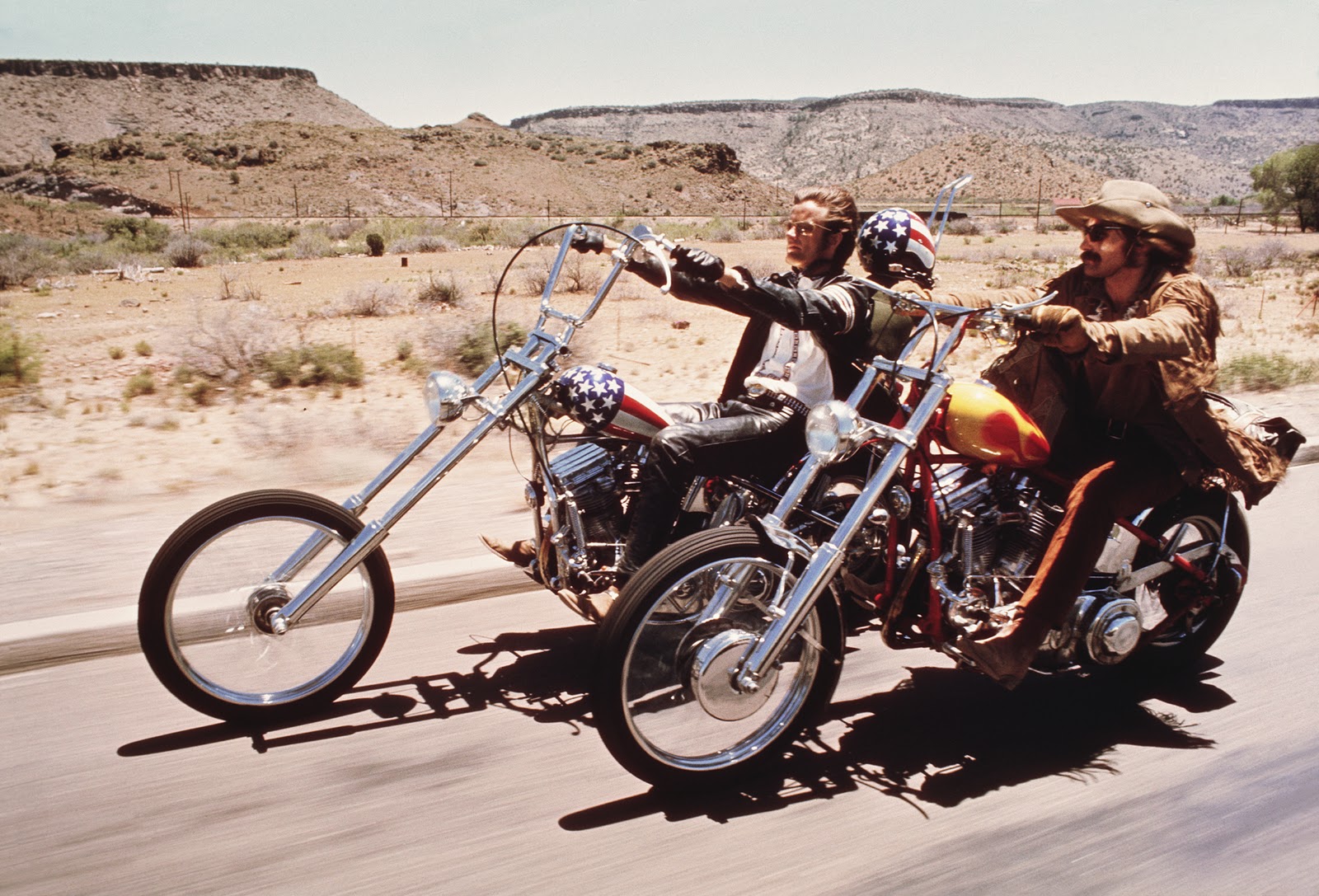
Roger Ebert calls Easy Rider one of the “rallying-points of the 1960s” but, like S&H Green Stamps and go go boots, seen through today’s eyes it seems a bit dated. The stoner dialogue is littered with hippie axioms—an intense and very drunken drinking game could be played by taking a swig every time Hopper says “man”—but one enigmatic three word sentence in particular still resonates forty years later.
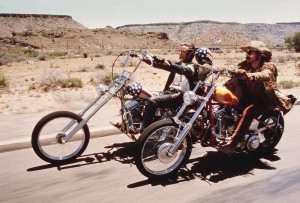
Following the film’s Mardi Gras / LSD sequence Billy (Hopper) and Wyatt (Fonda) hit the road, continuing their trip (double entendre intended) to Florida.
“We did it, man. We did it, we did it. We’re rich, man,” says Billy, referring to the drug money hidden inside the Stars & Stripes- festooned fuel tank of Wyatt’s Hydra-Glide chopper. “We’re retirin’ in Florida now, mister.”
Instead of reveling in the moment Wyatt answers cryptically, “You know Billy. We blew it.”
The meaning of the line has been the source of great debate. Some critics felt it was a comment on the futility of their life on the road; that Wyatt feels by leaving the commune he’s blown his chance at happiness. Others suggest the “it” represents everything from the American Dream, to the failure of the Woodstock Nation to really change the world, to freedom and self discovery.
Hopper has a simpler, more straightforward explanation. He claims the line refers to the corrupting power of their stashed drug money, how it stripped away some of their innocence.
“When Peter says, ‘We blew it’, he’s talking about easy money, that we should have used our energies to make it.”
Fonda is more tight-lipped on the meaning. He wants each viewer to bring their own perception to the line, but in 2010 he told The Toronto Star’s Peter Howell, “Is it still relevant? Look out the window and tell me that we haven’t blown it.
“We’re at war about religion (in Iraq and Afghanistan). We kill each other for racial and bigoted reasons, too, and sometimes just because we’re in the wrong gang. We do all these things today and we do them with much more gusto than we did in 1968 when we made that film.”
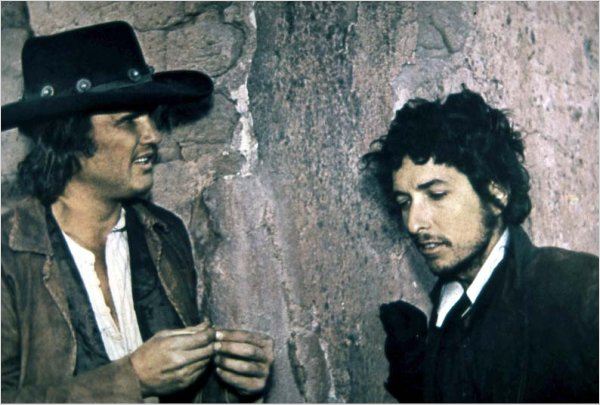
Kris Kristofferson has worked with a laundry list of brand name directors—Martin Scorsese, John Sayles and Tim Burton to mention a few—but his relationship, both professional and personal, with Sam Peckinpah tops them all. Not only did the hard drinking duo make three films together, Bring Me the Head of Alfredo Garcia, Convoy and the misunderstood classic Pat Garrett & Billy the Kid, but in tribute to the director Kris also wrote and recorded two songs, One for the Money and Sam’s Song (Ask Any Working Girl).
Peckinpah, known as one of Hollywood’s most hardheaded directors—at his funeral Robert Culp said what was surprising is not that Peckinpah only made fourteen movies, but that given the way he worked, that he was able to make any at all—returned the compliment, saying, “I like Kris because he writes poetry and he’s a fucking good man.”
The actor and director clicked, Kristofferson says, because they had self destructiveness in common. “Sam was an artist like I thought artists were. He was self destructive and the most important thing in his life was what he was creating. Unfortunately a lot of people who are built that way burn out.
Feeding the legend of Peckinpah’s prodigious intake of booze was a gag photo taken on the set of Pat Garrett & Billy the Kid showing the director laid out on a stretcher being fed whiskey through an IV bottle as cast members carried him.
“I don’t think his art came from his self destructiveness, that’s what destroyed his art. I don’t think you have to be self destructive to be a great artist. Some of us just have so many inhibitions going into it that to free ourselves we need to hit ourselves in the head with a hammer. Fortunately I don’t have to do that anymore.”
Peckinpah’s legendary battles with actors and studios may have been his undoing. “He was an artist and he was his own worst enemy,” says Kristofferson. “His work and it came first in front of everything else. I had the feeling it was burning out his energy at the end. He was spending so much time arguing with MGM, you know, that Pat Garrett suffered for it and they took it away from him. They stole it.”
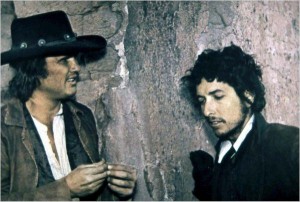
Pat Garrett & Billy the Kid, the story of former desperado turned lawman, Pat Garrett (James Coburn), and his quest to hunt down his old friend Billy the Kid (Kristofferson, age 36 playing a character of 21), was typical of the troubled productions that plagued Peckinpah’s career. But despite the turmoil, Peckinpah, who usually ruled his sets with a firm (although frequently drunken) hand, showed the singer-turned-actor respect, permitting him to change the script.
It happened during a scene where Billy the Kid blasts Deputy Bob Ollinger (R.G. Armstrong) with a shotgun loaded with 16 silver dimes. After the shot Billy the Kid wryly says, “Keep the change, Bob!”
“That was an adlib,” says Kristofferson. “I’m not sure Sam wanted that to happen but he recognized immediately when something was coming out more honest than the other.”
Later, in a scripted moment, Billy adds a second punch line to the macabre joke. When confronted by a man looking to be reimbursed for the horse Billy stole after shooting the Deputy the outlaw says, “There’s a buck-sixty in old Bob if you can dig it out.”
“I don’t think [Pat Garrett & Billy the Kid] was one of his best,” says Kristofferson, citing The Wild Bunch and Straw Dogs as the director’s masterpieces, but he relished the experience anyway, as did Peckinpah. “Working with Kris on Pat Garrett & Billy the Kid was one of the great experiences of my life,” he said.
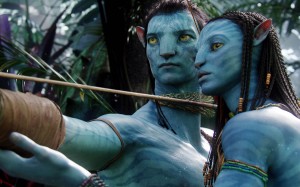
Paul Frommer has a varied resume. He taught English and math in Malaysia with the Peace Corps, is an American communications professor at the University of Southern California and the former Director of the Center for Management Communication at the USC Marshall School of Business. Most intriguing, however, is his designation as “alien language creator” on the James Cameron film Avatar. As the originator of the Na’vi language used by the fictional indigenous race in James Cameron’s 2009 film, Frommer is responsible for the most popular alien lingo since Klingon.
“Klingon is the gold standard for constructed alien languages,” says Frommer. “It is an extremely complex language. Of course, that language has been around for twenty five or more years and I think it is fair to say it took Klingon years to get to the point that Na’vi seems to be right now. Of course the reason is the internet, and the fact that a community can develop almost overnight and attract very many people who are interacting, and sharing material and supporting one another. I think in practical terms that’s why the language has gotten to the point it is now.”
Frommer was contacted in 2005 by Cameron’s people about creating a language for Pandora’s giant blue people. “I had a ball talking to him about language in general and about his vision for the film,” says the linguist. He left the meeting with a copy of the script and a mandate to create a unique language with “real rules, grammar and vocabulary.”
“[Cameron] wanted it to sound good; to be pleasant sounding. He wanted it to reflect the culture of the Na’vi on Pandora. I didn’t start from absolute zero. He had come up with a few words on his own, about thirty vocabulary words, the names of characters and the names of some animals and so on. So I had a bit of a sense pof the sound he had in mind. It sounded kind of Hawaiian to me, or maybe Maori, kind of Polynesian. Then I added some sounds that I thought would be kind of fun and the grammar was mine.”
The language in place, the next step was to teach the actors not only how to speak the language but to sound fluent.
“There were times when I was on set for twelve and thirteen hours,” says Frommer. “I couldn’t be there all the time because I have a day job but whenever I could and whenever the language was being used I was on set. I met with each of the actors ahead of time, maybe a couple of weeks before they would shoot a scene where they had to speak Na’vi. I gave them transcriptions of what they had to say and also I gave them an Mp3 filer so they could download them onto their i-pods or whatever and practice.”
Prep is one thing, but on a James Cameron production Frommer says you have to be on your toes.
“On the set there were a few times when the lines changed,” he says. “I thought for a film of this scope everything would be totally determined before they walked on set, but, in fact, I discovered there is a lot of creativity that happen on the spur of the moment. There were moments of panic when people came up to me and said, ‘Paul we need this line. We need to know how to say that.’ If I had the words and had the grammatical rules that was fine, but there were times when I had to say, ‘Give me a few minutes,” and I sometimes had to coin a few words. I can give you my most memorable example of that.
“There was a time when Sam Worthington and James Cameron came up to me and said, ‘Paul we’ve decided that Jake is going to be telling a story at this point in Na’vi and it is about a predator animal that almost bit him on his big blue ass. How do you say big blue butt in Na’vi?
“Well, I had the word for big and I had the word for blue, but I did not have the word for butt. I said, ‘Give me a few minutes.’ I tried to come up with something good and I tried it out on some people who were around and some people liked one word, some people liked another, but we decided the word was ‘Txìm’ so my big blue butt became ‘Tsawl ean txìm.’” (Na’vi spelling courtesy of Navilator.com.)
Since then the language has continued to thrive and grow.
“It’s remarkable how many people are interested in the language,” says Frommer. “For some people it is a way of holding on to the world of Pandora. It is a world a lot of people find extremely attractive. Then are there people who are very much into language. I’m pleased they find this language interesting, intriguing and challenging and want to be able to speak it. I would like to see it develop further and whatever I can do to help I certainly will, but interestingly it is kind of no longer entirely mine and that is a good feeling.”
Every actor has had one. A howler of a line that in retrospect might have been better left unsaid. Meryl Streep managed to live down “The dingo’s got my baby!” and Kelly Preston emerged from Battlefield Earth bloodied but unbowed after mouthing “I am going to make you as happy as a baby Psychlo on a straight diet of kerbango,” but not all actors are as lucky.
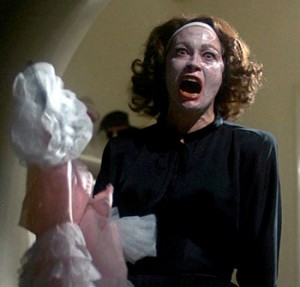
Take for instance, the example of an Oscar winning actress who went from hero to zero following a bonkers line reading in the movie Mommie Dearest. “It was meant to be a window into a tortured soul,” Faye Dunaway said of her performance as Joan Crawford. “But it was made into camp.”
“No wire hangers ever,” not only sunk Dunaway’s career, but Mommie Dearest fan John Waters adds it “probably really hurt the wire hanger industry” as well.
Based on the controversial 1978 memoir of the same name by Crawford’s daughter Christina, which alleged the movie icon was an abusive mother who adopted her four children for publicity purposes, the movie had the makings of a searing Hollywood tell-all.
Dunaway was a well respected Oscar winner who came with the ultimate seal of approval from Crawford herself. In the early 1970s the actress singled out Dunaway as the only up-and-comer who had “the talent and class and courage it takes to make a real star.” Add to that a hot button subject, a $5,000,000 budget (equal to another 1981 hit Time Bandits) and the prestigious Paramount Pictures, home of The Godfather and Chinatown and Mommie Dearest had all the ingredients to make it an important movie. Instead it was reviled by critics and described by Waters as “the first comedy about child abuse.”
What happened? “I was too good at Crawford,” Dunaway offers by way of explanation. Others suggest otherwise. Variety opined that “Dunaway does not chew scenery. Dunaway starts neatly at each corner of the set in every scene and swallows it whole, costars and all,” while Roger Ebert wrote, “I can’t imagine who would want to subject themselves to this movie.”
The backlash stemmed from not from Dunaway’s rather remarkable physical transformation and overall performance—she almost took home the New York Film Critics Circle award for Best Actress of the Year—but for two scenes. Two over-the-top sequences played with such conviction they ruined her career as a leading lady, won her a Razzie for Worst Actress and became camp classics.
First there is the lesser known, but wild scene in a rose garden that culminates with Crawford screeching “Tina! Bring me the axe!” But the campy pièce de résistance, the scene that single handedly earned the movie a place in the hearts of drag queens everywhere is the incredible “no wire hangers EVER” monologue. It’s a terrifying spectacle, Dunaway in white face—actually smeared cold cream—berating her daughter for hanging a $300 dollar dress on a wire coat hanger.
These days Dunaway refuses to talk about the movie, but at the time she said, “It was scary the first time I saw it” and later, in her autobiography blamed inexperienced director Frank Perry for the film’s excesses, suggesting he should have been able to rein in the performances.
Maybe so, but it is hard to rein in the moon and the stars and that’s what Dunaway seems to be shooting for here as she lets loose with a wild eyed tirade that must be seen to be believed. Charles Taylor of the New York Observer called it “one of the most reckless and extreme performances any star has ever dared,” and Dunaway herself admits to screeching herself hoarse while shooting the notorious tantrum.
The infamous line may have damaged both Dunaway’s career and the movie but it has found a second life, being quoted in everything from Buffy the Vampire Slayer to The Simpsons (who had an episode titled Mommie Beerest).
Ironically one of the film’s actors, Rutanya Alda (she played Joan Crawford’s personal secretary) reports that the “no wire hangers” outburst, if it did indeed happen in real life, didn’t leave a long term impression on Christina Crawford. The actress once looked inside Crawford’s real closet and there were, indeed, wire hangers.