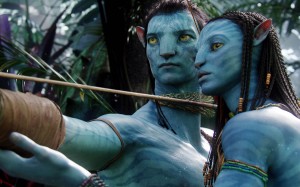
SYNOPSIS: In the third installment of the “Avatar” film series, “Avatar: Fire and Ash,” ex-Marine Corporal Jake Sully (Sam Worthington) and his Na’vi family’s peaceful way of life on their home planet of Pandora is threatened by the violent Ash People and returning baddie Colonel Miles Quaritch (Stephen Lang).
CAST: Sam Worthington, Zoe Saldaña, Stephen Lang, Sigourney Weaver, Joel David Moore, CCH Pounder, Giovanni Ribisi, Dileep Rao, Matt Gerald, Kate Winslet, Cliff Curtis, Edie Falco, Brendan Cowell, Jemaine Clement, Britain Dalton, Trinity Jo-Li Bliss, Jack Champion, Bailey Bass, Filip Geljo and Duane Evans, Jr. Directed by James Cameron.
REVIEW: “Avatar: Fire and Ash” does what cinema is meant to do; transport the audience to new worlds while reflecting and commenting on the reality of our world. An epic for the eyes, the visualization of Pandora is impressive and immersive, but the a-list visuals are let down by a b-movie story.
First, the look.
Rendered in eye popping 3D, Cameron’s concept for Pandora and her environs is spectacular will have your synapses firing on all cylinders. An ode to French impressionism by way of the sci fi landscapes of Frank Frazetta, whether his camera is gliding through the jungles of Pandora or swimming under the planet’s oceans or traipsing around gritty fire and ash biodomes or soaring though the sky on the back of a winged Great Leonopteryx, Cameron delivers a dopamine hit directly through the eyes.
It’s a whole lotta CGI, which is ironic, given that this is a story about the organic connection between nature and all of God’s creatures in which all the dazzling images were created in the least organic way possible. Still, the pictures, no matter how they were created, do come alive on the screen.
Less exciting is the story.
Cameron has spent the better part of two decades world building, creating the belief systems, language and traditions of the Na’vi people, only to hang them on the most generic of fantasy storytelling. His hot button pet themes of colonization, government overreach, community and environmentalism are very much in place, but the storytelling isn’t as passionate as the visual work.
Essentially picking up a few months after “Avatar: The Way of Water” left off, when “Fire and Ash” begins Jake (Sam Worthington), Neytiri (Zoe Saldaña), and their children Lo’ak, Tuk, Kiri (Sigourney Weaver), and Spider (Jack Champion) are grieving the death of Neteyam, the family’s eldest son.
Their peaceful life amid the reef-dwelling Metkayina clan is disrupted when Colonel Miles Quaritch (Stephen Lang), the ruthless RDA colonel reborn as a Na’vi recombinant, teams with the aggressive, volcano dwelling Mangkwan, or “Ash People,” lead by the vicious Varang (a compelling Oona Chaplin).
As Jake fights for the survival of his family, the fate of all of Pandora hangs in the balance.
Packed with big action set pieces, smaller, more intimate family moments, and one, “I am Spartacus” scene, “Fire and Ash” has a new, unsettling villain in the form of Varang but otherwise recycles old ideas under a slick CGI veneer.
The mix of A-list tech and B-movie dialogue like Quaritch’s quip, “I guess I don’t die that easy,” feels like watching a Saturday morning serial with boffo, stare-of-the-art visuals that distract from the often-cheesy dialogue.
The familiar story beats and the worn-out dialogue quickly take a backseat to Cameron’s unique vison. He is the star of “Avatar: Fire and Ash.” Like the other films in the franchise the new one invites the viewer to exit the real world and enter his world of imagination of three hours, and, despite some déjà vu story wise, it’s a trip worth taking.
“Avatar: The Way of Water” harkens back to a time when Hollywood bigshots thought, “If a picture is worth a thousand words, a 3D picture is worth a million words.” The original film, 2009’s “Avatar” was director James Cameron’s grand experiment in the audience’s tolerance for 2 hours 42 minutes of images popping off the screen.
Thirteen years ago, the million words theory worked. “Avatar” was a massive hit, grossing almost 3 billion dollars worldwide, as rumors of a series of sequels hung in the air. Delay after delay kept the blue people off screens for so long, four presidents came and went while Cameron tinkered with the story and the technology to bring his vision to life.
The tinkering is finally over. Cameron returns to theatres with the first of four planned sequels, “Avatar: The Way of Water,” an epic 3D sequel that mixes astonishing visuals with eye-rolling teenagers, a character with the b-movie name Z-Dog and a 3 hour and 12-minute tale of colonialism.
Set on Pandora, an Earth-like habitable extrasolar moon from the Alpha Centauri System populated by the Na’vi, the 9 to 10 feet tall Indigenous peoples, the movie picks up the action more than a decade after the events of the first film. Former Marine Jake Sully (Sam Worthington), who left his human body behind to permanently become Na’vi, lives on the peaceful planet with wife Neytiri (Zoe Saldaña) and children.
Their idyll is interrupted with the return of the Sky People, humans who want to“pacify the hostiles” and takeover Pandora.
“Earth is dying,” says General Frances Ardmore (Edie Falco). “Pandora is the new frontier.”
Despite having been killed off in the original, the Pandora-bound team is led by the ruthless Colonel Miles Quaritch (Stephen Lang), a genetically engineered “recombinant” or avatar version of the late Marine, implanted with his mind and emotions. “We have been brought back in the form of our enemy,” he says of he and his team. He plans on taking Pandora at any cost, and getting revenge on Sully, who he sees as a traitor.
Forced into hiding with Tonowari (Cliff Curtis), Ronal (Kate Winslet) and the reef people clan of Metkayina, Sully and his family learn the way of water—”no beginning and no end”—and fight to defend their world.
So, the big question is: Was “Avatar: The Way of Water” worth the wait?
As a technical achievement, yes, unquestionably. The visuals are stunning, particularly in the underwater scenes. Cameron’s camera has a nimbleness often missing in 3D films, which often feel locked-down. His fluid camera roams, on land and sea, capturing some of the most eye-popping, breathtaking scenes of this, or any other, season. Each and every frame is carefully considered, and most could be cut out, framed and hung on the wall to great effect.
The visuals facilitate Cameron’s world building, providing tantalizing views of the forest land of Pandora and the wet ‘n wild world of Metkayina, complete with giant whale-like creatures that could have sprung from the imagination of Ray Harryhausen, and lush, colorful flora and fauna.
It does not look like any other 3D film—even the original “Avatar”—and will engage the eye and stimulate the brain.
Unfortunately, the same cannot be said about the story, which is as simple as the images are complex. Essentially, Cameron continues the colonialization themes of the first film, while adding in mysticism, traditional medicine, poachers and even a nod to Jonah and the Whale.
Most of all, it is a story of family, of parents and children. Apparently, Pandorian kids behave sort of like Earth teens, eye rolls, attitude and all. The family relationships add an intimate element to the epic story, but the visuals often get in the way of the storytelling.
Long action sequences, like a spectacular sea creature attack, take away from the movie’s main thrust, pushing the running time upwards, but not advancing the story. Perhaps they are scheduled in to accommodate bathroom breaks. Whatever the reason, they showcase Cameron’s mastery of the form but often feel spectacular simply for the sake of spectacle.
Loud and proud, “Avatar: The Way of Water” can be, by times, overwhelming, but it’s also the kind of grand scale movie that demands to be seen on the biggest, most immersive screen possible. Cameron shoots for the moon, but goes even further, to a place called Pandora.
My “Avatar” review from December 2009. The film is being re-released into theatres this weekend in advance of the release of the sequel “Avatar: The Way of Water,” which will be in theatres on December 16, 2022.
*****
In the gap between James “King of the World” Cameron’s last theatrical feature, “Titanic,” and his new film, “Avatar” (in theatres this weekend) Clint Eastwood directed 11 movies, Michael Bay made 6 and even Uwe Boll, a director so reviled there is an on–line petition to prevent him from making any more films, has made fifteen in the time it took Cameron to make just one, but it’s quite a movie.
“Avatar,” based on an original idea by Cameron, is set in the 22nd century on a small planet called Pandora. Under the lush terra firma is a valuable mineral much sought after by the Avatar program—a collaboration between industry and military. Since the climate and atmosphere aren’t hospitable to humans a substitute for homosapien invaders is required. That would be living, breathing avatars of the Pandorian natives, controlled by a human “driver” through a high tech link-up that connects the driver’s mind to their Avatar body. The ten feet tall, blue skinned natives, called the Na’vi— although the humans dismissively call them “blue monkeys”—are deeply connected to their planet, sharing a connection with the land and all its creatures that defies human comprehension. Only one man comes close to understanding the Na’vi. He’s Jake Sully (Sam Worthington) a former marine who lost the use of his legs in combat. Brought on board the Avatar program he is initially used as a mole to infiltrate a Na’vi community to glean information that will make the harvesting of minerals easier, but what begins as simply completing his mission and using his legs again through the avatar soon becomes something else. He learns to love not only the Na’vi people, but one Na’vi in particular, Neytiri (Zoe Saldana).
First let’s dispel some myths. You don’t need to take Gravol with you to the movie theatre. 1.) There were rumors on the net that “Avatar’s” mix of hand held camera and 3-D was literally stomach turning. Not true. 2.) It’s not “Dances with Wolves in Space” or “Fergully” with aliens. 3.) Sight unseen people were calling it Cameron’s Folly, a three hour waste of film and money (a reported $300 million). Not true. 4.) “The Na’vi are the new Jar Jar Binks,” bloggers screamed! Also not true.
With “Avatar” Cameron has made a sprawling epic that lives up to the hype. It is something completely new, a movie that is not a sequel, a remake or based on an existing novel; a film that sprung from Cameron’s imagination and exists on its own plane. Brett Ratner, Michael Bay and all other Hollywood hacks, hang your heads in shame.
Cameron starts from scratch creating a whole new world with language, customs, religion and crazy creatures but never forgets that this is an action movie and not an anthological study. To that he adds allusions to the Iraq war, shock and awe policies and the Native American genocide all bundled up in one giant sci fi romance action flick.
It’s not all perfect, the dialogue is frequently 1980’s-action-movie lame, filled with clichés; there are logic lapses and Saldana’s character shifts from Ripley (remember “Alien”?) to damsel in distress in the blink of an eye, but the film’s achievements outweigh any of these misgivings.
Despite what the early word on the movie may have been Cameron—who at this rate won’t make another film until 2221—makes the audience feel compassion for obviously computer enhanced giant blue creatures, keep our interest for almost three hours and presents a dazzling climax that’ll leave you slack jawed.
There may be six “Terminator” films but James Cameron would like you to ignore half of them. Cameron, who returns to the producer’s chair after a twenty-eight year gap from the franchise, designed the new movie, “Terminator: Dark Fate,” to be a direct sequel to 1991’s “Terminator 2: Judgment Day.” So, forget about “Terminator 3: Rise of the Machines,” Christian Bale’s meltdown on the set of “Terminator: Salvation,” and “Terminator: Genisys,” they have been relegated to the delete bin.
The time-shifting reset, directed by “Deadpool’s” Tim Miller, dials the way-back machine to the end of “T2.” The tough-as-tacks Sarah Connor (Linda Hamilton), her teenage son John (a mix of actor Jude Collie and CGI to recreate original actor Edward Furlong) and a T-800 Terminator (Arnold Schwarzenegger) have saved the world from a take-over by the artificial neural network Skynet.
Cut to 2022 and a familiar set-up. Dani Ramos (Natalia Reyes) and brother Diego (Diego Boneta) are living quiet, unassuming lives in Mexico City when—wait for it—a shape-shifting Rev-9 “My whole body’s a weapon” Terminator (Gabriel Luna), is sent from the future to eliminate Dani before she can become a threat to the Legion Machine Network. “Two days ago, I had this nice, simple life,” Dani says. “And now it’s a nightmare.”
Her survival depends on two warriors, Grace (Mackenzie Davis), a time-traveling augmented soldier and Connors, the original Terminator butt kicker. “I hunt Terminators and I drink till I pass out,” she says.
Along the way they meet Carl (a salt-and-pepper Schwarzenegger), a retired T-800 “Model 101” who left Skynet behind to integrate into human society. He found his humanity, married a human, raised a stepchild but is brought back into the fold to battle against the new Terminator, even though he is a Commodore 64 compared to Rev-9’s quantum computer.
“Terminator: Dark Fate” feels familiar. The basic plot holds true to the classic original. The time travel, the protective force, the relentless evil, are time-honoured tropes that date back thirty-five years. Grace is even a cinematic echo of Kyle Reese and there are not one but two riffs on the famous, “I’ll be back” line. Director Miller and a long list of screenwriters including David S. Goyer and Billy Ray keep things current with references to undocumented immigration between Mexico and the United States and diverse and gender-blind casting but by the time the end credits roll it feels like we’ve been down this road before.
The main difference between then and now are the special effects. The original “Terminator” was a low-budget beauty that focused on story telling over wild effects. “T2” was more advanced but now our eye is accustomed to the kind of superhero CGI that allows Rev-9 to liquify and reconstitute. It doesn’t shock or charm, it just is. The Terminator characters must have remarkable capabilities but his gooey reformations don’t have the impact of the cool T-1000 liquid metal sequences.
Miller provides the kind of big set pieces we expect, wild car chases, and helicopter stunts but the interesting stuff lies in the characters. It’s fun to have Hamilton back as Connors, equal parts badass and wise ass. She’s snaps off one liners with ease and re-establishes her place as an action icon one bazooka shot at a time.
Schwarzenegger returns with a new twist on his famous cyborg character. He still weighs four hundred pounds and can punch his way through metal doors, but he’s discovered his human side. He gets a few laughs, provides some old-school heavy metal action but there’s a twinkle in his LED eye that hasn’t been there in past Terminator movies.
By not straying far from the roots of the franchise “Terminator: Dark Fate” is the best “Terminator” movie since “T2” but feels more like a chance at setting up a new batch of sequels than a rebirth of the story.
Richard interviews “Terminator: Dark Fate” director Tim Miller. They talk about Miller’s love of the Terminator franchise, what it was like having Linda Hamilton and Arnold Schwarzenegger on board for this sequel.
More than two decades have passed since Sarah Connor prevented Judgment Day, changed the future, and re-wrote the fate of the human race. Dani Ramos (Natalia Reyes) is living a simple life in Mexico City with her brother (Diego Boneta) and father when a highly advanced and deadly new Terminator – a Rev-9 (Gabriel Luna) – travels back through time to hunt and kill her. Dani’s survival depends on her joining forces with two warriors: Grace (Mackenzie Davis), an enhanced super-soldier from the future, and a battle-hardened Sarah Connor (Linda Hamilton). As the Rev-9 ruthlessly destroys everything and everyone in its path on the hunt for Dani, the three are led to a T-800 (Arnold Schwarzenegger) from Sarah’s past that may be their last best hope.
“There ain’t nothin’ in the world like a big eyed girl to make Christoph Waltz act so funny. Five years ago he played Walter Keane, the wannabe artist who wrongly took credit for his wife Margaret’s phenomenally successful paintings of sad looking kids with enormous eyes. He returns to screens this weekend as a mentor to a cyborg heroine who looks like she stepped out of one of Keane’s paintings.
Set in 2563, three hundred years after “the fall,” a deadly war, the story takes place in the dangerous and dystopian Iron City. Overcrowded and violent, the city doesn’t even have police, just Hunter Warriors who track down criminals for cash.
The action kicks off when the kind-hearted cybersurgeon Dr. Dyson Ido (Waltz) finding the cast-off “core” of Alita (Rosa Salazar) an abandoned cyborg with amnesia, discarded in a scrapyard. “I guess I’m an insignificant girl,” she says later, “thrown out with the rest of the garbage.”
Recognizing that there is more to her than metal and wiring, he takes her in, and like a high tech Dr. Frankenstein pieces together a body for her abandoned head and shoulders. He cares for her as if she was his daughter, attempting to give her a normal life despite the fact that there is very little normal about her. Sure, she giggles like a teenage girl and develops a love-at-first-sight crush on Hugo (Keean Johnson), but strange flickers of memory keep popping into her head.
Fragments of her former life come back when she least expects it. When she rescues a dog from danger an old instinct kicks in and she shows remarkable agility and speed. Later, when Hugo teaches her to play Motorball—sort of parkour on rollerblades—she displays incredible skill.
Turns out triggers recollections of her warrior past, providing clues to who she once was. As her true identity emerges—turns out she is one of the most advanced cyborg weapons ever made—sinister forces in Iron City including Motorball impresario Vector (Mahershala Ali) and the world-weary Chiren (Jennifer Connelly), want her stopped. At stake is not just her survival but the survival of Iron City, and everyone in it. “I do not stand by in the presence of evil,” she says.
Loosely based on Yukito Kishiro’s original manga, with a focus on the first four books, “Alita: Battle Angel” provides director Robert Rodriguez with lots of material for world building. Perhaps too much. Each main character has a backstory, whether it is in Iron City or the Eden-like floating world of Zalem. There’s hundreds of years of history to establish, the rules to Motorball and, of course, the blending of Alita’s two lives, past and present. There’s a lot going on. Exposition abounds and with the frenzy of plot it is inevitable there will be shards of unanswered and unexplored left by the time the end credits roll. Add to that a cliffhanger ending that doesn’t feel like an ending, more like Rodriguez simply ran out of film, and you have a movie more concerned with its franchise possibilities than telling a complete story.
“Alita: Battle Angel” is a feast of imaginative CGI, driven by large scale spectacle but, like its main character, has a synthetic heart.
Where would Arnold Schwarzenegger’s career be without these three simple words: “I’ll be back”? Taken from The Terminator it’s as simple a phrase as was ever uttered in the movies, but became a pop culture catchphrase, and came to define Arnold’s career on screen and off.
He’s used the line—or a slight variation on it—in three other Terminator movies and eight other films. In 1993’s Last Action Hero he says it three times! He utters it one more time as he jumps from one helicopter to another in this weekend’s Terminator Genisys.
Few actors have done so much with so little. But the perfectly crafted saying almost didn’t happen.
“In the treatment it was ‘I’ll come back,’” The Terminator director and co-writer James Cameron told me. “In the script it was ‘I’ll be back.’ I don’t remember why I changed it. It just sounded better.”
The line certainly played no small part in establishing Schwarzenegger larger-than-life action hero image even though Arnold had problems with it when they were shooting the film.
In his autobiography, Total Recall, Schwarzenegger recalls, “Our biggest disagreement was about ‘I’ll be back’. I was arguing for ‘I will be back’. I felt that the line would sound more machine-like and menacing without the contraction.
“[But] we shot it as written in the script. The truth was that, even after all these years of speaking English, I still didn’t understand contractions.”
“There is something about the way the line plays,” says Cameron, “not just Arnold’s delivery, but the fact that you’ve seen enough of him in action up to that point to know that when he says ‘I’ll be back’ something really bad is going to happen. There is a counterpoint between the innocence of the words and the threat that is a wink to the audience. And the audience likes to be in the position of knowing what is going to happen next. They may not know the details but they know something bad is going to happen and then it pays off. He just comes flying through the window in a car and takes out the whole place. So there is something kind of delicious about the anticipation that it produces.”
The line’s popularity wasn’t planned. Cameron, who has three quips on AFI’s 100 Years… 100 Movie Quotes list—“I’ll be back,” “Hasta la vista, baby” from T2 and Titanic’s “I’m king of the world!—says it is a bad idea to try and write catchphrases.
“I think it is a very hard thing to try and do that,” he says. “I think I was somewhat self conscious about it when I did Terminator 2 and he says ‘Hasta le vista baby.’ That I knew I was doing a line, an Arnold line. I think it is a very dangerous area because it can so easily blow up on you and I tend not to do that.”
Schwarzenegger has been associated with dozens of one-liners. So many, in fact that a youtube video titled 160 Greatest Arnold Schwarzenegger Quotes has over twenty million hits, but as widely imitated as “Hasta la vista, baby” was—even Chilean president Michelle Bachelet aped Arnold’s famous delivery of the line—“I’ll be back” remains his most iconic line.
Paul Frommer has a varied resume. He taught English and math in Malaysia with the Peace Corps, is an American communications professor at the University of Southern California and the former Director of the Center for Management Communication at the USC Marshall School of Business. Most intriguing, however, is his designation as “alien language creator” on the James Cameron film Avatar. As the originator of the Na’vi language used by the fictional indigenous race in James Cameron’s 2009 film, Frommer is responsible for the most popular alien lingo since Klingon.
“Klingon is the gold standard for constructed alien languages,” says Frommer. “It is an extremely complex language. Of course, that language has been around for twenty five or more years and I think it is fair to say it took Klingon years to get to the point that Na’vi seems to be right now. Of course the reason is the internet, and the fact that a community can develop almost overnight and attract very many people who are interacting, and sharing material and supporting one another. I think in practical terms that’s why the language has gotten to the point it is now.”
Frommer was contacted in 2005 by Cameron’s people about creating a language for Pandora’s giant blue people. “I had a ball talking to him about language in general and about his vision for the film,” says the linguist. He left the meeting with a copy of the script and a mandate to create a unique language with “real rules, grammar and vocabulary.”
“[Cameron] wanted it to sound good; to be pleasant sounding. He wanted it to reflect the culture of the Na’vi on Pandora. I didn’t start from absolute zero. He had come up with a few words on his own, about thirty vocabulary words, the names of characters and the names of some animals and so on. So I had a bit of a sense pof the sound he had in mind. It sounded kind of Hawaiian to me, or maybe Maori, kind of Polynesian. Then I added some sounds that I thought would be kind of fun and the grammar was mine.”
The language in place, the next step was to teach the actors not only how to speak the language but to sound fluent.
“There were times when I was on set for twelve and thirteen hours,” says Frommer. “I couldn’t be there all the time because I have a day job but whenever I could and whenever the language was being used I was on set. I met with each of the actors ahead of time, maybe a couple of weeks before they would shoot a scene where they had to speak Na’vi. I gave them transcriptions of what they had to say and also I gave them an Mp3 filer so they could download them onto their i-pods or whatever and practice.”
Prep is one thing, but on a James Cameron production Frommer says you have to be on your toes.
“On the set there were a few times when the lines changed,” he says. “I thought for a film of this scope everything would be totally determined before they walked on set, but, in fact, I discovered there is a lot of creativity that happen on the spur of the moment. There were moments of panic when people came up to me and said, ‘Paul we need this line. We need to know how to say that.’ If I had the words and had the grammatical rules that was fine, but there were times when I had to say, ‘Give me a few minutes,” and I sometimes had to coin a few words. I can give you my most memorable example of that.
“There was a time when Sam Worthington and James Cameron came up to me and said, ‘Paul we’ve decided that Jake is going to be telling a story at this point in Na’vi and it is about a predator animal that almost bit him on his big blue ass. How do you say big blue butt in Na’vi?
“Well, I had the word for big and I had the word for blue, but I did not have the word for butt. I said, ‘Give me a few minutes.’ I tried to come up with something good and I tried it out on some people who were around and some people liked one word, some people liked another, but we decided the word was ‘Txìm’ so my big blue butt became ‘Tsawl ean txìm.’” (Na’vi spelling courtesy of Navilator.com.)
Since then the language has continued to thrive and grow.
“It’s remarkable how many people are interested in the language,” says Frommer. “For some people it is a way of holding on to the world of Pandora. It is a world a lot of people find extremely attractive. Then are there people who are very much into language. I’m pleased they find this language interesting, intriguing and challenging and want to be able to speak it. I would like to see it develop further and whatever I can do to help I certainly will, but interestingly it is kind of no longer entirely mine and that is a good feeling.”
“Sanctum” is a James Cameron-produced 3D-a-rama set, not in outer space, but in a world almost as strange. Deep inside a cave, a place one of the characters says is so remote, “there are no rescues down here, only body recoveries.”
The movie follows a group of underwater cave divers—including the expert adventurist (Richard Roxburgh), his rebellious son (Rhys Wakefield), a rich hobbyist (Ioan Gruffudd, a dead ringer for the Food Network’s Surreal Gourmet Bob Bloomer) and a number of other disposable cavers—as they explore a cave system in Papua New Guinea. Their dangerous mission becomes even more life threatening when a sudden storm floods the system, blocking their most obvious exit. The only other way out is a dangerous route downward toward the ocean. Tack on a father and son story, some “Kubla Khan” references and a claustrophobic scene or two and you have a the kind of movie that gets released in February.
“Sanctum” is my first seatbelt movie of the year. It’s a movie so awful in almost every way I thought I might need a seatbelt to keep me in my chair for the whole thing.
Where to start? The dialogue is so wooden I swear I saw woodpeckers circling the theatre. At one point Carl (Gruffudd) says about Victoria (Alice Parkinson), “she’s strong like bull, but smart like tractor.” When she replies, sarcastically, “How original,” it’s unclear who she is talking to, Carl or the screenwriters.
It’s as if the screenwriters felt that the 3D would pick up the slack for the lack of story, interesting characters or good dialogue. They were wrong. Some of the movie is spectacular looking, but as the movie wears on, and it turns into a kind of “Poseidon Adventure” escape movie—but without the boat—and the portable flashlights they all carrying start to fade the 3D becomes murky and less pretty.
“Sanctum,” I think, is a good example of why 3D isn’t the great savior that Hollywood seems to think it is. Pretty pictures alone don’t make a great movie. They can help, but if you just want pretty pictures, go to a gallery. Movies are about the total package.
Don’t be fooled by James Cameron’s name in the credits. “Sanctum” is no “Avatar.”