According to Italian director Federico Fellini, “Rome is the most wonderful movie set in the world.” A quick IMDB check reveals thousands of movies shot in the ancient city—everything from forgettable fare like The Exorcism of Baby Doll to classics like The Bicycle Thief. The latest movie to use the Eternal City as a backdrop is When in Rome, a new Kristen Bell rom com opening this weekend.
The most famous Rome scenes in cinema are arguably Gregory Peck teasing Roman Holiday’s Audrey Hepburn by putting his hand in the Mouth of Truth, which purportedly bites off the hands of liars, and La Dolce Vita’s iconic image of Anita Ekberg standing in the Trevi Fountain but for my lira the famous last scene of Fellini’s Roma is the most spectacular.
The sight of a gang of motorcyclists driving through the city, past such landmarks as the Colosseum, the Capitoline Museum and the Forum, is breathtaking. Actress Claudia Ruspoli says it was an eye opener for Italians as well.
“Rome used to be a dark city; the monuments unlit,” she said. “When Fellini shot Roma that summer, the monuments were all lit and we saw them at night for the first time. Beautiful!”
A grittier vision of Rome appears in Roberto Rossellini’s Rome, Open City. Mixing documentary footage of German troops on Rome’s streets with a fictionalized story of Italian resisters on the lam from the Gestapo Rossellini created a new film genre—Italian neo-realism—and by moving the camera outside studio walls, using real locations, available light and nonprofessional actors, provides a real life glimpse of war ravaged Rome.
More polished than Rome, Open City is Vittorio De Sica’s Bicycle Thief. It’s still neorealist, but where Rossellini struggled to cobble together bits of film stock to complete his film, resulting in an uneven look, Bicycle Thief is beautifully photographed. The story of a poor man searching for the person who stole his bike plays like a walking tour of late 1940s Rome.
Since then hundreds of films have shot on the streets of Rome and while the city has been kind to the movies, the movies have also been kind to Rome. Patrizia Prestipino, head of Rome’s provincial department of tourism views any film set in Italy as “free advertising” and notes that the release of movies like Angels and Demons has created a new industry in the country—movie tourism.
You can blame (or thank, depending on your point of view) Vincent K. McMahon for movies like Mr. Nanny and Abraxas. Both starred wrestlers — Hulk Hogan and Jesse Ventura respectively — and while WWE chief McMahon didn’t write or direct either of the films, he understood the promotional importance of allowing his wrestlers to make the leap from the ring to the big screen.
It wasn’t always that way however.
Although wrestlers have been appearing in movies for decades—wrestler Lenny Montana played The Godfather’s Luca Brazzi and Tor Johnson, the Super-Swedish Angel, made 31 movies including the legendary Plan 9 From Outer Space — initially the powerful McMahon family actively tried to keep their wrestlers off the screen.
For instance, the elder McMahon, Vincent J., who originally hired Hulk Hogan, refused him permission to appear in Rocky III.
He resolutely believed wrestlers should fight, not act. It wasn’t until Vince Jr. stepped in and gave Hogan the go-ahead that the heyday of wraslin’ movies began in earnest.
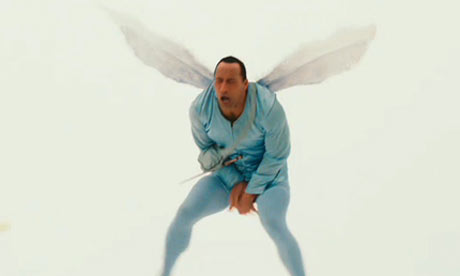
After that, many of McMahon’s bigger-than-life wrestlers tried their hands at Hollywood stardom, including Dwayne Johnson, a.k.a. The Rock, who headlines this weekend’s The Tooth Fairy.
Most of the movies in the wrestler genre aren’t great—filmjunk.com called Hulk’s Santa with Muscles a “crapterpiece”—but there are a couple of notable exceptions.
One of the more prolific wrestlers-turned-actors, Canadian-born Rowdy Roddy Piper has dozens of movie credits, but his high point came in 1988’s They Live, where he delivered the now classic line, “I have come here to chew bubblegum and kick ass. And I’m all out of bubblegum.” It’s his “Hasta la vista, baby!,” and is one of the great action quotes of the decade.
And while it is unlikely that WWE Hall of Famer Stone Cold Steve Austin could ever receive any kind of acting award unless he did his trademarked Axe Handle Elbow Drop on the entire Academy, he has held his own in The Longest Yard and The Condemned, and has three films coming out in 2010.
Recently Triple H, Stacy Keibler and Goldberg have all tried for acting careers, and why not? McMahon calls his wrestlers “entertainers” and The Wrestler director Darren Aronofsky asked rhetorically, “Why aren’t wrestlers in SAG? If you really think about it, the Screen Actors Guild should organize them.”
Whether it’s Denzel Washington dining on a meal of hairless cat in this weekend’s The Book of Eli or Knowing’s Nicolas Cage screeching, “How can I stop the end of the world?” grisly images of post apocalyptic lifestyle have recently been dominating movie screens.
Perhaps it’s the recession or the result of the anxious times we live in, but end-of-the-world stories are all the rage, but they are not new. Whether it’s nuclear fallout, an unexpected ice age or a zombie holocaust that brings about the end, filmmakers have peddled post apocalyptica for years.
In 1959 Gregory Peck headlined a dystopian drama that set the date for the end of the world just after World War III in 1964. In On the Beach nuclear war has destroyed all life on the planet save for a small enclave in Australia, but even they will succumb once the radiation clouds drift by. “We’re all doomed,” says Julian Osborne (Fred Astaire). “Doomed by the air we’re about to breathe.” As doomsday dramas go this one is particularly depressing—for example people gobble up “suicide pills”—but its Cold War commentary led one contemporary writer to label it “the most important film of our time.”
Several years later the post-atomic war film Panic in Year Zero! opened with one of filmdom’s great understatements. While on a fishing trip Harry Baldwin (Ray Milland) and his family see a mushroom cloud over Los Angeles. “We’ve had it; haven’t we dad?” says son Rick (Frankie Avalon). Well, not quite Rick, but the world as you know it is over. Made on a shoe-string, Panic in Year Zero! is notable not for its special effects—there aren’t any—but for its take on the difficult decisions Milland’s character must make to ensure his family’s survival in a world where old principles of humanity are obsolete.
Finally, to end the end-of-the-world list, fans of post apocalyptic fantasy will find a payday in the form of Rock & Rule, an animated film featuring Deborah Harry and Lou Reed’s voice work. In it the world has been destroyed and “legendary super-rocker” Mok—whose record went “gold, platinum, and plutonium in one day”—tries to use a demonic code to rule what’s left of the world.
With such a range of dystopian stories to mine it seems filmmakers could make post apocalyptic movies until the end of the world comes for real.
Who knew there were so many fang bangers out there? The success of HBO’s True Blood and the Twilight franchise is proof that vampires have risen from the dead, driven a stake through the very heart of popular culture and won over new fans in unprecedented numbers.
Never before have bloodsuckers done such boffo box office, but how can this newfound popularity be called a comeback when the vampires never went away?
No amount of garlic, it seems, can keep vampires out of the theatre. This weekend Daybreakers, a film about a world where vamps outnumber humans, joins the list of vampire films which dates back to the 1900s.
In the 101 years since audiences first sunk their teeth into a vampire movie — 1909’s Vampire of the Coast — vamps have come in all shapes and sizes. There’s The Vampire Effect, a Chinese martial arts vampire movie (guest starring Jackie Chan), Thomas Dolby’s vampire musical comedy Rockula and the self explanatory Gayracula to name just a few.
E
ven stranger than any of those is Dracula Blows his Cool, a 1979 German comedy featuring the Count as the proprietor of a disco in his ancestral castle. It’s quite awful, but worth a rental (if you can find it) to hear the disco “hit” Rock Me Dracula (Suck! Suck!).
More traditional is another German film made the same year. Roger Ebert called Werner Herzog’s Nosferatu the Vampyre, “the most evocative series of images centered around the idea of the vampire” since 1922’s Nosferatu.
It cannot be said that this is a particularly scary movie, but Herzog’s emphasis on slowly building tension and atmosphere rather than simply smearing the screen with blood is disquieting and decidedly eerie.
A little more rock’em sock’em is The Legend of the 7 Golden Vampires, the 1974 collaboration between Britain’s Hammer Studios and the Hong Kong based Shaw Brothers Studio. Peter Cushing is vampire hunter Prof. Van Helsing who battles Dracula and six disciples in a remote Chinese village. It’s weird and wacky, but as one critic said it gets by “on sheer novelty alone.”
So many vampires, so little time. How have vampires survived when other film fads are dead and buried? Adaptability. Just as every generation has placed a hero on the pop charts, cinematic vampires have shapeshifted over the years, bending to the times.
How else can you explain Dracula Blows His Cool’s disco dancing Drac?
In the gap between James Cameron’s last theatrical feature, Titanic, and his new film, Avatar (in theatres this weekend) Clint Eastwood directed 11 movies, Michael Bay made six and even Uwe Boll, a director so reviled an on–line petition demands he stop making films, has made 15 in the time it took Cameron to make just one.
So what’s the hold up?
Some suggest Cameron takes so long between gigs because his commitment to his projects is so intense he wants to be sure he is on the right track before camera starts to roll.
“I want you to know one thing,” he allegedly told one producer, “once we embark on this adventure and I start to make this movie, the only way you’ll be able to stop me is to kill me.”
Also, Cameron isn’t bound by the same considerations as most directors.
He wrote the script for Avatar in 1994 and was prepared to wait until special effects technology caught up with his vision.
The luxury of having time is what happens when you make the highest grossing movie in history, a fact he celebrates, wearing a t-shirt that reads “Time Means Nothing in the Face of Creativity.”
Like Cameron, Stanley Kubrick spent more time off movie sets than on. In a career that spanned 46 years he made only 13 movies but spent years developing pictures that never went into production — like Napoleon, an epic look at the life of the French Emperor that he expected to be “the best movie ever made.”
Others choose long lay-offs between projects for different reasons. Actor Casey Affleck (Ben’s younger brother) had three movies released in 2007 but nothing else scheduled until 2010. Why the break?
“To be perfectly honest, I don’t really enjoy playing anybody,” he says, “except Casey Affleck lying on the couch watching the Red Sox … usually, when I’m working, I’m not really having a good time.”
Then there’s Daniel Day-Lewis, an actor whose lapses between projects makes Affleck look like a workaholic. The There Will Be Blood star routinely takes years off between films, once disappearing from the big screen for five years.
When asked why he doesn’t work more often he said, “I like to cook things very slowly. I learnt early on that I couldn’t jump from one kind of work to another. I did it a couple of times and it didn’t work.”
Christopher Isherwood was a literary rock star with a taste for booze, much younger men and both spiritual and sexual experimentation. He palled around with thinkers like E. M. Forster and Aldous Huxley and turned his exploits into a string of semi-fictionalized novels, essays and plays. His best known work remains a collection of short stories called Goodbye to Berlin, which provided the basis for the Oscar winning movie Cabaret.
This weekend, forty-five years after it was first published, another of his books, A Single Man, hits the big screen. Directed by former fashionista Tom Ford it stars Colin Firth as George, a gay English professor contemplating suicide after the sudden death of his longtime lover.
“The gay aspect of A Single Man certainly wasn’t what drew me to make the film,” said Ford. “It was its human aspect, that unifying quality.”
That human characteristic is the thing that makes Isherwood’s best work so timely and, conversely, timeless. The work of his that translated best to the screen told stories that were specific in their setting, but universal in their themes.
Cabaret, for instance, was set in the last days of the Weimar Republic in Pre-Hitler Germany and features a healthy dose of decadence and perversion, but underneath the shiny surface is a sense of desperation. Roger Ebert wrote, “the context of Germany on the eve of the Nazi ascent to power makes the entire musical into an unforgettable cry of despair.” The setting and people may be unfamiliar, but the fear of the unknown is the universal element.
Less known is Isherwood’s script for The Loved One, (co-written with Dr. Strangelove scribe Terry Southern). It is a devastating satire on the funeral business which was advertised with the tagline “The motion picture with something to offend everyone!” The movie was a little too mean spirited for audiences in 1965, but has since gained a cult following among fans of dark humor. Sharp eyed viewers will also spy Isherwood as a mourner in the funeral scene.
A more up close and personal look at Isherwood can be found in Chris & Don: A Love Story a 2008 documentary chronicling the thirty year relationship between Isherwood, his much younger lover, artist Don Bachardy and their struggles as one of the first openly gay couples in Hollywood.
Morgan Freeman has played real-life characters before onscreen, most notably in Lean on Me, but with his latest role he takes on one of the most venerated people in the world, Nelson Mandela.
“This started out with Madiba (honourary title adopted by elders of Mandela’s clan) naming me as his heir apparent,” says Freeman. “When he was asked… ‘Mr. Mandela, if your book becomes a movie, who would you like to play you?’ He said, ‘Morgan Freeman.’”
That was fourteen years ago. It took Freeman that amount of time to find and develop Invictus — this weekend’s look at Mandela’s plan to use a rugby team as a symbol of South African unity — into a film directed by Clint Eastwood. Freeman used that time to prepare, getting to know the real Mandela.
Freeman may be the latest to play Mandela on screen, but he isn’t the first.
The first major dramatization at Mandela’s life starred Danny Glover (who won an Emmy for his work) and was made in the 25th year of his 27-year prison sentence. Shot on location in Zimbabwe, the made-for-TV Mandela covers the years 1948 to 1987, focusing on not just on Mandela’s struggle for freedom but his personal life as well.
“I’m always interested in people who become symbols,” said writer Ronald Harwood, “and I’m curious to know what such people are like as ordinary men and women, beneath the trappings we bestow upon them.”
Next came Mandela and deKlerk, another made-for-television drama starring Sidney Poitier and Michael Caine. The story of how these men engineered the end of apartheid was shot in South Africa at many of the locations where the real story took place. Newsreel footage furthers the film’s feeling of historical authenticity.
There have been several other dramas based on Mandela’s life, including Goodbye Bafana, starring 24’s Dennis Haysbert, but to catch a glimpse of the man himself, check out Malcolm X.
Just months after his release from prison, Mandela played a schoolteacher in a Soweto classroom in the film’s final scene, reciting a snippet of one of Malcolm X’s most famous speeches.
In the movies often the only thing brothers have in common is a last name. Creating conflict between siblings makes good dramatic sense and it’s a practice that harkens back to the very first set of brothers. Would the story of Cain and Able have as much biblical oomph if the boys got along? I don’t think so.
So it is with Tommy and Sam Cahill, played by Jake Gyllenhaal and Tobey Maguire, in this weekend’s Brothers. In the great tradition of movie siblings they’re polar opposites; Tommy is an ex-con, Sam is a Marine Captain and former football star. You get the idea. But will Tommy go all Cain on Sam? You’ll have to buy a ticket to find out, but in the meantime here are some other movie brothers who turned out differently than mom and dad may have hoped.
Ricky & Doughboy Baker (Morris Chestnut and Ice Cube) from Boyz N the Hood are opposites, but when Doughboy takes revenge on the people who killed his brother it proves that blood, and blood shed, is thicker than water.
In The Darjeeling Limited Jack (Jason Schwartzman) asks his brothers Francis (Owen Wilson) and Peter (Adrien Brody), “I wonder if the three of us would’ve been friends in real life? Not as brothers, but as people.” Good question. You couldn’t find a more diverse trio: Francis is a compulsive sad sack, Peter a bundle of manic energy and Jack a collection of jangled nerves. They may never be friends, but by the end of a road trip in India they can at least tolerate one another.
“When brothers agree,” the old saying goes, “no fortress is so strong as their common life.” But when they disagree, look out. Just ask Fredo Corleone. The Corleone boys each brought something different to the Godfather trilogy, but it is the “kiss of death” scene in part two between the kindhearted Fredo (John Cazale) and the ruthless Michael (Al Pacino) that gives new meaning to the term sibling rivalry. “I know it was you Fredo,” Michael says. “You broke my heart.” Siblings may not get along but it takes a real grim brother to order a hit on his younger brother.
In Go West Chico Marx summed up the relationship most of these on- screen brothers share.
If the name Shô Kosugi doesn’t conjure up images of whirling nunchucks or twirling throwing stars then your knowledge of ninja films probably doesn’t extend much further than Teenage Mutant Ninja Turtles. Kosugi is the godfather of the modern ninja film, a Japanese martial artist who, during the 1980s, used his mad ninjitsu skills to battle every movie bad guy from evil terrorists to Mafia thugs and even possessed break dancers. When the “invisible warrior” craze petered out in the early 90s Kosugi became a star on Japanese TV and created a workout regimen called Ninjaerobics. This weekend, however, he returns to the big screen in Ninja Assassin, playing Ozunu, head of a dangerous cult that turns orphans into blood thirsty killing machines.
The movie that kicked off ninja mania was 1981’s Enter the Ninja, a wild b-movie that features nineteen minutes of hardcore ninja action in the first twenty minutes. Kosugi is an evil ninja hired to take down a virtuous “white ninja” (Franco Nero, who didn’t do any of his own fight scenes), who is protecting a friend’s Philippine plantation. The body count is high—36 people get ninjaed, including one security guard who falls victim to the dreaded “mosquito spikes”—and even though the acting is terrible and the jokes a little flat it has, nonetheless, been described by one ninja fan as “fantastic crap.”
Probably the most outlandish of the original 80s wave of ninja flicks is Ninja III: The Domination, which features a lead character described as completely normal, aside from her “exceptional extrasensory perception and preoccupation with Japanese culture.” In this one an evil ninja attempts to avenge his death from beyond the grave, by possessing an innocent woman’s body. Ninja III is packed with cool stunts—a throwing star is tossed by some very limber ninja toes—and we learn that a ninja can transfer his soul through his sword to another person.
Besides outrageous ninja action the only thing these movies have in common is stiff acting, but acting isn’t why you buy a ticket to see a movie called Rage of Honor. If you want good acting look up Phillip Seymour Hoffman, but if you want to see a ninja take on a pick-up truck and win or slice a bad guy in half (sending his legs to and his torso fro) then Shô Kosugi is your man.