Instead of running the title card “based on a true story” up front, “The Whistleblower,” a new drama starring Rachel Weisz, Monica Bellucci and Vanessa Redgrave, begins with the disclaimer “inspired by true events. Some of the characters may be composites or fictitious.” No “just the facts ma’am” for this movie. The filmmakers decided to take a perfectly serviceable and important story and tart it up with Hollywood story elements. Because facts are often stranger than fiction, it’s a shame they didn’t stick more with the truth and less with the movie contrivances.
Weisz plays Kathryn Bolkovac a Nebraska policewoman based on a real life person of the same name. Divorced, she’s desperate to move across country to be closer to her kids but can’t lay her hands on either the job transfer or the money to make the trip. To raise the cash she takes a six month job as a peace keeper in Sarajevo, Bosnia. War has ended and a company called Democra Security has been contracted by the U.N. to help smooth the transition from strife to peace. Soon, however, she uncovers a human trafficking ring specializing in young women sold into prostitution. Uncovering a far reaching conspiracy she finds herself making some powerful enemies.
“The Whistleblower” is a well intentioned film that more often than not plays like an episode of “Law & Order: SVU,” albeit with more exotic locations. It’s a police procedural with many of the tried and true plot devices of the genre. Evidence seems to show up when needed, progress is inevitably slowed by bureaucratic process and the main character is true blue. “I’m an American police officer,” she says to a young woman afraid that the U.N. isn’t going to be able to help, “it doesn’t matter who I work for.” No that’s plucky.
Where it differs from other procedurals is in its uncompromising imagery. A dank dungeon brothel is identified by close-ups of chains, dirty mattresses and used condoms and a scene involving the bad guys disciplining one of their captives is too grim to be described here. Those scenes have impact and underline the importance of telling this story from a humanist standpoint, but from a cinematic perspective it all feels kind of standard and often borders on the sanctimonious.
Weisz, in the role that Mariska Hargitay would have played if this was a TV movie, brings some depth to the gritty cop stereotype we’ve seen a hundred times before, conveying urgency and determination.
“The Whistleblower” is topped by an effective and exciting final reel but for my money it takes just a bit too long to get there.
The gentle humor of Winnie the Pooh has been a childhood staple for almost a century. From the original A. A. Milne book in 1926 to radio, television, film and even philosophical adaptations like the Tao of Pooh, the little stuffed bear with a jones for hunny and his pals Piglet, Owl, Rabbit and Eeyore, is a pop culture superstar.
After years of new Pooh stories his latest big screen adventure, simply titled “Winnie the Pooh,” goes back to the source for its inspiration. Disney has woven together six chapters of Milne’s stories to form one satisfying whole.
The movie starts, as all great Pooh movies do—and there’s 51 of them to choose from—with Pooh searching for hunny. Along the way he helps Eeyore, the pessimistic stuffed donkey, find a replacement for his lost tail and searches for a mysterious creature called a Backson.
Directors Stephen Anderson and Don Hall have wisely updated the story—the pace is snappier than the classic 1960s cartoons—but kept the elements that have made Pooh an indispensable character for the under ten crowd. The gentle humor is in place, along with the beautiful water color backgrounds of Hundred Acre Wood and the voices so connected to the series (they’re done by different people now, but are true to style established by Walt himself).
Disney has done something special with this reboot; they’ve created a movie that feels modern without sacrificing its nostalgic charm. And at just over an hour “Winnie the Pooh” is geared to the attention spans of a young audience.
“Water for Elephants” is told from the point of view of an older man. Looking back at the most important years of his life old Jacob Jankowski (Hal Holbrook) tells the story of how a 9000 pound pachyderm introduced him to his wife. At first I wondered why they bothered with this device. Other than giving us a chance to see Hal Holbrook, which is always welcome, it didn’t seem to add much to the story. Then I realized that the tale has a warm fuzzy kind of glow that is the result of being told from the point of view of memory and not reality.
Set during the Great Depression, the flashback part of the movie begins with veterinary student Jacob Jankowski (Twilight’s Robert Pattinson) finding a job as a roustabout on the Benzini Brothers Most Spectacular Show on Earth circus. On the job he meets Marlena, (Reese Witherspoon) a beautiful equestrian star married to August (Inglourious Basterds’ Christoph Waltz), an abusive animal trainer. He falls in love with her while tending to Rosie, the faltering circus’ 9,000 pound star attraction.
“Water for Elephants” has a decidedly old fashioned feel. The old time carnies speak like characters out of a John Steinbeck novel and the treatment of the animals clearly predates PETA. There’s a nostalgic glow to every frame of the film which helps cover up occasionally overwrought dialogue like Jacob’s summation of his first day as a circus hand: “The Benzini Brothers outdid God himself. They build heaven in one day.” It’s a bit melodramatic, but makes narrative sense when seen as the foggy recollections of an old man looking back at the single most important time of his life. Who hasn’t embellished a detail or two when retelling a story?
The movie’s occasional excesses are overshadowed by the winning cast. Reese Witherspoon looks like she was born to sit atop an elephant, R. Patz gets more action here than in all the Twilight movies combined and Christoph Waltz once again shows he was a way with cruel and unusual characters.
The only thing missing from Waltz’s bad guy performance here is his SS uniform from Inglourious Basterds. He really is becoming Hollywood’s guy we love to hate, and he’s good at being bad, but I’d like to see if he can do other things as well. Pattinson on the other hand proved to me that he can play something other than a lovesick vampire, which, the success of Twilight aside, is kind of limiting career wise.
“Water for Elephants” is an old school epic, or at least as close as we get to an old school epic these days. It’s a movie for adults, although they’ll probably have to fight their way through the crowds of teens who’ll line up to catch Robert Pattinson without his fake fangs in place.
The opening shot of “Win Win,” a new dramedy from “The Station Agent” director Tom McCarthy, tells you almost everything you need to know about the main character, played by Paul Giamatti. Dressed in a tacky bright yellow New Providence Pioneers sweatshirt he’s jogging down a country road. The camera stays with him for a moment until two other, better-dressed older men pass him, running at a loping gait. Breathing heavy, he stops and watches the pair fade into the distance.
The scene tells us, wordlessly and elegantly, that he, no matter how hard he tries, is always getting passed by in life. It’s a quick scene, but what would have been a throwaway in most movies becomes a poignant opening to one of the most enjoyable movies of the year so far.
Giamatti is small-town lawyer and wrestling coach Mike Flaherty. With his practice on the ropes he make a dubious decision to become the legal guardian to client Leo Poplar (Burt Young), a wealthy man suffering from dementia. He desperately needs the $1500 a month pay cheque that comes along with the guardianship, but when Leo’s grandson Kyle (Alex Shaffer) shows up the arrangement becomes complicated.
While there is much to admire in “Win Win,” like the great performances from old pros Giamatti or Amy Ryan, or the stirring work from newcomer Alex Shaffer or even how funny it is, the thing that really stands out about “Win Win” is its heart. McCarthy understands family and friend relationships and it shows in every frame of this film.
These are complicated characters with back stories and shortcomings galore, but McCarthy deftly shows us their relationships, exposing why they behave the way they do, why they like one another, and ultimately why we should care about them.
Part of it is casting—Giamatti is never bad and Shaffer is a thoroughly believable teen—but McCarthy, as writer and director, has to take the credit. It’s a tricky dance to introduce so many story threads—there’s a wrestling subplot, the story of Leo’s living arrangements, the drug addict mother’s relationship with Kyle and more—but McCarthy keep the film on track, keeping the focus where it belongs, on the characters.
The premise of “Waiting for Superman,” the new documentary from “An Inconvenient Truth” Oscar-winner Davis Guggenheim, isn’t a new idea. We’ve heard for years that America’s public school system is broken, letting down the very people it was designed to help—the kids. It sounds standard, yet what Guggenheim reveals is anything but.
His unflinching camera follows a number of students as they navigate their way through the landmine ridden terrain of a school year. His careful analysis of the state of education reveals some disturbing truths by putting a human face on it. By and large he leaves out the politics and allows the stories of the children to become the focus leading up to a climax—a lottery system to win a place at a better school—that will have you on the edge of your seat.
“Waiting for Superman” is riveting stuff, and for Canadians, a cautionary tale.
“The Walk Back,” a new drama from “Master and Commander: The Far Side of the World’ director Peter Weir, is a sprawling epic with a very personal focus. Set against the backdrop of war, inhumanity and an almost insurmountable challenge, it is about that most personal of things, survival.
Based on a controversial memoir written by Slavomir Rawicz, “The Way Back” begins with Polish solider Janusz (Jim Sturgess) sent to a hellish Siberian gulag in 1941 on trumped up charges. Sentenced to ten years—a term he knows he won’t survive—he and a group of prisoners, including a grizzled American soldier (Ed Harris) and a violent Russian criminal (Colin Farrell) make a break for it. Their goal? Freedom. The obstacle? A 4000 kilometer walk through the harsh terrain of Mongolia, China and Tibet on the way to India and a new life. Along the way they pick up one more traveler, a young girl (Saoirse Ronan) whose camaraderie helps bond the ragtag band of escapees.
Visually Weir and cinematographer Russell Boyd have created a film in which the surroundings really become as much a part of the fabric of the story as the characters. The breathtaking shots of the terrain the travelers pass through add much to the story, emphasizing the isolation and hardship of the journey. Their choice to showcase the backgrounds echoes David Lean and gives the film an epic feel as the story narrows and focuses on the characters.
The acting is uniformly excellent, with Ed Harris and Colin Farrell handing in tremendous work, but the most memorable performance belongs to Saoirse Ronan, the sixteen-year-old Irish actress. Here she plays an orphan whose enthusiasm and spirit gives the men the will to go on. She brings heart to a film that occasionally is a bit dour for its own good.
“The Way Back” is compelling stuff, a nicely painted portrait of the will to outwit, outlast and outplay against all odds.
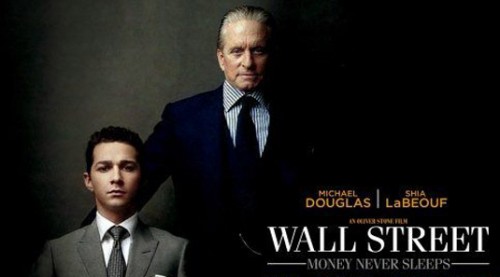
“Wall Street: Money Never Sleeps,” the long awaited sequel to Oliver Stone’s 1987 Oscar winning film Wall Street, is bogged down by financial claptrap. The explanation of how Wall Street ended up in Bailout City is almost endless. Money terms like short selling, moral hazard and derivative are tossed around like coins down a wishing well. Luckily a lot of the dialogue is delivered by good actors like Frank Langella and Michael Douglas, but ultimately the whole experience is kind of like watching an episode of Mad Money with better looking people.
Shia LaBeouf, continuing his resurrection of 1980s film franchises, plays Jacob Moore, a Wall Street trader with a conscious—a mix of greed and green. He’s ploughing millions of dollars into sustainable energy, but just as a major project is on the brink of a breakthrough the bottom falls out, his firm goes bankrupt and his mentor (Frank Langella) commits suicide. At home things are better. His girlfriend Winnie is devoted to him. She’s also the estranged daughter of Gordon Gekko (Michael Douglas) the disgraced inside trader recently released from prison. Jacob and Gekko make a deal—a non financial one. Jacob will facilitate a reconciliation between father and daughter and Gekko will help find out who was responsible for the rumors that led to death of Jacob’s mentor. The question is, can Gekko, who once famously said, “Greed is good,” be trusted?
“Wall Street: Money Never Sleeps” shows how Wall Street fell due to crashing markets and clashing egos. Stone wants us to understand how it all fell apart, but unfortunately the inner workings of banks and big financial deals, at least the way they are presented here, aren’t that dramatic. Real people losing their jobs, their homes, their bank accounts, that’s dramatic, but a bunch of bankers sitting around talking about money is less so. Stone fails to listen to his own creation, Gekko, when he says, “it’s not about the money, it about the game.” Unfortunately the game is a little dull.
The cautionary message about greed and its effects is good and timely—“Bulls make money. Bears make money,” says Gekko, “Pigs get slaughtered.”—but it is wrapped up in a movie that is too earnest and a little odd tone wise. A meeting between Gekko and Bud Fox (Charlie Sheen), the man responsible for sending him to jail in the first movie, is played for laughs which seems out of place, and frankly, kind of unlikely. Stone tries to cram too much story into the film—the father-daughter story, the meltdown angle, the revenge plot, the Gekko comeback—and with each of those plot shards comes a different tone.
Like the people who caused the financial meltdown that inspired this “Wall Street: Money Never Sleeps,” director Stone seems to have lost perspective. He draws good performances from the cast—Douglas could be nominated for a second time for playing Gekko, and LaBeouf is very good—but allows the rest of the movie to get as bloated as Lehman Brothers on a spending spree.
“The Wild Hunt” takes place in the world of LARP. No, that’s not a place like Middle Earth or Oz, it’s an acronym for Live Action Role Playing. Imagine Dungeons and Dragons outdoors and with elaborate costumes and you get the idea. Players create a mythology, don costumes and physically act out their characters’ actions. “The Wild Hunt” examines what happens when the real world collides with fantasy land.
The film starts simply enough. Dumped by his girlfriend Evelyn (Tiio Horn), lovesick Erik (Ricky Mabe) follows her to a LARP event where she now wears the pelts and crown of a Viking princess. Also attending is Eric’s wacked-out brother Bjorn (Mark A. Krupa) who takes his role as a Viking warrior a bit too seriously. As the Viking showdown with the Celts approaches Eric realizes he must carry a foam sword and play along if he hopes to leave with Evelyn on his arm. Here the story deepens. Eric’s outside interference is unwanted, not just by Evelyn but also by the evil Shaman Murtagh (Trevor Hayes). Eric’s presence throws off Murtagh’s plan to “sacrifice” Evelyn in The Wild Hunt ceremony. Before you can say “Pass me the mead,” bona fide violence erupts and the line between fantasy and real life blurs.
“The Wild Hunt” is a strange beast. Set against a backdrop of Viking mythology, complete with battles, elves and some real violence, it is by turns amusing, engrossing and horrifying. The tone of the film darkens as the running time ticks by. The violence—both mental and physical—becomes more realistic as the LARP spins out of control, but none of this would matter much if the characters weren’t as well developed as they are.
Both Eric and Bjorn have story arcs that exist in real life and fantasy land. Eventually as the two meld the brothers discover what really makes each of them tick. It’s interesting stuff, and even if the tone is a little uneven, “The Wild Hunt” remains one of the most intriguing films of the year so far.
Like its star Benicio Del Toro, “The Wolfman” is a little wonky but strangely appealing. The film, which has more to do with the atmospherics of Hammer horror than, say, the theatrics of the lame “Underworld” series, is a perplexing beast that mixes some fairly good shocks with a lifeless lead performance.
Del Toro is Lawrence Talbot, a Victorian-era actor who returns to his ancestral home outside London after his brother is attacked and killed by… something. Awaiting him at the dusty old country house is his estranged (and just plain strange) father Sir John (Anthony Hopkins) and his brother’s fiancée, Gwen Conliffe (Emily Blunt). Determined to find out who or what mauled his brother, he launches an investigation that leads to a gypsy encampment on a full moon. Guess what? He gets bitten by a werewolf and every full moon transforms into the thing he hates most.
Director Joe Johnston, (the helmer behind “Honey, I Shrunk the Kids” and “Hidalgo”) proves he has a knack for old school horror atmosphere—the film is all cobwebs, shadows and candlelight—and action scenes but absolutely none for dealing with the heart and soul of the film—the characters. The Talbots and Gwen dominate the movie but are more sketches of horror movie characters than fully drawn individuals. Hopkins (who gets the movie’s best intentional laughs playing the Worst. Father. Ever.) and Blunt squeak by on acting chops alone, but Del Toro, who is in nearly every scene, isn’t so lucky.
Perhaps he was poorly cast or perhaps he isn’t really trying, it’s hard to tell. He doesn’t have a natural flair for the courtly dialogue that seems to roll off the British tongues so easily, but then again, the dialogue doesn’t exactly sparkle. When your most memorable line is, “I will kill all of you,” (repeated twice for emphasis) you know more time was spent on the set decoration (which is great) and the transformation scenes than the words.
Despite lots of dramatic moments—long stares, meaningful glances—there is little actual drama. The story is pure B-movie horror and exists solely as a vessel to keep things afloat until we get to the action scenes and the Holy Grail of every wolfman movie, the all important man to beast transformation.
On that score the movie entertains. Blood squirts, a disembodied hand shoots a gun and more blood squirts. It’s a gory little flick that takes off after a slow start with some decent jolts (once it gets over using loud sounds to create tension) and two great transformation scenes courtesy of special effects wiz Rick Baker.
“The Wolfman” isn’t going to do for werewolves what “Twilight” and “True Blood” have done for vampires—werewolves are too hairy to be sexy—but despite its flaws is a howlingly fun Saturday afternoon matinee movie.