Fast reviews for busy people! Watch as I review three movies in less time than it takes to scream seven times. Have a look as I race against the clock to tell you about the return of Sidney Prescott in “Scream 7,” the northern noir of “In Cold Light” and the music doc “Paul McCartney: Man on the Run.”
SYNOPSIS: “Paul McCartney: Man on the Run,” a feature length documentary now streaming on Prime Video, covers the years 1970 to 1981 as the former Beatle reinvented himself for a new era.
CAST: Paul McCartney, Ringo Starr (archival footage), John Lennon (archival footage), George Harrison (archival footage), Linda McCartney (archival footage), Wings (archival footage). Directed by Morgan Neville.
REVIEW: For music fans of a certain vintage, 2026 is already a gold star year. “EPiC: Elvis Presley in Concert” strips the kitsch away from the King of Rock ‘n’ Roll’s Vegas years in exhilarating fashion and now comes “Paul McCartney: Man on the Run” an up-close-and-personal look at a rarely documented and often misunderstood chapter in the career of the former Beatle.
By the time 1970 rolled around Paul McCartney had spent most of his life playing with John, George and Ringo. With the eyes of the world on him, the twenty-seven-year-old, one of the most famous people on the planet, had to shoulder the perception that he broke up the band, and find a way to move forward personally and professionally.
Millions of gallons of ink have been spilled documenting the legendary band, there have been movies and even a West End play, but relatively little time has been afforded the beginnings of McCartney’s transition from The Beatles to Wings and beyond.
As the title suggests, “Man on the Run” paints a portrait of McCartney, a restless musician in motion, searching for a new creative outlet. It’s here that director Morgan Neville digs deep, capturing the pressure that threatened to crush McCartney’s creativity as animosity regarding the Beates’ demise swirled around him, exacerbated by an ongoing business dispute with ruthless manager Allen Klein, whose dealings further estranged McCartney from Lennon.
As Lennon marshalled the counterculture in New York, McCartney, wife Linda and kids, decamped to a farm in remote Scotland, where he hid from the world, releasing albums like “Ram” that failed to satisfy fans and critics. (Although it should be said, those records have been critically reassessed in the years since then.)
Worried he wouldn’t be able to top his Beatles era work and trading musical jabs with Lennon, McCartney put together Wings, longing for the excitement of being in a band.
The altruistic blending friends and family fed McCartney’s need to feel part of a group, but, as the doc makes clear, several members complained of feeling like underpaid hired hands. McCartney, who is an executive producer on the film and is quoted throughout, responds by saying he wasn’t in charge of the accounts and didn’t realize his bandmates didn’t share his enthusiasm.
It’s a rare disingenuous moment. McCartney may well have been oblivious to the power dynamic within Wings, but his response comes across as a cop out. It’s one of the few moments that feels like a missed opportunity to shed a bright light on the band’s inner workings.
Also strange is the absence of “Give Ireland Back to the Irish” and “Hi Hi Hi,” two controversial singles banned for their political and sexual lyrics.
Still, the doc is a treasure trove of never-before-seen footage (with some cool added animation effects), musical performances and insight from McCartney and those close to him that paints a picture of a vulnerable risk taker, an artist who spent the 70s outrunning his previous work. In the film’s final moments, the musician sums up his Wings journey succinctly. “We made what seemed like an impossible dream come true.”
It wasn’t the wind and snow that Thomas Haden Church found “punishing” when shooting the new psychological thriller Whitewash in northern Quebec, but the lack of it.
“You know how it goes,” he says. “You shoot one day and it’s the perfect conditions and two days later it’s 50 degrees (10 degrees Celsius) and you have to figure out a way to make it match. We had blizzards and we had giant fans with cornstarch.
“When we started shooting there was a storm blowing in but as God would have it three hours later there’s not a flake of snow floating through the air so they pull out the eight-foot fans and crank up the Corvette engines that drive them and start hucking cornstarch at me.
“It is still cold as all get out, and with those fans blowing sometimes you wish the blizzard would come back and they’d turn the fans off. Those fans will fling stuff at you at sixty miles an hour. Those things are punishing to stand in front of.”
The cornstarch plays a crucial role in the film’s opening and defining scene. During a whiteout snowstorm — enhanced with the white, fluffy thickener for extra effect — Church’s character Bruce takes a wild, drunken ride on a bulldozer that leaves a man dead.
Unnerved, he hides the body in a snow bank and lams it to the deep woods to avoid police and clear his head. “When I read it a buddy of mine who works with me said, ‘You know, sometimes you read ’em and you know what you know. You gotta go.’ I knew as soon as I read Whitewash I had to go. The challenges, the character, the uniqueness of the setting, the emotional complexity of what he goes through. There is tragedy but I think by the end of the movie there is this affirmation that everybody landed on the mortal coil where they were supposed to be.”
Church is in virtually every scene and delivers an extraordinary, minimalist performance.
He doesn’t appear to be doing much, but subtly rides the lines between sanity and insanity, between absurdity and logic, leaving the viewer off balance as the film veers between the present and flashbacks.
“Even as far back as working in television comedy as I did, I always wanted more nuance, more reflection, more moments of whatever the whisper line between comedy and drama is,” he says.
“That really is defined by human circumstance and human behavior. Even when we were promoting this picture that I did called Sideways, we’d do these big Q&As and one time this guy said, ‘It must be really interesting.
In the dramatic scenes you make very dramatic choices and in the comedic scenes you make very comedic choices.’ No man, maybe it sounds a bit elitist or pseudo-intellectual but I make human choices. I’m just trying to play a real guy.”
Thomas Hayden Church is a former sitcom star best known as the lovably dim-witted mechanic Lowell Mather on the show “Wings” before making the leap to big screen stardom as a comedic sidekick to Paul Giamatti in the Oscar winning wine movie “Sideways.”
His latest film, “Whitewash,” sees him leave the comedy behind to take on a darkly psychological role that pits him against the snowy backdrop of Northern Quebec.
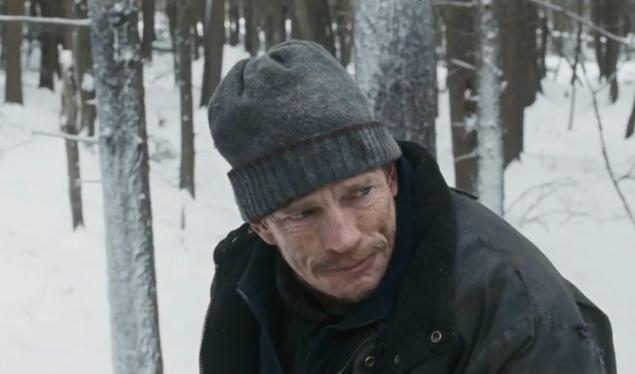
In the film’s opening moments we witness the event that shapes the remainder of Bruce’s (Church) life. A wild, drunken ride on a bulldozer through town leaves a man (Marc Labreche) dead. Panicked, Bruce hides the body in a snow bank and hightails it for the deep woods in an effort to avoid the police and clear his head.
The cold rugged wilderness provides a backdrop for Bruce as he pieces together the events of the past few days and flashbacks on exactly how he wound up in this situation.
There are moments of dark humor here as Bruce struggles to survive, physically and mentally, but the tone of the film is bleak. It starts with an accidental murder and never strays far from the primal necessities of Bruce’s life.
Church is in virtually every scene and delivers an extraordinary, minimalist performance. He doesn’t appear to be doing much, but subtly rides the lines between sanity and insanity, between absurdity and logic, leaving the viewer off balance as the film veers between the present and flashbacks. It’s Church’s performance that adds colour to “Whitewash’s” bleak story and ice white surroundings.
The dynamic between Labreche’s character Paul and Bruce fuels the story, building slowly to the film’s climax.
“Whitewash” is quietly suspenseful, melancholic that won’t be to everyone’s taste, but is an elegantly told story of redemption and survival.