Los Angeles is a sun-dappled utopia with a Mediterranean climate, palm trees as far as the eye can see and only 35 days of precipitation annually. It’s a sprawling Garden of Eden, with pockets of paradise connected by an interweaving series of freeways. Think year-round sun tans, flip-flops and driving the convertible with the top down.
So why, when such natural beauty surrounds it, does Hollywood seem obsessed with stories about the end of the world? Could it be it’s because they live above the San Andreas Fault, an inner earth rupture that issues occasional rumblings that threaten to drop much of Southern California into the Pacific Ocean? Perhaps it’s because it’s the home of Kim, Kourtney and Khloé, an alliterative television family who seem to be a harbinger for the dissolution of society.
Whatever the reason, in movie after movie Hollywood hands us terrifying visions of what the world will look like when the Kardashians are done with it.
This weekend 10 Cloverfield Lane, which producer J.J. Abrams calls a “blood relative” but not a sequel to his 2008 monster flick Cloverfield, sees Michelle (Mary Elizabeth Winstead) trapped in an underground bunker with a sinister survivalist played by John Goodman. Outside, he says, an attack is about to leave the world uninhabitable. “Something’s coming,” he hisses.
What exactly is happening outside the bunker’s walls is unclear. Whether it’s nuclear fallout, an unexpected ice age or a zombie holocaust that brings about the end, the post apocalyptic feel of 10 Cloverfield Lane is just the latest attempt by the film biz to tap into the world’s general feeling of unease.
In 1959 bright and sunshiny Hollywood offered up a scary story that set the date for the end of the world just after World War III in 1964. In On the Beach, nuclear war has destroyed all life on the planet save for a small enclave in Australia, but even they will succumb once the radiation clouds drift by. As doomsday dramas go this one is particularly depressing — for example people gobble up “suicide pills”— but its Cold War commentary led one writer to label it “the most important film of our time.”
Not all end-of-the-world scenarios are as grim as that, however. Seeking a Friend for the End of the World’s set up sounds bleak but it’s actually amusing and inventive.
Three weeks before a giant asteroid is scheduled to collide with earth, Dodge (Steve Carell) and his flaky downstairs neighbour (Keira Knightley) head out of town, looking for meaning in a world that soon won’t exist. It’s a low-key movie that could have been a broad comedy, but instead chooses for a more modest, heartfelt approach.
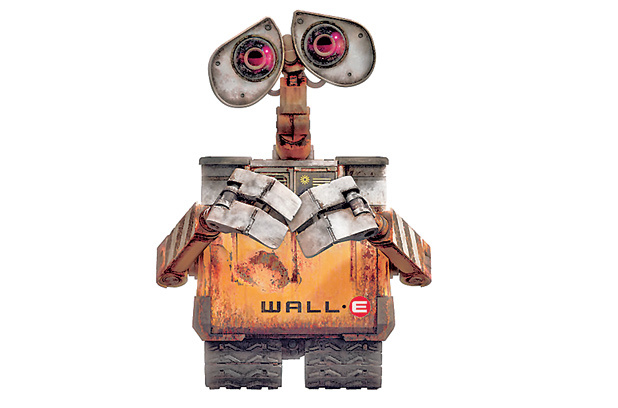
Sometimes the end of the world is appealing; cute even. WALL-E, the story of a lonely, but adorable, robot who inadvertently gives humankind a second chance, is aimed at kids but doesn’t look like any other kid’s movie you’ve seen. Don’t expect the same old from Pixar. It’s ambitious and beautiful like 2001: A Space Odyssey for children.
With such a range of dystopian stories to mine it seems sunny Hollywood just might produce dark visions of our planet until the end of the world comes for real.
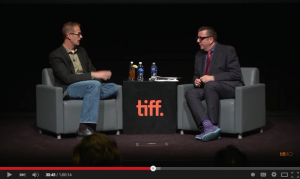
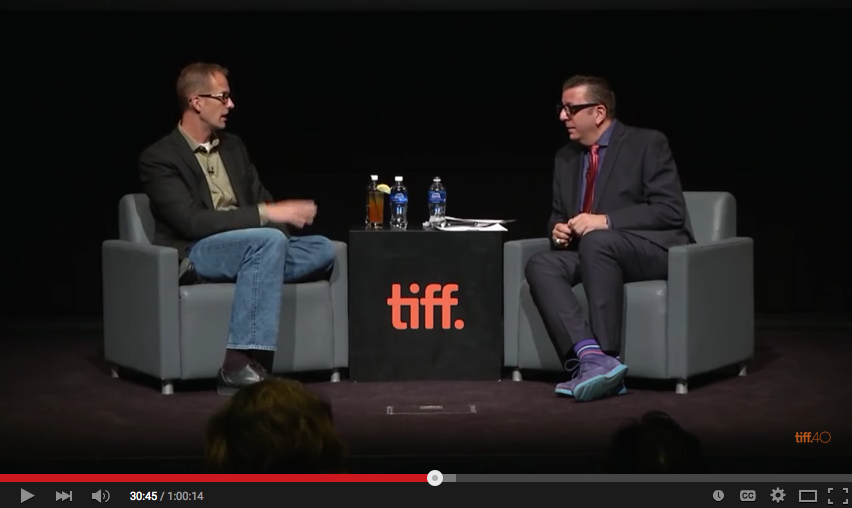
Pete Docter, the visionary director of Pixar’s Up, Monsters, Inc. and Inside Out, joined host Richard Crouse in March for this onstage discussion of his extraordinary career in animation and screenwriting.
Actress Phyllis Smith has had many jobs in and out of show business.
She was working as a casting associate when director Ken Kwapis fell in love with the way she read opposite the auditioning actors and cast her as Dunder Mifflin saleswoman Phyllis on The Office. She appeared on the hit show for nine years and just as that series wound down she got a call from Pixar.
Inside Out producer Jonas Rivera was flicking around the stations one night when he settled on Bad Teacher, a 2011 comedy co-starring Smith and Cameron Diaz. The raunchy film couldn’t be further afield of Pixar’s family friendly movies, but Rivera liked the sound of Smith’s voice. He knew she was the actor to play one of Inside Out’s main roles, the living embodiment of an emotion in an eleven-year-old girl’s head.
“He picked up the phone and called [director] Pete Docter and said, ‘I think I’ve found our Sadness,’” recalls Smith. “I guess it was the timidity in that scene and the timbre of my voice. That’s the nice thing about working for Pixar, when you get that call they pretty much already know what they want.”
Smith joins an all-star cast — Bill Hader, Lewis Black, Mindy Kaling and Amy Poehler as Fear, Anger, Disgust and Joy respectively — in a film that Variety called, “the greatest idea the toon studio [Pixar] has ever had.”
“Long after we’re gone people will still be watching,” Smith says. “Sort of like the Wizard of Oz.”
Smith, who is much more gregarious in person than her onscreen persona would suggest, is riding high today but it was a long circuitous route to television and film success.
“I started out as a professional dancer,” she says. “A show dancer. No stripping, but there were plumes, feathers, g-strings and all that. I was also in two ballet companies, a jazz company. That was my passion but I had an injury and knew logically it was time for me to make a switch in my career. I was getting older. So I just did what I had to do to pay my bills.”
She worked as a receptionist, an NFL cheerleader and manned the box office at a Los Angeles movie theatre. She dressed as Marilyn Monroe and played Steve Carell’s mother in a deleted scene from The 40-Year Old Virgin, but one job stands out for her.
“I worked for JC Penny in the warehouse tagging the merchandise,” she remembers. “I used to stand there and tag thousands of fishing lures or bowling balls or roller shades, which were heavy as heck to lift around. The people were great to work with but the merchandise was a little challenging.
“I used to stand there, thinking about life, wondering what it is we all have in common because we’re not all given the same opportunity. Some people’s health is impaired when they’re born while others are charmed with intelligence or looks. I thought, ‘There has to be something that we all have. A commonality.’ I figured out that it’s the ability to love. We all, in some form or another, want to love and be loved. That was my big revelation. My lightbulb moment. Also, if you’re standing on a concrete floor, make sure you’re wearing comfortable shoes or you’ll pay for it later.”
If you’ve ever looked at someone and wondered what’s going on inside their head—and who hasn’t?—the new Pixar film “Inside Out” tries to provide some answers. Loosely based on the mood swings of director Pete Docter’s twelve-year-old daughter it’s an action adventure set in the subconscious of a young girl.
The set up is simple. A Minnesotan family, Mom (voice of Diane Lane), Dad (Kyle MacLachlan) and eleven-year-old daughter Riley (Kaitlyn Dias), leave their comfortable Midwestern life behind in favour of business opportunities in San Francisco. Riley leaves behind her friends, her school and her beloved hockey team; everything she’s ever known.
Plopped down in a new city, homesick and surrounded by new people, she becomes moody. She’s completely guided by her emotions, which happen to run things from Headquarters, located deep inside her thinking box. In these San Fran days and nights Fear (Bill Hader), Anger (Lewis Black), Disgust (Mindy Kaling) and Sadness (Phyllis Smith) rule the roost, while Joy (Amy Poehler) tries to hold things together. Navigating Riley’s cerebrum, Joy journeys through long term and core memories, the Islands of Personality and Dream Productions to realize it takes a variety of emotions to make a balanced life.
I don’t know if there is such a thing as an instant classic but “Inside Out” is the best argument for creating the term I’ve come across for some time. From dazzling animation, to a script that toggles between childlike wonder and ingenious introspection “Inside Out” is glued together with a degree of emotional acumen not often found in mainstream film. In other words, it will make you laugh, cry and think.
Like the best of Pixar’s work—“Toy Story,” “Up,” “WALL-E”—“Inside Out” works on multiple levels. It is, first and foremost a family film designed to entertain everyone from the young’uns to grandma, but it’s also simultaneously a flight of fancy and a grounded story about growing up that kids (and anyone who has ever been a kid) will relate to. The movie may deal with abstract thought, but the idea that without sadness there can be no joy, and vice versa, is clear as day.
“Inside Out” is a film that will deepen with repeat viewings, which is probably a good thing as when it hits Blu Ray kids are going to want to watch it again and again, and for once, parents won’t mind joining in.
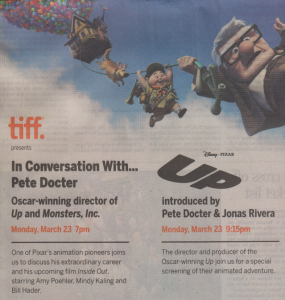
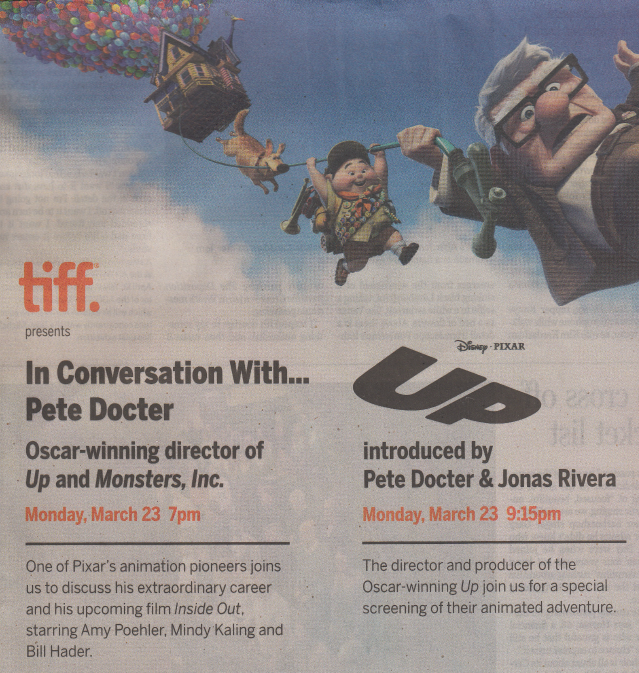
The visionary director of Pixar’s Up and Monsters, Inc. joins us for this onstage interview to discuss his extraordinary career in animation and screenwriting — which includes collaborations on Toy Story and WALL-E — and his upcoming animated feature Inside Out, featuring Amy Poehler and Mindy Kaling.
Pete Docter joined Pixar Animations at the age of 21, and has since become a creative force behind the studio’s string of hits, including the Toy Story films (supervising animator), A Bug’s Life (storyboard artist), and WALL-E (story treatment). In 2001 he made his feature directorial debut with Monsters, Inc., which was nominated for the Academy Award for Best Animated Feature — a prize Docter would eventually take home for his acclaimed sophomore film, Up. He joins host Richard Crouse to look back at some of these extraordinary career highlights and chat about his upcoming feature Inside Out, which is voiced by an all-star cast: Amy Poehler, Mindy Kaling, Bill Hader, and Lewis Black.
Docter returns with producer Jonas Rivera to introduce a special screening of their smash-hit animated adventure, Up, on March 23 at 9:15pm.
‡This screening is eligible for our Rush policy. Ticket holders must arrive at least 15 minutes prior to the start of the screening in order to ensure entry. If this event goes Off Sale, tickets will be made available to the Rush line 10 minutes before the start of the screening.
Would you spend money to see an animated movie starring Nicole Jaffe and Henry Corden? Probably not, because you’ve never heard of either of them.
Oh, but you’ve heard them.
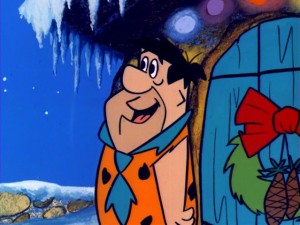
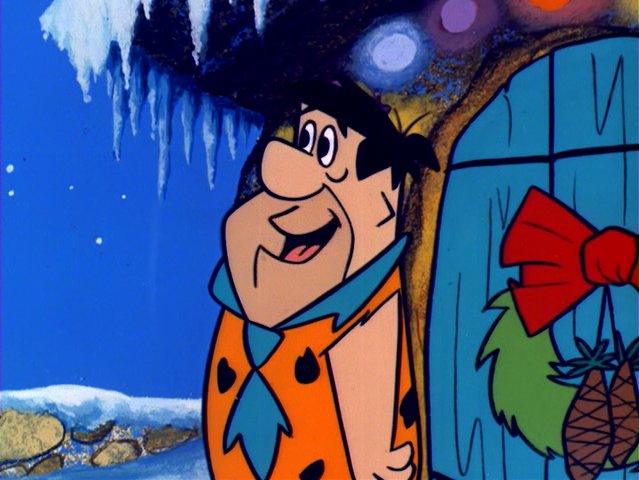
Jaffe voiced Velma on Scooby Doo, while Corden vocalized for Fred Flintstone. Their voices are familiar, but not well-known enough for the producers of most of today’s big budget cartoons.
“If they were doing a half-hour Flintstone show today, they’d still go with me,” said Corden in 1999, “but for a motion picture, even an animated one, they’d go with a celebrity to play Fred, because they need to sell the picture.”
It boils down to bucks —George Clooney as the Fantastic Mr. Fox will put more bums in seats than Henry Corden. “I hate it but I understand it,” Corden said.
Luckily marquee actors like voice work— the hours are good and you don’t have to shave.
Marlon Brando was so taken with the easy money of voice acting he suggested doing the role of Superman’s Jor-El in voice-over, with his onscreen character portrayed as a glowing, levitating green bagel. That one didn’t pan out but he took further audio-only roles, including his final gig performing an old lady voice in the unreleased Big Bug Man.
Other star turns haven’t been so ignoble. Orson Welles thrilled a generation of tweens as the voice of planet-gobbler Unicron in Transformers: The Movie and Angela Lansbury was Mrs. Potts , the perkiest teapot ever in Disney’s Beauty and the Beast.
In the old days, Disney frequently used celebrity voices to augment their cartoons — remember Bob Newhart in The Rescuers?—but the trend kicked into overdrive when Robin Williams’s hyperkinetic jabbering stole the show in Aladdin.
It was a tour de force performance and Williams’s star power helped push the box office past $200,000,000, an animated film first. Since then Disney has made a habit of regularly hiring well known actors to voice their characters—“They properly recognized that you couldn’t send an animated character out there to Entertainment Tonight to promote your movie,” said animation producer Fred Seibert–but sometimes big name talent can work against the part they’re playing. Can you hear James Earl Jones as Mufasa without thinking of Darth Vader? Me neither.
Perhaps that’s why the House of Mouse went a different way with The Princess and the Frog, premiering this month on The Movie Network. They kept things fresh by casting Keith David, Bruno Campos and Anika Noni Rose.
“I was so wanting to be a Disney voice my entire life,” says Rose, the voice of Disney’s first African-American princess in The Princess and the Frog, “and I would have been more than happy to play anything. Is there a blade of grass? Do you need it to whistle? Because I’ve got that.”
She’s a good actor, but hardly a household name and that lack of familiarity allowed her character to live and breathe and not simply be an extension of an already well-known celebrity persona.
In animation circles the debate rages on about the pros and cons of casting big name actors versus voice only performers, but there is one thing everyone agrees on. “It’s not just about the voice, it’s about the character under the role,” says voiceover actor M.J. Lallo.
“It’s not just standing in the studio doing funny voices, it’s acting,” adds casting director Michael Hack. “It’s more realistic CG animation and more realistic voices. You need to be trained and have instincts for real acting. If you don’t bring anything as an actor, the animation suffers.”
Voxography: Ten Great Voice Actors
1. The Man of a Thousand Voices Mel Blanc was best known as the voice behind Bugs Bunny, but he also vocalized for Porky Pig, Bugs Bunny, Daffy Duck, Tweety & Sylvester and Yosemite Sam. He supplied so many voices in films that Jack Benny once joked, “There are only five real people in Hollywood. Everybody else is Mel Blanc.”
2. June Foray, best known for voicing Rocket “Rocky” J. Squirrel, was praised by animation kingpin Chuck Jones who said, “Mel Blanc is the male June Foray.”
3. Andy Serkis says he used the sound of his three cats clearing fur balls out of their throats to develop the inspired voices he produced for Gollum and Smeagol in the Lord of the Rings trilogy.
4. Paul Lynde played off his irascible personality to play Templeton the Rat in Charlotte’s Web. Tony Randall was originally cast in the role, but when the director asked him to sound more “nasal” Randall suggested they get Paul Lynde instead.
5. Ben Burtt in WALL-E makes the list for creating the blips and beeps that make Pixar’s Waste Allocation Load Lifter Earth-Class, or WALL-E character, such a charmer.
6. Despite an acting career that spans almost 70 years Peter Sallis is best known as the Yorkshire accented voice of eccentric inventor Wallace in the Wallace & Gromit films.
7. Named a Disney Legend in 1991 Sterling Holloway voiced dozens of characters for the Mouse House including the endearingly raspy voiced Winnie the Pooh. Ironically the actor best known for his distinctive voice made his silver screen debut in silent movies.
8. As the know-it-all Judith in Where the Wild Things Are Catherine O’Hara left behind her mimicry skills—remember her turn as Katharine Hepburn on SCTV?—to deliver a pure and lovely unaffected performance in her own voice.
9. As the swashbuckling Puss in Boots in the Shrek series Antonio Banderas is a scene stealer. He’s flirty—“I don’t know you,” he says to one comely cat, “but I’d like to.”—and daring with a flair for the dramatic.
10. In addition to writing and directing The Incredibles Brad Bird also cast himself in one of the film’s most memorable roles, the superhero costume designer and Edith Head look-a-like Edna “E” Mode.
It’s one thing to feel cut off from other people. It’s another thing to be alone thousands of miles above the earth.
A new film from Children of Men director Alfonso Cuarón does a great job of showing the isolation felt by two cosmonauts who, in the words of David Bowie, are “sitting in a tin can, far above the world.”
Gravity stars Sandra Bullock and George Clooney as astronauts who get pelted by a debris storm, comprised of bits and pieces of old satellites. With their space shuttle disabled and their communications offline and they are forced to become Space MacGyvers in order to survive.
Bullock and Clooney aren’t the first movienauts to be cut adrift in space. From animated films like WALL-E to epics like 2001: A Space Odyssey Hollywood has mined the vastness of space in some unforgettable movies.
In the film Moon Sam Rockwell is astronaut Sam Bell, a Lunar Industries employee living and working on a space station on a three year contract.
His job is to tend to machines that are “harvesting solar energy from the dark side of the moon” and providing almost 70% of earth with power. His only companion is a robot / cup holder named Gerty (voiced by the appropriately named Kevin Spacey) although he can receive taped messages from his wife Tess (Dominique McElligott). The loneliness of the job is broken, however, when he discovers that he may not be truly alone.
The comparisons to 2001 are obvious, made even more apparent by Spacey’s HAL-like delivery of his robot lines, but director Duncan Jones has simply used Kubrick’s film as a visual reference on his way to creating a unique and fascinating film. Another thing he borrowed from Kubrick and many other sci-fi films of the 60s and 70s is his emphasis on ideas rather than special effects. Michael Bay this ain’t.
One of the earliest alone-in-space movies came in 1950. Destination Moon is noted as the first Hollywood movie to contain scientific representations of space travel. The story involves a two-man journey to the fifth largest moon in the Solar System and the difficult decision to leave one behind. Heralded at the time for its realism, through today’s eyes it looks somewhat corny. For example: “I know one thing,” says a spacesick General Thayer (Tom Powers), “unless these pills work, space travel isn’t going to be… popular.”
Will and Jaden Smith are not only the stars of After Earth, the upcoming sci fi adventure film, they’re also Metro’s special Earth Day guests. On Monday April 22 the father and son will sit for an exclusive Q&A with Metro to discuss the earth’s future, the impact on the environment and advances in technology, transport and the media.
In the meantime, here’s a look at our future, as seen through the movie camera lens.
1.) Idiocracy takes place in a world ruled by advertising and commercialism where the average IQ has dropped into the low twenties. Private Joe Bauers (Luke Wilson), an average American frozen for 500 years as part of an experiment, is thawed and released into the year 2505. The world has changed, and now he’s the smartest man in earth.
Best future earth line?: “I’m Secretary of State, brought to you by Carl’s Jr.”
2.) John Ritter and Meatloaf star in Americathon, a 1979 film set twenty years in the future. The USA is bankrupt and everyone gets around on bikes and roller skates because there’s no gas. To pay off a $400 million debt the president tries many things, including filling the Statue of Liberty with jellybeans for a “Guess How Many” contest before staging a wild telethon.
Best future earth line?: “Everyone all across the country was watching the telethon. From what was left of New York, to the first all-gay state, North Dakota. All eyes were glued to their sets…”
3.) In WALL-E, set in the year 2700, Earth is now a dystopian world rendered uninhabitable by wasteful and excessive humans who exited the planet centuries ago. A waste removal robot named WALL-E loves alone, until a search robot named EVE changes his life.
Best future earth line?: “Too much garbage in your face? There’s plenty of space out in space!”
4.) Silent Running is the story of the man (Bruce Dern) who tends all that is left of earth’s plant life in large interplanetary greenhouses. When he is ordered to destroy the foliage and return to earth, he takes another, deadly but more eco-friendly path.
Best future earth line?: “On Earth, everywhere you go, the temperature is 75 degrees. Everything is the same; all the people are exactly the same. Now what kind of life is that?”
5.) Children of Men takes place in 2027 after twenty years of human infertility has left society on the brink of collapse. Clive Owen plays a civil servant who helps a pregnant West African refugee (Clare-Hope Ashitey) escape the chaos and possibly save the world.
Best future earth line?: “Your baby is the miracle the whole world has been waiting for.”
WALL-E, the new movie from the animation wizards at Pixar, is the first art film for kids I have ever seen. The story of a lonely robot who inadvertently gives humankind a second chance is aimed at kids but doesn’t look like any other kid’s movie you’ve seen. If you’re expecting the same-old from Pixar—maybe Finding Nemo 2: That Darned Fish or Toy Story Three: This Time It’s Personal—think again. WALL-E is an ambitious and beautiful stand alone film. It’s 2001: A Space Odyssey for children.
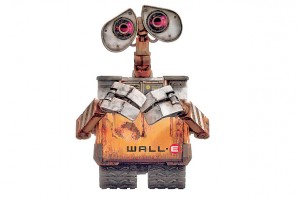
Set in the year 2700, Earth is now a dystopian world rendered uninhabitable by wasteful and excessive humans who exited the planet centuries ago. For seven-hundred years WALL-E (Waste Allocation Load Lifter Earth-Class) has lived alone (save for a friendly cockroach named Hal) compacting the heaps of trash and collecting trinkets left behind when the exodus from Earth happened.
The monotony of his lonely life is interrupted by a search robot named EVE who thinks one of WALL-E’s discoveries is the key to repopulating the planet. When she heads back to the mother ship to pass along the news WALL-E tags along, unwilling to lose the only friend he’s ever had.
WALL-E is one of the most unique children’s films I have ever seen. Despite its relatively simple story, it’s risky filmmaking that has more to do with the great science fiction films of the 1970s than family friendly fare like Nemo. The world director Andrew Stanton has created here is a dark one, where Earth is a wasteland (with tones of The Andromeda Strain and The Omega Man) and overly pampered humankind has reverted back to an almost child-like state.
Add to that the fact that there is no dialogue at all for the first 30 minutes and only sporadic chit chat after that, and you are left with a film that can only be described as a brave and adventurous outing in the formulaic world of kid’s entertainment.
This is a kid’s film that doesn’t pander to kids; that assumes they can use their imaginations to fill in the blanks left by the lack of talk. Most kid’s flicks entertain the eye but don’t give their minds much of a workout. WALL-E does both. It’s the evolution of children’s films; after this the wisecracking animals and toilet jokes of Madagascar and the like will look like relics, as current as Steamboat Willie.
A few famous names pop up on the cast list—Jeff Garland, Sigourney Weaver—but Stanton doesn’t rely on them to sell the movie. Nor does he use current pop culture references to earn cheap laughs à la Shrek. Instead he relies on the most old fashioned of devices—good storytelling—to tell his futuristic story.
Coupled with the good story is spectacular animation from the computer nerds at Pixar whose great achievement here is to give WALL-E and EVE, two inanimate objects, complex emotions while staying true to the characters without stooping to cheap manipulation.
Director Stanton’s great achievement is to fill every frame with a sense of wonder and provide the viewer with one of the most unique and satisfying movie experiences of the summer.