For much of its running time the new film “Horns” has the kind of over-the-top black humour And easy vulgarity of a Stephen King adaptation from the 1980s. It’s not by accident either. It’s in its genes. You see, it’s based on a novel by Joe Hill, eldest son of Maine’s most famous writer of horror fiction.
Daniel Radcliffe plays Ig Perrish, a young man accused of killing his longtime girlfriend Merrin (Juno Temple). His life has been turned upside down. Protestors with signs that read, “You Will Burn in Hell!” and reporters camp outside his home twenty-four seven and the only people who think he’s innocent are his family and his lawyer and best friend Lee (Max Minghella).
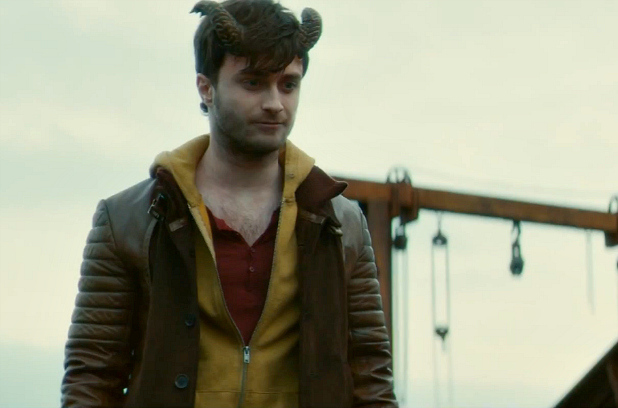
One morning Ig wakes up to discover the disapproval of the world and the hangover he’s fighting aren’t the worst things happening in his life. In the night big, dark devil horns have sprouted from his forehead. “They hurt like hell,” he says.
He soon discovers the horns prompt people to tell him their deepest, darkest desires. “I hate mommy,” says a little girl in a doctor’s office. “I want to burn her in her bed with matches!” This newfound honesty is occasionally hurtful—“She was my favorite thing about you,” Ig’s father says about Merrin—but also provides helpful information in Ig’s search for his girlfriend’s true killer.
“Horns” is a tricky story to bring to the screen. It’s admittedly very visual—the sight of Harry Potter with devilish goat horns crowning his head is memorable for sure—but tone wise it’s all over the place. Director Alexandre Aja gear shifts through Ig’s range of emotions in present day and flashback, without ever making us care that much about his situation, past or present. It’s not exactly a horror film, or a romance or even a murder mystery. Instead it’s a movie that feels like a jigsaw puzzle with pieces from another puzzle forced in to fit.
The idea, I suppose, is to present a story that defies any of its genre inspirations, but the result is an unholy mix; a lackluster fable that fails to mine the material for subtext or a moral, and leaves the audience with very little sympathy for this devil.
Courtesy Lionsgate Daniel Radcliffe’s character discovers he has acquired dark new powers in “Horns.”
“The book is a really unhappy, paranoid novel by a really unhappy, paranoid man,” says author Joe Hill of his thriller Horns, now a movie starring Daniel Radcliffe as a man who grows devil horns after he’s accused of murdering his girlfriend.
“I wasn’t in a great place mentally when I wrote it, (but) I’m very proud of Horns. I think it’s a really fun novel.
“I had tremendous success with Heart Shaped Box and I fell into that cliché, the second novel trap. I wrote 400 pages of a novel I threw away. It was called The Surrealist Glass and it didn’t work. It was no good. Although in some ways the Surrealist Glass was the first draft of Horns because there were ideas and elements and even one or two chapters that were almost lifted wholesale and slotted into Horns.”
The book finally came into focus when Hill, the son of none other than Stephen King, remembered a line he once read in a review of a sci-fi movie: ‘This movie doesn’t quite succeed because it isn’t about anything except itself.”
“The science-fiction film (that the critic) was talking about was a prequel to a well-known franchise about trade federations and robots blowing each other up,” says Hill, the eldest son of horror legend Stephen King, “and it wasn’t about anything except lasers, guns and robots. It didn’t ask any of the great, almost unanswerable questions that people turn to fiction to explore.
“The one thing I always look for in a story is for it to have some sort of internal life.
“To be about something more than just a ghost or a vampire or a devil; to ask some kind of interesting question so it is about something bigger than itself. That’s very possible to do in fantasy.
“I think any story about the devil is the same way. What happens when all the dirty secrets come out? What would it be like to be tempted by the things you fear most?”
The resulting book earned critical praise — Publisher’s Weekly called it a “compulsively readable supernatural thriller” — and snagged him a Bram Stoker Award nomination for best novel. “Now when he’s asked what he thinks of Alexandre Aja’s film adaptation of his “unhappy, paranoid novel” he is effusive.“I think the film is wonderful,” he says.
“It has a lot of cross-genre elements. It’s funny. It has romance. It has a tragic aspect. It has a horror movie aspect to it.
“Someone asked me when I was in Toronto for the premiere, ‘What genre is it?’, and I said, ‘It’s a tragecomehorredy.’ I have no idea what the rest of the world will make of it, but I think it’s a lot of fun.”
“Grand Hotel… always the same. People come, people go. Nothing ever happens.”
That famous line from the Greta Garbo film Grand Hotel is only half right. Hundreds of movies have used hotels as a backdrop for the action because people come, people go, but despite the quote’s assertion, there’s always something happening.
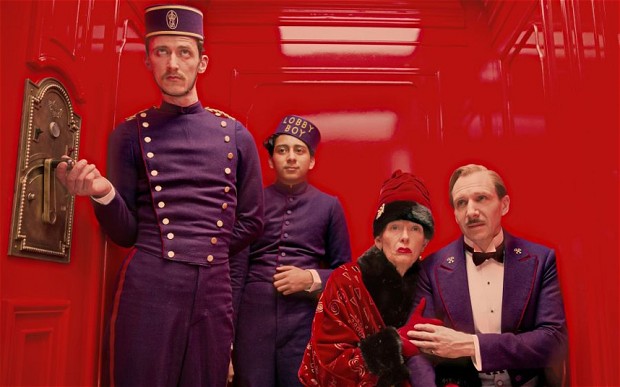
This weekend’s The Grand Budapest Hotel is a case in point. Starring Ralph Fiennes as a concierge at a European hotel between the world wars, it features an all-star cast, including Bill Murray, Owen Wilson, Harvey Keitel and Edward Norton. They are all part of the fabric of the hotel’s history, which includes assassins, murder, riches and a mysterious painting.
Hollywood has always recognized that the transient nature of hotels makes for great drama.
New York City’s Plaza Hotel has played host to many famous movie scenes. Everything from Barefoot in the Park to Funny Girl to The Great Gatsby has used the iconic hotel as a backdrop, but it is probably best known as a location for North by Northwest. In the Alfred Hitchcock film Roger O. Thornhill (Cary Grant) is mistaken for a government agent and kidnapped from the ornate lobby.
The opening shot of Goldfinger features a stunning aerial view of Miami’s Fontainebleau Hotel, which at the time was the most luxurious guesthouse on Miami Beach. Later in the film Bond Girl Jill Masterson (Shirley Eaton) dies of skin asphyxiation inside the hotel after henchman Oddjob (Harold Sakata) coats her whole body in gold paint.
In the 1920’s the Hotel del Coronado was a famous weekend getaway for Hollywood stars like Mae West, Charlie Chaplin, Clark Gable and Errol Flynn but the Victorian wooden beach resort found fame as the setting for several scenes in Some Like it Hot. Located on San Diego Bay across from San Diego, the beachfront location was the scene of one of the film’s most famous lines. When Jerry (Jack Lemmon) first spies Sugar Kane (Marilyn Monroe) sashaying through the sand he says, “Look how she moves! It’s like Jell-O on springs.”
Stephen King was inspired to write The Shining after staying at the 140-room Stanley Hotel in Colorado. “I think a lot of things happened right here in this particular hotel over the years,” says Dick Hallorann (Scatman Crothers) in the film version. “And not all of ’em was good.”
The Stanley has been used as a location for Dumb and Dumber and other films, but Stanley Kubrick chose not to showcase the place in his 1980 adaptation of the novel. Instead, much to King’s disappointment, he used Oregon’s Timberline Lodge as a stand-in for the film’s fictional Overlook Hotel.
If you’ve watched old Roger Corman movies like Attack of the Crab Monsters and thought, ‘I wonder what Corman would have done with a few extra dollars in the budget?’ well, wonder no more. The Mist, the latest Stephen King literary adaptation to hit the big screen is Roger Corman on steroids. Gone are the papier-mâché creatures—they’ve been replaced by expensive high tech computer generated giant bugs—but make no mistake, despite the tarted-up effects and big budget, The Mist is a good old-fashioned grindhouse film.
The set-up is simple. The day after a violent thunderstorm a mysterious a pea-soup fog envelopes the small east coast town of Bridgton, Maine trapping a couple of dozen people in the local supermarket. Outside they hear the screams of people not lucky enough to be indoors when the mist settled. Soon the grocery store takes on a Lord of the Flies vibe as the survivors start to splinter off into different sects, each with a plan for survival. When giant bugs materialize out of the mist and attack it’s everyone for themselves.
Based on a 1980 short story by Stephen King first published in the horror anthology Dark Forces, The Mist, like all good exploitation films, is remarkably timely. In his third adaptation of a Stephen King work director / screenwriter Frank Darabont plays up a storyline involving a fundamentalist Christian woman (Marcia Gay Harden) whose extreme ideas push the desperate group into uncharted and dangerous territory. While watching her twisted logic push the mist’s hostages to violence, one can’t help but equate her rants to the kind of fundamentalism that has poisoned the minds and actions of so many people around the world today.
Political statements aside, Darabont clearly loves the horror genre and knows how to slowly build tension until the audience is white-knuckling it waiting for the payoff. Once inside the supermarket he not only creates interesting dynamics between the trapped townsfolk, but also allows a feeling a dread to settle over the proceedings, punctuated only by bursts of breathless action.
Like the great grindhouse flicks of yore The Mist is a crowd-pleaser. Well defined characters—particularly the heroic Thomas Jane and over-the-top Marcia Gay Harden—and energetic direction had the audience I saw it with hooting and hollering at the screen. It’s entertaining and the best horror film of the year. Roger Corman would approve.
Mike Enslin (John Cusack) makes his living off of the fear of the unknown.
As the author of a series of books like Ten Nights in Haunted Hotel Rooms he is a professional cynic who doesn’t believe in ghosts, and delights in debunking the supernatural beliefs of others. He’s stayed in hundreds of spooky places, but it isn’t until he checks into room 1408 of New York’s Dolphin Hotel that he experiences true terror for the first time.
Based on a short story by horror specialist Stephen King, 1408 isn’t just a ghost story, it delves into the psychological trauma suffered by Enslin as the result of the death of his young daughter.
At first the only evil thing about room 1408 is the price of the beer nuts in the mini bar, but soon enough strange things start to happen. The clock radio mysteriously turns itself on, and if that isn’t creepy enough, every time it turns on it’s playing a Carpenter’s song. At first he tries to rationalize his feelings of dread— maybe he’s been drugged, the visions he’s seeing are hallucinations, maybe he’s overtired—but soon the terror grips him and he wants out of the hotel. Trouble is he can’t leave. It’s like the Hotel California, except with ghostly apparitions, paintings that come to life and that damn annoying Carpenter’s song. The question is: Will he survive the night? Or will he become room 1408’s fifty-seventh victim?
1408 has some spooky scenes and some OK special effects, but unlike The Body, another King short story that inspired Stand By Me, 1408 doesn’t have enough meat on its bones to warrant a long-form film. Director Mikael Håfström takes a story that might have made an interesting hour-long episode of The Outer Limits and stretched it to a long 94 minutes by inserting lots of filler scenes of John Cusack making scared faces.
The psychological catalyst for the story—the death of Enslin’s daughter and his subsequent loss of faith in a God that would allow a child to die—has been done before, most recently in The Reaping from earlier this year. More interesting is the idea that by debunking the idea of ghosts Enslin is somehow taking people’s hope of life after death away. Neither idea is explored in any depth, but at least the latter concept adds some weight to the paper thin story.
1408 has a great trailer but fails to deliver the spine-tingling goods.