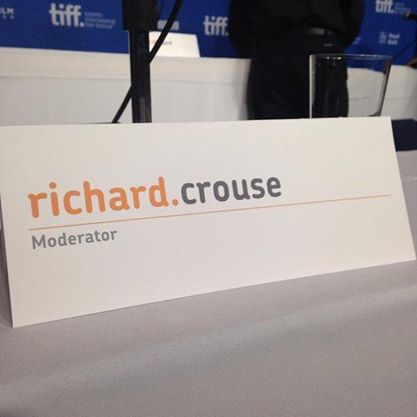
Appearing in one of the movies! I was in Red Alert, a short that played before the movie Wet Bum. IT’s not enough that I cover 100 movies during the fest, now I have to be in them too! I even got a review. “@richardcrouse is great in Red Alert…” Mike Bullard wrote on twitter. “I’d like to tell you I didn’t know he was a redhead but I knew… I just knew ok.”
In person Benedict Cumberbatch’s voice sounds like hot melting wax. I liked Sherlock well enough and have seen him in several movies, but for me, and I know I’m the last to get it, his performance in The Imitation Game is a game changer. He plays real-life character Alan Turing, a Cambridge mathematician who volunteers to help break Germany’s most devastating WWII weapon of war, the Enigma machine. It was a top-secret operation, classified for more than 50 years, but that wasn’t Turing’s only secret. Gay at a time when homosexuality was illegal, punishable by jail or chemical castration, he was forced to live a world of secrets, both personal and professional.
Robert Pattinson telling me about how Hollywood was before camera phones: “When I first started going to LA everyone was underage and if you were a famous actor the rules did not apply. You could be a sixteen-year-old and go into a club but now that there are camera phones everywhere that doesn’t exist anymore. That period was so weird. You’d see a fourteen-year-old actor wasted, doing lines of blow on the table. It was crazy. Now they just do it at their parent’s house.”
Julie Taymore telling me that A Midsummer Night’s Dream “It was the first play I ever saw. I saw it here in Canada at the Stratford Festival…”
Michael Moore’s answer to my question about his reaction to all the celebrity he gained after appearing at TIFF 25 years ago with Roger and Me: Asked what was going through his head while all this was swirling around him, Moore says: “Why didn’t I go to Jenny Craig three months ago?”
“I don’t know where they are,” Kingsley says about his characters, “if they’re inside me waiting to come out or whether they are outside of me. Are they hunting me or am I hunting them? I don’t know.”
Repairing Dustin Hoffman’s watch. During a roundtable interview the alarm on his watch went off several times. He gave it to me and I looked up the instructions on how to fix it on Google. “How did it you look it up on line? They have instructions to fix Timexes on line? I don’t automatically go to those things,” he said. During the interview he said: “I was told to take acting. Nobody flunks acting.” Later he said that it wasn’t such a bad choice because, for instance, “No one ever says, ‘I want to be a critic when I grow up.’”
Lowlight… waiting for BIll Murray for seven hours. (Although I love this from @ZeitchikLAT: Bill Murray, offering implicit proof on the merits of Bill Murray Day: “If this is really my day, why do I have to do so much work?”)
Sitting next to next to Boo Radley, Bill Kilgore and Tom Hagan. (Robert Duvall!)
Most quotable actors of the festival? Robert Duvall who said, about acting, “There’s no right or wrong just truthful or untruthful.” He calls Billy Bob Thornton “The hillbilly Orson Welles…” and said “Brando used to watch Candid Camera.” Jane Fonda was a close second when she said acting is great for the heart but terrible for the nerves… “Butts have become more in fashion… (since Barbarella) and “Television is forgiving to older women and making it possible for us to have longer careers.”
“I have distilled socialism in this box and am taking it back to America.” – Robert Downey Jr in my roundtable interview.
#TIFF14 socks day 3. Chris O’Dowd called them “powerful.” and Rosamund Pike said, “I’m enjoying your socks. They make me happy.”
Watching “Whiplash” knock the socks off an audience at an IMAX P&! screening. It is part musical—the big band jazz numbers are exhilarating—and part psychological study of the tense dynamics between mentor and protégée in the pursuit of excellence. The pair is a match made in hell. Teacher Fletcher, played by J.K. Simmons is a vain, driven man given to throwing chairs at his students if they dare hit a wring note. He’s an exacting hardliner who teaches by humiliation and fear. This movie doesn’t miss a beat.
Love this quote: “Being in the military,” said Adam Driver of This Is Where I Leave You, “believe it or not, is very different than being in an acting school.”
In “Crazy Heart” Bad Blake, played by Jeff Bridges in what will likely become his fifth Oscar nomination, is Willie Nelson if the IRS had their way with him, or Kris Kristofferson if he hadn’t written “Me and Bobby McGee.” “I used to be somebody,” he sings at one point, “but now I’m somebody else.” That someone else is a broke, drunk country music has-been whose idea of a great gig is playing a bowling alley where he isn’t even allowed to run a bar tab.
In a story that echoes “The Wrestler” “Crazy Heart” follows the tail end of the career of a man who once had everything but threw it away. Bad Blake was a big country music star whose life seems ripped from the lyrics of a hurtin’ Hank Williams song. On the road he’s so lonely he could die, so he fills his time with groupies; women who follow him back to his seedy hotel room, remembering the star he once was and not the sweaty, drunk wreck he has become. His downward spiral is slowed when he meets Jean Craddock (Maggie Gyllenhaal), a journalist and single mother who becomes his anchor.
“Crazy Heart” is an average movie buoyed by a great central performance. We’ve seen stories like this before but Bridges’s performance and the film’s details make this a recommend.
First the details. As a general rule most movies about fictional musicians get the most basic thing wrong—the music. Forgettable songs have ruined many a music movie but “Crazy Heart” and composers T-Bone Burnett and Stephen Bruton (who died of cancer before the film was released) nail an authentic country sound. The songs sound Grand Ole Opry ready and once filtered through Bridges’s weathered vocal chords could be echoes from any small town honky tonk or dive bar. It’s hurtin’ music and is spot on.
Beyond the music there are the small details that add so much to the film. There are the nice shards of dialogue like Bad’s flirty remark to Jean as they do an interview in a dingy motel room, “I want to talk about how bad you make this room look” and the accurate portrayal of small town bars and bowling alleys.
It all helps to elevate the predictable story, but none of it would matter a whit if Jeff Bridges wasn’t firmly in control. His Bad Blake is pure outlaw country, a hard drinking and cigarette smoking poet who breathes the same air as Waylon Jennings and Merle Haggart. Bridges throws his vanity out the window, allowing his gut to peak out from behind his guitar and wrinkles to peer out from the sides of his aviators. More than that, however, he nails the troubled charm that made Bad a star and then brought him to his knees. It’s complex work but Bridges, with his smooth, relaxed way with a character makes it look easy. Don’t be fooled; this is the work of a master who is often underrated.
“Crazy Heart” has some major flaws but is worth a look for the performances from Bridges, Gyllenhaal (although she seems a tad young for the part) and Colin Farrell in a small un-credited part as Bad’s former protégé.
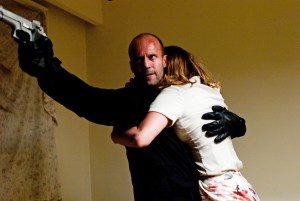
In the movie Parker Jason Statham, British actionman and Hollywood star, plays the title character. He’s a ruthless career criminal with a twisted sense of ethics—he doesn’t steal from the poor or hurt innocent people.
Sound familiar? Well it should, as the character is the star of 24 books written by Donald E. Westlake (under the pseudonym Richard Stark). In the books Parker is a man of mystery, who has never had a given name. Westlake never gave a first name to the character, once joking, “I don’t know what the hell it would be, maybe Frank.”
Many films have also been made from the books, with Parker played by everyone from Lee Marvin to Mel Gibson to Robert Duvall.
If the movies don’t ring a bell, however, it’s because on film Parker has often been renamed.
For instance in 1967’s Point Blank (based upon the novel The Hunter) Lee Marvin played the character named Parker in the book but changed to Walker for the film. In Marvin’s version Walker is a tough, hard man, a characteristic the actor may have taken too seriously. Legend has it that in rehearsal Marvin hit co-star John Vernon so hard Vernon burst into tears.
The next year The Split (named The Seventh in print) saw Parker played by Jim Brown but called McClain. This movie is most notable as the first theatrical release to receive an R rating from the brand new MPAA’s film rating system.
In the 70s and 80s the Westlake Parker novels remained popular Hollywood source material. Robert Duvall switched the name to Macklin in 1973s The Outfit, one of Quentin Tarantino’s favorite films, while the excellently named Slayground with Peter Coyote in 1983 featured a character called Stone.
The best-known Parker adaptation is Payback in 1999, the second film made from The Hunter. In this revenger story Mel Gibson as Parker (switched to Porter) plays a man shot by his wife and best friend and left for dead.
So many actors have played the character, but who would Westlake, his creator, like to have seen in the role? “Usually I don’t put an actor’s face to the character,” he said, “though with Parker, in the early days, I did think he probably looked something like Jack Palance. That may be partly because you knew Palance wasn’t faking it, and Parker wasn’t faking it either.”
 Appearing in one of the movies! I was in Red Alert, a short that played before the movie Wet Bum. IT’s not enough that I cover 100 movies during the fest, now I have to be in them too! I even got a review. “@richardcrouse is great in Red Alert…” Mike Bullard wrote on twitter. “I’d like to tell you I didn’t know he was a redhead but I knew… I just knew ok.”