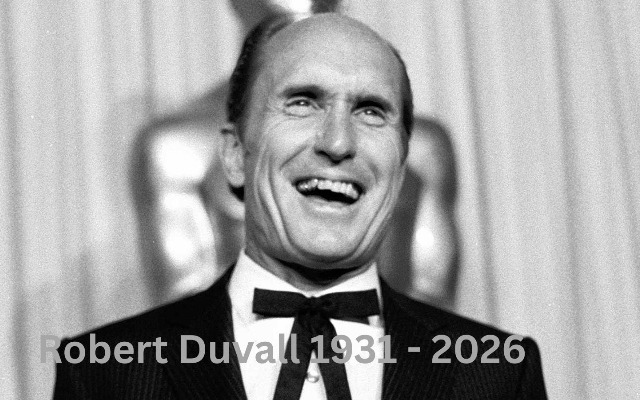
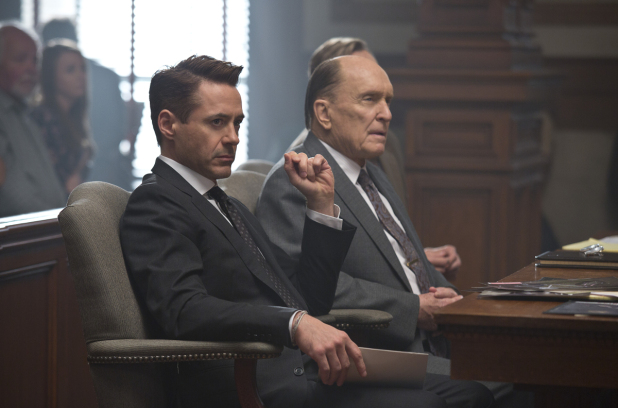
I’ve done this a long time, but on Friday as I sat next to Boo Radley, Lt. Col. William “Bill” Kilgore and Tom Hagan, all rolled up in the form of Robert Duvall, I don’t mind admitting I was star struck.
Even though he was one of the most quotable actors I had spoken to during the opening days of TIFF — for instance he said, “I call Billy Bob Thornton the hillbilly Orson Welles.” — while he was talking all I could hear were his lines from his famous movies rolling around in my head.
Getting an up close and personal look at the 83-year-old Oscar winner, brought back memories of him as Apocalypse Now’s warmongering Kilgore, shirtless kneeling down to tell his soldiers, “I love the smell of napalm in the morning,“ and Don Corleone’s loyal adopted son Tom in The Godfather. “He never asks a second favor when he’s been refused a first.”
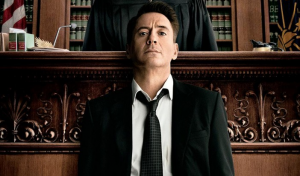
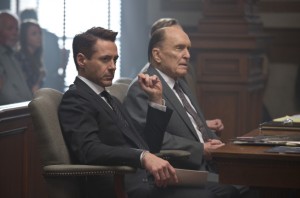
The actor was at TIFF to discuss the opening night film The Judge. He stars opposite Robert Downey Jr. as an erasable old judge, who, when accused of vehicular manslaughter must reluctantly rely on his estranged lawyer son for a defense in court. Luckily I pulled myself together long enough to take some notes.
When he’s asked what it’s like to play a mean character, he says, “Who’s mean? What’s mean about him? He’s a human being.”
He adds, “I almost didn’t take this but once I took it I had to jump in. There are so many negative things about the guy.”
But when asked if he’s afraid to immerse himself in negative characters, his answer turns into a master class on acting. “Why would I be afraid? Once I commit to do it, I’ll do it. I just wonder about it sometimes. Is it worth it to show those negative aspects of somebody?
“But Shakespeare said you hold a mirror up to nature. You try and approximate life as much as possible. Brando used to watch Candid Camera. You try and watch things as closely as you can. You learn from life and you try and represent life as accurately as possible. There’s no right or wrong, there’s just truthful and untruthful.”
He’s a living legend, a star whose career spans six decades, but he’s not nostalgic for the past.
“I think movies are better than ever now. The actors are better. There’s room for everybody now. If you go world wide, I think the actors are better than ever.”
As for his own career, he has more movies on tap, including one he’s directing, starring his wife Luciana Pedraza as a “lady Texas Ranger.” “I got a few more left in me before they wipe the drool,” he says.
Adapted from Louis Bayard’s 2003 novel of the same name, “The Pale Blue Eye,” a somber new Christian Bale murder mystery now streaming on Netflix, begins with a grisly murder in a society that favors discretion.
Set at West Point Military Academy in upstate New York, circa 1830, the story kicks off on a chilly day, an atmospheric note that informs the tone of the film. A cadet is found dead, hanging from a tree on the grounds. What appears to be a case of a young man taking his own life, becomes suspicious when it is discovered his heart has been removed post mortem.
Hoping to avoid a public scandal, West Point enlists Augustus Landor (Christian Bale), a local detective still smarting from the loss of his only daughter, to quietly solve the case. Hindered by the academy’s strict code of silence, Landor gets a break when meets an eccentric young cadet at a local tavern. “I am an artist,” he flamboyantly declares, “I have no nation.” The man, Edgar Allen Poe (Harry Melling), is a poet and truth seeker whose ambitions lay in the written word, not the stuffy traditions of the military.
“Poe,” Landor says, “I need you to discretely infiltrate the cadets.”
A fictional story, “The Pale Blue Eye” inserts Poe, credited with inventing the American detective story, into this tale of intrigue. The poet, sans his famous moustache, did attend West Point, and after two years of service, attained the rank of Sergeant Major for Artillery, but that is where any similarity to reality ends.
Poe, as played by Melling, is arguably the film’s most entertaining character, the only one cut loose from the restraint that casts a pall over the proceedings like a shroud. Bale raises his voice a few times, breaking his character’s unshakable, flinty self-possession, but it is Melling, and his ostentatious demeanor that brings the, as he says, “hot thrashing flurry,” to break free of the movie’s gothic shackles.
Writer, director Scott Cooper sprinkles engaging supporting performances throughout. As the wife of the very proper Dr. Marquis (Toby Jones), Gillian Anderson’s low rumbling voice gives her character a malevolent edge, and it’s a treat to see Robert Duvall as occult expert Jean-Pepe, even if his role is under-written.
“The Pale Blue Eye” is a handsomely mounted, pulpy murder mystery, with some fine performances, but its methodical pace and bleak nature clip its wings, and don’t allow it to make like the E.A.P.’s Raven and take flight.
“Hustle,” a new sports dramedy staring Adam Sandler, now streaming on Netflix, is an underdog story like “Rocky,” if that movie featured Burgess Meredith’s name above the title instead of Sylvester Stallone.
Sandler plays Stanley Sugarman, a veteran basketball scout for the Philadelphia 76ers. Decades spent on the road searching for new talent have left him weary and jaded, missing his wife (Queen Latifah) and daughter (Jordan Hull).
His new boss, the arrogant Vince Merrick (Ben Foster), isn’t making the job any easier. The two butt heads over Stanley’s latest find, Spanish b-ball phenom Bo Cruz (NBA star Juancho Hernangomez). On the court Bo is all unrefined power, used to hustling unsuspecting players for cash. Stanley sees greatness in him, but Bo’s troubled past raises alarms with Merrick and the 76ers management.
Convinced he has a winner, Stanley brings Bo to the United States. They form a bond based on their love of basketball and family, and together set out to prove that they have what it takes to succeed on the court and in life.
“Hustle” may be formulaic and easy to read, but it succeeds because of the chemistry between Sandler and Hernangomez. What begins as an odd couple pairing quickly becomes something more. This isn’t “Billy Madison” with a basketball, it’s a story of fathers and sons, of mentorship, one that provides uplift while avoiding the sentimentality that often shoehorns its way into movies like this.
Sandler’s performance is simple. It’s not as showy as his work in “Uncut Gems” or “Punch Drunk Love.” Instead, he infuses Stanley with world weariness tempered with resilience, to create a sincere portrait of a man and the game he loves. Screenwriters Taylor Materne and Will Fetters nail the seriocomic tone, feeding Sandler a string of self-depreciating one-liners that help define the character.
Director Jeremiah Zagar and cinematographer Zak Mulligan capture the excitement of the game with frenetic on-court camera work that heightens the drama and showcases the NBA action and player skills.
“Hustle” is an upbeat, predictable sports story but succeeds because of the stakes. You’ll know where this story is going (NO SPOILERS HERE) but it transcends the usual sports narrative because the characters have it all on the line. It’s not about the basketball, really, it’s more about the struggle of overcoming adversity and thus has a universal appeal even if you’ve never heard of an Alley-Oop.
Inspired by true events, “Twelve Mighty Orphans,” new historical sports drama starring Luke Wilson, and now playing in theatres, reunites Martin Sheen with his “Apocalypse Now” co-star Robert Duvall.
Set during the Great Depression, the story revolves around WWI hero and up-standing citizen Rusty Russell (Wilson), a math and science teacher, tasked with teaching orphans at the Masonic Home in Fort Worth, Texas. The students are exploited, forced to work manual labor and beaten when they step out of line, and even when they don’t. In an effort to build char acter and foster a feeling of self-worth in the boys, Russell forms a football team, even though they don’t have a football or shoes.
“We have two seasons,” says Doc Hall (Sheen). “One without shoes and one with shoes. This is the season without shoes.”
A montage or two later, Russell seems to be making progress with the team of underdogs but not everyone is happy about it. “Every second they’re on the field, we’re losing money. says Frank Wynn (Wayne Knight), the taskmaster who mistreats the boys.
According to Doc, their early practices look more “like an Arthur Murray dance class” than an organized sport but soon the team comes together. Named the Mighty Mites, they use new, innovative strategies that set them up for success and, ultimately, to be an inspiration to a nation in need of heroes. “You have to adapt if you want to be competitive,” Russell says. “We don’t have the size, so we have to utilize what we do have.”
“Twelve Mighty Orphans” is a feel-good film light on surprises but heavy on inspiration. It’s predictable and old-fashioned, but it undeniably has its heart in the right place: right on its sleeve. Fine performances from Wilson, Sheen (who appears to be having the most fun of anyone on set) and Duvall, as the team’s financier, help ground the film’s high strung emotional tone.
You’ll root for the team, and the movie too, even when you can barely see through the clichés.
“Widows” may be one of the most subversive heist films ever made. Based on a British mini-series from the 1980’s it stars Viola Davis, Elizabeth Debicki, Michelle Rodriguez and Cynthia Erivo as four women bonded by debts left to some very bad men by their late husbands. It is part caper flick and part survival story that makes strong statements on hot button topics like sexism, poverty, prejudice, power and police brutality.
Set in modern day Chicago, the action in the story begins when Harry (Liam Neeson) and his crew of robbers gunned down and blown up after a heist gone wrong. His widow, teachers’ union executive Veronica Rawlins (Viola Davis), is left with a $2 million debt to local crime boss Jamal Manning (Brian Tyree Henry). Manning is a tough guy attempting a stab at legitimacy by entering politics, running against corrupt local alderman, Jack Mulligan (Colin Farrell). Manning wants his money and, after mistreating Veronica’s dog, gives her just one month to come up with the cash. “That money was meant to buy me a new life,” snarls Jamal. “That money was about my life. Now it is about yours.” If she can’t come up with the cash she’ll have to deal with psychopathic strong arm Jatemme Manning (Daniel Kaluuya).
It is a dire situation but Veronica has a plan, or rather, a notebook and a plan. Harry left behind a handwritten book detailing every bribe he ever paid and blueprints for a future heist. Putting the widows of her late husband’s hoodlum crew to work (Debicki, Rodriguez, and non-widow Cynthia Erivo), she creates a gang of her own to steal $5 million cash and save their lives. “I’m the only thing standing between you and a bullet in your head,” says Veronica.
Co-written by McQueen and Gillian Flynn, the author and screenwriter of “Gone Girl,” “Widows” is a tightly constructed thriller that builds with each passing moment. McQueen takes his time with the material, allowing the audience to get to know the characters, to learn what’s at stake if this caper goes south.
First and foremost is Davis, fierce and formidable. Her evolution from executive and unsuspecting wife to criminal mastermind is emotional, logical and very motivated.
Opposite her is Debicki as a damaged woman whose own mother suggests prostitution as a career choice to make things meet. Her shift from abused woman to a person completely in control of her life and the way she is perceived—“It’s mine to be ashamed of or be proud of,” she says. “It’s my life.”—is one of the film’s true pleasures.
The cast is universally strong. Farrell could use a different accent coach but Kaluuya is evil personified, a psychopath with dead eyes and an attitude.
“Widows” is a stylish art house heist flick that pays tribute to the genre but layers in not only intrigue but also social commentary about racism, the cost of political power and the imbalance of power between some of the female characters and their male counterparts. The thrills will appeal both to your heart and head.
As an actor two time Academy Award winner Dustin Hoffman has created some indelible characters—Midnight Cowboy’s Ratso Rizzo and Tootsie to name a couple—but from an early age he dreamed of being a professional pianist.
“I wanted to be a musician but I was never talented enough,” he says, “so I’m not a musician. I have small hands—and by the way there is no correlation to your hands and personal parts—so I can’t reach much more than an octave.”
In the new film Boychoir he shows his musical side playing a choirmaster to a group of talented youngsters. During the film’s making he tinkled the ivories on screen and off, spending his downtime duetting with director François Girard.
“As far as François and I noodling on the piano,” he says, “I would have preferred it was only me. He was busy lining up the shots, but he did noodle, so there was a bit of competitive noodling.”
As a young man he studied classical piano but when it became apparent he’d never turn pro, he tried his hand at acting. “I had been flunking out of junior college and somebody said, ‘Try acting. Nobody flunks acting.’”
Enrolling at the Pasadena Playhouse, he shared a room with Robert Duvall and studied with Gene Hackman.
“No one told me I was a good actor,” he says. “No one told Gene and there was a third person, Duvall, and we hung out together. They are both much, much older than me. If someone was to say to the three of us in those early days that we were going to be successful, forget about being movie stars, everyone would have laughed. It’s kind of a freak accident that it happened to all three of us.”
Hoffman’s big break came in the form of Benjamin Braddock in The Graduate. Robert Redford was considered for the part but director Mike Nichols rejected the traditionally handsome actor—“ You can’t play it,” he told Redford. “You can never play a loser.”—in favour of the unknown Hoffman. The Graduate made him a star and is now considered a classic, but almost fifty years later he remembers how the critics savaged his performance.
The barbs hurt at the time, but he doesn’t let them get under his skin any more. “Critics are… I shouldn’t say,” he laughs, “I don’t know if anyone grows up saying, ‘When I grow up I want to be a critic.’”
Interviewers love talking with Robert Downey Jr., not just because he’s one of the biggest movie stars in the world, but also because he’s a one-man quote machine.
Walking into a room full of Canadian reporters to chat up his latest film, The Judge, he’s wearing a festooned shirt — and that is the only word that can be used to describe his flamboyant sartorial choice — with a pattern that resembled a bisected tree trunk. More intriguingly he carried a small green, nondescript box.
Asked what was inside he said, “I have distilled socialism in this box. It wasn’t easy. I’m bringing it back to America.”
And the quotes kept coming.
The Judge is a family drama about Hank, a hotshot, big-city lawyer who returns to his hometown for his mother’s funeral. He’s been estranged from his father, Judge Joseph Palmer (Robert Duvall), for years — “He’s dead to me” — but is forced to re-examine everything he knows about his dad when the judge is accused of murder.
Downey says, “I found myself crying all the time,” (great quote No. 2 for those keeping track) during filming, but not because he was reflecting back on his own life. “I got caught up in the reality the movie expresses,” he says. “Hank’s mom’s funeral is every funeral and Hank’s cut-off with his dad is every cut-off that anyone has ever had. It’s not even particularly a father-son story because the judge could have been the mom. I just think about these family dynamics and they light up constellations that are very emotional” (great quote No. 3!).
He describes shooting the movie as a “weird game of Sudoku” (great quote No. 4) in terms of making sure the emotional moments didn’t stack up against one another, blunting their impact.
“You can’t just play 120 catharses in a row,” he says. “I hate it when I see that in movies. It’s like, ‘All right, is everyone always crying in real life?’”
The first step in finding the character meant not allowing his Hollywood persona to bleed into Hank. “That was the first thing I had to smash,” he says.
“Hank is really observing this situation that’s happening around him and to him and he becomes this person who has to go through this terrible and wonderful crucible. It was really just about doing less and less and less and less and I like being busy. I like to talk and I like to be active and all that stuff, so sometimes I felt like I was literally just sitting on my hands.”
He leaves us with one last great quote that sums up his emotional response to the film. “It kicks me in the stomach in the nicest way.”
You get value for your money in Robert Downey’s Jr’s new film “The Judge.” Stepping away from the superhero movies that made him a household name, he stars in a film with so many story shards and plot derivations you need a scorecard to keep up.
It’s a legal drama. No, it’s a manboy coming-of-age story. Wait! It’s also romance, a dramedy, a father-and-son tale and a mystery. The only genres missing are horror and science fiction and I suspect they will be included on the director’s cut Blu Ray.
Downey Jr is Hank Palmer, a hotshot defense lawyer. He’ll do anything to win and is proud of it. “Everybody wants Atticus Finch,” he says, “until there’s a dead hooker in the hot tub.” In court he’s Iron Man, an unstoppable force with a thick skin and a quick line. He’s the same outside of court as well, except when it comes to his father.
He’s been estranged from Judge Joseph Palmer (Robert Duvall) for years—“He’s dead to me.”—but is forced to see him when his mother passes away. Returning to his hometown of Carlinville, Indiana for the funeral Hank must confront the life he left behind—ex-girlfriend Samantha (Vera Farmiga), brothers Glen (Vincent D’Onofrio) and Dale (Jeremy Strong) and his cold-fish father. The quick in-and-out trip is extended, however, when the Judge is accused of murder and Hank becomes his lawyer.
“The Judge” feels like Oscar bait. It’s a long movie with a wide story arc that gives its leads ample opportunity to strut their stuff. Downey hands in a solid, if somewhat familiar performance while Duvall plays elder statesman, resurrecting the alpha male feel of “The Great Santini.” Both are used to good effect and the supporting cast keeps things humming along despite a story that pushes credulity to the limit.
The devil is in the details and when the details, no matter how small they are, verge on silly, they become a distraction.
Most of the silly stuff comes in the form of the clues Hank pieces together while forming the Judge’s defense and the trial itself. There will be no spoilers here, but suffice to say the whole thing hinges on a bit of information so implausible that it gives new meaning to the term suspension of disbelief. Trouble is, it didn’t have to be that way. There were any number of ways to establish the point in question (OK, HERE’S AMILD SPOILER ALERT: It involves chemotherapy and a cottage) without trying so hard, but that’s not the kind of film this is.
“The Judge” is the hardest working movie in show business. It’s a film that wants to check all the boxes and tries just a little too hard. Downey and Co. float above it all, however, touching down every now and again to introduce a new plot twist and deliver the occasional touching moment.
“My father’s a lot of unpleasant things. A murderer’s not one of them.”
That’s how Robert Downey Jr. describes his father, the titular character in this weekend’s legal thriller The Judge. Robert Duvall plays the irascible old judge, who, when accused of vehicular manslaughter, must reluctantly rely on his estranged lawyer son for a defence in court. While he’s on the bench, he’s a no-nonsense justice who doles out old-fashioned common sense along with his judgments. In one case, he makes a deadbeat dad hand over his brand-new truck to his ex-wife, joining a long list of movie magistrates who have meted out law and order on the big screen.
Remember Fred Gwynne as My Cousin Vinny’s Judge Chamberlain Haller —his classic question, “What is a yoot?” may be one of the most famous movie lines delivered from the bench — but how about Judge Doom, the much feared judge of Toontown? As played by Christopher Lloyd in Who Framed Roger Rabbit, he presides over a town of cartoon characters, punishing lawbreakers with the dreaded Dip, a bubbling vat of turpentine, acetone and benzene that “erases” them. His mission is to pin the murder of Marvin Acme on Roger Rabbit. “I’ll catch the rabbit, I’ll try him, convict him and execute him!”
Everyone has heard the term “judge, jury and executioner,” but Judge Dredd adds one more title, police officer. Set in 2080, this Sylvester Stallone movie sees the justice system boiled down to Street Judges who enforce the laws and dole out instant justice. When Joseph Dredd is convicted for a crime he didn’t commit, he must prove his innocence. “The evidence has been falsified! It’s impossible! I never broke the law, I AM THE LAW!”
Finally, a more conventional judge is seen in Anatomy of a Murder, the 1959 Otto Preminger film about an army lieutenant accused of murdering a bartender who attacked his wife. The all-star cast — defence attorney James Stewart, George C. Scott as the prosecutor, Ben Gazzara and Lee Remick as the defendant and his wife — was presided over by real-life lawyer Joseph N. Welch as Judge Weaver. Welch made several pictures, but is best remembered as the attorney who represented the Army in the McCarthy hearings and scolded the Communist-hunting senator with the famous words, “Have you no sense of decency, sir?” when he verbally attacked a member of Welch’s law firm.
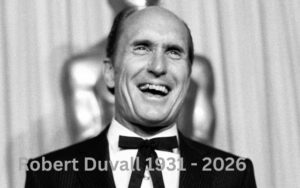 FROM METRO CANADA SEPTEMBER 2014: