Every now and again a movie comes along that is so artfully weird, so unconventional in its approach and ethos, that it defies description and earns a recommend even though it isn’t completely successful in reaching its loft goals. “Birdman or (The Unexpected Virtue of Ignorance),” the new film from “Babel” director Alejandro González Iñárritu, is that movie.
In what may be the most meta casting coup of the year Michael Keaton plays Riggan Thomson, a former movie star whose fame floundered when he left the “Birdman” franchise of super hero movies. Twenty years later with his money running out, he makes a comeback bid in the form of a Broadway show based on a Raymond Carver novel. Surrounded by family—daughter Sam (Emma Stone)—friends—BFF Brandon (Zach Galifianakis)—intense actors—played by Edward Norton, Andrea Riseborough and Naomi Watts—and a nasty theatre critic (Lindsay Duncan) who resents movie star Riggins for taking up space in a theatre that could have been used for art, he fights to reestablish himself as a serious actor.
“Birdman” could have been a stunt film. The casting of “Batman” star Keaton as a washed up former superhero is inspired but mostly because he hands in a performance that rides the line between comedic and pathos. “I’m the answer to a Trivial Pursuit question,” he says.
It doesn’t feel like stunt casting because Keaton plays the truth of the situation and not just the situation. His Riggins is obnoxious, self-absorbed and yet earnest in his desire to create great art. Keaton plays it all, wallowing in a stew of self-pity—he says he looks like “a turkey with leukemia.”—and ego while never once trying to appeal to the audience’s good graces. It’s a bravura performance that is the beating heart of this strange beast.
The supporting actors also impress. As an extreme method actor with an uncompromising attitude toward acting and fame—“Popularity is the slutty little cousin of prestige,” he says—the movie gives Ed Norton the most interesting and challenging part he’s had in years, and Watts is a suitably seething mass of insecurity and sexuality.
Also dazzling is the movie’s style. Filmed to look like one continuous steady-can shot, “Birdman” is as much a technical feat as it is an artistic one. Again, what could have been a stunt turns into a visual rollercoaster that propels the action forward constantly while creating a unique and stylish palette for the story.
But it doesn’t all work. Some of the insight is a bit too on the nose—“You’re no actor. You’re a celebrity.”—and labors to hammer home it’s points. The spiteful theatre critic becomes a caricature of New York intellectuals, scornful of Riggin’s accomplishments in Hollywood. ”You measure your worth in weekends,” she sneers, “and give one another awards for cartoons.” As fiery as that scene is, it feels a little too easy.
That is a small quibble, however, in a movie that takes so many chances and lampoons celebrity culture by having a reporter ask Riggins, “Is it true you have been injecting yourself with seaman from baby pigs?”
“Grand Hotel… always the same. People come, people go. Nothing ever happens.”
That famous line from the Greta Garbo film Grand Hotel is only half right. Hundreds of movies have used hotels as a backdrop for the action because people come, people go, but despite the quote’s assertion, there’s always something happening.
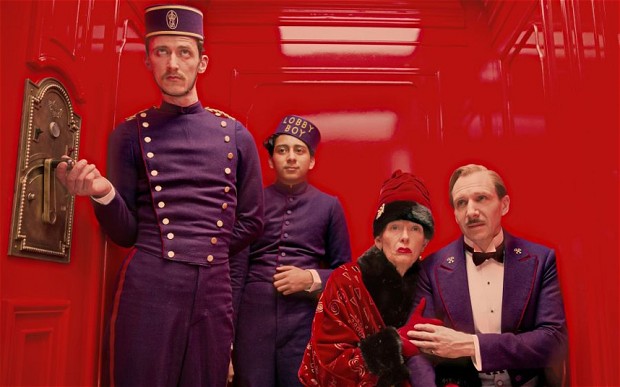
This weekend’s The Grand Budapest Hotel is a case in point. Starring Ralph Fiennes as a concierge at a European hotel between the world wars, it features an all-star cast, including Bill Murray, Owen Wilson, Harvey Keitel and Edward Norton. They are all part of the fabric of the hotel’s history, which includes assassins, murder, riches and a mysterious painting.
Hollywood has always recognized that the transient nature of hotels makes for great drama.
New York City’s Plaza Hotel has played host to many famous movie scenes. Everything from Barefoot in the Park to Funny Girl to The Great Gatsby has used the iconic hotel as a backdrop, but it is probably best known as a location for North by Northwest. In the Alfred Hitchcock film Roger O. Thornhill (Cary Grant) is mistaken for a government agent and kidnapped from the ornate lobby.
The opening shot of Goldfinger features a stunning aerial view of Miami’s Fontainebleau Hotel, which at the time was the most luxurious guesthouse on Miami Beach. Later in the film Bond Girl Jill Masterson (Shirley Eaton) dies of skin asphyxiation inside the hotel after henchman Oddjob (Harold Sakata) coats her whole body in gold paint.
In the 1920’s the Hotel del Coronado was a famous weekend getaway for Hollywood stars like Mae West, Charlie Chaplin, Clark Gable and Errol Flynn but the Victorian wooden beach resort found fame as the setting for several scenes in Some Like it Hot. Located on San Diego Bay across from San Diego, the beachfront location was the scene of one of the film’s most famous lines. When Jerry (Jack Lemmon) first spies Sugar Kane (Marilyn Monroe) sashaying through the sand he says, “Look how she moves! It’s like Jell-O on springs.”
Stephen King was inspired to write The Shining after staying at the 140-room Stanley Hotel in Colorado. “I think a lot of things happened right here in this particular hotel over the years,” says Dick Hallorann (Scatman Crothers) in the film version. “And not all of ’em was good.”
The Stanley has been used as a location for Dumb and Dumber and other films, but Stanley Kubrick chose not to showcase the place in his 1980 adaptation of the novel. Instead, much to King’s disappointment, he used Oregon’s Timberline Lodge as a stand-in for the film’s fictional Overlook Hotel.
A few years ago it looked like director Ang Lee had ruined The Incredible Hulk franchise. His version of the big green guy’s origin story, Hulk starring Eric Bana, started strong with a promising $62 million take on the opening weekend only to plunge to $18 million, and then to $8 million on the two subsequent weekends. Superheroes, especially ones as beloved as the Hulk are expected to rake in super bucks, so when Lee’s vision of the character fizzled it looked like Bruce Banner’s alter ego would be best remembered for the comic books and the cheesy but fun television series starring Bill Bixby.
Marvel, however, had different ideas. After a five year break they’ve brought him back, bigger and greener than ever and ready to do battle with Iron Man for supremacy of the summer’s box office.
The new one starts all over again as if Lee’s Hulk never existed. When we first see Bruce Banner (Edward Norton) he is living in South America, a fugitive from the US Army—namely General Thaddeus “Thunderbolt” Ross (William Hurt) and mercenary Emil Blonsky (Tim Roth)—who desperately want to turn the Hulk technology into a weapon. Banner, meanwhile, is desperate to find a cure, or at least a way to control his angry outbreaks.
After a nasty one-on-one confrontation with the Hulk Blonsky volunteers his body to science, and is injected with Banner’s gamma ray formula. When the procedure transforms him into a power crazed giant fighting beast—“This is a whole new level of weird,” he says—it looks like the Hulk is the only one who can stop him. Add to that a Beauty and the Beast love story and you’ve got a story that is more or less true to its comic book origins.
The buzz on the internet for The Incredible Hulk was not good. Bloggers said Edward Norton as Bruce Banner was too slight, too much of an artiste; that the action in the trailer looked stilted and the hulking beast too cartoony. The buzz on the net was wrong; wrong like it was for Snakes on a Plane. The internet chatter pegging Snakes as a hit was off the mark and to paraphrase Mark Twain, “the internet reports of The Incredible Hulk as box office poison have been greatly exaggerated.”
It’s actually great fun; fast and furious with enough story to please the purists, enough action to entertain the eye and just enough humor to keep the actors from taking it all too seriously.
Norton (who also did an unaccredited rewrite on the script) acquits himself well in the lead role, bringing some dramatic weight to the character but never forgetting that this is a Saturday matinee kind of movie and also requires a light touch. There is an unexpected laugh out loud love scene and some nice in-jokes for the comic fans, but frankly, we like him better when he’s mad.
When he goes koo-koo bananas he turns into the nine-foot behemoth Hulk, and the transformation is pretty cool even if his arms and legs do look like giant pieces of boiled okra. The Hulk’s big action set pieces are what you’d expect—loud and frenetic adrenaline fueled special effect extravaganzas and quite effective.
The Incredible Hulk is a crowd-pleaser which should even play well to audiences unfamiliar with the big green guy, but will really thrill fanboys and gals with the revelation that this may be just one more step toward a multi-hero movie based on the popular comic The Avengers. That movie, featuring Captain America, Iron Man, Ant-Man and The Incredible Hulk is rumored to be set for a 2010 release, and would be, for comic book fans, a kind of Holy Grail of Superheroes.
Until then they’ll have to make due with just one superhero at a time, and for now, The Incredible Hulk will do just fine.
Wes Anderson specializes in idiosyncratic films rich in detail and populated with dysfunctional people. “Rushmore,” “The Royal Tenenbaums,” “The Life Aquatic with Steve Zissou,” “The Darjeeling Limited” and even his stop motion animated “Fantastic Mr. Fox” are studies in human behavior with liberal doses of humor and melancholy.
Some find his films twee, a bit too clever, but there is real beauty in very one of them and not just in his wonderfully composed shots. What is obvious, particularly in his new film, the coming-of-age “Moonrise Kingdom,” is a love of humanity in all its forms. They maybe eccentric pieces of work, but they’re heartfelt.
The year is 1965, the place is a New England island town called New Penzance. On one side of the island orphan Sam (Jared Gilman) is a twelve-year-old Khaki Scout disliked by the rest of his troupe. He’s unstable, they say. Dangerous. On the other is Suzy (Kara Hayward), an unhappy girl who lives in what looks to be a giant dollhouse with her parents (Bill Murray, Frances McDormand) and three younger brothers. In love, united in their outsider status, they run away, going on an extended camping trip. Search parties are launched—led by the Sheriff (Bruce Willis) and Scout Master Ward (Edward Norton) but true love prevails and these soul mates will not be kept apart.
Adjectives like beautiful and lyrical spring to mind when I recall the movie. Anderson is the anti-David Lynch, a uniquely American filmmaker, a dysfunctional Norman Rockwell who peels back the veneer of typical life not to reveal a seedy underbelly as Lynch does, but the best in human nature.
Anderson’s characters don’t always start in a good place, but circumstance usually pushes them to explore the better side of their psyches.
As usual Anderson brings out nice performances from his cast. Murray returns for this eighth collaboration with the director, Willis puts aside his usual “Die Hard” bravado to play a sad, small town cop and Jason Schwartzman steals the show in a cameo as a fast talking camp councilor. The real stars, however, are Gilman and Hayward, who both hand in complex performances as troubled kids.
Also present is Anderson’s usual attention to detail—“Suzy’s “Sunday school shoes”—and unerring eye for composition.
More importantly though, is his sense of character. It’s clear he cares about his characters, and with this film he establishes himself as one of the great humanist directors working today.
The level of eccentric filmmaking in “Moonrise Kingdom” won’t be for everyone, but the film’s warmth and gentle humor earn it a big recommendation.
Angry corrupt cops who “bleed blue” and speak with heavy Brooklyn accents are nothing new at the movies. We’ve seen them for years, decades even, in everything from Serpico to last year’s We Own the Night. The trick to keeping audience interest is to add in some new elements to shake up the old formula. Pride and Glory, written by the son of a cop and starring Edward Norton and Colin Farrell, attempts this by telling a multi-generational story of a family of policemen.
Ray and Francis Tierney (Noah Emmerich and Norton respectively) are New York police officers at very different stages of their careers. Francis, like his father and namesake (Jon Voight) before him, is a well thought of commanding officer, while Ray, a former hotshot, now a traumatized ex-street cop, is currently riding a desk at Missing Persons. At the urging of his father Ray is lured away from the relative safety of his desk to investigate the murder of four cops at a failed drug bust. When Ray’s investigation leads him to believe that his brother and brother-in-law (Colin Farrell) may be involved he is forced to choose between his family and his brothers in blue.
Pride and Glory doesn’t reinvent the wheel, and even the intergenerational twist isn’t that new—just ask James Gray, the director and screenwriter for We Own the Night—but it does a good job of presenting the moral quandary that arises when telling the truth is going to have serious consequences for the ones you love.
Ed Norton convincingly portrays Ray’s conundrum. He’s a bubbling caldron of bile that threatens to boil over at any moment, and if you’re Colin Farrell you might not like him when he’s angry. Norton expertly conveys anger, confusion and remorse often in the same scene. It’s a nicely calibrated performance that is better than the rest of the movie.
If you could describe Norton’s performance as finely tuned then only the opposite can be said of Farrell’s work. As dirty cop Jimmy Egan he is kind of one note, but it’s a good note. He plays the out-of-control cop as a delightfully unhinged man who will do anything—including menacing a baby with a piping hot iron—to get what he wants. It’s a performance that borders on camp, but Farrell keeps it on the right side of the line and his passion adds some much needed gusto to the film’s slower scenes.
Jon Voight, Noah Emmerich and the rest of the cast hand in solid performances, although there’s nothing nearly as memorable as Farrell’s wild ride.
In many ways Pride and Glory is little more than a slightly above average cop drama, but its willingness to splash around in the grey areas of cop morality and loyalty plus the commanding performances of Norton and Farrell earn it a recommendation.
The Painted Veil, W. Somerset Maugham’s novel about a dysfunctional British couple who travel to rural China in the early part of the 20th century has been brought to the screen twice before. Greta Garbo’s 1934 version used the title but little else from the book, while a 1957 take on the story, titled The Seventh Sin, skirted around some of the more unsavory aspects of the story. The new version, starring Edward Norton and Naomi Watts has the old-fashioned epic old-fashioned feel of its predecessors, but is far more frank than either of the first two films could ever be.
Norton and Watts play Walter and Kitty Fane, an unhappily married couple who stay together out of habit rather than love. He is an unaffectionate biologist who is married to his work, she a shallow party girl who craves attention. When she has an affair with one of her husband’s colleagues Walter explodes, showing real passion for the first time in their marriage. He cruelly offers her an ultimatum: she can either follow him to a cholera ravaged village in rural China where he will study the disease or suffer the indignity and ensuing scandal of being sued for divorce on the grounds of adultery.
She chooses the former and while in the dangerous rural village, away from everything and everyone they know, the couple discovers forgiveness and is able to reconnect.
The film was shot on location in Mainland China and looks spectacular and both Norton and Watts hand in good performances that really get under the skin of a relationship that is in real trouble. The movie is set in post Victorian times and these two actors adhere to the etiquette of the day, but also show the passion that boils just beneath their mannered facades. The achieve something remarkable—they make an eighty year old story set nearly a century ago feel up-to-date and modern.
“Stone,” the new film starring powerhouse method actors Robert de Niro and Edward Norton, is the very definition of an actor’s movie. Richly drawn characters populate the film giving actors a chance to brood, use funny accents and, in the case of Milla Jovovich, deliver a career altering performance. It’s just too bad the story doesn’t give the actors the support they deserve.
De Niro plays parole case worker Jack Mabry. He’s a month away from retirement, and in an effort to cross ts’s and dot i’s he’s clearing his desk of all his outstanding paperwork. One of his final cases is Gerald “Stone” Creeson (Norton), an arsonist looking for spiritual enlightenment and a way out of prison. They engage in an elaborate verbal game but when words fail, Stone resorts to plan B, convincing his wife Lucetta (Jovovich) to seduce Mabry and use blackmail to earn his release from jail. She’s a willing participant, but soon after ethical and moral lines are crossed the deception deepens, revealing the true character of all involved.
First and foremost “Stone” is a movie to be admired for its performances. Norton, corn rows and all, impresses, playing a riff on the sketchy but emotionally layered characters he’s played before in films like “American History X” and “Primal Fear.” Mabry seems like a character De Niro could play in his sleep, a family guy with a reserve of rage hidden just under the surface, but his skilful performance takes Mabry to interesting and unexpected places. The biggest surprise, however, is Jovovich. The queen of the “Resident Evil” series taps into previously unseen reservoirs of talent, hinting that she may soon add Oscar nominee to her imdb listing.
The performances are admirable but as good as they are the story won’t inspire admiration, just frustration. It has the bones of a gripping drama but as the running time approaches the ninety minute mark character motivations become muddled and Norton’s metaphysical transformation seems more like a plot device than a believable life change. It allows Norton to do some interesting work but feels like it belongs in a different movie. Near the end it almost feels as though director John Curran (who worked with Norton before on the period drama The Painted Veil) ran out of time and had to tie up all the story shards in the quickest, most efficient way possible. There is little resolution and a metaphor, at least that’s what I think it is, involving a fly is mystifying.
“Stone” shines when it focuses on the actors but sinks like a, well, stone story wise.
Director Danny DeVito uncovers the soft underbelly of children’s television in this dark comedy starring Edward Norton and a manic Robin Williams. This is a mean spirited piece of work, so dark and profane you have to give Mrs. Doubtfire and the guy from Taxi credit for making it work. With a lesser cast and without a steady hand behind the camera this could have turned into an unredeemable mess. Instead DeVito and cast churn out a comedy that does something unusual, they remain likeable – particularly Williams playing against his recent family-man image – while delivering unpredictable laughs for those who like their humor with a mean streak. Maybe the “Posterboy for Bad Taste” Tom Green should study this movie before he writes his next screenplay.
Edward Norton has made a career of playing jailbirds on screen. His edgy intensity lights up movies like this weekend’s Stone, despite one writer calling him “the passport definition of no distinguishing marks.”
The Yale graduate’s slight, gawky frame is not exactly what you have in mind when you think criminal and yet his portrayals of people on life’s fringe’s have earned him Oscar nominations and come to define his career.
In his first big screen part Norton played the dual role of altar boy Aaron and his alter ego, the psychotic Roy in the film Primal Fear. Accused of murder, he is zealously defended by a defense attorney (Richard Gere) who is drawn to the sweet Southern boy until he realizes that Aaron is totally insane. A complete unknown when he auditioned for the role, he tricked the film’s director into thinking he shared an eastern Kentucky background with Aaron by speaking with a twang —which he picked by watching Coal Miner’s Daughter.
“The most I had to offer was anonymity,” he later said. “The potency of the revelation about who my character really was in that film was in part reliant on the fact that people had absolutely no prior knowledge of me.”
Next time behind bars he pulled a De Niro, and in American History X physically transformed to play the role of a white supremacist sent away for murder. In jail he learns the error of his ways and works to help his brother from going down the same, wrong-headed path.
“I knew this guy was going to have to be really physically fearsome,” he says, “and that’s not something anyone would peg me for. [He’s] defined by rage and this body he’s created is the physical manifestation of that.”
In this weekend’s Stone he stars as an arsonist who will do anything, including using his wife as bait, to earn parole. Despite having played convicts in the past, Norton was keen to bring an extra layer of realism to this role so he met with actual prisoners to learn how they spoke.
“Their language is fantastic. At one point, one of these guys was telling me about a fight and how he had to just let it happen and not fight. (He said,) ‘When you’re short time, you have to be a vegetarian.’ I said, ‘What?’ He said, ‘Vegetarian, you can’t have beef with nobody.’”