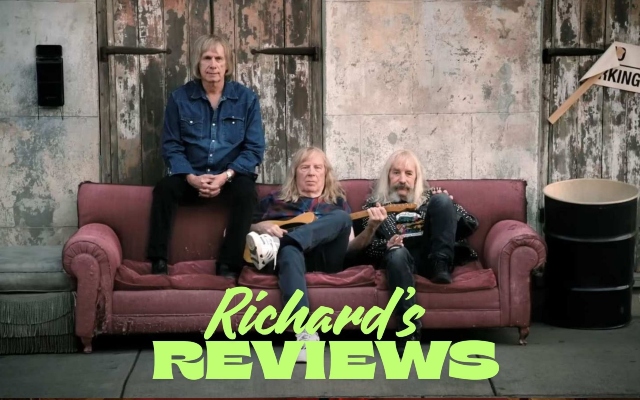
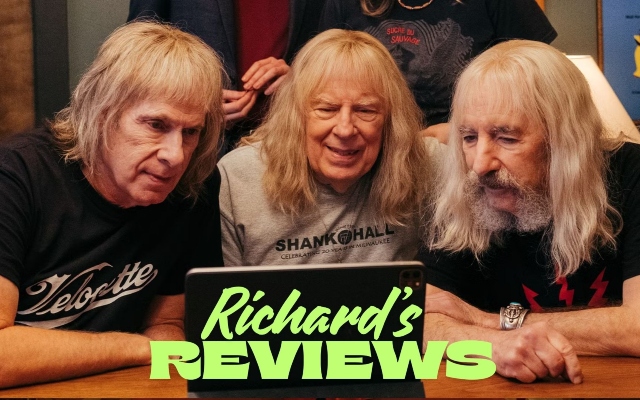
I join CTV NewsChannel anchor Scott Hirsch to recap the final days of TIFF and talk about the harrowing “The Long Walk,” the soapy “Downton Abbey: The Grand Finale” and the rockin’ “Spinal Tap: The End Continues.”
I joined CTV NewsChannel anchor Roger Peterson to have a look at new movies coming to theatres including the harrowing “The Long Walk,” the soapy “Downton Abbey: The Grand Finale” and the rockin’ “Spinal Tap: The End Continues.”
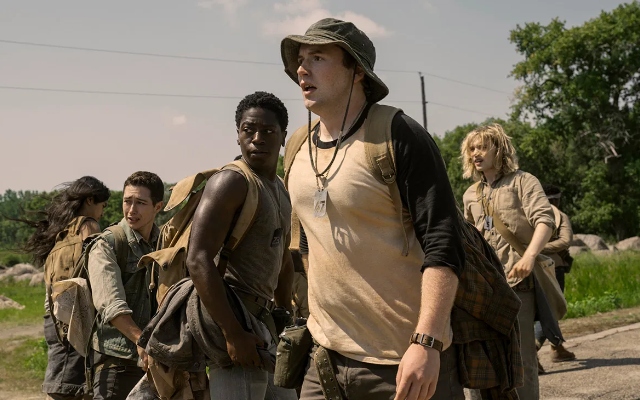
SYNOPSIS: Based on a Stephen King novel (written under the alias Richard Bachman) of the same name, “The Long Walk” is set in a world so hopeless that, ironically, a march to the death is the only option to obtain a better life. “One winner,” says the Major (Mark Hamill), “no finish line.”
CAST: Cooper Hoffman, David Jonsson, Garrett Wareing, Tut Nyuot, Charlie Plummer, Ben Wang, Roman Griffin Davis, Jordan Gonzalez, Josh Hamilton, Judy Greer, and Mark Hamill. Directed by JT Mollner.
REVIEW: “The Long Walk” covers a lot of ground. The story of march to the death is a harrowing look at authoritarianism and the extremes that despairing people will go in search of hope.
Set in a dystopian United States after a war has left the country struggling financially under a totalitarian government, the film centers around a televised endurance contest meant to inspire work ethic in the downtrodden public. Like “The Hunger Games,” but without the costumes or folk songs, the titular walk sees fifty young men volunteer to, as the Major (Mark Hamill) says, “walk until there’s only one of you left.”
“Anyone can win if you don’t give up!”
Fall behind or failed to keep pace you get a ticket, as in, get your ticket punched.
As the title suggests, “The Long Walk” is just that, a long walk punctuated by character insights, explosive diarrhea and the odd gunshot. It’s a horrifying situation, but despite King’s name attached to the project, this isn’t a horror film. There are no jump scares, nothing supernatural—unless you regard the walker’s ability to stay awake for five days on their 300-mile marathon as mystical—and the only monster comes in the form of a very human, totalitarian ruler known as The Major.
With a minimum of fuss director Francis Lawrence, who directed three of the “Hunger Games” movies, presents the story for what it is, a talky literary adaptation. The characters put one foot in front of the other and speak reams of dialogue, but Lawrence trusts the material to organically provide intensity as the audience gets to know and become involved in the lives and deaths of the characters.
It’s an ensemble piece, with a large cast of Hollywood up-and-comers like Tut Nyuot and Charlie Plummer, but it’s Cooper Hoffman as the resilient Raymond Garraty and David Jonsson as the loyal Peter McVries that stand out. They become the de facto leaders of the Walkers, and the guides who remind us that there are humans at the heart of the movie’s dehumanizing ordeal. Although they come to the Walk with differing motives, as friendship blossoms between Ray and Peter it suggests other King relationships born out of adversity, like John Coffey and Paul Edgecomb in “The Green Mile” or “The Shawshank Redemption’s” Andy Dufresne and Ellis “Red” Redding. Their connection and empathy stand in stark contrast to the bleak backdrop of the Walk.
“The Long Walk” may be overlong and Hamill is one note in his portrayal of evil, but in the telling of the tale is a relentless intensity that builds until the film’s final, explosive moments.
SYNOPSIS: Taking its inspiration from an ancient text, “The Return,” a new historical drama starring Ralph Fiennes and Juliette Binoche now playing in theatres, is the story of a disgraced king returning from the disastrous Trojan War.
CAST: Ralph Fiennes, Juliette Binoche, Charlie Plummer. Directed by Uberto Pasolini based on Homer’s Odyssey.
REVIEW: A story of loyalty and vengeance, “The Return” is a stripped-down version of the Greek poem “Homer’s Odyssey.” Epic in its themes if not in its execution, the story derives much of its power from the performances of Ralph Fiennes and Juliette Binoche as lovers separated by the ravages of war and time.
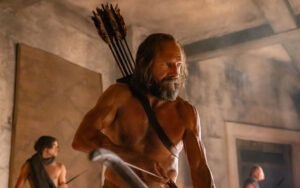
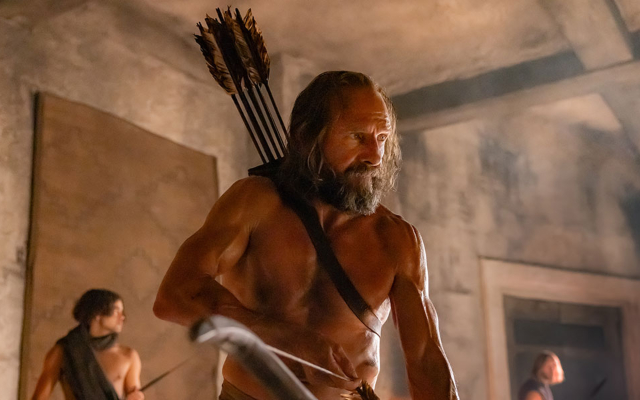
Director Uberto Pasolini, who co-wrote the script with John Collee and Edward Bond, skips past the more fanciful parts of Homer’s poem. There’s no cyclops, divine intervention or multi-headed monsters. Instead, it skips to Odysseus (Ralph Fiennes), the legendary Greek king of Ithaca, returning home after twenty years at war. Assumed dead, unrecognizable and mistaken for a beggar, he finds his former kingdom in disarray.
His wife Penelope (Binoche) never remarried, despite the dozens of suitors who vied for her hand. As she is pressured to choose a husband to take the throne, her son Telemachus (Charlie Plummer) is threatened with death by ambitious wannabe-kings.
Before he can return home to his wife, son and throne, Odysseus must come to grips with his past as a warrior responsible for his vanquished army. “What will the people say when they see I have returned alone?” he asks. “That I led all their men to their deaths.”
Fiennes embraces this more earthbound adaptation. His Odysseus is a man beaten by war, scarred mentally and physically. “It’s everywhere,” he says of war. “It’s in everything you touch.” Just as the movie is stripped down, so is his performance. Divested of the formality and archaic language that frequently comes along with adaptations of ancient stories, “The Return” allows Fiennes to concentrate on what fundamentally makes the character interesting, his humanity.
Weary from war, he is defeated, but we still get a sense of the warrior he once was and the guile that helped him survive. It’s a terrific performance that showcases the character’s duality, at once sorrowful and frail and yet, able to muster the power that made him a king.
And, at age 61, Fiennes is ripped, sinewy and shredded, as revealed by his loose-fitting toga and a full-frontal nude scene.
Binoche is regal, displaying the kind of dualism that makes Fiennes’s Odysseus so compelling. She’s mournful at the loss of her husband, the wreck her kingdom has become and the political maneuvering that threatens the life of her son. And yet, she persists, using her wits to control the situation.
“The Return” is not a spectacle by any means. The sets and wardrobe are kept to a minimum, but the simplicity works, bringing focus to a story that could easily have been distracted by flashier design or a load of CGI.
“The Return’s” slow-ish pace and conversations with more pauses than dialogue may take some getting used to, but they are all in service of building tension, which eventually explodes in the film’s fiery climax.
Based on Julia Walton’s 2017 young adult novel of the same name, “Words on Bathroom Walls,” now on EST, VOD, DVD and Blu-ray, follows a teenager, diagnosed with schizophrenia, navigating mental illness and life in a new school. “How hard could it be to hide my burgeoning insanity from the unforgiving ecosystem that is high school?” says Adam Petrazelli (Charlie Plummer) in the film’s opening moments.
Adam is a foodie with dreams of being a chef but when he accidentally injures a classmate during a psychotic break in lab class his future is jeopardized. A diagnosis of treatment resistant schizophrenia leaves him ostracized from his former friends. They taunt him in the halls—“Where’s the straightjacket?” and call him “freak” as he confronts the voices in his head, the new-agey Rebecca (AnnaSophia Robb), the Bodyguard (Lobo Sebastian) and troublemaker Joaquin (Devon Bostick), a varied group he calls “my inescapable roommates.”
A new drug trial offers hope, as does a switch to a new Catholic school. For the first time in ages he feels like he has autonomy over his life. “I woke up to complete silence. No whispers. No banter. No visions. Just pure, unfiltered, beautiful quiet.” His friendship with valedictorian Maya (Taylor Russell) blossoms, but as the medication slowly affects his ability to cook he struggles to hide the side effects from mother (Molly Parker) and step dad (Walton Goggins).
“Words on a Bathroom Wall” is a coming-of-age story with a difference. Adam’s journey with schizophrenia is sensitively handled, with director Thor Freudenthal finding inventive ways to put the viewer into the main character’s shoes. The voices and hallucinations are brought to life without sensationalism or exploitation. Instead, they show us what is happening in Adam’s mind as he navigates the minefield of high school and first love. Far from demonizing his disease, as has been the case in other less humane cinematic depictions of schizophrenia, they add dimension to the story.
Plummer hands in a break out performance as Adam. He’s an awkward teen, a dutiful son who learns how to cook to comfort his mother and a teen struggling with an illness. His subtle performance goes a long way to creating a character in three-dimensions who is both strong and vulnerable. He shares good chemistry with Russell who brings depth to an underwritten Maya.
“Words on a Bathroom Wall” hits hard before settling into more familiar, optimistic territory but the respectful tone established early on makes up for the sappiness that bogs down the film’s final moments.
“In all honesty if I heard about a film about a boy and his horse I wouldn’t want to go see that because I would think it was a family movie,” says English director Andrew Haigh. We are talking about his newest film Lean on Pete, which is, ironically, a film about a boy and his horse.
Based on the book by Willy Vlautin, it sounds like family fare but it is anything but. The cast should be the first clue. Steve Buscemi, Chloë Sevigny and Steve Zahn, all edgy 90s indie virtuosos, are the above-the-title stars, hinting that this isn’t going to be another National Velvet retread.
“The book is sad at times and tragic at times so the movie felt like a faithful adaptation of that. Oddly, I think that’s why I liked it because it was seemingly playing with more traditional ideas but telling the real life version of that. There could be a family movie about a boy on the road with a horse but it not going to be real. It was only after I finished the film that I realised, ‘This is going to be quite a challenge.’”
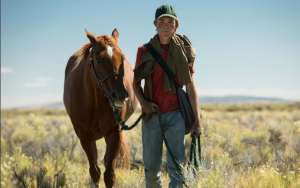
Charlie Plummer, last seen as John Paul Getty III in All the Money in the World, plays Charley Thompson a fifteen-year-old looking for permanence in his hardscrabble life. To pass the time he gets a job tending to an aging Quarter Horse named Lean On Pete. When the horse’s owner, a crusty old horse trader played by Buscemi, decides to get rid of Pete, to “send him to Mexico”—i.e.: the glue factory— Charley makes off with the horse, embarking on a road trip in search of a better life for both of them.
“It isn’t about the horse,” says Haigh. “It is about Charley’s desperate need for some stability, some security, someone to care for him, someone to care about him. That’s what’s driving him.”
As Charley the eighteen-year-old Plummer is magnetic, quietly creating the character of a desperate young man who does bad things for mostly the right reasons.
“It is not easy trying to cast someone about that age. Especially someone who has to both physically feel right, that they are still a kid but very nearly an adult. I knew I wanted him, in a frame, to look like a kid and then suddenly go older, then younger.
“There a lot of good boys that we had seen but Charley had something different. He approaches scenes in a different way. He doesn’t go the easy emotional way. He finds something a more challenging which sometimes keeps you at even more of a distance but then sometimes pulls you in with that amazing face he has.”
Haigh, who next project is The North Water, a sprawling TV movie about a disgraced ex-army surgeon now working as ship’s doctor on a whaling expedition, hopes people respond to Lean on Pete’s messages of kindness and compassion.
“If people leave the cinema and they feel for that kid and think about him that is all I can really hope for,” he says. “I hope it speaks to the importance of the need to help people who are suffering. I don’t know if people will take that away or not but it is certainly in the DNA of the film.”
The boy-and-his-horse story of “Lean on Pete” sounds like family fare but it is anything but. The cast should be the first clue. Steve Buscemi, Chloë Sevigny and Steve Zahn, all edgy 90s indie virtuosos, are the above-the-title stars, hinting that this isn’t going to be another “National Velvet” remake.
At the beginning of the story fifteen-year-old Charley Thompson (Charlie Plummer) and his single father Ray (Travis Fimmel) are starting their lives over in Portland, Oregon. Charley’s mom went out for cigarettes years ago and never came back. Since then father and son and moved around the country, Ray chasing work, Charley trying to find a place to fit in. They are more like friends than father and son. Ray offers up dubious fatherly advice—“The best women have all been waitresses at some point.”—and finds a new women in every new town.
To pass the time Charley gets a job tending to an aging Quarter Horse named Lean On Pete. Working for crusty old horse trader Del Montgomery (Buscemi) Charley finds purpose and despite the warnings of jockey Bonnie (Sevigny) not to get emotionally involved with the horse—“Don’t think of them as pets,” she says.—the teenager coddles the horse even as it becomes clear Pete isn’t going to win anymore races.
When Del decides to get rid of Pete, to “send him to Mexico”—i.e.: the glue factory— Charley makes off with the horse, embarking on a road trip in search of a better life for both of them.
There are many good messages here for kids about resilience and loyalty but again let me remind you this isn’t a kid’s movie. Del’s foul language and a scene where Charley beats a homeless man with a tire iron rule that out. What we’re left with is a story that feels like it was written for a young adult audience but made by someone weaned on mid-period Wim Wenders. Tonally it feels as though it has one hoof in YA, the other in more adult fare.
Tonality aside, the first hour works very well. Plummer is magnetic, quietly creating the character of a desperate young man who does bad things for mostly the right reasons. His scenes with Buscemi and Sevigny sparkle with a gruff warmth, setting up the lesson in resilience that dominates the second half. As Charley sets off into America’s hinterland Bonnie’s statement of fact, “There’s only so many times you can fall down, right?,” is proven wrong time after time. It’s a road trip of misery that sees Charley survive in very trying circumstances. Paced a little too leisurely in its second hour the road trip section, despite the dramatic events portrayed, is far less interesting than the character work of the first hour.
“Lean on Pete” is an effective portrait of a lonely boy but ultimately simply becomes a laundry list of Charley’s bad decisions.
 I join CTV NewsChannel anchor Scott Hirsch to recap the final days of TIFF and talk about the harrowing “The Long Walk,” the soapy “Downton Abbey: The Grand Finale” and the rockin’ “Spinal Tap: The End Continues.”