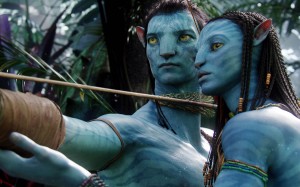
“Avatar: The Way of Water” harkens back to a time when Hollywood bigshots thought, “If a picture is worth a thousand words, a 3D picture is worth a million words.” The original film, 2009’s “Avatar” was director James Cameron’s grand experiment in the audience’s tolerance for 2 hours 42 minutes of images popping off the screen.
Thirteen years ago, the million words theory worked. “Avatar” was a massive hit, grossing almost 3 billion dollars worldwide, as rumors of a series of sequels hung in the air. Delay after delay kept the blue people off screens for so long, four presidents came and went while Cameron tinkered with the story and the technology to bring his vision to life.
The tinkering is finally over. Cameron returns to theatres with the first of four planned sequels, “Avatar: The Way of Water,” an epic 3D sequel that mixes astonishing visuals with eye-rolling teenagers, a character with the b-movie name Z-Dog and a 3 hour and 12-minute tale of colonialism.
Set on Pandora, an Earth-like habitable extrasolar moon from the Alpha Centauri System populated by the Na’vi, the 9 to 10 feet tall Indigenous peoples, the movie picks up the action more than a decade after the events of the first film. Former Marine Jake Sully (Sam Worthington), who left his human body behind to permanently become Na’vi, lives on the peaceful planet with wife Neytiri (Zoe Saldaña) and children.
Their idyll is interrupted with the return of the Sky People, humans who want to“pacify the hostiles” and takeover Pandora.
“Earth is dying,” says General Frances Ardmore (Edie Falco). “Pandora is the new frontier.”
Despite having been killed off in the original, the Pandora-bound team is led by the ruthless Colonel Miles Quaritch (Stephen Lang), a genetically engineered “recombinant” or avatar version of the late Marine, implanted with his mind and emotions. “We have been brought back in the form of our enemy,” he says of he and his team. He plans on taking Pandora at any cost, and getting revenge on Sully, who he sees as a traitor.
Forced into hiding with Tonowari (Cliff Curtis), Ronal (Kate Winslet) and the reef people clan of Metkayina, Sully and his family learn the way of water—”no beginning and no end”—and fight to defend their world.
So, the big question is: Was “Avatar: The Way of Water” worth the wait?
As a technical achievement, yes, unquestionably. The visuals are stunning, particularly in the underwater scenes. Cameron’s camera has a nimbleness often missing in 3D films, which often feel locked-down. His fluid camera roams, on land and sea, capturing some of the most eye-popping, breathtaking scenes of this, or any other, season. Each and every frame is carefully considered, and most could be cut out, framed and hung on the wall to great effect.
The visuals facilitate Cameron’s world building, providing tantalizing views of the forest land of Pandora and the wet ‘n wild world of Metkayina, complete with giant whale-like creatures that could have sprung from the imagination of Ray Harryhausen, and lush, colorful flora and fauna.
It does not look like any other 3D film—even the original “Avatar”—and will engage the eye and stimulate the brain.
Unfortunately, the same cannot be said about the story, which is as simple as the images are complex. Essentially, Cameron continues the colonialization themes of the first film, while adding in mysticism, traditional medicine, poachers and even a nod to Jonah and the Whale.
Most of all, it is a story of family, of parents and children. Apparently, Pandorian kids behave sort of like Earth teens, eye rolls, attitude and all. The family relationships add an intimate element to the epic story, but the visuals often get in the way of the storytelling.
Long action sequences, like a spectacular sea creature attack, take away from the movie’s main thrust, pushing the running time upwards, but not advancing the story. Perhaps they are scheduled in to accommodate bathroom breaks. Whatever the reason, they showcase Cameron’s mastery of the form but often feel spectacular simply for the sake of spectacle.
Loud and proud, “Avatar: The Way of Water” can be, by times, overwhelming, but it’s also the kind of grand scale movie that demands to be seen on the biggest, most immersive screen possible. Cameron shoots for the moon, but goes even further, to a place called Pandora.
My “Avatar” review from December 2009. The film is being re-released into theatres this weekend in advance of the release of the sequel “Avatar: The Way of Water,” which will be in theatres on December 16, 2022.
*****
In the gap between James “King of the World” Cameron’s last theatrical feature, “Titanic,” and his new film, “Avatar” (in theatres this weekend) Clint Eastwood directed 11 movies, Michael Bay made 6 and even Uwe Boll, a director so reviled there is an on–line petition to prevent him from making any more films, has made fifteen in the time it took Cameron to make just one, but it’s quite a movie.
“Avatar,” based on an original idea by Cameron, is set in the 22nd century on a small planet called Pandora. Under the lush terra firma is a valuable mineral much sought after by the Avatar program—a collaboration between industry and military. Since the climate and atmosphere aren’t hospitable to humans a substitute for homosapien invaders is required. That would be living, breathing avatars of the Pandorian natives, controlled by a human “driver” through a high tech link-up that connects the driver’s mind to their Avatar body. The ten feet tall, blue skinned natives, called the Na’vi— although the humans dismissively call them “blue monkeys”—are deeply connected to their planet, sharing a connection with the land and all its creatures that defies human comprehension. Only one man comes close to understanding the Na’vi. He’s Jake Sully (Sam Worthington) a former marine who lost the use of his legs in combat. Brought on board the Avatar program he is initially used as a mole to infiltrate a Na’vi community to glean information that will make the harvesting of minerals easier, but what begins as simply completing his mission and using his legs again through the avatar soon becomes something else. He learns to love not only the Na’vi people, but one Na’vi in particular, Neytiri (Zoe Saldana).
First let’s dispel some myths. You don’t need to take Gravol with you to the movie theatre. 1.) There were rumors on the net that “Avatar’s” mix of hand held camera and 3-D was literally stomach turning. Not true. 2.) It’s not “Dances with Wolves in Space” or “Fergully” with aliens. 3.) Sight unseen people were calling it Cameron’s Folly, a three hour waste of film and money (a reported $300 million). Not true. 4.) “The Na’vi are the new Jar Jar Binks,” bloggers screamed! Also not true.
With “Avatar” Cameron has made a sprawling epic that lives up to the hype. It is something completely new, a movie that is not a sequel, a remake or based on an existing novel; a film that sprung from Cameron’s imagination and exists on its own plane. Brett Ratner, Michael Bay and all other Hollywood hacks, hang your heads in shame.
Cameron starts from scratch creating a whole new world with language, customs, religion and crazy creatures but never forgets that this is an action movie and not an anthological study. To that he adds allusions to the Iraq war, shock and awe policies and the Native American genocide all bundled up in one giant sci fi romance action flick.
It’s not all perfect, the dialogue is frequently 1980’s-action-movie lame, filled with clichés; there are logic lapses and Saldana’s character shifts from Ripley (remember “Alien”?) to damsel in distress in the blink of an eye, but the film’s achievements outweigh any of these misgivings.
Despite what the early word on the movie may have been Cameron—who at this rate won’t make another film until 2221—makes the audience feel compassion for obviously computer enhanced giant blue creatures, keep our interest for almost three hours and presents a dazzling climax that’ll leave you slack jawed.
An exercise in “found footage” handheld camera technique, “Into the Storm’s” story is almost as shaky as its visuals.
Playing like a cross between “Twister,” “Wizard of Oz” and “The Blair Witch Project,” the story is set in Silverton, a small Midwestern American town besieged by tornadoes. In just one twenty-four hour span deadly twisters rip through the town, sending sensible citizens rushing for cover while a storm chasing documentary crew led by director Pete (“Veep’s” Matt Walsh) and meteorologist Allison (Sarah Wayne Callies of “The Walking Dead”) rush headlong into the cyclone to get some up-close-and-personal footage. Meanwhile Gary (Richard Armitage) and son (Nathan Kress) are on the hunt for their son/brother Donnie (Max Deacon) who went missing when the storm started.
Director Steven Quale was the visual effects supervisor on “The Abyss,” “Terminator 2: Judgment Day,” “True Lies,” “Titanic” and “Avatar,” so the guy knows how to stage an action scene. It’s the other stuff he has trouble with. When the wind isn’t tearing the town apart it’s as if Quale doesn’t know what to do with the characters or the story.
To kill time between the wild wind storms the characters tell you what is about to happen—“Oh [crap],” says Allison, “it’s headed for the school!”—and talk about shooting anything that movies. “I can’t stop filming or I’ll be fired!” says cameraman Jacob.
Everyone seems to have a camera crazy-glued to their hands, and those who don’t seem to spend their time yelling, “Make sure you keep filming,” to the people who do. In fact, this movie should have been called “Keep Filming,” because it is the film’s mantra.
Mix that with a wooden performance from Richard Armitage that would make Woody Pecker’s mouth water, a series of tornadoes and a Firenado—an idea so silly I imagine the makers of “Sharknado” rejected it as too over the top—and you get a disaster movie that is a disaster of a film.
Paul Frommer has a varied resume. He taught English and math in Malaysia with the Peace Corps, is an American communications professor at the University of Southern California and the former Director of the Center for Management Communication at the USC Marshall School of Business. Most intriguing, however, is his designation as “alien language creator” on the James Cameron film Avatar. As the originator of the Na’vi language used by the fictional indigenous race in James Cameron’s 2009 film, Frommer is responsible for the most popular alien lingo since Klingon.
“Klingon is the gold standard for constructed alien languages,” says Frommer. “It is an extremely complex language. Of course, that language has been around for twenty five or more years and I think it is fair to say it took Klingon years to get to the point that Na’vi seems to be right now. Of course the reason is the internet, and the fact that a community can develop almost overnight and attract very many people who are interacting, and sharing material and supporting one another. I think in practical terms that’s why the language has gotten to the point it is now.”
Frommer was contacted in 2005 by Cameron’s people about creating a language for Pandora’s giant blue people. “I had a ball talking to him about language in general and about his vision for the film,” says the linguist. He left the meeting with a copy of the script and a mandate to create a unique language with “real rules, grammar and vocabulary.”
“[Cameron] wanted it to sound good; to be pleasant sounding. He wanted it to reflect the culture of the Na’vi on Pandora. I didn’t start from absolute zero. He had come up with a few words on his own, about thirty vocabulary words, the names of characters and the names of some animals and so on. So I had a bit of a sense pof the sound he had in mind. It sounded kind of Hawaiian to me, or maybe Maori, kind of Polynesian. Then I added some sounds that I thought would be kind of fun and the grammar was mine.”
The language in place, the next step was to teach the actors not only how to speak the language but to sound fluent.
“There were times when I was on set for twelve and thirteen hours,” says Frommer. “I couldn’t be there all the time because I have a day job but whenever I could and whenever the language was being used I was on set. I met with each of the actors ahead of time, maybe a couple of weeks before they would shoot a scene where they had to speak Na’vi. I gave them transcriptions of what they had to say and also I gave them an Mp3 filer so they could download them onto their i-pods or whatever and practice.”
Prep is one thing, but on a James Cameron production Frommer says you have to be on your toes.
“On the set there were a few times when the lines changed,” he says. “I thought for a film of this scope everything would be totally determined before they walked on set, but, in fact, I discovered there is a lot of creativity that happen on the spur of the moment. There were moments of panic when people came up to me and said, ‘Paul we need this line. We need to know how to say that.’ If I had the words and had the grammatical rules that was fine, but there were times when I had to say, ‘Give me a few minutes,” and I sometimes had to coin a few words. I can give you my most memorable example of that.
“There was a time when Sam Worthington and James Cameron came up to me and said, ‘Paul we’ve decided that Jake is going to be telling a story at this point in Na’vi and it is about a predator animal that almost bit him on his big blue ass. How do you say big blue butt in Na’vi?
“Well, I had the word for big and I had the word for blue, but I did not have the word for butt. I said, ‘Give me a few minutes.’ I tried to come up with something good and I tried it out on some people who were around and some people liked one word, some people liked another, but we decided the word was ‘Txìm’ so my big blue butt became ‘Tsawl ean txìm.’” (Na’vi spelling courtesy of Navilator.com.)
Since then the language has continued to thrive and grow.
“It’s remarkable how many people are interested in the language,” says Frommer. “For some people it is a way of holding on to the world of Pandora. It is a world a lot of people find extremely attractive. Then are there people who are very much into language. I’m pleased they find this language interesting, intriguing and challenging and want to be able to speak it. I would like to see it develop further and whatever I can do to help I certainly will, but interestingly it is kind of no longer entirely mine and that is a good feeling.”
The man who made the most technologically advanced movie to ever hit the big screen has just hung up on me. Not on purpose. Calling from his car, James Cameron was defeated by some very simple machinery—his cellphone.
A minute later, my phone rang again.
“Sorry about that,” he said, “it was totally my bad. I was reaching out to turn up the volume and I hit the disconnect, which is right next to it. I have to learn to keep my hands off the damn thing.”
Cellphone and their pesky buttons are one thing, but when it comes to big budget epics with complicated technology, nobody is as hands on as Cameron. Last December Avatar became the highest grossing movie of all time, making $2,712,115,019 on a budget that fell somewhere between $230 million (according to The New Yorker) to nearly $500 million (so says The New York Times).
“We’re very cognizant of the fact that it is a big expensive movie,” he says. “When you make a film at that highest level you know the imagery is going to be quite astonishing. That’s what I’m all about. That’s what my career has been all about, starting with the Abyss, then Terminator 2 and True Lies and Titanic. Every one of these films was decried in the largest way possible as being the biggest budget films in history. [But] as an artist, there is no second position on my throttle. It’s full throttle so it may as well be the highest grossing film in history because I’m working like it is anyway.”
Cameron may be the go-to guy for big budget spectacles, but despite his track record there are no guarantees of success.
“I don’t know if I knew it until it was really out there,” he says when asked when he knew he had a hit on his hands. “I had a suspicion that the film would perform beyond what its opening weekend would indicate. I thought our challenge was not the film itself as much as the marketing of the movie. We didn’t have Brad Pitt or George Clooney. It was an unfamiliar story. We had to create a brand from scratch and we had these characters that were blue and were maybe a little off putting when people first saw them. There were a lot of marketing hurdles. I was much more concerned about the 30-second TV spot than the film. I knew the film played fine.”
Now, just four months after its record breaking theatrical run Avatar and its eco friendly message is coming to DVD and Blu Ray just in time for Earth Day. This is a bare bones release, with no extras. (The “über edition” with extra footage and supplements will be out in time for Christmas.)
“It was going to take until November for us to do good supplement stuff and I didn’t think people wanted to wait until November to see an Avatar DVD,” he says, “so we put the plain wrap version out.
“By the way,” he adds with a swagger, “[Avatar] is the highest grossing film in history and has nine Academy Award nominations so people should acknowledge that that film needs to be in the marketplace before we start screwing around and getting creative.”
Chances are the first movie assassin names that pop into your head are The Jackal, Martin Q. Blank or El Mariachi. What do they have in common, other than flashy names and a predilection for gunning down their on-screen enemies? They’re all men.
What about the ladies? Beatrix Kiddo, Charlie Baltimore or Jane Smith?
Jean Luc Goddard said, “All you need to make a movie is a girl and a gun,” and often these days filmmakers are placing that gun in the hands of female film assassins. Nikita is back on the tube and earlier this year Saoirse Ronan played a deadly 16-year-old in Hanna. This weekend, Avatar’s Zoe Saldana is back as a stone-cold killer in Colombiana.
As Charlie Baltimore, Geena Davis created one of the screen’s most loved female assassins in The Long Kiss Goodnight. Suffering from amnesia, when her past catches up with her she flip flops from suburban mom to killer. Best Line? “They’re gonna blow my head off, you know. This is the last time I’ll ever be pretty.”
Angelina Jolie’s deadly demeanour has pumped up several action movies. Lara Croft was a gun-slinging super-heroine, but she’s also played assassins in two movies.
In Mr. and Mrs. Smith she’s a hitlady assigned to kill her own on-screen (and future real life) partner, Brad Pitt. “Still alive, baby?” she purrs after trying to shoot him through a wall.
Also, as Fox in Wanted she was a member of the Fraternity, a deadly group of killers with the useful ability to shoot around corners. Best line? “We kill one, and maybe save a thousand. That’s the code of the Fraternity.”
The highest body count must go to Beatrix Kiddo, played by Uma Thurman in Kill Bill. As a bride done wrong by her former Deadly Viper Assassination Squad colleagues, (including Vivica A. Fox who plays Vernita Green and Lucy Liu as O-Ren Ishii), Kiddo slices and dices her way through more than 100 opponents.
But the two most unlikely female assassins on film were found in Leon: The Professional and Kick-Ass. In the former, Natalie Portman was a 12-year-old who learns how to kill from her teacher, Léon (Jean Reno), a skillful but sensitive hitman.
In Kick-Ass, a 2010 action-comedy starring Nicolas Cage and Chloë Moretz, Hit Girl (Moretz) asks her father (and assassin mentor) for a Benchmade model 42 butterfly knife for her eleventh birthday.
In the gap between James Cameron’s last theatrical feature, Titanic, and his new film, Avatar (in theatres this weekend) Clint Eastwood directed 11 movies, Michael Bay made six and even Uwe Boll, a director so reviled an on–line petition demands he stop making films, has made 15 in the time it took Cameron to make just one.
So what’s the hold up?
Some suggest Cameron takes so long between gigs because his commitment to his projects is so intense he wants to be sure he is on the right track before camera starts to roll.
“I want you to know one thing,” he allegedly told one producer, “once we embark on this adventure and I start to make this movie, the only way you’ll be able to stop me is to kill me.”
Also, Cameron isn’t bound by the same considerations as most directors.
He wrote the script for Avatar in 1994 and was prepared to wait until special effects technology caught up with his vision.
The luxury of having time is what happens when you make the highest grossing movie in history, a fact he celebrates, wearing a t-shirt that reads “Time Means Nothing in the Face of Creativity.”
Like Cameron, Stanley Kubrick spent more time off movie sets than on. In a career that spanned 46 years he made only 13 movies but spent years developing pictures that never went into production — like Napoleon, an epic look at the life of the French Emperor that he expected to be “the best movie ever made.”
Others choose long lay-offs between projects for different reasons. Actor Casey Affleck (Ben’s younger brother) had three movies released in 2007 but nothing else scheduled until 2010. Why the break?
“To be perfectly honest, I don’t really enjoy playing anybody,” he says, “except Casey Affleck lying on the couch watching the Red Sox … usually, when I’m working, I’m not really having a good time.”
Then there’s Daniel Day-Lewis, an actor whose lapses between projects makes Affleck look like a workaholic. The There Will Be Blood star routinely takes years off between films, once disappearing from the big screen for five years.
When asked why he doesn’t work more often he said, “I like to cook things very slowly. I learnt early on that I couldn’t jump from one kind of work to another. I did it a couple of times and it didn’t work.”