Blade Runner 2049 director Denis Villeneuve and I are talking about how technology impacts our lives, when technology impacts our interview. The phone goes dead.
“Sorry about that,” he says back on the line. “There was another call and I didn’t want it to be distracting but I pushed the wrong button. I was doing an interview with someone who was not understanding a word I was saying! Then I realized, I’m not talking to Richard anymore. I’m talking to an unknown person. That says a lot about where we are now.”
Villeneuve, the Oscar-nominated Trois-Rivières, Que.-born director, saw the original Blade Runner when he was 15 years old.
“It was a hybrid of film noir with sci-fi,” he says. “The world that was depicted in the first movie, it was the first time I felt like I had seen a serious vision of what could be our future. There was so much poetry involved in the characters. There is strength in the vision. It is very singular, very unique and at the time I was a science fiction addict and for me it became an instant classic.”
A self-described dreamer, Villeneuve says the movie lit his imagination on fire.
“In those years my strength was dreaming,” he recalls. “I spent the first years of my life more in dreams than in reality. There are a lot of dreams I had back then that are inspiring me today.”
Thematically the new film harkens back to Ridley Scott’s original but instead of being a reboot or a remake it grows organically out of the 1982 film. Like the original it is about discovering what is real and what it means to be human and how technology fits into that puzzle.
“I felt it had the potential to tell a very strong story about the human condition,” he says, “about our relationship with technology. These are timeless questions that were already present in the first movie but I thought it made sense to bring back those questions today, 30 years later when our relationship with technology has evolved so much. When Blade Runner was released it was the time when we were starting to see personal computers in homes. It was the very beginning of the electronic revolution and now it is a different world.
“When you make a science fiction movie it is a mirror of today. It is nothing else than that, an exploration of today.”
Blade Runner 2049 is a mix of old and new, of Scott’s classic vision and Villeneuve’s new ideas. A throwback to the first film comes in the form of Harrison Ford, who recreates his role of retired blade runner Rick Deckard. To find someone who could carry himself against the screen legend Villeneuve brought in fellow Canadian Ryan Gosling.
“I needed that taciturn quality; quiet and strong,” he says. “I needed someone with charisma, big enough to be in front of Harrison Ford and not melt. A real movie star. I knew at some point he would be face-to-face with one of the biggest stars of all time.”
Reinventing a beloved classic like Blade Runner takes guts. When I ask Villeneuve if he looked to Scott for guidance he laughs. “His advice was, ‘Don’t f-— it up.’”
BladeHeads hoping to learn intimate details about Denis Villeneuve’s continuation of Ridley Scott’s 1982 sci fi detective masterwork will be disappointed by this review. I’m treating “Blade Runner 2049” like a high tech “Crying Game.” Remember that? “The movie everyone is talking about… But no one is giving away its secrets.” Spoilers for the flick will likely be available on twitter roughly 0.0001 nanoseconds after the film’s first public showing so check there. You won’t find them here.
I will say the new film is set thirty years after the events of Scott’s film. Ryan Gosling is Los Angeles Police Department’s Officer K, a blade runner who hunts down and eliminates rogue humanoid androids called replicants. When he makes a startling discovery in the field his supervisor Lieutenant Joshi (Robin Wright) sends him to track down the only person who can help save humanity, retired blade runner Rick Deckard (Harrison Ford). “You’re a cop. I did your job once. I was good at it,” he says.
I will also say that Jared Leto plays a replicant manufacturer named Niander Wallace, that David Bautista makes an appearance and that it rains a lot. But that’s it.
“Blade Runner 2049” is a beautiful looking movie, simultaneously lush but austere. Villeneuve’s frequent collaborator, cinematographer Roger Deakins, creates eye-catching tableaus that blend moody film noir, desaturated dystopia, vivid neon cityscapes and more. Each setting in every scene has its own unique palette that has echoes of the original film, but feels fresh. It’s a movie that visually doesn’t slavishly adhere to Scott’s vision but grows organically out of it.
Thematically it harkens back while creating a new story. Like the original it is still about discovering what is real, and what it means to be human but it expands on the search for self and the coming to grips with what you find, touching on real life issues like false memories and fear of progress.
Keeping it grounded are reverberations from our lives. A hologram that keeps K company is simply the logical extension of Siri, a comforting voice that tells you what you want to hear. Our brave new world of self-driving cars and machines that replace human interaction is simply the analogue “Blade Runner,” a prototype of the world we see on screen. Virtually everything we see is futuristic but not outside of the realm of possibility. These touchstones from our present lives and the primal search for self ensure the humanity of the story doesn’t get lost amid the technology.
Fans of the original will find much to like in “Blade Runner 2049.” It’s a skilfully made movie that works as a companion piece to Scott’s film and as a detective mystery. What it isn’t is easy. It’s a ponderous two-and-a-half hours long, grappling with ideas rather than simply allowing characters to physically grapple with one another. There is the odd combat scene but the real action here happens internally.
By definition the term ‘war dogs’ refers to “bottom feeders who make money off war without ever stepping foot on the battlefield.”
In the new film War Dogs Jonah Hill plays Efraim Diveroli, a true to life 20-something arms dealer who fits that description to a tee.
“You try to understand why someone would end up like that,” Hill says when I ask how he got inside the head of the fast-talking character. “It might be a combination of wiring, lack of empathy, ego and insecurity and obsessiveness. I don’t know. I try to approach it from a therapeutic point of view. Get into the psychology of why people behave the way they do. Probably most actors do that.”
He wasn’t able to meet the real-life Diveroli but he was able to piece together the character without a face-to-face.
“I would always prefer to meet the person but if someone was playing me in a movie I would give them the best version of myself. A lot of times when you meet the person you end up having to be a really good editor, choosing what to include, but always I found meeting the people around them ends up being more helpful to me because they are giving you a warts-and-all portrayal of the person at that time.”
Hill found that version of Diveroli from many sources.
“I had a lot of help,” he says. “I got to meet David, who Miles (Teller) plays, and a few people who knew Efraim at that time. The biggest key was that they are from Miami and Miami culture is very specific. There is a very big sense of the American dream there, in a positive and negative way. There’s a big immigrant culture. People from Cuba and Haiti end up in America for the first time through Miami. Efraim is a corruption of that (American) dream.”
In the film Efraim is a self- described “Ugly American,” a borderline sociopath for whom belligerence is a default setting.
The unhinged nature of the character and Hill’s venal glee in playing up the worst in human nature keeps War Dogs interesting but some audience members see it differently.
Recently a crew of South African arms dealers approached Hill in a restaurant after seeing a trailer for War Dogs.
They were impressed and wanted to high five the actor. He says the same thing happened after he made Wolf of Wall Street, another film where he played a morally ambiguous character who struck a chord with the very people it was satirizing.
“A lot of times Wall Street bros will come up to me as if the movie is their Goodfellas or Scarface. People see what they want to see. It is a little scary sometimes when people misinterpret.”
He describes the run in with the arms dealers as “uncomfortable.”
“You don’t want to make it an overly uncomfortable environment while that is happening,” he says, “but you also don’t want to lie and be dishonest that you are agreeing with them. You don’t want to make them feel bad about their misinterpretation. It’s an unusual an awkward situation to be sure. In the end, we all want to be seen as heroes in our own story, I guess.”
In “War Dogs,” the new film from “The Hangover” director Todd Phillips, war profiteer David Packouz (Miles Teller) describes how arms dealers think. We see a soldier in battle, he sees $17,500, the cost of outfitting GI Joe with weapons and gear. “War is an economy,” he says. “Anyone who tells you otherwise is either in on it or stupid.”
When we first meet Packouz he is a twenty-something massage therapist father-to-be barely making ends meet. His fortunes change when his childhood friend Efraim Diveroli (Jonah Hill) recruits him to sell weapons to the U.S. military. Taking advantage of new rules regarding the allocation of military funds, they bid on small contracts, profiting on deals that aren’t big enough to attract the attention of huge players like Halliburton. “I live on crumbs like a rat,” says Diveroli, “and when you’re dealing with the Pentagon you can live on crumbs.”
It’s a lucrative business. Claiming “we’re not pro war, we’re pro money,” they soon have matching Miami condos, Porsches and an appetite to get a bigger slice of the “gold rush in Iraq.” Enter Henry Girard (Bradley Cooper), a legendary arms dealer rumoured to have sold the government the rope used to hang Saddam Hussein. With his shady connections—“This is the job,” Efraim says, “to do the business with people and places in the US can’t deal with directly.”—David and Efraim make the biggest deal of their lives, a $300 million contract to arm the Afghan Military. It is smooth sailing until they realize they’re in over their heads and greed and hubris
Based on Guy Lawson’s 2011 Rolling Stone article “The Stoner Arms Dealers,” the main hurdle “War Dogs” faces is the obnoxious nature of its main characters. David and Efraim are, to varying degrees, are not likeable but luckily Teller and Hill make sure they are watchable.
Teller plays David as a guy caught up in the fast pace even though he’s in way over his head. Of the two bros, he’s the everyman, the character we’re meant to identify with and the actor makes us understand—but probably not agree with—his choices. He makes terrible decisions and it takes him too long to grasp the moral and legal repercussions of his actions (MILD SPOILER ALERT) but at least he eventually does.
Hill has a steeper mountain to climb. By definition the term ‘war dogs’ refers to “bottom feeders to make money off war without ever stepping foot on the battlefield,” and Efraim, a fast talking “Scarface” aficionado, lives up to the description. He is a self described “Ugly American,” a borderline sociopath for whom belligerence is a default setting. The unhinged nature of the character and Hill’s venal glee in playing up the worst in human nature keeps “War Dogs” interesting even when the filmmaking gets choppy.
“War Dogs” is an odd beast. It’s a star driven message movie that condemns the Pentagon procurement process while balancing elements of satire and intrigue. Films like “The Big Short” breathe the same air, but take deeper breaths. Phillips has made a film that entertains but remains a character study rather than a searing, insider’s look at the business of war.
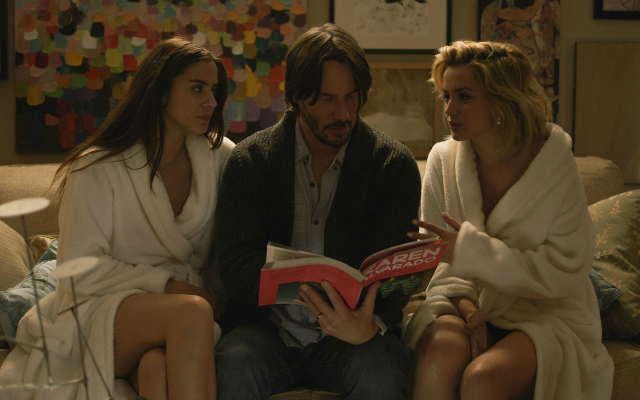
Knock, Knock’s opening plays like one of those Penthouse Forum “name withheld by request” letters but director Eli Roth quickly dumps the sexy stuff in favour of presenting a cautionary tale about the consequences of infidelity.
When we first meet the Webbers they are a happy, 1% family with a home perched high in the Hollywood Hills. Karen (Ignacia Allamand) is an artist with a major show coming up at a Los Angeles gallery, Evan (Keanu Reeves) is an architect and their adorable kids are, well, just adorable. They even have a French Bulldog named Monkey. Cute…