LATE FAME: 4 STARS. “Dafoe and Lee hand in powerhouse performances.”
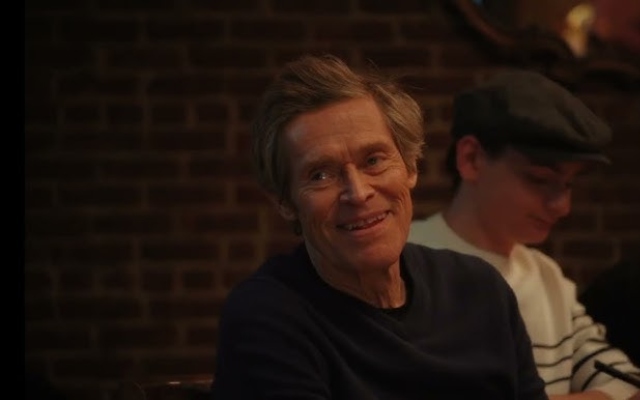 SYNOPSIS: In “Late Fame,” a new drama now playing in theatres, Willem Dafoe stars as a forgotten New York City poet whose work is rediscovered by an enthusiastic group of young fans.
CAST: Willem Dafoe, Greta Lee, Edmund Donovan, Clay Singer, Luca Padovan, Graham Campbell, Arthur Langlie, Jake Lacy, Tony Torn, Clark Johnson. Directed by Kent Jones.
REVIEW: Ed Saxberger (Willem Dafoe) moved to New York City in 1977 with dreams of becoming a poet. “Downtown was another world,” he says, “and Soho was like being on the moon.” In present day, he’s a postal worker who spends most nights at the local bar, and whose one book of poetry lies, mostly unread, in the delete bin of bohemian history.
His long-forgotten dreams of glory are reignited when he’s approached by Meyers (Edmund Donovan), an animated young man who slowly ingratiates his way into Saxberger’s quietly ordered life through flattery and persistence. Meyers is the leader of a circle of twentysomething so-called renaissance men called the Enthusiasm Society. Their literary salon is a pretentious throwback to old New York in their stilted celebration of poetry and art.
Feted as a rediscovered genius, Saxberger reluctantly bathes in the group’s attention, particularly from Gloria (Greta Lee) a tragic heroine in the vein of Daisy Buchanan.
In the ramp up to the group’s inaugural poetry reading, Saxberger’s first public appearance in decades, the poet-turned-postal-worker ponders his place in the world of letters and whether this newfound attention is genuine or not.
Based on the novella “Late Fame” (“Später Ruhm”) by the nineteenth century Austrian writer Arthur Schnitzler, the film is a witty and wistful look at art and aging that gives Dafoe and Lee a showcase for their powerhouse performances.
As Saxberger, Dafoe goes low-key, delivering a natural performance without any of the fun artifice of his work in “Poor Things” or “The Lighthouse.” Those heightened characterizations are expertly crafted, but he’s doing something different here, playing a world-weary guy whose second chance at recognition is a thorny rose; alluring but potentially harmful. It’s beautiful work that subtly reveals frustrations and ambition he thought were long buried.
Working opposite him is Greta Lee, in a much more flamboyant role. As the would-be flapper diva Gloria, she is by time theatrical à la Sally Bowles, even handing in an exhilarating version of Kurt Weill and Bertolt Brecht’s “Surabaya Johnny,” by times prickly and by times vulnerable. It’s dramatic, scene stealing work, the opposite of her restrained performance in “Past Lives.” Here she’s filled with glamour and pathos.
“Late Fame” longs for a more bohemian time, one where art and poetry had cultural currency. As a relic from that era, Saxberger is a curiosity to the Enthusiasm Society, but Dafoe quietly never allows us to forget that he’s a living, breathing person and not an artefact from another time. He is as authentic and grounded as Gloria is ephemeral and that push and pull gives the film its enticing allure.