I write about Weird Al Yankovic and how his career began with a song about a car!
“Weird Al Yankovic, the curly haired, accordion-playing hit maker of songs like “Amish Paradise” has sold more comedy records than any other artist in history — and his success all began with a song about a car…” Read the whole thing HERE!
“Down with intelligence! Long live death!” — a fascist general in Viva La Muerte
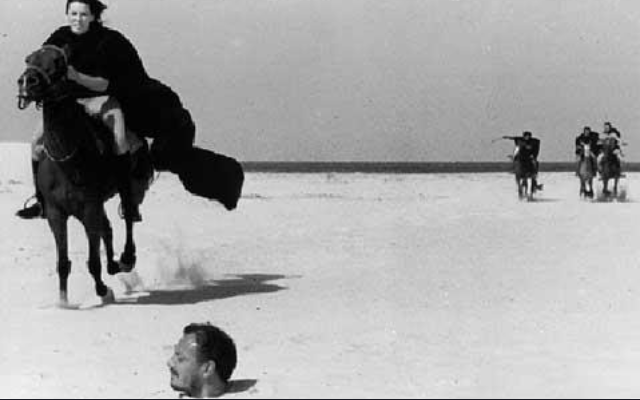
Filmmaker Fernando Arrabal’s troubled childhood haunts his first and most famous surrealist film, Viva La Muerte. The framework of the story of Fando (Mahdi Chaouch) whose father has been arrested for treason in Franco era Spain was based, in part, on true events.
Born on the cusp of the Spanish Civil War, Arrabal was just a child when his father, an officer in the Spanish Army, was sentenced to death for trying to assassinate the head of the Popular Front government. His punishment was later commuted to life-in-prison. When Fernando was nine, however, the elder Arrabal broke out of jail and was never heard from again.
The loss of his father informs much of Arrabal’s work, but none so much as Viva La Muerte, a movie called one of three “perfect surrealist films” along with Un Chien Andalou and El Topo by digitalbits.com.
The movie begins with some very strange yet striking opening credits. Superimposed over a childlike theme song sung by French schoolchildren Arrabal has layered Hieronymus Boschian etchings (by Fantastic Planet’s Roland Topor) of torture and sexual deviancy. It’s a grabber of an opening but the strange ride has just begun.
Episodic in nature, it’s a nightmarish coming of age story for Fando, who, despite his father’s execution for “political crimes” and his mother’s strange assertion that the father wasn’t executed, but actually committed suicide, clings to the belief that his father is alive and well. Fando soon realizes that his life is part of a web of lies when he learns that his mother was the one who turned his father into the authorities. In reaction to the mounting pressure from everyone in his life to renounce his Communist father, Fando conjures up a series of increasingly twisted Oedipal fantasies.
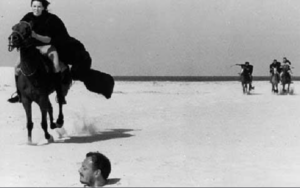
What follows is not for the weak of heart. These multi-colored scenes, seen decades after the film’s release, still have the power to cause shock and awe. Arrabal not only pushes the envelope, he tears it in half, showing disturbing and scatological scenes of Fando’s father being beheaded by his mother; his mother making love to his captors and later, the mother wearing a freshly slaughtered ox like a coat. I would say most certainly that Arrabal can’t guarantee that no animals were harmed during the production of this picture, and while he would never be able to get away with the butchery of the ox (or the beetle that is sliced in half or the decapitated lizard, for that matter) on film today, it is a vivid image.
Viva La Muerte’s jumble of surrealism and autobiography is a potent mix, made more effective by Arrabal’s unwavering use of disquieting imagery. Good taste is certainly not on the menu, but the dream sequences are unforgettable. In one scene Fando urinates over the side of a building while imagining that the entire town below is drowning in a sea of his urine. In another he imagines Arabesque men playing Polo with his father’s disembodied head. These are strange and unsettling images that take us further into the psyche of young Fando. He has been lied to, mistreated by those closest to him and in the end his only refuge is in the dark recesses of tortured mind.
Viva La Muerte is the very definition of “not for everyone.” It is risky and upsetting viewing, but in the avant-garde descriptions is a beautifully crafted — although completely gonzo — portrait of a young person in mental anguish.
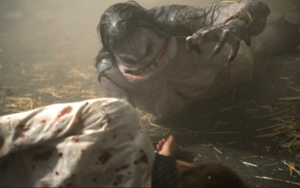
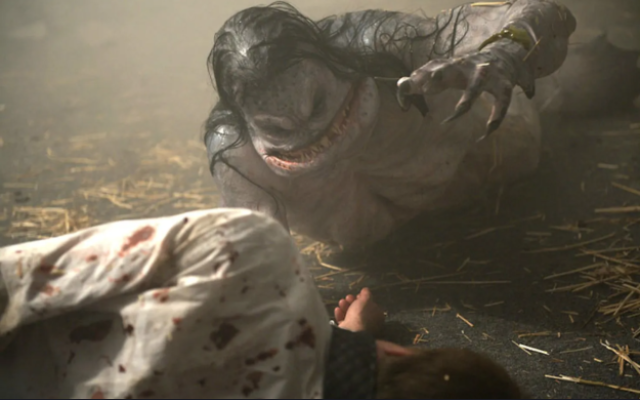
A movie about a group of college kids who go to a remote cabin—a jock, a scholarship jock, a stoner and some hot girls, one a brainiac, one a party girl—complete with a dangerous hillbilly type, mysterious incantations and lines like “No matter what, we have to stay together,” sounds very familiar. Like a thousand teen chillers we’ve seen before, but add in a secret government agency, ancient evil life forms and other surprises (you’ll get no spoilers here) and you have the best mash-up of horror and humor since “Scream.”
All I will tell you about the plot is this: five college friends go to a cabin in the woods. Then all hell breaks loose. All the conventions of the teen horror genre are here, but turned upside down.
The pleasure of “Cabin in the Woods” is in the not knowing, so excuse the brief synopsis. Go in fresh and be surprised.
I can tell you there has never been a slasher flick quite like “Cabin.” The subversive mix of horror movie lore—“The virgin’s death is optional.”—post modern self awareness and gruesome gags isn’t new but rarely has it been this smartly presented.
Like romantic comedy, horror is a genre that frequently takes the easy way out. By the time we got to “Saw 3478: A Stab in the Dark” the movies were more about how many gallons of stereoscopic blood could be squirted toward the audience than creating a new, intriguing story.
Conversely “Cabin in the Woods” screenwriters Joss Whedon and Drew Goddard (who also directed) have crafted a film that is exhilarating in the way it adopts and then challenges the conventions of the form. They even have fun with J-horror with hilarious results.
Expect Whedon’s trademark crackling dialogue. Expect gallons of blood. Expect to be challenged. Expect the unexpected.
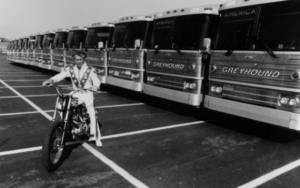
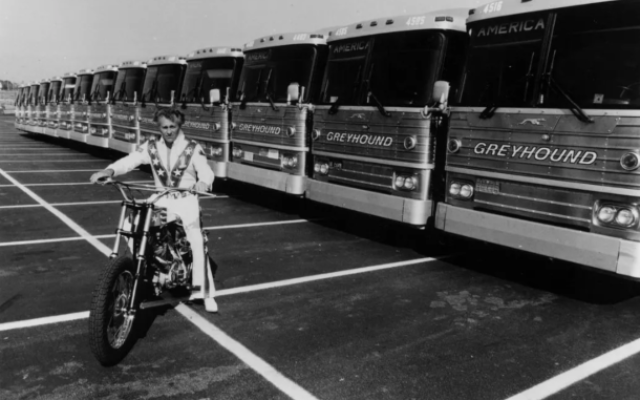
I write about Evel Knievel, a daredevil who blurred the line between stunt performer and entertainer for the Toronto Star!
“A larger-than-life character, his ramp-to-ramp motorcycle jumps made him a superstar. Known for his fearlessness and flamboyance he was like P.T. Barnum on a motorcycle…” Read the whole thing HERE!
I write about the greatest chase scene in movie history for today’s Toronto Star.
“In 1968, “Life” called “Bullitt’s” eye-popping 10 minute and 53 second car chase scene “a terrifying, deafening shocker.” Today, it is generally considered to be the gold standard, the car chase that all others are measured against. Strapped into a Highland Green, 1968 four-speed Ford Mustang Fastback GT, and going at speeds up 110 miles-per-hour, Steve McQueen raced through the cinematic landscape, changing it forever…” Read the whole thing HERE!
I wrote a short history of the car cupholder for the Toronto Star!
“What was the key element of safety when you were a child?” he said. “It was that your mother fed you, and there was warm liquid. That’s why cupholders are absolutely crucial.” Read the whole thing HERE!
I write about Transformers and the people who collect them for the Toronto Star!
“Brian Flinn and his fiancée are looking to buy a new house, and like most house hunters, they have some very specific wants and needs. Top of the list? A space for Brian’s collection of Tranformers toys. “We need a basement or a separate building something to house all these,” he said. “She doesn’t collect them, but she’s very supportive. When you find somebody like that you don’t want to let them go. I’m not getting any younger, and I don’t think I’ll find somebody that goes, ‘Oh, yes, I love Transformers. I love your passion…’” Read the whole thing HERE!