Clive Owen should be breathing the same air as George Clooney and Will Smith; that crystal clean A-lister air that only the rarified few ever get to sample.
He ought to be a massive movie star, but despite smouldering good looks and some big hits like Children of Men and The Inside Man, he isn’t.
Last year the Globe and Mail noted that Owen “remains just below popular radar” despite “critical acclaim for his acting chops.” He’s a Golden Globe and BAFTA winner and an Oscar nominee, so the acting chops aren’t in doubt, but being a movie star and being a good actor are not mutually exclusive. If so, Sam Rockwell and Casey Affleck would be superstars.
So why isn’t Owen in the mega leagues?
Partly by choice. It’s said that he prefers a quiet life in the coastal town of Harwich, England, with his wife of almost two decades and children, to walking a red carpet.
Fair enough, but I think the eclecticism of his choices prevents audiences from getting a handle on him.
This weekend, for instance, he plays a protective father who battles a bogeyman named Hollowface to protect his daughter in the horror film Intruders.
It’s not the first time he’s played a family man but in very different kinds of films, with varying portrayals.
In Trust he was a sensitive father shattered by his daughter’s involvement with an online predator and in The Boys Are Back he had to learn how to be a father to two kids he barely knew after his on-screen wife died.
Then there is the long list of action movies on his resumé. He has punched, kicked and shot his way through violent films that relied on cartoon theatrics like Shoot ’Em Up and Sin City, espionage thrillers like Killer Elite and The International and even spy comedies like The Pink Panther.
Then there are the swashbuckling period pieces like King Arthur and Elizabeth: The Golden Age, where he’s all ruffles and chain mail, and Gosford Park, a murder mystery set in 1932, where he plays Robert Parks, the valet to a wealthy land owner.
The only constants connecting Owen’s movies are his charisma — “I don’t ‘do’ emotion,” he says. “Emotions are overrated. I’m more interested in creating a presence” — and his acting ability. Mega star or not, no one can deny the guy has presence no matter what the role.
If you’ve read The Hunger Games novels, you’re likely excited about the big screen adaptation hitting theatres this Friday. The story of a dystopian world where children killing children is a national pastime — think American Idol, only with knives — was a mega-hit in book stores and promises to pack theatres.
But if the movie lineups are enough to keep you away from the theatre on Saturday night, here are some similar themed movies to get you in the mood.
Battle Royale is the ultra-violent Japanese cousin to The Hunger Games.
The movie is a futuristic nightmare about a group of kids who are shipped off to a remote island and forced to wage war against one another until only one remains.
The film’s bloody conflict enraged the Japanese censors who tried to ban the movie, but their plan backfired. Slapping a tough R15 rating on the film only increased people’s desire to see it. “Because it was forbidden,” says director Kinji Fukasaku, “they wanted to watch it even more.”
Also breathing the same air is Series 7: The Contenders, a parody of reality television where contestants hunt down and murder one another. This gory satire won a passing grade from Roger Ebert who said, “It’s not the idea that people will kill each other for entertainment that makes Series 7 jolting. What the movie correctly perceives is that somewhere along the line we’ve lost all sense of shame in our society.”
The idea of televising human blood sports isn’t new to the reality TV era, however. Years before Survivor made the phrase, “You’ve been voted off the island” a household term, Steven King and Arnold Schwarzenegger unleashed The Running Man on audiences.
Arnold plays a wrongly convicted man fighting for his survival on a TV game show, overseen by Family Feud host Richard Dawson.
“I’ll be back!” Arnold says, mimicking his Terminator catchphrase. “Only in a rerun,” says Dawson, who hopes Arnold bites it and gives the show a spike in ratings.
Finally, director Norman Jewison imagined a theme similar to The Hunger Games in his 1975 film Rollerball.
Set in 2018, it’s about a deadly sport that combines roller derby, hockey, football and a generous helping of violence.
The movie’s style seems a bit dated but the ideas aren’t. Jewisons’ prophetic take on violence, the influence of corporations and the state of entertainment are bang on.
When Jonah Hill’s reboot of 21 Jump Street hits theatres this weekend, it joins a long list of big screen adaptations of small screen hits.
Everything from sci-fi shows like The X-Files to comedies like The Addams Family and even reality and games shows (Jackass and The Gong Show) have made the leap from TV to theatres.
Hill describes the new 21 Jump Street as an “R-rated, insane, Bad-Boys-meets-John Hughes-type movie.”
I don’t remember the TV show the movie is based on as being that edgy but if William Shatner’s cop show T.J. Hooker can be turned into an adult-friendly flick called T.J. Hookers, I suppose anything is possible.
Probably the most spun-off TV franchise is Star Trek. Between the original show and the TV offshoots, 11 films have gone where no film series has gone before.
The 2009 J.J. Abrams reboot with Chris Pine as James T. Kirk was a special effects extravaganza but the Wrath of Khan seems to tickle Trekkies the most. Based on the 1967 episode Space Seed, it’s believed to be the first time a movie was made as a sequel to a specific episode.
Ricardo Montalbán took a break from Fantasy Island to take the role, but had one request: he was a gym devotee and wanted costumes that would show off his muscular chest.
The original pilot for the hip spy show The Man From U.N.C.L.E. was actually shot with a theatrical release in mind. Although the show would air in black-and-white on NBC, the pilot was shot in colour with some racier scenes added in. The tame version aired on television, while the sexier edit played in theatres as To Trap a Spy.
Finally, sketch comedy shows have also been a fertile breeding ground for movies. Saturday Night Live has spawned a dozen films, giving us characters like Wayne and Garth and the Coneheads.
Years before SNL was even on television legendary comedy troupe Monty Python used cinema as a way to court a new worldwide audience for their TV show. And Now for Something Completely Different contains re-filmed skits from the first two seasons of their show, including the classic Nudge, Nudge, and Dead Parrot sketches.
The movie is best summed up in the words of Sergeant-Major (played by Graham Chapman). “Now, I would just like to point out that this film is displaying a distinct tendency to become silly.”
What do spiritual gurus and comedy have in common? More than you might think.
Deepak Chopra, possibly the world’s most famous guru, says, “When your soul responds to the paradox of our existence, to the contradictions of our existence, to the fact that wherever there is joy there is suffering, when your soul recognizes this, it can do nothing except laugh.”
In other words, chuckle — it’s good for your soul.
These are words to live by, particularly if you are Eddie Murphy in A Thousand Words, opening this weekend. In this comedy, Murphy plays a shady literary agent who cheats a spiritual guru in a business deal.
His punishment teaches him the value of every word that comes out of his mouth.
A Thousand Words isn’t the first comedy to go gaga for gurus.
In the 1968 counter-culture hit I Love You, Alice B. Toklas!, Peter Sellers plays a 30-something who visits a maharishi for enlightenment. “You will know yourself when you stop trying,” he is told. “I’m trying to stop trying,” Sellers replies.
A year later came The Guru, a movie that echoed the real-life musical journey of Beatle George Harrison’s internship with Ravi Shankar. Michael York starred as a famous British rock ‘n’ roller who travels from London to Bombay to study sitar at the feet of guru Ustad Zafar Khan.
Director James Ivory (who along with producer Ismail Merchant would go on to make Howard’s End and The Remains of the Day) called The Guru “the most unseen and mysterious of our movies … Merchant Ivory’s version of a ‘60s trip.”
Sharing a title is the 2002 Jimi Mistry film about a young Indian man who moves to New York with dreams of becoming an actor but instead becomes a sex guru who doles out catchphrases such as, “the most powerful sexual organ is your brain.”
In The Love Guru, Mike Myers mixed gross-out humour with spiritualism, a combo that proved toxic for both audiences and critics.
Even Mike’s own guru agreed it flopped.
“Humour mixed with spirituality can work, if it’s done well,” Deepak Chopra, who has a cameo in the film, said. “But frankly speaking, this was not a good attempt.”
So what exactly do gurus and comedy have in common? Myers says he learned from Chopra that “ha ha” is related to “ah ha,” the sound one makes upon the realization of truth.” Maybe it’s that simple.
You may not be aware of this, but we’re living in a bissextile year. What does that mean? Well, it means today’s date, Feb. 29, didn’t exist last year. Or the year before that. In fact, you have to flip the calendar back to 2008 to find the last time February had 29 days.
But how to celebrate the year’s extra day? If you are Ja Rule, Antonio Sabato Jr., or Tony Robbins, all leap year babies, you could throw yourself a birthday party, but if not, why not rent or download (legally of course!) a movie about those rare years with 366 days?
The Amy Adams rom-com Leap Year is based on an old Irish legend that says that women can propose to men, but only on Feb. 29.
She travels to Ireland to ask for her longtime beau’s hand, only to get sidetracked in Wales by a tall handsome stranger played by Matthew Goode.
You can likely guess the rest (and if you can’t you need to go to romantic comedy school and learn how this works) but the proposal Amy finally gives is much different than the one she originally intended.
Also on the romantic side is The Leap Years, a Chinese film about a woman who meets her lover once every four years on, you guessed it, Feb. 29. The main character, Li-Ann, is played by three actresses. Beatrice Chia handles all the narration, Wong Li-lin ushers her through her 20s with Joan Chen playing her in middle age.
Rounding out our look at leap year movies are two films with nothing whatsoever to do with romance.
The strange and disturbing Ano Bisiesto was the first Mexican film to win the Camera D’Or award at the Cannes Film Festival.
The story of a lonely woman (Monica del Carmen) who marks off the days on a calendar as she reveals her true self to her lover was called “a blind leap into the void of art-house cinema du extreme, South of the Border division” by Time Out but is also a deeply felt psychological drama.
On the scary side is The Curse of February 29, a Korean horror film about a blood stained bus ticket, a vengeful ghost and a leap year murder.
Leap years at the movies offers something for everyone — love, ennui and even ghosts!
Most “name” directors have a trademark that makes their movies instantly recognizable.
Is there a long tracking shot? Must be Scorsese. How about a blue sun flare? That’s Spielberg. A car trunk shot? Thanks Tarantino.
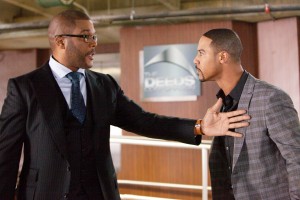
A man in drag as a pistol-packing grandmother? Well that would be Tyler Perry. His trademark isn’t as auspicious as, say, John Woo’s slow motion doves, but what Tyler’s movies lack stylistically they generally make up in box office success.
This weekend’s Good Deeds isn’t likely to make Tyler’s name synonymous with auteur, but when Forbes calls you the highest paid man in entertainment — he took home $130 million between May 2010 and 2011 — no other title really matters.
But what if you’ve never seen a Tyler Perry movie? For the uninitiated, here’s a checklist of how to spot a Perry film:
1. Is there a character named Mabel (Madea) Simmons? She is the cornerstone on which Perry built his empire.
Perry has played the argumentative character in dozens of productions on stage, TV and in movies like Madea Goes to Jail.
Entertainment Weekly put the character on its end-of-the-decade “best-of” list saying, “Tyler Perry’s Madea is the profane, gun-toting granny you never had but (maybe) wish you did.”
Weird accent — she says things like, “Halleluyer! Praise da lort!” — and bad behaviour aside, Madea is usually used to teach a lesson.
2. Is the story melodramatic, up-lifting and/or redemptive?
While none of those traits are exclusive to Perry’s films, he manages to highlight the melodramatic aspects of his stories in ways not usually seen outside of The Young and the Restless.
As for uplift and redemption, Perry’s deeply held religious beliefs bleed into his films and plots, which frequently reference Christian values.
“I don’t want to do movies just to do movies,” he says. “I want to do movies that inspire, motivate and change lives.”
3. Do the critics hate it? If so, it might be a Perry film.
His average Rotten Tomatoes rating clocks in around 50 per cent, and The Times suggests that his movies have “a little something for everyone, as long as you’re not expecting too much.”
Does Perry care? Not so much. “The highbrow. They don’t get it,” he says.
4. Lastly, and this is the dead give-a-way, most of his films have his name in the title.
In this weekend’s Ghost Rider: Spirit of Vengeance, Johnny Blaze, played by Nicolas Cage, joins a long line of movie characters in the ultimate fight — battling Satan! Everyone from Jack Black to Viggo Mortensen to Santa Claus has been hell bent on battling Old Scratch on the big screen.
In Tenacious D in The Pick of Destiny, Jack Black and Kyle Glass play heavy metal musicians who must play a musical battle with Lucifer.
“The demon code prevents me from declining the rock off challenge,” says Old Scratch before they engage in a metal showdown.
If they win, they’ll be superstars and the keepers of the magic pick made of Satan’s tooth. Lose and Kyle gets a new roommate — the prince of darkness.
The Devil in Prince of Darkness takes a slightly different form than Pick of Destiny’s traditional ruby-skinned imp.
In this John Carpenter chiller the Devil is an alien life form trapped in an alternate world.
Meanwhile, his son lives on our planet, boiled down into a vat of sinister-looking green liquid.
E-critic.com hated the movie, suggesting the advertising tagline for the movie should be: It’s NEW and IMPROVED LIQUID SATAN!!!, but it has some good thrills, a moody synthesize score, a cameo by Alice Cooper and a great performance by Donald Pleasance as a priest who does battle with the Devil.
One critic called The Prophecy “Paradise Lost reimagined as a droll B horror picture.”
Christopher Walken plays an angel trying to wage war against God. You might imagine that would put him in league with the Devil, but you’d be wrong.
“Your war is arrogance,” says Mephistopheles, who looks a lot like Viggo Mortensen, “That makes it evil. That’s mine.”
The movie spawned four sequels, but the original remains the best, if only to watch Mortensen deliver lines like, “While heaven may be closed I am always open, even on Christmas.”
And speaking of Christmas, one of the strangest cinematic demonic battles happens in the Mexican fantasy film Santa Claus. Described as “Ho Ho Horrible!” by one critic, it’s cut-rate and cheesy but has a certain kitschy charm.
Sometimes referred to as Santa Claus Conquers the Devil, this weird movie sees St Nick shoot the Devil with toy arrows.
Though marketed to kids, the Mystery Science Theater 3000 folks summed it up best when they said the movie is “good old-fashioned nightmare fuel.”
Denzel Washington is a famous guy. Since his 1974 film debut — he played the uncredited part of Alleyway mugger in Death Wish — he’s won two Academy Awards and a Tony, directed two films and been voted one of the most handsome people in the world.
This weekend, he teams with Ryan Reynolds in what will certainly be the handsomest film of the month, Safe House. The story of a young CIA agent guarding a fugitive turns ugly when their safe house is attacked, is bound to break the box office, but not all of Denzel’s movies have been huge hits.
Though he’s had great success with films like Training Day, let’s have a look at some of his overlooked films.
The 1991 crime-thriller Ricochet starred Washington as a Los Angeles cop-turned-attorney going head-to-head with a bitter escaped criminal (John Lithgow) he put behind bars. Solid action and a great villain from Lithgow’s psycho period — before he did 3rd Rock from the Sun and went soft — it never found the audience it deserved.
Years later in Training Day, Washington’s character flashes a picture of himself as a young LAPD officer. The photo is a still from Ricochet.
Washington has played his share of attorneys and policemen over the years, but he has never been afraid to try new things, as he did in 1993’s Much Ado About Nothing. In this all-star adaptation of Shakespeare’s most famous romantic comedy, he plays the powerful Don Pedro of Aragon.
The movie took hits for its miscasting of Keanu Reeves and Michael Keaton in key roles, but Washington was praised for his work. He has performed Richard III and Julius Caesar on stage, but this movie remains his only filmed Shakespearean role.
From the light comedy of the 17th century we next look at the post-apocalyptic The Book of Eli, set just a few years from today. It’s a strange movie. Denzel plays a coiled spring of righteous power in this timely movie about how religion can be used for both good and evil.
Finally, a movie that should have spawned an ongoing franchise but dried up after just one film was Devil in a Blue Dress. Rolling Stone called Washington’s take on private investigator Ezekiel ‘Easy’ Rawlins a “richly detailed portrayal,” adding that you leave the movie hoping the other books in the Rawlins series will be turned into films. Sadly, that didn’t happen.
What does it really take to become a superhero? Wikipedia simply defines a superhero as “a type of stock character, dedicated to protecting the public.”
What? No mention of capes or crazy gadgets? I guess because there are so many types of superheroes, Wiki decided to keep the definition vague.
Take, for instance, the lads in this weekend’s Chronicle. After uncovering a mysterious crater they develop telekinesis, flight and invulnerability all without the aid of butlers named Alfred, secret identities or spandex suits.
They’re just ordinary guys with extraordinary powers. Civilian superheroes, if you will.
But they’re not the first everyday movie characters to make the leap (sometimes over tall buildings) to become superheroes. The flickers are filled with stories of regular folks who become crusaders — some with extraordinary powers, and some without.
In Defendor, Woody Harrelson plays a man whose rich inner life spills out into his real life. By day he is dead-end-job Arthur, but by night he is Defendor, a masked superhero do-gooder. His task? To clean up the streets of Hamilton, Ont.
Speaking in comic book clichés — “Look out termites,” he says, “it’s squishin’ time!”— and with a duct tape “D” on his chest, Defendor and his homemade arsenal of weapons patrols the streets looking for crime to prevent. He’s a bit delusional, but his heart is in the right place.
“Who writes your dialogue?” asks a bad guy, “Spiderman?”
“No, I do it myself,” he answers innocently, before teaching the guy a lesson he won’t soon forget.
Based on a wild indie comic of the same name by Mark Millar, Kick-Ass tells a couple of intertwining stories. First up is Dave Lizewski (Aaron Johnson), a fanboy who creates a superhero alter ego called Kick-Ass as a way to boost his self-esteem. In life he says his only superpower is being invisible to girls, but when he dons the suit he becomes… only marginally more super.
His exploits, however, grab the attention of Big Daddy (Nicolas Cage) and Hit Girl (Chloë Moretz), a slightly psychotic father-and-daughter team of masked (and in Hit Girl’s case, wigged) avengers who admire Ass’s style and moxie. Defendor and Kick-Ass don’t have superpowers, but they do have cool costumes and the right attitude. That places them alongside other characters that helped redefine what it takes to be a superhero, the better-known movie heroes Batman and Iron Man.