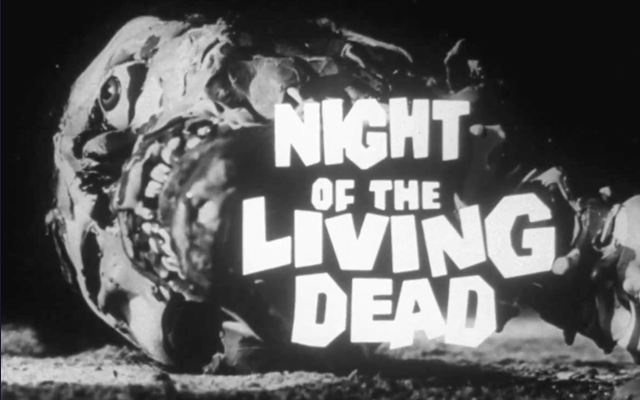
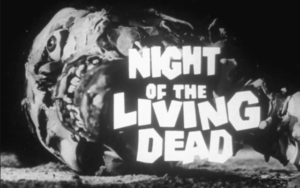
Without Night of the Living Dead movies like 28 Days Later, Shawn of the Dead or even Zombie Strippers wouldn’t exist. In 1968 the story of story of people trapped in a rural Pennsylvania farmhouse trying to survive an attack by reanimated ghouls dragged a bloody new horror genre into the marketplace. For better (see Re-Animator) and for worse (see Zombie Nightmare) the movie Rex Reed called “a classic” has spawned four decades of brain eating and head explosions, but according to the film’s co-author John Russo the origin of the idea was anything but sinister.
“Sometime in the winter of 1966 George Romero and I were having lunch with Richard Ricci,” says Russo, then a co-partner with Romero and Russell Streiner (who has the film’s most famous line, “They’re coming to get you, Barbara!”) in The Latent Image, a commercial television production house. “George and I were complaining about the fickleness of our commercial clients who, when they had not too much money to spend, would come to us for a good, creative job on their spots and sales films, and would promise to come back to us next time, when they would have more money to spend. But when they got more money they’d run away to the supposed glitz and glamour of New York or Hollywood. Richard said, ‘So why don’t you do something about it?’ I thought about it and said, ‘We oughtta be able to make something better than the crap we see on Chiller Theater.’
“George right away got excited, slammed the table with his big hand, sending bottles and glasses flying, and yelled, ‘We’re gonna make a movie!’”
The two batted around several ideas. One, titled Monster Flick, was a horror comedy about teenage aliens, while another focused on flesh eating aliens. “But we quickly discovered that we could not afford all the necessary special effects,” he says, so the writing continued.
“We’d go to work late at night in separate offices, at separate typewriters,” says Russo. “I said right away that our story should start in a cemetery because folks found cemeteries spooky. I was working on a script that started in a cemetery and involved aliens coming to earth in search of human flesh. But George took a break at Christmas time and came back with half of a story that started in a cemetery, and was in essence what became the first half of Night of the Living Dead. There were all the proper twists and turns and a lot of excitement, but George never said who the attackers were or why they were attacking.
“I said, ‘I like this, George, but who are these attackers? You never say.’ And he said he didn’t know. So I said, ‘It seems to me they could be dead people. But why are they attacking? What are they after?’ Again, he said he didn’t know. So I said, ‘Why don’t we use my flesheating idea?’ And he agreed.
“So that’s how the modern flesheating zombies were born!”
The film, titled Night of the Flesheaters, was shot on a shoe string budget—Bosco Chocolate Syrup and pig’s intestines subbed for real blood and guts—in rural Pennsylvania between June and December 1967. Once finished, Russo and Romero had a hard time selling the movie because of its unflinching violence and gory special effects. The pair stuck to their guns, however, denying distributor after distributor who demanded cuts or a happy ending. Finally they found a company who would show the film uncensored but there was still a problem.
“There was already a movie called Flesheaters, and their attorney threatened us, so we had to come up with a different title,” says Russo. “George Romero decided on Night of Anubis, after the Egyptian god of the dead. This was a weak title, and when Continental Pictures got ready to distribute we changed it to Night of the Living Dead.”
The movie premiered on October 1, 1968 earning a rave from Roger Ebert and that other mark of success for a horror film, condemnation from fundamentalist Christian groups.
These days it doesn’t take a lot of braaaaaaaaaaaaaaaains to see the legacy of Night of the Living Dead. The ghoulish story is considered a classic, has spawned comedies like the box office hit Zombieland and serious television shows like The Walking Dead and was even selected by the Library of Congress for preservation in the National Film Registry as a film deemed “culturally, historically or aesthetically significant.”
“We were absolutely dedicated toward making a movie that was true to its premise and the motivations of its characters, from start to finish,” says Russo, adding, “[the movie] struck a primal chord in everybody, perhaps because of the atavistic memory of our species as easy prey for wild beasts, which we were for most of human history. We all carry the deep-seated fear of being devoured.”
Two far flung events inspired director Tobe Hooper to write The Texas Chain Saw Massacre, the down-and-dirty 1974 indie film that spawned sequels, prequels and last year’s splashy 3D remake–the imaginatively titled Texas Chainsaw 3D.
In November 1957 police raided the home of Plainfield, Wisconsin farmer Ed Gein, uncovering some gruesome evidence that would lead to charges of murder and body snatching. After two trials he spent the rest of his life in a mental facility, but his story would go on to inspire three memorable movie characters–Norman Bates from Psycho, Buffalo Bill from The Silence of the Lambs and one other that would serve as the basis for six films.
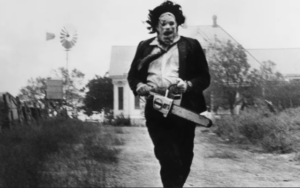
Gunnar Hansen, who played Leatherface in Texas Chain Saw Massacre, says Hooper and co-writer Kim Henkel based the character of the hooded chainsaw killer on Gein.
“When they set out to write this movie,” he said, “they decided to have a family of killers who had some of the characteristics of Gein: the skin masks, the furniture made from bones, the possibility of cannibalism.”
Hooper adds the story was also partially inspired by “the massacres and atrocities in the Vietnam War” and a display of chainsaws in the hardware section of a crowded Montgomery Ward’s department store.
“The idea popped,” he remembered. “I said, ‘Ooh, I know how I could get out of this place fast — if I just start one of these things up and make that sound.’”
That nerve jangling noise–the revving of a chainsaw–has been the soundtrack of terror ever since. The original is an atmospheric gem, a white-knuckle movie that made Leatherface the first icon of modern horror.
The apron-wearing cannibal has appeared in five more films–most of which don’t veer too far from the original plot line of unsuspecting kids falling prey to a family of demented, cannibalistic inbreds. There’s The Texas Chain Saw Massacre 2, directed by Tobe Hooper and starring Dennis Hopper, Leatherface: TCM III, TCM: The Next Generation (starring the then unknown Matthew McConaughey and Renée Zellweger), The Texas Chain Saw Massacre, TCM: The Beginning and the new 3D version.
Leatherface’s scares don’t always happen on screen, however. At the Kingsway Theatre in Toronto the flick inspired audience participation when someone dressed in a butcher’s outfit ran down the aisle brandishing a real, revving chainsaw.
A: A Quiet Place: Imagine living in complete silence. Never raising your voice over the level of a faint whisper. No music. No heavy footsteps. You can’t even sneeze. Silence. Then imagine your life depends on staying completely noiseless. That’s the situation for the Abbott family—and the rest of the world—in the effective thriller A Quiet Place. Uncluttered and low key, it’s a unique and unsettling horror film.
B: Black Christmas: Without this groundbreaking 1974 Canadian horror film there might never have been a Jason Voorhees, Freddy Krueger or Michael Myers. Between them the gruesome threesome has sliced and diced their way through at least two dozen movies, but the mayhem they imposed on promiscuous college girls and studly teens owes much to one film made in Toronto, a movie Film Threat magazine calls “the first modern slasher movie.”
C: Candyman (2021): Candyman is a movie that succeeds on two levels, as a comment on the echoes of historical racism that can be heard today and as a horror film that’ll scare the pants off of you. A study of trauma in the Black community, “Candyman” expands the scope of the original to suggest that the Candyman isn’t singular. In the 2021 film William says, “Candyman’s the whole damn hive,” representing all Black men who have been lost to race-based violence.
D: The Descent: The Descent is scary. Run home to your Momma scary. Scream like a little girl scary. Close your eyes and think of something else scary. “Hold me, I’m scared” scary. There are gory moments, but it isn’t the blood and guts that terrifies. It is the hopeless situation, the unrelenting air of menace that really plays on the viewer’s fears.
E: The Exorcist: This one so traumatized audiences with shots of the possessed Regan MacNeil’s 360-degree head spinning that in the U.K. the St. John’s Ambulance Brigade were on-call at screenings to tend to fainters. Star Linda Blair says she wasn’t traumatized by the film but admits there has been one long lasting side effect. “You wouldn’t believe how often people ask me to make my head spin around,” she says.
F: Freaks: Set in the world of a funfair sideshow, it features a cast primarily made up of actual carnival performers—like Elizabeth Green the Stork Woman and Prince Randian a.k.a. the Human Torso—to tell the story of a beautiful trapeze artist who agrees to marry a deformed sideshow performer for his money. As a young man, director Tod Browning (who also helmed Dracula) had been a member of a travelling circus and that experience brought such a horrifying realism to the story that one woman threatened to sue MGM, claiming the film had caused her to suffer a miscarriage.
G: Ginger Snaps: From 2000, and directed by John Fawcett, this is a great reinvention of the werewolf myth that mixes and matches a werewolf tale with a coming-of-age story.
H: Humanist Vampire Seeking Consenting Suicidal Person: Atmospheric and gothic though it may be, the movie is actually a tender-hearted story that uses the undead to celebrate life. It breathes some of the same fetid air as What We Do In The Shadows, Let the Right One In and Only Lovers Left Alive in its creation of a vampire world that intersects with our own. Quebec filmmaker Ariane Louis-Seize builds a world for reluctant vampire Sasha to inhabit that feels familiar, like our reality, only filtered through a Tim Burton lens.
I: It Follows: It Follows is a hybrid of genres. It’s a scary film through and through, but it’s the dual horror of teenage boredom and ennui coupled with a strange and terrifying supernatural virus that is transmitted sexually. Coming of age and body/mind horror steeped together in an unholy mix and it is an effective brew.
J: Jennifer’s Body: A bloody story about demonic transference and a cheerleading succubus who feeds on the intestines of teenage boys, Jennifer’s Body breathes the same air as the great Canadian horror film Ginger Snaps. Both are inventive takes on established horror mythology—in Ginger’s case it was the werewolf legend here it is demonic possession—and both feature humor and lots of blood and guts.
K: Killer Klowns from Outer Space: Killer Klowns from Outer Space will scare the heck out of coulrophobics. The alien Klowns are beautifully realized creations, reminiscent of the outrageous puppets form the British television satire Spitting Image. Beneath large painted-on grins are rows of yellowed sharp teeth, topped off with beady jaundiced eyes, oversized ears and wildly colored hair. Every feature is madly exaggerated until you have a living caricature of a clown—something funny, but weird and scary at the same time. That feeling is the film’s greatest asset. The creative minds behind Killer Klowns, the Chiodo Brothers—Charles, Edward and Stephen—manage to strike a balance between camp and seriousness by playing it straight. The situation is bizarre and some of the dialogue is downright cheesy, but the actors never wink at the camera. Hamming it up would have made Killer Klowns just another jokey sci-fi take-off, a self-conscious look at a genre that is easy to poke fun at.
L: Late Night with the Devil: Late Night with the Devil is a Faustian show biz satire about the price of success, that contains enough genuinely disturbing images and ideas to become a found footage favorite. The film’s production value and attention to detail makes it seem like we’re watching a suppressed tape of an actual broadcast, like “War of the Worlds,” only real. The skillful filmmaking builds up the tension to an exciting and eye-popping payoff.
M: Monster Squad: A 1987 teenage horror comedy that owes a big nod to Abbott and Costello Meet Frankenstein with a side order of The Goonies thrown in for good measure.
N: Night of the Living Dead: The movie premiered on October 1,1968 earning a rave from Roger Ebert and that other mark of success for a horror film, condemnation from fundamentalist Christian groups. These days it doesn’t take a lot of braaaaaaaaaaaaaaaains to see the legacy of Night of the Living Dead. The ghoulish story is considered a classic, has spawned comedies like the box office hit Zombieland and serious television shows like The Walking Dead and was even selected by the Library of Congress for preservation in the National Film Registry as a film deemed “culturally, historically or aesthetically significant.”
O: Orphan: There are a couple of lines necessary for the success of every Creepy Kid movie. Chief among them: “I have a surprise for you, Mommy!” Why is the line so successful? Because the surprise is never good. A close second is the old, “I don’t think Mommy likes me very much” gag. These lines work because of the juxtaposition of innocence against a malevolent backdrop. In other words, evil children are scary. As Orphan’s resident creepy kid, Isabelle Fuhrman is particularly good, just other-worldly looking enough to be freaky but able to turn on the charm when she needs to. She is a stern mistress who I could see inspiring a drinking game. How about a shot of Jäger every time she gives someone the creepy kid stink eye? You’d be on your butt before the forty-minute mark.
P: Psycho: If Alfred Hitchcock had any doubts about the effectiveness of the shower sequence in Psycho they must have been put to bed when he received an angry letter from the father whose daughter stopped bathing after seeing the bathtub murder scene in Les Diaboliques and then, more distressingly, refused to shower after seeing Psycho. Hitch’s response to the concerned dad? “Send her to the dry cleaners.”
Q: Q: The Winged Serpent: In a career filled with gonzo movies, exploitation director Larry Cohen outdid himself with his big monster opus Q: The Winged Serpent. The story of a petty thief, played by Law & Order’s Michael Moriarty, who comes across the nest of winged, reptilian Aztec god Quetzalcoatl. “It couldn’t have been an egg,” he says. “There are no eggs that big!” His discovery unwittingly unleashes “the fantastic flying forces of a lost age” on New York City. It’s called Quetzalcoatl, the trailer tells us,” but just call it Q because that’s all you’ll have time to say before it tears you apart.” Shot in just 18 days, this is a creature feature unlike any other. The cut rate special effects reveal its bottom-of the-barrel-budget, but fun performances from Moriarty, Candy Clark, David Carradine and Richard Roundtree and Cohen ‘s energetic work breathe life into the film, about which critic Colin Greenland noted, “It is not often that a film is enjoyable as a monster movie, a character study and a satire, but Q: The Winged Serpent scores on every one.”
R: Ready or Not: This film is a bloody satire with sly commentary about the lengths the 1% will do to keep their cash. The surprisingly nasty third act gives “Ready or Not” the feel of a future cult classic, a crowd-pleaser with some laughs and a giddily gory climax.
S: Sleepaway Camp: This gory slasher flick is most notable for a wild twist ending that has been called a “jaw-dropping, tape-rewinding, pause-and-stare-and-call-your-friends-over-to-stare” moment. Ignore the sequels, although the number two’s title Unhappy Campers is pretty great.
T: The Texas Chain Saw Massacre: An atmospheric gem, a white-knuckle movie that made Leatherface the first icon of modern horror. It’s an unforgettable movie. An atmospheric gem that, combined with other transgressive films like “Night of the Living Dead” and “The Last House on the Left,” initiated a modern age of horror in the 1970s.
U: Us: Inspired by an episode of the Eisenhower-era Twilight Zone series called “Mirror Image,” Us is a gory take on class structure, on the chasm between rich and poor, between those with power and advantages and those without. It’s an outlandish story but the powerful message resonates loudly.
V: Viva La Muerte (Long Live Death): Risky and upsetting viewing, but in the avant-garde descriptions is a beautifully crafted — although completely gonzo — portrait of a young person in mental anguish.
W: The Witch: The Witch is the kind of horror film that is not content to simply say “Boo!” There are few, if any, jump scares in the film. Instead, it’s the kind of puritanical folk tale that slowly burrows itself into your brain, leaving you queasy and uneasy. It won’t be for everyone, and certainly not for casual horror fans. There’s no Freddys or Jasons in sight, just pure terror.
X: X: X is a throwback to the horror of Tobe Hooper and Wes Craven, but with a sensibility that simultaneously feels like a tribute and an update.
Y: You’re Next: Disturbing, violent and without any redeeming social value, this home invasion survivalist film, doesn’t offer anything new in terms of motive for the killing, but the ruthless efficiency with which the killing is done is chilling. Morals or feelings need not apply. So even though there isn’t a lot of blood—it is mostly implied—the film still packs a grisly punch.
Z: Zombieland: Making a horror comedy is tricky business. Do it right and you get a classic like “Sean of the Dead,” a movie whose body count is offset by just the right amount of laughs. Do it wrong and you’ll wind up with “Repossessed,” a movie that is neither funny nor scary, just dull. “Zombieland” director Ruben Fleischer understands that horror comedies are neither fish nor fowl—they are both. For every decapitation you must have a giggle and Zombieland delivers on both counts.
On a special Halloween edition of The Richard Crouse Show I’ll have a look at a list of Canadian horror films that are scarier than the Frankenstein Burger King on Clifton Hill. I’ll tell you about a 3D archaeologist, a werewolf movie that reinvents the genre, the first slasher flick, a vocal virus, Canuck zombies and much more.
SYNOPSIS: An inside look at the creative process of an iconic performer, “Springsteen: Deliver Me from Nowhere” is an up-close-and-personal look at the making of his 1982 album “Nebraska,” a turning point in Bruce Springsteen’s career. “It’s like he’s channeling something deeply personal and dark,” says Springsteen’s manager Jon Landau (Jeremy Strong).
CAST: Jeremy Allen White, Jeremy Strong, Paul Walter Hauser, Stephen Graham, Odessa Young, Gaby Hoffmann, Marc Maron, David Krumholtz. Directed by Scott Cooper.
REVIEW: Compared to other rock bios “Springsteen: Deliver Me from Nowhere” is unlikely; as unlikely as Bruce Springsteen following up his biggest hit to date, the upbeat, jangly “Hungry Heart,” with the stark, downbeat “Nebraska.”
Set in the early eighties in the weeks and months after the close of the phenomenally success tour for “The River,” the film begins as a standard rock biography. Springsteen’s manager John Landau (Jeremy Strrong) is the buffer between a record company hungry for another record, preferably laden with big hits, and an artist (Jeremy Allen White) struggling to find himself in this wake of fame that came with his new, widespread success and the pressure to “hit it out of the park again.”
Springsteen’s journey “to find the real among the noise” leads him to a rented house in Colts Neck, New Jersey. Equipped with only a lo-fi Teac Tascam 144 four-track cassette recorder, he records the sparse demos inspired by the meditative crime drama “Badlands” intertwined with memories from his troubled childhood. The songs are stark, introspective and the polar opposite of what the record company is expecting.
“Springsteen: Deliver Me from Nowhere” is a quiet, minor chord portrait of an artist at a crossroads. But what begins as a story of an artist struggling with the pressures of fame and a greedy record company soon turns to the fight for artistic integrity as depression and isolation take hold.
“I know who you are,” says a car salesman, recognizing the rock star. “That makes one of us,” Springsteen replies with a straight face.
Director Scott Cooper, who also wrote the script based on the 2023 book “Deliver Me from Nowhere” by Warren Zanes, avoids most, but not all, of the rock bio genre’s trappings to deliver a brooding character study of a man battling depression as he is cut loose from the world he came from and thrust into an uncertain future.
It sounds like a cliché, but Jeremy Allen White channels Springsteen. His singing voice doesn’t quite match the Boss’s power, but in the film’s contemplative moments, and there are many, White is not afraid to leave space around the performance. His take on Springsteen is a vibe, as reliant on the character’s unspoken moments as it is on what the character actually says.
The movie does rock out from time to time with some randomly inserted concert footage (While “Born in the U.S.A.” was written for the “Nebraska” album, the inclusion of the full-band rave-up here may please fans but feels out of place) but works best when it focusses on White’s stripped-down performance.
The film is really a solo act.
The singer’s relationships are given a short shrift. His courtship of Jersey girl Faye Romano (Odessa Young) is underwritten and, considering how large The E Street Band looms in Springsteen’s mythology, they are barely a presence here. It’s in his bond with longtime manager Jon Landau (Jeremy Strong) and the complicated relationship with his father (Stephen Graham) that he shows the kind of emotional vulnerability that lies at the heart of the performance.
“Springsteen: Deliver Me from Nowhere” is a solemn movie that drags in its latter section as Springsteen fights for the release of the starkly poetic “Nebraska.” The tortured artist’s insistence on musical integrity is commendable but feels repetitious by the film’s end.
Still, Cooper’s focus on the artist’s path, on resilience, on forgiveness and not simply Springsteen’s Wikipedia page, is admirable.
SYNOPSIS: “Blue Moon,” the new biographical comedy now playing in theatres, stars Ethan Hawke as legendary Broadway figure Lorenz Hart, songwriter of “Blue Moon,” “The Lady Is a Tramp,” “Manhattan,” “Bewitched, Bothered and Bewildered” and “My Funny Valentine,” on one long, melancholy night at the bar at Sardi’s.
CAST: Ethan Hawke, Margaret Qualley, Bobby Cannavale, Andrew Scott. Directed by Richard Linklater.
REVIEW: Anchored by a tour-de-force performance from Ethan Hawke, “Blue Moon” is a deceptively simple character study of an artistic genius who was equal parts brilliance and frailty.
Set at the bar of the legendary Broadway restaurant Sardi’s, the action takes place on a single evening, March 31, 1943, opening night of “Oklahoma!” A triumph for composer Richard Rodgers and librettist Oscar Hammerstein, the show’s success left Rogers’s previous partner, lyricist Lorenz Hart, isolated, alone at the bar, save for the company of a bartender Hart nicknames Dr. Bacardi (Bobby Cannavale) and the restaurant’s piano player (Jonah Lees).
“We write together for a quarter of a century,” Hart says, “and the first show he writes with someone else is gonna be the biggest hit he ever had. Am I bitter? Yes.”
Charming, witty but with a deep sadness, Hart props up the bar, slowly losing the battle with the bottle, waiting for 20-year-old Yale student, Elizabeth Weiland (a sparkling Margaret Qualley) to arrive. Though closeted, he loves her, and she loves him, “just not in that way.”
As the evening unfolds, liquor flows in Hart’s direction as he pines for Elizabeth, lobs jabs at his former partner’s use of an “!” in the title of “Oklahoma!” and inspires essayist E. B. White (Patrick Kennedy) to write his novel “Stuart Little” as the evening takes a decidedly bittersweet turn.
A chamber piece—pretty much the whole thing takes place in the downstairs bar at Sardi’s—“Blue Moon” is a complex, humanizing slice of Hart’s life.
Hawke’s remarkable performance embraces the extremes of what Hammerstein and cabaret performer Mabel Mercer said about Hart. Hammerstein commented, “He was alert and dynamic and fun to be around,” while Mercer called him, “The saddest man I ever knew.” Hawke embodies those polarities and touches on many things in between in ways subtle and overt.
An extroverted introvert, Hart put on a brave face, spitting out witticisms—“Leave the bottle,” he tells the bartender, “it’s a visual poem.”—but each barb and every funny line betrays an undercurrent of insecurity and torment.
Hawke is in virtually every frame of the film, reciting pages of dialogue—“Who are you talking to?” asks the bartender. “Me,” Hart replies. “I gotta talk to someone interesting.”—and yet his stream of consciousness always engages because each speech, every word illuminates part of this complicated character.
“Blue Moon” is a showcase for a Hawke—he uses an elaborate combover and director Richard Linklater’s shoots him to reflect Hart’s diminutive stature—but the performance doesn’t rely on the physical transformation. Instead, it is Hawke’s nuances that create this sometimes funny, sometimes sad valentine to Hart.
On the Saturday October 18, 2025 edition of The Richard Crouse Show we meet Billy Corben. He is a documentary filmmaker from Miami, whose documentaries have covered everything from religious hypocrisy, baseball doping, drug running and other controversial topics. His latest film, “Canceled: The Paula Deen Story” traces the history of celebrity chef Paula Deen and reconsiders the scandal that exploded her multi-million dollar empire.
Then, Sloan is one of Canada’s most enduring and influential rock bands, blending infectious power pop with sharp alternative rock since 1991. Originally from Halifax, Nova Scotia, the band—Chris Murphy, Patrick Pentland, Jay Ferguson, and Andrew Scott—stands apart for their rare, democratic approach, with all four members writing and singing. Their landmark album Twice Removed is consistently ranked among the greatest Canadian records, and their catalog of hook-laden anthems and harmonies has earned them critical acclaim and a devoted fanbase worldwide. With an unstoppable live show and decades of hits, Sloan continues to define and defy the sound of modern rock.
Today the band’s guitarist Jay Ferguson joins me to talk about their fourteenth studio album, “Based on the Best Seller,” which is available now wherever you buy fine music.
Each week on the nationally syndicated Richard Crouse Show, Canada’s most recognized movie critic brings together some of the most interesting and opinionated people from the movies, television and music to put a fresh spin on news from the world of lifestyle and pop-culture. Tune into this show to hear in-depth interviews with actors and directors, to find out what’s going on behind the scenes of your favourite shows and movies and get a new take on current trends. Recent guests include Chris Pratt, Elvis Costello, Baz Luhrmann, Martin Freeman, David Cronenberg, Mayim Bialik, The Kids in the Hall and many more!
All iHeartRadio Canada stations are available across Canada via live stream on iHeartRadio.caand the iHeartRadio Canada app. iHeartRadio Canada stations are also connected through Alexa, Siri, and Google Home smart speakers.
SYNOPSIS: In “Good Fortune,” a body-swap comedy starring Seth Rogen and Keanu Reeves and now playing in theatres, a bumbling guardian angel attempts to convince a down-on-his-luck guy that money won’t solve all his problems. “”Money in your pocket can’t hide the poverty in your character,” says tech mogul Jeff (Seth Rogen).
CAST: Seth Rogen, Aziz Ansari, Keke Palmer, Sandra Oh, and Keanu Reeves. Directed by Aziz Ansari.
REVIEW: If “Trading Places,” “Nomadland” and “It’s a Wonderful Life” had a baby, it might look something like “Good Fortune.”
In his directorial debut, Aziz Ansari, who also wrote the script, stars as Arj, a down-on-his-luck handyman who, if he didn’t have bad luck, wouldn’t have no luck at all. He does odd jobs for tech bro Jeff (Seth Rogen), a wealthy guy who never met an excess he didn’t embrace. “I did everything right,” Arj says, “but nothing is working out.”
Arj gets a second chance at life when his “budget” Guardian Angel Gabriel (Keanu Reeves)—he usually sticks to saving people from texting and driving—is inspired by the other guardian angels to do something more meaningful with his job.
Wanting to show lost soul Arj how superficial a life of wealth can be the angel offers him a chance to see life through Jeff’s eyes.
Literally.
Gabriel swaps Arj and Jeff, allowing them to live one another’s lives. “Maybe I can show you that [that] life is not all it’s cracked up to be,” Gabriel says to Arj.
Trouble is, Arj’s problems are solved by Jeff’s cash. “I tried to show him that wealth wouldn’t solve all his problems, but it seems to have solved most of his problems.” As punishment for his divine intervention Gabriel loses his wings and is sent to Earth to become Jeff’s roommate. “You have to get Arj to go back,” says head angel Martha (Sandra Oh). “Until then I have to take your wings.”
“Good Fortune” is an American Dream satire with a standout performance from Keanu Reeves who brings humor and heart to the fallen angel Gabriel. All innocence and wide eyes, Reeves plays Gabriel like a baby in a man’s body as he learns about the simple pleasures of street tacos, dancing and laughing. “How will I know when I’m done chewing?” he asks as he tastes food for the first time. It’s a strange, committed performance that provides many of the film’s unexpected laughs.
Rogen and Ansari are solid, playing characters that echo their previous roles, but Reeves is the glue that sticks “Good Fortune’s” simple and sentimental story together.
Hidden underneath the character driven story are incisive and biting commentary on the difficulty of the gig economy—“We have it good” rich guy Jeff tells his board of directors, “because they have it bad.”—being true to yourself and finding hope in life. The presentation of the ideas is earnest, but effective situationally.
“Good Fortune” isn’t a laugh a minute, but the situation overall is amusing and director Ansari milks some laughs out of the circumstances.
 Without Night of the Living Dead movies like 28 Days Later, Shawn of the Dead or even Zombie Strippers wouldn’t exist. In 1968 the story of story of people trapped in a rural Pennsylvania farmhouse trying to survive an attack by reanimated ghouls dragged a bloody new horror genre into the marketplace. For better (see Re-Animator) and for worse (see Zombie Nightmare) the movie Rex Reed called “a classic” has spawned four decades of brain eating and head explosions, but according to the film’s co-author John Russo the origin of the idea was anything but sinister.