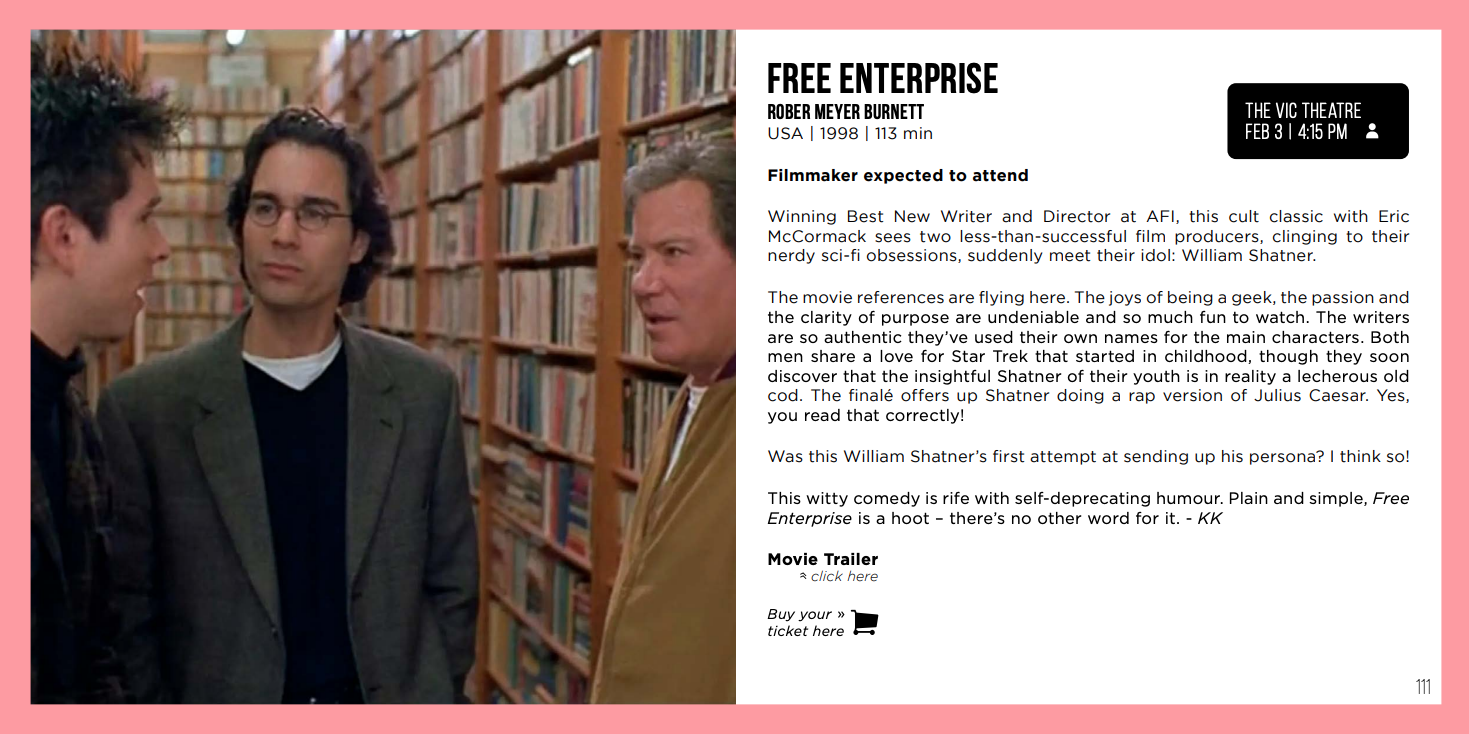
On Saturday February 3 at 2:45 pm I’ll host an “In Conversation” with Eric McCormack, followed by a screening of the cult classic “Free Enterprise,” at The Vic Theatre at the Victoria Film Festival!
Best known for his eleven seasons as Will Truman on NBC’s Will & Grace, Torontoborn Eric McCormack was nominated for four Emmy Awards and six Golden Globes, receiving the Emmy for Lead Actor in a Comedy in 2001. He served as a producer, director and leading actor on three seasons of Perception, and for three seasons of the Netflix sleeper hit Travelers, produced in Vancouver. He currently stars in Slasher: Ripper for AMC+ and in Hulu’s The Other Black Girl. On Broadway, McCormack starred in Tony-nominated productions of The Music Man and Gore Vidal’s The Best Man and spent the summer in the new hit comedy, The Cottage, directed by Jason Alexander. Films include Holy Man, The Architect, Free Enterprise and the new Canadian comedy, Drinkwater, for which he won last year’s UBCP/ACTRA Award. He can also be heard weekly on Just Jack & Will, his popular podcast with his Will & Grace pal, Sean Hayes.
On the Saturday January 27, 2024 edition of the Richard Crouse Show we meet Nick Broomfield, director of the new documentary “The Stones And Brian Jones,” now playing in theatres. With candid interviews and never-before-seen footage he reveals how Brian Jones, the founder of the Rolling Stones, was left behind in the shadows of history.
Broomfield props the film up with first-hand accounts, particularly from former Rolling Stones bassist Bill Wyman, whose enthusiasm for the music, and Jones’s contributions to it, is infectious. The old stories are bolstered by the addition of new, fresh interviews but it is the focus on Jones as a brilliant musician and not simply another rock ‘n’ roll casualty, that elevates “The Stones and Brian Jones.” The story has its sordid moments, but Bloomfield emphasizes the very heart of Jones’s being, the music.
We’ll also meet Douglas Smith, author of “The Dream Rider Saga.” Douglas is following up the award winning first two books in the series, “The Hollow Boys” and “The Crystal Key,” with a third book to round out the successful trilogy. The new book, which is available wherever fine books are sold, is called “The Lost Expedition.” Described by Library Journal as “one of Canada’s most original writers of speculative fiction.” Smith calls the series “Indiana Jones meets Teen Titans.” All three books have been “Editor’s Picks” from BookLife, which described “The Lost Expedition” as “The explosive conclusion to this spectacular fantasy joyride.”
“The Lost Expedition” has a five out of five star rating on Good Reads and in this interview we’ll find out how Douglas came to writing as a second career, how he approached writing a trilogy, and much more.
Each week on the nationally syndicated Richard Crouse Show, Canada’s most recognized movie critic brings together some of the most interesting and opinionated people from the movies, television and music to put a fresh spin on news from the world of lifestyle and pop-culture. Tune into this show to hear in-depth interviews with actors and directors, to find out what’s going on behind the scenes of your favourite shows and movies and get a new take on current trends. Recent guests include Chris Pratt, Elvis Costello, Baz Luhrmann, Martin Freeman, David Cronenberg, Mayim Bialik, The Kids in the Hall and many more!
All iHeartRadio Canada stations are available across Canada via live stream on iHeartRadio.caand the iHeartRadio Canada app. iHeartRadio Canada stations are also connected through Alexa, Siri, and Google Home smart speakers.
A vivid portrait of an urban dystopia, “The Kitchen,” now streaming on Netflix, is sci fi that sets up a troubling vision of the future, while finding room to emphasize the humanity at the core of the story.
Set in the near future, the story takes place in a dystopian, “Blade Runner-esque” London. The divide between the 1% and everybody else has widened, with the effects of rising home prices, an AI workforce and a dismantled Welfare State turning the city into a playground for the rich, with no regard for people living in poverty.
The last remaining block of social housing, The Kitchen, is a dilapidated set of North London towers and home to hundreds of Black and brown residents. Scheduled to be demolished by the authoritarian government, its inhabitants live in constant fear of their power and water being shut off, or worse, being evicted in a violent police raid.
Izi (Kane Robinson), a funeral home worker whose company, Life After Life, composts the bodies of those who cannot afford a traditional burial, lives in The Kitchen, but has no plans of waiting around to be forced out of his home. Tired of lining up at the communal shower, and uncertainty of life at the crumbling estate, he has an eye on getting out. Saving his cash, he hopes to move into Buena Vida, a glitzy new development far away from The Kitchen.
His life is changed when he meets Benji (Jedaiah Bannerman), a youngster left to his own devices in the wake of his mother’s death. Izi knew the mother, and may, or may not, be the boy’s father. After a rough start, the two bond as Izi offers him a place to stay and steers him away from bad influences that live with the housing project.
As the two become close, Izi asks Benji to move in with him at Buena Vida, but doing so means he will have to reapply for a double occupancy apartment. That means waiting, and spending even more time wrapped in the uncertain embrace of The Kitchen.
“The Kitchen,” written by Daniel Kaluuya (the actor best known for “Get Out,” “Black Panther” and “Judas & The Black Messiah”) and Joe Murtagh, and directed by Kaluuya and Kibwe Tavares, is set in 2040, but feels vital and timely. In an increasingly besieged world, the gap between rich and poor, the breakdown of community and the pressure marginalized communities feel under the thumb of an authoritarian state, as presented in the film, doesn’t feel like sci fiction. It feels more like a humanistic portrait of a community under fire.
It’s not all doom and gloom. The co-directors inject moments of joy with scenes set in a roller disco and a pirate radio voice named Lord Kitchener, played by former Arsenal-and-England footballer Ian Wright, who maintains morale in The Kitchen with music and spiritual advice.
Ultimately, for all its elaborate world building, “The Kitchen” is a personal story. Like most speculative fiction, the background sets the scene, but the meat of the story is anything but speculative. In this case, it is a father and son story that details the pressure and responsibility Izi feels to do the right thing for himself and Benji.
Robinson is effective in portraying Izi’s worldview. The character is aspirational but tethered to his reality, made more complicated by his relationship with Benji. It’s the storyline that grounds the film, and provides the most interesting moments.
“The Kitchen” brims with ideas, but they are sometimes muted by an episodic presentation. Kaluuya and company juggle a great many storylines, but the film works best when it gets up-close-and-personal with Izi and Benji.
“Going In,” a gritty new crime drama now available on Amazon Prime Video, Apple/iTunes and cable video on demand, is a stylistic homage to the buddy movies of the 1980s that rides the line between parody and tribute.
Set in Toronto, in a time before sky scrapers dominated the downtown, writer and director Evan Rissi plays philosophy professor Leslie Boothe, a dullish, straight-edge type, more interested in Jean Paul Sartre than booze, drugs or partying.
“You come to realize that coming into being is the same as turning into nothing,” he lectures to his students, “that being and nothing unite as becoming.”
“Yeah,” says a smart aleck student, “becoming… bored.”
His wild child past, however, is revealed when Reuben Goldstein (Ira Goldman), a face from the past, appears. Once best friends, the two haven’t seen one another in five years, ever since Boothe got sober and started going to bed before 10 pm.
“I need to talk to you,” says Goldstein. “Meet me tonight at the bar. You know the one.”
Boothe made a promise years ago to help Goldstein whenever he needed it, and how Goldstein has come to collect. Seems his kid brother Saul has been working for a drug lord named Feng (Victor D.S. Man) selling a nasty new drug called Pearl.
News reports say the highly addictive drug has turned the city upside down, and is “even more dangerous than originally anticipated.” It gives uses a fifteen-minute out-of-body experience or “O.B.E for short” that turns them into a zombie-like state with white, glassy eyes.
Saul has disappeared and Goldstein needs help to find him. The police can’t do anything, Feng is too powerful, and the security around him is airtight. The only way they can get access is through an underground tournament the criminal hosts every six months. “It’s a mysterious competition,” says Goldstein. “No one knows what the challenge is till they begin. You have to prepare for anything. If you come with me, we have a better chance.”
A man of his word, Boothe reluctantly agrees to help, and dives into the seedy underbelly of 1980s Toronto.
“Going In” is a low-budget, yet loving throwback to 1980s film stereotypes. The soundtrack drips with a synth score, there are underground nightclubs, mismatched buddies à la “Lethal Weapon” and “Silver Streak,” a work-out montage, a subway shootout, clothes borrowed from Sonny” Crockett’s closet, a villain who cackles “You came here for your brother? No! You came here to die!” and even motorcycle ninjas.
Rissi pays tribute, but it’s not really tongue-in-cheek. The references are there, should you be keeping track, but they’re accompanied by a pretty good story, one with stakes and forward momentum.
The situation is extreme—particularly when we get to the high-stakes competition—but that’s part of the appeal. The party trick Rissi manages here is ride the line between satire and straight-faced storytelling. It works, even if the action scenes are scarce and hindered by the film’s shoestring $80,000 budget. Nonetheless, “Going In” has a DIY charm, that feels born out of a genuine love of the films that inspired it.
The suspenseful “The Integrity of Joseph Chambers,” now on VOD, is a dark twist on the “Green Acres” idea of leaving the city behind for a quiet life in the country.
Clayne Crawford plays Joseph Chambers, an insurance salesman tired of the hustle and bustle of big business and big city life. Relocating, with his two kids, to his wife Tess’s (Jordana Brewster) hometown of Pell City in rural Alabama, he embraces country life. The chores. The fresh air. Good bye city life.
When he gets it in his head to go hunting, solo, in the nearby woods, Tess tries to talk him out of it. They have enough money for groceries, she argues, and anyway, he doesn’t know how to shoot and doesn’t own a gun. But old Joe has already trimmed his beard, leaving behind a patch under his nose he dubs his “hunter’s moustache.”
He wants to fit in, prove his manliness, but more importantly, wants to be able to provide for his family if and when the world falls apart. “If things get worse,” he says, “we may need to know how to do this stuff.”
With ideas of doomsday clouding his mind, he borrows a gun and a truck, slips into his hunting gear, including an orange puffer vest, and heads out. Hours later, when he finally spots a deer, he reacts quickly and fires. His bullet finds its target, but it’s not a deer, it’s another hunter.
The story burns slowly, setting up Joseph as a decent but naïve suburbanite desperate to prove his macho bone fides. He brims with bravado—quoting old Westerns like “The Outlaw Josey Wales” and imagining crowds cheering for him on his quest for a ten-point buck—but those affectations are a cover for a deep core of insecurity. The quest here isn’t really for a buck, it’s actually a search for masculinity.
Joseph feels he has much to prove to himself and his family, so “The Integrity of Joseph Chambers” isn’t really the story of the fatal shot, but of his reaction to it. Questions of responsibility vs. consequences flood his mind as the open expanse of the forest envelopes him.
Danish sound designer Peter Albrechtsen embellishes these scenes with unsettling sounds that sonically give life to Joseph’s inner feelings.
Crawford occupies the vast bulk of the movie, and holds focus. His take on Joseph is equal parts ridiculous—he playfully sings “I’m the moustache man!”—and repentant. It’s a raw-edged performance, aided in its grittiness by screenwriter and director Robert Machoian’s refusal to offer easy answers.
“The Integrity of Joseph Chambers” isn’t an easy film to digest. It is very slow and a bit repetitive. It asks more questions than it answers, and will likely frustrate those wanting a pat ending, but it raises interesting questions about the real meaning of masculinity.
On the January 20, 2024 edition of The Richard Crouse we spend some time with Rik Emmett. He is a solo artist, a guitarist, a poet, a song writer, a teacher, a Canadian Music Industry Hall of Fame and is probably best known as the co-singer and guitar player of Triumph, the gold and nine platinum selling rock trio who lit up radios in the 70s and 80s.
Rik Emmett left Triumph in 1988 to pursue a solo career, and released records in a variety of styles, including rock, blues, jazz, classical, bluegrass, and flamenco. He’s he won the Canadian Smooth Jazz Award for Guitarist of the Year and now has written a book called “Lay It On the Line: A Backstage Pass to Rock Star Adventure, Conflict and Triumph,” available now wherever you buy fine books.
In this conversation we talk about the memoir, objective perspective of a career when you’re inside it, his favorite guitar players and much more.
Then, we’ll get to know Alan Frew, the Scottish-Canadian singer, songwriter, actor, and author, and notably lead singer of the Canadian rock band Glass Tiger. Today we’ll talk about his up-coming 80’s>90’s<<REWIND! Shows that will feature performances of classic hit songs that have left an indelible mark on the music industry to this very day. Concert goers can expect to hear Frew perform hit songs by Simple Minds, Tears for Fears, Midnight Oil, REM, INXS, Tragically Hip, Pearl Jam, and Robert Palmer to name a few.
Each week on the nationally syndicated Richard Crouse Show, Canada’s most recognized movie critic brings together some of the most interesting and opinionated people from the movies, television and music to put a fresh spin on news from the world of lifestyle and pop-culture. Tune into this show to hear in-depth interviews with actors and directors, to find out what’s going on behind the scenes of your favourite shows and movies and get a new take on current trends. Recent guests include Chris Pratt, Elvis Costello, Baz Luhrmann, Martin Freeman, David Cronenberg, Mayim Bialik, The Kids in the Hall and many more!
All iHeartRadio Canada stations are available across Canada via live stream on iHeartRadio.caand the iHeartRadio Canada app. iHeartRadio Canada stations are also connected through Alexa, Siri, and Google Home smart speakers.
In “I.S.S. (International Space Station),” a new sci fi/horror drama starring Oscar-winner Ariana DeBose and Chris Messina, and now playing in theatres, the conflict that drives the outer space story is very much earthbound.
In the spirit of international co-operation, astronauts and cosmonauts aboard the International Space Station hail from the United States and Russia. The Americans, team leader Gordon Barrett (Chris Messina), biologist Dr. Kira Foster (Ariana DeBose) and Christian Campbell (John Gallagher Jr.), work alongside Russians Alexey Pulov (Pilou Asbæk), Weronika Vetrov (Masha Mashkova), and Nicholai Pulov (Costa Ronin).
“We don’t talk politics. Here we are one.”
Despite having virtually no privacy in the cramped quarters, tensions are kept to a minimum, although Pulov ominously hints at the trouble to come when he notes that it won’t end well for the laboratory mice Foster brought on-board and keeps in a small paddock.
For now, however, all is well. They play chess, do sing-alongs and drink booze in zero gravity.
“You forget everything that happens down there,” Pulov says, “when you can see the beauty from up here.”
The peaceful ship’s tranquil atmosphere is shattered when a sudden burst of flame appears on Earth. Foster first thinks it is a natural phenomenon, like a volcanic eruption, but when a cluster of explosions occurs in rapid succession, it’s clear something devastating is happening below.
Stepping outside the ship to repair a broken antenna, Barrett witnesses a terrible sight. War has broken out between the U.S. and Russia, and the Earth is on fire.
NASA has instructed the Americans to “take the I.S.S. by any means necessary.” Trouble is, both countries see the I.S.S. as an asset, and both want control. “We have to assume the Russians have the same order,” says Campbell.
What began as an exercise in co-operation soon becomes a matter of survival as they lose communication with Earth, and must overcome their mistrust of one another to keep the I.S.S. from plummeting from the sky.
A study of human nature rather than a sci fi epic, “I.S.S.” is a fairly simple, yet effective, story of loyalty, sabotage and treachery. The I.S.S. setting is compelling, providing horror elements like claustrophobia and isolation, but this is essentially a locked room drama that is more about human nature than it is about zero gravity. The monsters here isn’t from outer space, it’s the mistrust and paranoia that forms in the face of adversity.
Set to an anxiety-inducing soundtrack by Anne Nikitin, the movie doesn’t rewrite the isolation horror playbook, but delivers tension with interesting characters and their ever-shifting, murky allegiances.
DeBose leads the small cast, acting as the story’s focus and moral core. All the other characters interact with her and it is, more often than not, up to her to guide the audience through the plot’s many machinations. She brings gravitas and likability to her first big screen dramatic role, after winning an Oscar for her work in the musical “West Side Story.”
The rest of the cast add capable support, particularly Asbaek, whose character is torn between duty and the humanity of the situation.
“I.S.S.” is a barebones effort with decent special effects and some good zero gravity visuals, but don’t expect the lavish treatment of a film like “Gravity.” Director Gabriela Cowperthwaite does a lot with a little, effects wise, but is more concerned with the life-and-death, us-vs-them conundrum at the story’s heart as paranoia and suspicion give way to sabotage and betrayal.
“Memory,” a poignant new drama now playing in select theatres and starring Jessica Chastain and Peter Sarsgaard, is a difficult, delicate story about how the past impacts the present.
Chastain is Sylvia, a self-reliant social worker and overprotective single mother to Anna (Brooke Timber). Sober for a dozen years and counting, she wears her emotions on her sleeve, and when she isn’t working, she’s often at AA meetings, sometimes with Anna in tow.
The story kicks in when Sylvia reluctantly attends a high school reunion with sister Olivia (Merritt Wever). Sitting alone, she’s alarmed when a bearded stranger stares blankly at her, before sitting at her table. Unnerved, she bolts, with the man in pursuit. He follows her home to her rough Brooklyn neighborhood, parking himself outside while she hurriedly goes inside and bolts the door.
The next morning it’s revealed he is a middle-aged man with early onset dementia named Saul (Sarsgaard) who lives in a fancy townhouse with brother Isaac (Josh Charles) and niece Sara (Elsie Fisher). When Sylvia takes on the job of Saul’s caregiver, a relationship blossoms, as she confronts memories of her young life, while Saul strains to remember the day-to-day.
“Memory” is a simply rendered, quiet movie with powerhouse performances from Chastain and Sarsgaard. Director Michel Franco is a fly-on-the-wall, keeping the camera at arm’s length, with no fancy cinematography to distract from the performances. Ditto the soundtrack. Or, should I say lack thereof. Franco doesn’t manipulate emotion with music, save for repeated spins of Saul’s favorite song, Procol Harum’s “A Whiter Shade of Pale.”
The no-frills approach is in service to the characters and the story. With no distractions, the narrative, which details sexual abuse and trauma, unfolds in an unexpectedly warm way. That is thanks to Chastain, who plays Sylvia with emotional bluntness and Sarsgaard, who won the Volpi Cup for Best Actor at the Venice Film Festival, who brings vulnerability to Saul, but never forgets his strength of character.
They share remarkable chemistry, and even when “Memory” drifts into implausibility, the story of two outsiders who find redemption in one another packs an emotional wallop.
 On Saturday February 3 at 2:45 pm I’ll host an “In Conversation” with Eric McCormack, followed by a screening of the cult classic “Free Enterprise,” at The Vic Theatre at the Victoria Film Festival!