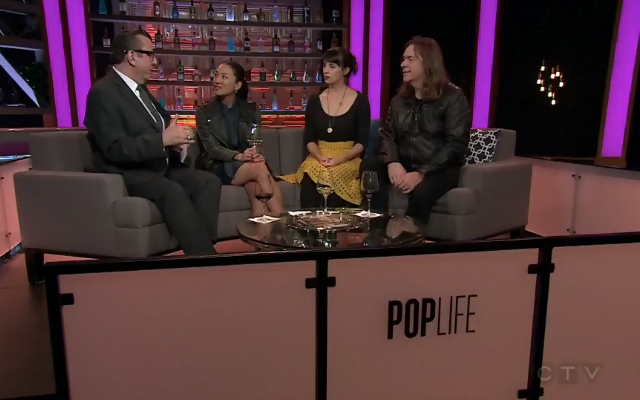
From hitchhiking to working with fishermen at 10 years old, Alan Dolye swings by the “Pop Life” bar to share what it was like growing up in Newfoundland. Then he joins the Getting Over Failure panel with author Adrienne Kress, “The Social” co-host Lainey Lui. Watch the whole show HERE!
Film critic and pop culture historian Richard Crouse shares a toast with celebrity guests and entertainment pundits every week on CTV News Channel’s all-new talk show POP LIFE.
Featuring in-depth discussion and debate on pop culture and modern life, POP LIFE features sit-down interviews with celebrities from across the entertainment world, including superstar jazz musician Diana Krall, legendary rock star Meatloaf, stand-up comedian and CNN host W. Kamau Bell, actor and best-selling author Chris Colfer, celebrity chef Jeremiah Tower, and many more.
Watch all new shows every Saturday at 8:30 pm on Saturday or 2:30 pm on Sunday on the CTV NessChannel! (channel 1501 on Bell Fibe, 62 on Rogers)
In the movie Hitchcock, the master of suspense, played by Anthony Hopkins, says, “Audiences want to be shocked — they want something different.” He’s referring to the lurid horrors of his ground breaking 1960 film Psycho but he could have been talking about any number of frights available on screens this month.
Trends come and go but one thing is for sure, audiences will always line up to get scared at the movies. Whether it is the time loop terrors of Happy Death Day or the return of Jigsaw, the evil mastermind from the Saw series, there is no shortage of things that go bump in the night at the movies this Halloween.
But why do we pay to be scared? Isn’t that counterintuitive?
Scientists tell us that we like the rush of adrenalin that comes from watching Leatherface chase victims, chainsaw roaring.
That jolt of fear makes the heart race and releases a hormone called dopamine that’s also associated with pleasure. Science journalist Jeff Wise called the experience of extreme movie fear “the biological equivalent of opening the throttle.”
A Saturday matinee screening of Paranormal Activity was the first and only time I ever heard anyone actually scream in a theatre.
I don’t mean a quiet whimper followed by an embarrassed laugh or a frightened little squeal. No, I mean a full-on, open throated howl of terror. But the woman didn’t run from the theatre. She stayed and enjoyed the rest of the film, so she must have liked the cathartic release of tension the scream gave her.
Legendary filmmaker and showman William Castle took full advantage of the audience’s love of shocks.
The advertising campaign for Macabre, his 1958 schlockfest about a doctor’s daughter who’s been buried alive, boasted that every ticket purchaser would receive a $1,000 insurance policy against “death by fright” issued by Lloyds of London.
Those brave enough to make it through to the end credits were rewarded with a badge that read, “I’m no chicken. I saw Macabre.” The gimmicks worked, drawing thrill-seeking crowds who spent an astronomical $5 million (roughly $42,505,633.80 in today’s dollars) at the box office to see a movie that cost Castle a paltry $90,000 to produce.
Alfred Hitchcock knew how to scare the wits out of people. The shower scene in Psycho, for example, is a benchmark in cinematic fear. If he had any doubts about the effectiveness of that sequence they must have been put to bed when he received an angry letter from a father whose daughter stopped bathing after seeing the bathtub murder scene in Les Diaboliques and then, more distressingly, refused to shower after seeing Psycho.
Hitch’s response to the concerned dad? “Send her to the dry cleaners.”
The director was always quick with a line, but when it got down to the business of terrifying audiences he summed up the appeal of the scary movie in one brief sentence: “People like to be scared when they feel safe.”
But what scares the people who scare us?
Guillermo del Toro, director of Pan’s Labyrinth and the upcoming The Shape of Water, says, “I love monsters the way people worship holy images,” but it isn’t Frankenstein or Dracula that gives him the willies. “Politicians,” he said recently, “they’re the scariest thing there is right now.”
In “Suburbicon” director George Clooney pays tribute to the great melodramatic thrillers of the past with a timely story about two families, one in a quagmire of their own making, another harassed by outside forces. It’s a morality—or should that be a-morality—play that is as grim as it
Set in Suburbicon, a picture perfect suburb, new, sparkling with all the amenities, we first meet Gardner Lodge (Matt Damon) and his family, wife Rose (Julianne Moore), son Nicky (Noah Jupe) and sister-in-law Margaret (also Julianne Moore). It’s a “Leave it to Beaver” life until a home invasion shatters the American Dream idyll. “Nothing like that ever happened here,” a neighbour says. “This was a safe place.”
Meanwhile an African-American family moves in next door and immediately becomes the target of racial intolerance from the townsfolk. Based on the real-life harassment of the Myers family, husband William (Leith M. Burke), wife Daisy (Karimah Westbrook) and son Andy (Tony Espinosa) in Levittown, Pennsylvania in 1957, the citizens of Suburbicon create a twenty-four-hour-a-day disturbance outside their home, making normal life almost impossible inside.
As the police investigate the invasion and the murder of Rose, uncomfortable questions arise. When an insurance inspector (Oscar Isaac) starts poking around it little Nicky begins to suspect his father might not be the man he thought he was.
On one fateful night tensions come to boil at both the Lodge and Myers households.
There will be no spoilers here, just know that “Suburbicon” plays like the leering devil child of Alfred Hitchcock and David Lynch or the evil godchild of the Coen Brothers, who wrote the original script before Clooney and long time collaborator Grant Heslov did a rewrite. It’s a beautifully nasty film, nicely made but marching to the beat of a very dark heart.
Against a seemingly wholesome backdrop Clooney paints a picture of greed, murder, racism and infidelity. There are laughs—like the ridiculous sight of Damon riding a kid’s bicycle away from a crime scene—but make no mistake this is not “Ocean’s Eleven.” He builds the story block-by-block, carefully creating character facades only to shatter them. Hardly anyone is who they seem. Only Nicky is pure-of-heart and if this was real life Nicky would need some serious therapy. It’s gripping and grim stuff about the American Dream gone wrong.
Murder and infidelity are, I guess, the timeless aspects of the story. The racism, particularly in light of recent events in Charlottesville, Virginia, brings a timely and urgent facet. The portrayal of the racism levelled at the Myers family is ugly and, sadly, all too believable. The “decent” folks of Suburbicon are all too quick to grab a Confederate flag when an African-American family moves in next door. It’s a strong anti-segregation message that contrasts the craven behaviour of the Lodge family.
Damon doles out the creepy vibe sparingly, bring the character to a slow simmer, only to have it boil when things go sideways. Moore is a dim-witted femme fatale with a mean streak. Isaac inserts some smarmy energy mid-movie, but it is Jupe as little Nicky who grounds things. We see Suburbicon’s carefully constructed world fall apart through his eyes, taking the ride with him. He’s a Hitchcockian figure in short pants, the boy who knew too much, and he’s an effective mirror of the dangers of conformity.
“Suburbicon” is a horror film, but the monster is us.
The new film from “Far From Heaven” director Todd Haynes is show-me-don’t-tell-me cinema that comes close to being a sublime time at the movies but falls just short.
Based on children’s novel written and illustrated by Brian Selznick, “Wonderstruck” weaves together two separate but related stories.
Ben’s (Oakes Fegley) story takes place in 1977. He’s a preteen living with his aunt in Minnesota following the death of his mother in a car accident. He’s unhappy, missing his mom and eager to reconnect with a father he never knew. Rummaging through his mother’s stuff he finds clues about his father’s whereabouts in New York City just before a lightening strike renders him deaf in both ears. Despite not being able to hear he runs away to the big city.
Meanwhile Rose’s (Millicent Simmonds) tale takes place fifty years earlier. It’s 1927 and the little girl, deaf since birth, is living with her father, a stern New Jersey businessman. Obsessed with film and stage star Lillian Mayhew (Julianne Moore) she sets off to New York City to meet her idol. There’s more to Rose’s story, but no spoilers here.
Up until this point Haynes uses every ounce of artistry in his considerable arsenal to bring these stories to life. New York, both in the 20s and 70s, is presented in vivid detail. Both stories are told with a minimum of dialogue—show-me-don’t-tell-me—with Rose’s time on screen mimicking a silent movie while Ben’s is more impressionistic, creating a vibrant portrait of NYC’s chaotic 1970s street life.
The film works best when Haynes let’s the pictures do the work. For much of its running time “Wonderstruck” plays like a dream, when it gets down to brass tacks—tying up the story threads—it disappoints, allowing reality to crash the party. What begins as a beautifully crafted flight of fancy grounds itself with a thud in the final half hour with a series of incredulous coincidences.
“The Florida Project,” mixes joy with heartbreak in a story about life just outside the doors of the Magic Kingdom.
Six-year-old Moonee (Brooklynn Prince) lives at the Magic Castle Motel, a dowdy Florida pink dump located just behind Disney World. Halley (Bria Vinaite), her ex-stripper mom, barely makes ends meet. She’s almost always late with the weekly rent she owes to the exasperated motel manager Bobby (Willem Dafoe) and every thirty days they have to check out and check back in so as not to establish permanent residency. It’s a chaotic lifestyle but for Mooney, it’s normal. She’s a happy little girl who, with her friends, turns the motel and surroundings into their own Adventureland. They hustle the locals for ice cream money, spit on car windshields and get up to harmless no-good fun. She makes the best of a bad situation, comforted in the childlike belief that her mom and friends will always be there for her.
“The Florida Project” is, hands down, one of the best films of the year. Low-budget and naturalistic, it packs more punch than any superhero. Director Sean Baker defies expectations. He’s made a film about kids for adults that finds joy in rocky places. What could have been a bleak experience or an earnest message movie is brought to vivid life by characters that feel real.
It’s a story about poverty that neither celebrates or condemns its characters. Mooney’s exploits are entertaining and yet an air of jeopardy hangs heavy over every minute of the movie. Baker knows that Halley and Moonie’s well being hangs by a thread but he also understands they exist in the real world and never allows their story to fall into cliché.
An electric and charismatic cast aids Baker. Prince makes Moonie the film’s beating heart while Vinaite is a live wire, simultaneously careless and protective. Dafoe hands in his most memorable performance in years as a man whose obvious empathy is coloured by the difficult choices he must make.
“The Florida Project” has heartbreaking moments but celebrates the power of friendship and the bond between mother and daughter. Mooney may be having a rough go of it now, but she’s not prepared to give up. Check out the unwitting metaphor for her own life she uses to describe her favourite landmark, a gnarled tree. “It’s fallen over,” she says, “but it’s still growing.”
Film critic and pop culture historian Richard Crouse shares a toast with celebrity guests and entertainment pundits every week on CTV News Channel’s all-new talk show POP LIFE.
Featuring in-depth discussion and debate on pop culture and modern life, POP LIFE features sit-down interviews with celebrities from across the entertainment world, including superstar jazz musician Diana Krall, legendary rock star Meatloaf, stand-up comedian and CNN host W. Kamau Bell, actor and best-selling author Chris Colfer, celebrity chef Jeremiah Tower, and many more.
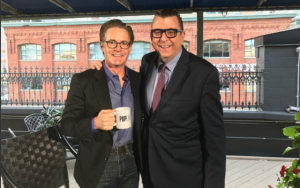
Watch the sixth episode with Agent Dale Cooper himself, actor Kyle MacLachlan who talks about working with David Lynch, “Twin Peaks” and what career setbacks have taught him. Then the Work Life panel, Traci Melchor, Dan Riskin and Joanna Track weigh in on work-life balance! Watch the whole show HERE!
Watch all new shows every Saturday at 8:30 pm on Saturday or 2:30 pm on Sunday on the CTV NessChannel! (channel 1501 on Bell Fibe, 62 on Rogers)
Based on the play Blackbird by Scottish playwright David Harrower, the new film Una is an uncomfortable look into an uncomfortable subject.
“In the theatre it is kind of like a verbal boxing match,” says Una’s director Benedict Andrews. “You are trapped in the same room with the two protagonists as they face each other off. There is a profound shift that happens once it becomes cinema. After living with the film for a while I think the film hurts a lot more than the play ever did.”
Rooney Mara plays the title character, a 20-something who takes action after seeing a picture of Ray, played by Ben Mendelsohn, in a magazine. The two have a past. Fifteen years earlier, when she was 13 and Ray was a middle-aged man, he seduced her, a crime he paid for with four years in prison.
Convinced his actions put her in a downward spiral, she goes to his place of work to confront him. He’s re-established himself with a new name, wife and job. She demands to know why he did what he did, and why he abandoned her when they were about to make a run for it and leave England to start a new life together.
Andrews first directed the play in November 2005 but had no interest in revisiting his previous work.
“There will continue to be fine productions of the play because it really is one of the best chamber plays of this century,” he says.
“It is rich material for actors and provocative and rich material for audiences. Neither of us wanted to make a well-made version of the play. It had to become distinct. I sometimes see them as two children coning from the same DNA. In many ways I’m trying to respect and amplify the core of the play.”
What might have been a straightforward story of a search for answers defies preconceived audience expectations with the ethical landmines Andrews and Harrower (who also wrote the script) plant along the way. In its most startling turn Una asks the audience to consider the interaction between Ray and Una, the abuser and the abused, as some kind of love story.
“This is about two people who see each other after 15 years,” he says, “the chemical charge of that meeting and their encounter is a profoundly cinematic idea. I was interested in how the camera might be able to pursue a special intimacy, the scar tissue opening up again between these two characters, and being able to microscope in on that scar tissue.”
Although the play was first performed 12 years ago, Andrews calls it “prescient” in the wake of recent events that have shone a light on sexual abuse in Hollywood.
“Part of the intelligence of the play is the way (Harrower) unpacks the moral problems of the survivor and the abuser relationship,” Andrews says.
“Thankfully that silence is breaking in journalistic and legal ways. We’ve seen that over the course of the week with the dam bursting about the systemic abuse of actresses within the Harvey Weinstein story. From my point of view it wasn’t necessarily a conscious thing although I think the play absolutely touches a raw nerve now and is part of a conversation that needs to happen about a topic that was kept in silence.”
There was a time when serial killers ruled the movie theatres.
Movies like Kiss the Girls, Se7en and Silence of the Lambs were big hits and law enforcement types like Alex Cross and Clarice Starling were big draws. Now those stories have moved to the small screen and television shows like CSI and Criminal Minds track down the kinds of killers their big screen counterparts used to stalk.
This weekend serial killers return to the movies in the form of The Snowman, a Michael Fassbender film based on a novel by Jo Nesbø.
Fassbender plays Harry Hole, leader of an elite special victims unit charged with investigating a grisly murder on the first snow of winter. He believes it is the work of serial killer known as The Snowman.
Teaming with Katrine Bratt (Mission: Impossible’s Rebecca Ferguson) he is determined to catch the killer before the next snowfall.
Scott Bonn, criminology professor at Drew University, says audiences are drawn to serial killer movies in much the same way they are attracted to car accidents.
“The actions of a serial killer may be horrible to behold,” he wrote in the book Why We Love Serial Killers, “but much of the public simply cannot look away due to the spectacle.”
The Federal Bureau of Investigation defines a serial killing as “a series of two or more murders, committed as separate events, usually, but not always, by one offender acting alone.”
Hollywood defines them by the box office they draw, and has never been shy about portraying serial killers or the police who track them down.
One of the first movies to take advantage of the fascination with serial killers was 1931’s M. Moon-faced actor Peter Lorre plays Hans Beckert, a serial killer who lures children with candy and companionship. “I can’t help myself,” he moans. “I haven’t any control over the evil that’s inside me! The fire! The voices! The torment!”
For a serial killer movie, M is remarkably free of graphic violence or bloodshed. That doesn’t mean it’s not harrowing. A scene in which the gnome-like Beckert lures a young girl with a balloon is spare — there’s virtually no dialogue — but it packs an emotional punch.
Just as important as the killer in the movies are the cops who bring the baddies to justice. In The Calling, Susan Sarandon creates a memorable serial killer hunter. She’s pill-popping Det. Hazel Micallef, a world-weary small town Canadian cop just a drunken whisper away from unemployment. The sleepy little town of Fort Dundas doesn’t offer up much in the way of major cases until a string of grisly murders — slit throats and organ removals — forces Micallef to dust off her detecting skills and track down a killer driven by fanatical religious fervour.
First time director Jason Stone ratchets the bleak atmosphere up to Creep Factor Five in this eerie character-driven mystery. There’s a little bit of Fargo in the mix, with some dark humor — “I just found the guy’s stomach!” — and disquieting imagery, but the real draw is watching the characters navigate through the film’s unsettled but strangely familiar world.
Bonn says movies like Psycho and Summer of Sam allow people to play armchair detective. “We may feel a bit guilty about indulging in them,” he writes, “(but) we simply cannot stop.”
In “Breathe” Andrew Garfield plays Robin Cavendish, one of the longest-lived responauts in Britain history. It is, among other things, undoubtedly the bubbliest movie about polio ever made.
The opening moments of breeze are so unrelentingly chipper that as an audience member you just know the party will soon and in some sort of tragedy will happen. When we first meet Cavendish it’s 1958. He’s a young, vital man who falls in love at first sight with Diana Blacker (Claire Foy), a beautiful, rich woman he meets at a cricket match. It’s all sunshine and roses as they quickly fall in love, get married, get pregnant and move to Kenya to pursue Robin’s career as a tea merchant.
It’s a picture perfect romance until Robin’s health begins to falter. He’s short of breath, his limb ache. Soon he can barely stand. By the time he is diagnosed with polio he is paralyzed from the neck down. “The result is you become like a ragdoll,” Diana is told by the doctor. “He can’t breath for himself. The paralysis is irreversible.”
Grim news for the newlyweds. Given just three months to live Robin asks to be allowed to die but his doctors and Diana will hear nothing of it. Hooked up to a ventilator he lays motionless and despondent in a hospital ward waiting for the inevitable. Unable to find any joy in life he tries to push Diana away but she perseveres, visiting everyday.
Then the jaunty music reappears on the soundtrack and a smile returns to Robin’s face. The couple hatch a plan to move home so Robin can live out his final moments surrounded by the creature comforts of home. “No one, anywhere in the world with your husband’s degree of disability exists outside a hospital,” warns the doctor. Except that he does. In fact he thrives, living for decades, becoming an activist for disabled people and helping to design mobile life support machines to untether patients from their beds. “Do you see a creature who is barely alive,” he asks, “or a man who escaped the confines of a hospital board? I don’t want to just survive I want to truly live.”
“Breathe” breathes the same air as other indomitable spirit movies like “My Left Foot” and “The Theory of Everything.” The big difference is that this is a relentlessly upbeat film. “Are we plucky or pitiful” asks Diana. The answer is obvious but eventually there is something endearing, winning even, about its uncompromisingly buoyant tone. Perhaps that’s because director Andy Serkis paints the story as a love story rather than a medical drama or maybe it’s because of the winning performances from Garfield and Foy.
Garfield is ostensibly the lead but it is Foy who impresses. “The Crown” actress is the heart and soul of the story, providing a rock solid foundation for Garfield’s character.
“Breathe” doesn’t have the gravitas of “The Theory of Everything”—it spends too much time trying to wring all the emotion out of the story like tears from a sponge—but it does have compassion and heart.
 From hitchhiking to working with fishermen at 10 years old, Alan Dolye swings by the “Pop Life” bar to share what it was like growing up in Newfoundland. Then he joins the Getting Over Failure panel with author Adrienne Kress, “The Social” co-host Lainey Lui. Watch the whole show HERE!