Read Michael D. Reid’s Times – Colonist wrap of The Victoria Film Festival HERE!
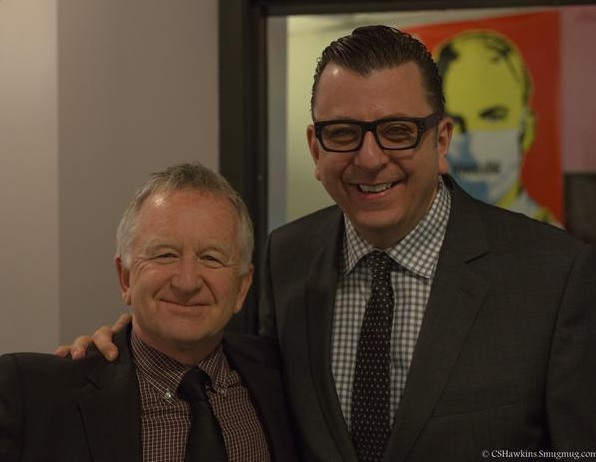
“Festivals like this make people aware there are things other than superhero and comic book movies,” said Richard Crouse, CTV’s Canada AM film critic, back for his fifth time.
“Hollywood is only in the business of giving people what they want, so every time you buy a ticket to Guardians of the Galaxy after seeing it 25 times you’re tacitly saying ‘This is all I want to go and see.’ What you need to do is support smaller, more interesting films, particularly if you’re ever going to complain that Hollywood’s all out of ideas.”
Before Crouse interviewed James and Mark McKinney onstage last weekend, he did the extensive research he’s known for.
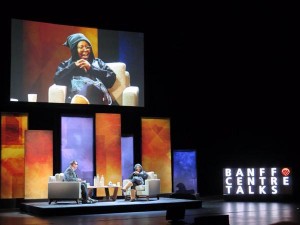
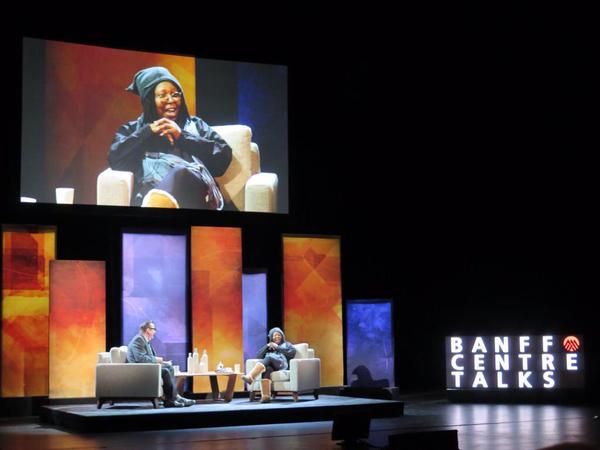
“By the time I get onstage I’ll know more about Whoopi Goldberg than Whoopi Goldberg does,” said Crouse, who’s reading books and watching her movies before interviewing the actress and comedian at the Banff Centre next weekend.
On Saturday February 21 Richard hosted an Edwards Family Legendary Leaders Event at The Banff Centre’s Eric Harvie Theatre with Whoopi Goldberg. She is one of a very elite group of artists who have won the Grammy (“Whoopi Goldberg,” 1985), the Academy Award (“Ghost,” 1991), the Golden Globe (“The Color Purple,” 1985 and “Ghost,” 1991), the Emmy (as host of AMC’s “Beyond Tara: The Extraordinary Life of Hattie McDaniel,” 2002 and a Daytime Emmy for “The View” in 2009) and a Tony (Producer of “Thoroughly Modern Millie,” 2002). She is equally well-known for her humanitarian efforts on behalf of children, the homeless, human rights, education, substance abuse and the battle against AIDS, as well as many other causes and charities. Among her many charitable activities, Whoopi is a Goodwill Ambassador to the United Nations.
The lively conversation lasted for 90 minutes and covered everything from Goldberg’s early life to finding success on stage with The Spook Show to Hollywood to getting an ill-advised Brazilian wax.
The first time around “Hot Tub Time Machine” stars John Cusack, Rob Corddry, Craig Robinson and Clark Duke, grappled with the mysteries of the Red Bull-fuelled space and time continuum as they tripped back in time to the Regan years.
Since we’ve seen them last they (minus Cusack, who is replaced by Adam Scott) have exploited “their knowledge of the future for personal gain.” What they did in the past changed their futures and Nick (Robinson) is now a popular songwriter—he “wrote” “MMMBop” and “Feelin’ Like Teen Spirit”—while Lou became the “father of the internet,” and the creator of the search engine Lougle. Adam’s (Cusack) absence is explained away with a passing reference to an “experiential journey.”
They are rich beyond belief—“That hot tub really turned it all around.”—but soon discover the future isn’t exactly the way their remembered it—wrap your head around that—when Lou takes a bullet from an unknown assassin and Nick and Jacob fire up the hot tub to try and stop the shooting before it happens. They inadvertently end up in the future in a world they don’t quite understand. “Who is to say the past isn’t this present.”
“Hot Tub Time Machine 2” feels like it was written by a group of frat boys in the throws of a raging kegger at the Delta Tau Chi House after a “Bill and Ted’s Excellent Adventure” marathon. All the animal house trademarks are here—vomit gags, jokes about sex with animals, a drug trip, testicle terror and homophobic razzing. The only thing missing is Seth Rogen and boy, did he miss a bullet.
Working from a script that feels improvised, the usually funny guys Corddry, Robinson, Duke and Scott are at sea in a movie that abandons the story—the search for the shooter is side tracked for twenty or more minutes while the guys flit through time—in favour of raunchy jokes and random situations. As the cast tries in vain to find the funny you hope that the next trip in the Hot Tub Time Machine will be their last.
“Hot Tub Time Machine 2” is a waste of time—past and present.
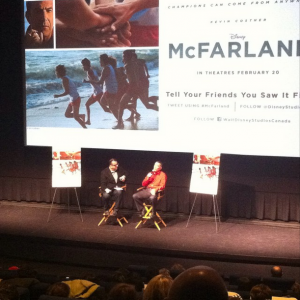
“McFarland” is based on the life of Jim White, a hothead football coach who worked his way down from good paying jobs at big schools to taking an assistant coach position in McFarland, California, one of the poorest towns in America.
When we first see White (Kevin Costner) he’s hurling a cleated shoe at the lippy captain of his football team. He opens the kid’s cheek and loses his job. It’s a recurring pattern for the temperamental teacher, and the thing that lands him in McFarland. He and his family are fish-out-of-water in this mainly Latino town where jobs as “pickers” in the local fruit and vegetable fields are valued over athletic or academic achievement.
White soon notices that several of his students have a remarkable ability; they can run like the wind and strengthened by years of picking, have great physical strength and endurance. He puts together the school’s first ever cross-country track team and after a rocky start—placing last in their first meet—and not so hidden racism from other teams—“Bet they can’t run without a cop behind them and a Taco Bell in front of them.”—White teaches the seven runners how to be champions while they teach him a thing or two about dedication, loyalty and family.
There’s nothing in “McFarland” we haven’t seen in a hundred other sports movies. The underdog-pulling-themselves-up-by-the-bootstraps may be a potent source of drama but it is a familiar one, so it’s hard to get too excited about “McFarland’s” story arc, even if it is tarted up with American Dream messaging about the virtues of heart and hard work. It’s not just a sports movie, it’s an ode to what it is to be American—family + heart = success! They even sing the “Star Spangled Banner” at one point.
“McFarland” is a standard issue inspiration coach movie. White—or “Blanco” as his students call him, inspires the runners but, in a twist, they inspire him to let go of his preconceptions about success and family. On one hand the lack of cynicism is refreshing but it feels a bit old fashioned, like an afterschool special with a bigger budget.
According to the movies high school is made up of a few, very specific characters. There’s the good-looking jock whose life isn’t nearly as rosy off field as it is on. The standard issue mean girl with an attitude and feathered hair, the supportive best friends and the outsider who discovers they’re more of an insider than they ever could have imagined.
Based on the book by Kody Keplinger, “The Duff” mixes and matches these stereotypes, shaking things up just enough to keep things interesting… at least until recess.
“Parenthood’s” Mae Whitman is Bianca, a senior whose idea of a good time is taking in a horror movie marathon and hanging with BFFs Jess and Casey (Skyler Samuels & Bianca Santos). Her happy life is turned upside down, though, when the best looking guy in school, Wes (Robbie Amell), informs her that she is a DUFF, the Designated Ugly Fat Friend. As the gatekeeper to her prettier friends she is the approachable one who boys befriend to get closer to Jess and Casey. The news drives a wedge in her friendship with the girls, forcing her to turn to Wes to reverse-DUFF her. In her mom’s (Allison Janney) words when she gets proactive her problems get subtractive. Wes builds her confidence and soon a date with the boy of her dreams (Nick Eversman) teaches her an important lesson about the place of DUFFs in the world.
“The Duff” is a typical teen comedy, sprinkled with some funny lines—when the school institutes a cell phone ban one student complains, “I just thought of something funny and now no one will know!”—the usual examination of the all-important school social hierarchy and for the first half of the running time it works well in a low-to-no expectations kind of way.
Elevating “The Duff” from a C- to a B is Mae Whitman. Funny and charismatic she has a Bette Midler-esque way with a joke and enough pathos to make you care about her teenage crush. She delivers the movie’s best lines and, not surprisingly, has the best delivery of anyone in the film. Hopefully next time out she’ll graduate from high school shenanigans to more grown-up material.
“The Duff” is “Mean Girls Lite,” a school comedy so predictable the screenwriters should be sent to the principal’s office but with a central performance worth skipping last period for.
The name Tommy Tedesco is likely unfamiliar to you, but if you have played air guitar sometime in the last fifty years, chances are you have mimed to at least one of his guitar licks.
Tedesco was one of the guitar players of an unofficial group of musicians known as the Wrecking Crew, the session band who played on records by everyone from the Byrds to Cher and Nancy and Frank Sinatra to the Beach Boys, the Monkees, and Captain and Tennille.
In “Wrecking Crew” Tedesco’s son, filmmaker Denny Tedesco, has brought together many of the anonymous west coast players who provided much of the back beat of the 1960s and 70s.
It’s a personal project for Denny who spends a great deal of time reminiscing about his dad. We learn about how his father became the most recorded guitar player in history, some personal and studio stories and there is even a clip of Tommy on “The Gong Show,” wearing a pink tutu singing his satirical song “Requiem For A Studio Guitar Player.” “I used to be number one / Did all the work in this town / In the Fifties I was something / In the Sixties I was king / Now the Seventies come around and I will do anything…” It’s a funny moment that really speaks to the big picture story of The Wrecking Crew. They were the kings and queens of the Los Angeles music scene, hitmakers who worked round the clock and became millionaires until the work dried up as the singer-songwriter phase of the 1970s took hold.
Tedesco doesn’t focus on the post 70s careers of the players. Light and breezy, “Wrecking Crew” is as frothy as the music it details but he does mine some interesting biographical details about musicians like Hal Blaine, the genius drummer who went from millionaire to security guitar to working musician again, Carol Kaye, the lone female member of the band and Earl Palmer, a jazz drummer who played with everyone from Count Basie to Little Richard.
“Wrecking Crew” is a heartfelt and interesting peak into an unexplored part of our collective musical history and it has a good beat and you can dance to it.
For Canadian actor Robbie Amell his latest starring role was all about chemistry. To make sure he had the kind of spark needed to play opposite potential The DUFF co-star Mae Whitman he not only had to audition, he then had to try out again at a “chemistry read.”
“They narrowed it down to a few guys,” says the youthful looking twenty-seven year old. “They had signed Mae and they brought us in one after the other. Before I went in my best friend Nick, who’s very funny, and I sat down and figured out some alternate lines. I thought I’d have a shot at this if I could make her laugh.”
Preparation aside, he says for Whitman, fresh off a stint on Parenthood, it wasn’t love at first sight.
“Mae didn’t want to drive in for the chemistry read,” he says. “She was already sour and she said she was not excited. I walk in and she said, ‘Screw this guy.’ But I dropped some really rude improv line on her and she totally busted out laughing. I think that was the turning point.”
Then it was a waiting game. “My chemistry read was at 11 on a Friday morning,” he says, “which means there is nothing else I am thinking about for the next couple of days. It slowly started to disappear and it got to a point where I thought, ‘If I’m the guy, great. If I’m not the guy, I’m not. I just want to know.’”
Two weeks later he had the part of Wes, the best looking guy in Bianca’s (Whitman) school, who informs her that she is a DUFF, the Designated Ugly Fat Friend. He tells her she is the gatekeeper; the approachable one boys befriend to get closer to her prettier friends.
The all-important high school social hierarchy is the backbone of the story. Bianca and Wes are at opposite ends of the ecosystem, but Amell explains, “the movie is about knocking down these labels, embracing what makes you, you.”
Amell, who in real life graduated from Toronto’s Lawrence Park Collegiate Institute in 2006, says his school experience was very different than the one depicted in the movie.
“I didn’t have great skin in high school so that was kind of my DUFF moment but I always joke around that I grew up in Canada and everyone is polite so no one would call anyone the DUFF.
“I went to high school not that long ago but not every kid had a camera in their hand. Now everything is so documented you can’t get away with anything. It sucks. I don’t know if I could be an actor if there were camera phones when I went to high school. Everybody makes mistakes and you should be allowed to make a few without them being documented in HD.”
Jim and Cheryl White have seen the movie McFarland three times and teared up every at every viewing, even though, he says, “we knew what was going to happen.”
The film, which stars Kevin Costner as the most successful Californian high school cross-country coach in history, is the story of White, his wife and their life and work in McFarland, California, an impoverished town transformed by sports.
The Texas native taught in McFarland for forty years, establishing a cross-country running team that would win nine state championships and give the runners a glimpse of life outside their small town and nearby fields where many of them worked as migrant “pickers.”
His success may have earned him a Hollywood biopic and a more permanent tribute in the form of a dedicated gazebo in the town square but he sees his influence in more metaphysical terms.
“To me my legacy is in the hearts and minds of these boys I’ve taught.”
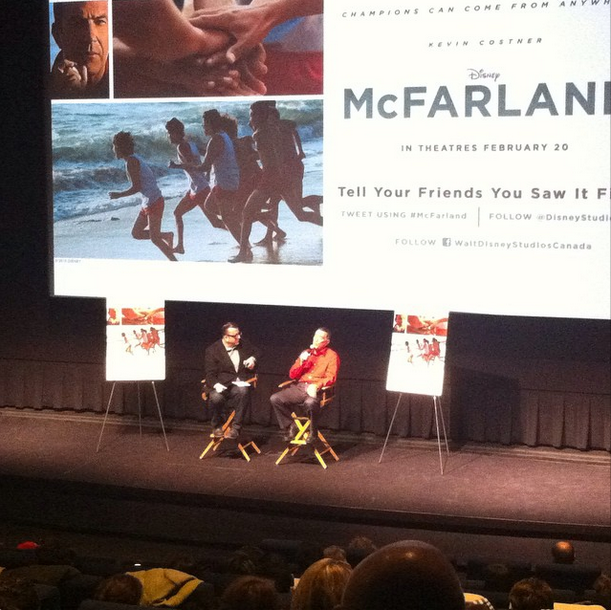
In person White is a humble man who quietly commands respect. At a post screening Q&A I hosted with him in Toronto he earned a standing ovation before even saying a word. As the audience clapped he was genuinely moved, and with a quivering voice whispered to me to, “take over for a second.”
Earlier in the day we discussed seeing his life played out on the big screen. “We just hoped they could portray our true feelings of love for the town; for the community. That came across real well. We also felt like they portrayed the true hardships these boys went through.”
Hollywood did make some changes to White’s story and one scene in particular irked him. When we first see White in the film he’s hurling a cleated shoe at the lippy captain of his Idaho school football team, opening the kid’s cheek.
“That is dramatic licence,” he says. “It bothered me for a while but I talked to Kevin Costner about it. I said, ‘Kevin, can you give me your true feelings about the situation that happened in Idaho?’ He said, ‘I think, Jim, you’re going to come across as the hero and not the villain because you’re standing up for what’s right.’ I said, ‘All right and I was satisfied with that.’”
White often uses the phrase “well, that’s Hollywood for you,” when describing the making of the film and the liberties taken with his life’s story but now that the movie is finished he says, “What was really fascinating to both us was watching the screen and seeing them say, ‘Mr. White would you come in here…’ Jim White this, and Cheryl White that. We’re sitting there looking at ourselves up there. It was kind of funny.”
Anna Kendrick is perhaps best known for her break out role as the ambitious Human Resources person in Up in the Air who suggests conducting layoffs via videoconferencing to save money. Her performance opposite George Clooney created a stir at the 2009 Toronto International Film Festival, and now she’s back at TIFF with a much different movie.
The Last Five Years is a musical based on Jason Robert Brown’s Off-Broadway hit of same name. It’s the story of the five-year relationship between actress Cathy and her novelist husband Jamie, played by Smash star Jeremy Jordan. It’s told from two different perspectives. Her storyline begins with the breakdown of the relationship. His starts at the beginning (it’s a very good place to start, as they say in musical theatre) as they court and eventually marry.
Kendrick, last sang on screen in Pitch Perfect and will soon be seen as Cinderella in the much anticipated movie version of Into the Woods, says the decision to sing live in front of the cameras, instead of prerecording in studio, aided her performance of the complex role.
“Doing it live was something we wanted to do whenever possible,” she says. “We didn’t want to make a point of it or be precious about it because it was equally important for us to be visually dynamic and change locations and be outside occasionally. I thought I would feel that the pre-recorded days would be a breeze, but it was so much easier to act the songs live because you weren’t retroactively going, ‘Oh yeah, that’s how I was playing that in the recording booth four weeks ago.’ So doing it live was a physical challenge, because, you know, it’s your voice, but it was so much easier to be present and honest and all that with singing live.”
Kendrick plays a struggling actress and in one memorable scene details the pain of auditioning for roles. In the Climbing Uphill sequence she sings, “I’m up ev’ry morning at six, And standing in line, With two hundred girls who are younger and thinner than me.” It;’s a feeling Kendrick says she knows well.
“It’s a competitive business by nature,” she says. “I know that room and that line of two hundred girls. I didn’t have to dig all that deep to know the anxiety and self-doubt. That was a fun thing to perform and see inside her head and talk about the indignity of not being paid attention to when you are trying to perform for somebody.”
Even though she is a Tony nominee for her work on Broadway in High Society and has starred in high profile films like Twilight and Scott Pilgrim vs. the World she says she still auditions.
“If there is something really incredible everybody wants it so I audition,” she says. I see friends of mine and we’re all in business suits and then at the next one we’re all in leather jackets. I’m like, ‘Yeah, this is so embarrassing.’ But that is the grind.”
 Read Michael D. Reid’s Times – Colonist wrap of The Victoria Film Festival HERE!