Like “All the President’s Men,” the new Michael Keaton drama is a story about newspaper reporters taking on the establishment. Instead of going after the highest office in the land, as Woodward and Bernstein did in their Watergate exposé, in “Spotlight” Keaton, Mark Ruffalo and Rachel McAdams play Boston Globe reporters delving into the Catholic Church’s cover-up of abusive priests.
Following a buyout the Boston Globe has a new editor, Marty Baron (Liev Schreiber), who assigns the investigative Spotlight bureau to look into a delicate subject, a priest accused of molesting 80 kids. It’s a hot button story in the city of 1500 priests, where 53% of Globe subscribers are Catholic. The plan is to examine sealed documents, which requires legal action. The Bostonians view it as suing the church, a sacrilege in their city, whereas the outsider Baron sees it as simply making sealed documents public.
As the investigation plods along—“ The church thinks in centuries,” says lawyer Mitchell Garabedian (Stanley Tucci), “does your paper have the resources to take that on?”—the story becomes much larger than originally thought, uncovering a far reaching conspiracy that includes not only the church but lawyers and possibly newspapermen as well.
“Spotlight” is set just fourteen years ago, but feels of another age. The internet has, by and large, rendered this kind of methodical reporting obsolete. The door knocking, working-the-phones investigation with months to form and write stories is now the kind of thing that exists only in the movies. We see it all here in detail and much of it is very interesting. The reporter’s investigation allows for huge loads of exposition in the form of interviews with witnesses and victims and exports and while there’s a bit too much, “Are you telling me..?” the slow and steady unveiling of details is compelling stuff.
Director and co-writer Tom McCarthy keeps it simple and straightforward, allowing the occasional “gotcha!” revelations speak for themselves. Clues and information are uncovered slowly, with a minimum of red herrings. The result is portrait of the kind of grunt work the Spotlight team used to break the story, not nearly as flashy or verbose as Aaron Sorkin’s overwritten and over sentimentalized look at news gathering, “The Newsroom.”
Keaton has dialled it down a few notches from his recent turn in “Birdman” while Ruffalo kicks out the jams, all jittery energy and Hulk-like anger.
“Spotlight” is a refreshingly barebones movie that allows the story to provide the fireworks.
When the first “Avengers” movie with the Hulk came out I asked Mark Ruffalo how tied he was to the franchise. He said he was signed on for a half dozens more films, but also understood the power of the kind of celebrity that comes from starring in blockbuster movies. That power trickles down and makes it possible to more easily raise money for smaller more interesting (my words, not his) projects.
“Infinitely Polar Bear” is one of those movies. Ruffalo stars in and is executive producer of this low budget indie film about Cameron, a manic-depressive man’s efforts to win back the affections of his wife Maggie (Zoe Saldana) and reunite his family.
Based on the real-life childhood experiences of writer-director Maya Forbes, the film shows, in heartbreaking and carefully observed detail, Cameron’s attempts to cope as he raises the couple’s two daughters (Imogene Wolodarsky and Ashley Aufderheide) while Maggie studies in New York.
Forbes has crafted a heartfelt and honest portrait of a loving man struggling to get by day-to-day. Ruffalo and Saldana hand in engaging, nuanced performances. They have chemistry to burn and their affection for one another pours off the screen. Both are from the Marvel Universe and both are using their stardom for good here, but it is Wolodarsky and Aufderheide as the daughters who give the movie its beating heart. Lovely, naturalistic performances ground the movie and prevent it from becoming simply a feel-good dramedy.
“Infinitely Polar Bear” might have had more depth if it spent less time on Cameron’s highest highs and more on his despair, but it’s agile enough to present a fully formed portrait not just of a manic depressive man but of a group of people trying to be a family.
This time around The Hulk used his superpowers for good.
It’s not a spoiler to let you know the Avengers save the world in The Age of Ultron. The spectacular six have rescued the planet before and, no doubt, will save it again in future. In superhero movies the globe is always on the eve of destruction.
The original movie, 2012’s The Avengers, saw the team protect the planet from Thor’s evil brother Loki while in Superman II the Man of Steel battles three Kryptonian criminals set to obliterate our orb. A baddie named M tries to wage world war in The League Of Extraordinary Gentlemen and recently the Fantastic Four prevented a giant cosmic entity called Galactus from gobbling up the earth.
“I see a suit of armour around the world,” says Tony Stark in Age of Ultron. “Peace in our time, imagine that.”
The movies get bigger every time out and with thirty more superhero flicks scheduled for the five years—including Deadpool, Doctor Strange and Gambit—the mind reels at the ways villains might endanger our world. It sounds entertaining but haven’t we’ve already been there? Where do you go from the threat of total annihilation?
Diminishing returns in terms of audience reaction, that’s where. We all know The Avengers will pull out all the stops to save the earth. Buildings will crumble, trucks will go airborne and giant cracks will appear where city streets used to be but by the end credits you know everyone will emerge relatively unscathed, with the bad people vanquished and the good guys grinning from ear to ear. Viewers are left with CGI fatigue, but dammit a catastrophe was averted. Again.
But we’ve been there, done that. Why not freshen things up and turn back the hands of the doomsday clock a few minutes to create tension in the form of different kinds of situations? It sounds counter intuitive—bigger is always better, right?— but imagine Captain America going mano a mano with Kim Jong-un or Iron Man shrinking down to the size of a microbe to battle cancer from the inside à la Fantastic Voyage.
The real world is a very complicated place. Every day the news delivers more bad information than all the tragedies of Aeschylus and Sophocles combined. Stories of beheadings, terrorism and all manner of terrible behaviour flood the airwaves aching to be corrected by some sort of superhero. How great would it be to see warrior princess of the Amazons Wonder Woman unleash the Lasso of Truth on the Canadian Senate or weather maven Storm get all medieval on climate change?
An injection of real world issues might not make for big box office, but it certainly would infuse the movies with a sense of unpredictability—just like real life events. Real life is messy and volatile and that’s what keeps it interesting.
I understand one of the reasons we go to movies like The Avengers: Age of Ultron is to see things we’ll never witness in real life, but it’s hard not to agree with Hawkeye (Jeremy Renner) when he says, “We’re fighting an army of robots and I have a bow and arrow—it makes no sense!” These movies try to dazzle our eyes—and they do!— but bringing them down to earth, literally, might help us engage our brains as well.
“Can we hold them?” asks evil scientist Baron Wolfgang von Strucker (Thomas Kretschmann) as a team of superheroes tear up his supposedly impenetrable HYDRA lair.
“They’re the Avengers,” comes the reply. The only thing missing is the “Duh!” at the beginning of the sentence.
Not only does the exchange answer the question of every film producer who has a movie opening opposite “Avengers: Age of Ultron” this weekend but it also sets a loose, funny tone for the film.
Twenty seconds into the movie we’re already engaged in a wild action scene that puts them in possession of an ancient gem containing artificial intelligence. Tony Stark (Robert Downey Jr.) and Bruce Banner (Mark Ruffalo) intend to use the technology to build a peacekeeping army—“I see a suit of armour around the world,” says Stark. “Peace in our time, imagine that.”—but the plan backfires and instead of creating a global peace initiative they create a robot monster named Ultron (voice of James Spader). “I really miss the days when the weirdest thing science created was me,” says Captain America (Chris Evans). Hell-bent on improving the world by exterminating humanity, Ultron says, “When the dust settles the only things left will be metal.”
Cue the metalocalypse.
While many superhero movies have chosen a dark road—think Christopher Nolan’s ennui ridden “Batman” movies or the dour looking “Batman v Superman: Dawn of Justice”—director Joss Whedon delivers action with a grin. There’s always time for a quip in “Age of Ultron.” The wisecracks are the glue that hold the film together, acting as a bridge between the battle scenes.
Stark is his old cocky self with none of the insecurity of the emo “Iron Man 3” in sight. Gone is the introspection of “Winter Solider.” Sure, Banner is still tormented by his Hulk alter ego—but let’s be honest, if you take away his torment, you take away his character—but nonetheless finds time to do a faceplant into Scarlett Johansson’s chest and Black Widow (Johansson) shows more of her feminine side than ever before, but the film is less interested in the characters than how carnage the characters can cause.
There are action scenes galore. If all you want are trucks flying through the air, buildings crumbling and Iron Man assembling and disassembling, look no further. It’s a smorgasbord of skirmishes, a constant barrage of action scenes, many of which appear in a blur, just glints of metal and flashes of colour. These sequences are stuffed to bursting with an overload of CGI that becomes less interesting the more you watch.
One of the reasons we go to the movies like “Avengers: Age of Ultron” is to see things we’ll never see in real life, but it’s hard not to agree with Hawkeye (Jeremy Renner) when he says, “We’re fighting an army of robots and I have a bow and arrow—it makes no sense!” Whedon has tried to dazzle our eyes—and he does!— but has forgotten about engaging our brains.
“I think I can comfortably say we were all very happy when the movie was over,” says Channing Tatum of making the crime drama Foxcatcher.
Based on a true story, the movie begins with former Olympian Mark Schultz, played by Tatum, training to regain the glory of his past achievements. When he accepts multi-millionaire John du Pont’s (Steve Carell) offer of sponsorship he begins a journey that will end in world championship glory and murder.
Director Bennett Miller wanted Foxcatcher to be the follow-up to his Oscar winning biopic Capote. When he first approached Tatum to play Schultz the muscle bound actor was best known as the eye candy in teen comedies like She’s the Man and dance movies like Step Up.
“I think the first time I read the script I just didn’t understand why you’d want to make the film,” he says. “There’s no resolve to any of this. No lesson learned. It’s way more complicated than that. It’s actually more close to life. It is a portrait of something that happened. I don’t think I was anywhere near to understanding the story or the character. I think I did a lot of growing in those seven years. I fell in love with this idea of attempting this.”
The actor threw himself into the role, studying wrestling, which he says is impossible to fake on screen—“It is just a melee but you get used to being inside that melee.”—and even destroying a hotel room in one powerful scene.
“I told them, ‘Whatever is in that room probably won’t come out not broken.’ That is all from Mark Schultz. He told me he would punish himself so badly after losing that he would make losing so much worse than any physical pain he was going through in the match so he would never want to lose again.”
He kept up that level of intensity for the whole shoot. “It just never stopped,” he said, not even when his wife, actress Jenna Dewan, came to visit.
“My wife was pregnant and she came to Pittsburgh during [the shoot],” he says. “She was supposed to stay a week but left after the second day. She was like, ‘Nope. It is not healthy for me to be here. You’re in a weird place. It’s OK but I’m just going to go now. Love you! Call me at least once a night before you go to bed and we’ll be fine.’”
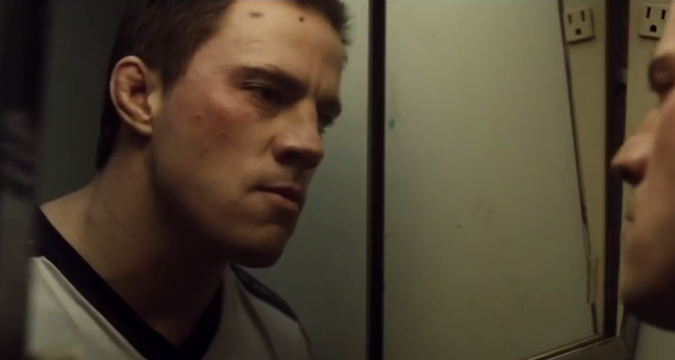
If nothing g else “Foxcatcher,” a true-life crime drama from Bennett Miller, director of “Moneyball,” is an exercise in the transformative nature of an under bite. Jutting out his jaw changes Channing Tatum from movie star handsome to thick-necked gym rat Mark Schultz, one third of a story of murder and America’s wealthiest family.
Based on true events, the story begins with Schultz, a gold medal-winning wrestler at the 1984 Olympics, training with his brother David (Mark Ruffalo) to regain the glory of his past achievements. Out of the blue he is contacted by John du Pont (Steve Carell), multi-millionaire and sports enthusiast with a simple but grand offer. The patriotic du Pont asks Schultz to put together a team of wrestlers, who would train at a special facility at Foxcatcher Farms and establish America’s dominance at the upcoming Seoul Olympics. Schultz signs for $25,000 a year–“I just said the highest number in my head.”—beginning a journey that will end in world championship glory and murder.
Even though this is a true story that more or less follows the public record of events I’ve left the synopsis vague so as not to spoil the film’s climax. In doing so I also failed to mention the growing sense of alienation and the slow burn of psychological dysfunction. A pall hangs over the entire film, building toward the culmination of the action that is shocking not only in its randomness, but in its volume. Miller has made a quiet, restrained film, one that demands the viewer to lean forward to appreciate, so when three loud gunshots ring out they shatter the quiet in a jarringly effective depiction of violence.
But for as effective as that scene is, the build-up is demands patience. The leads are uniformly great—particularly Carell who, as a repressed man used to getting what he wants and winning, whether it is a world championship title or play wrestling at a party, hands in a career re-defining performance—but the studied precision of the direction bogs down the pacing. If Miller edited the VERY long pauses in the conversations between Mark and John he could have trimmed half-an-hour from the running time. Some will find the start-and-stop delivery adds to the film’s surreal feel, other will simply find it tedious.
“Foxcatcher” is buoyed by interesting, unexpected performances and an unnerving tone but adds little to the examination of the complex issues that lie at the center of the story. Unchecked privilege and moral decadence are on display but the underlying pathology of the piece remains a mystery.
Near the end of “Begin Again,” the new musical romance from “Once” director John Carney, record producer Dan (Mark Ruffalo) instructs a guitar player, who is also his daughter (Hailee Steinfeld), to “keep it simple.” It seems director Carney took the advice as well, using the KISS principle—Keep It Simple Stupid—in the telling of this uncluttered story of redemption and pop songs.
When we first meet Dan he’s having a bad day. His estranged daughter is mouthing off to him, he gets fired from the label he helped create and even his car breaks down. The day—by this time it’s night, actually—improves when he stumbles into a bar to drink his blues away and hears Gretta (Keira Knightley) singing a sad song from the stage. In his mind’s eye he hears a hit, a song that could make her a star and give him another shot at relevancy.
Before he can begin again, however, he must help Gretta get over her ex-boyfriend, up-and-coming rock star Dave Kohl (Adam Levine)—he’s the kind of guy whose voicemail says, “It’s Dave. I’m probably doing something awesome so I won’t get back to you… ever.”—and her distrust of the trappings of fame.
“Begin Again” is as much about the love of music and it’s ability to heal as it is about the various relationships it essays. Carney is covering familiar ground here. His film “Once” breathed the same air, but it’s rarefied air, and he pulls it off with panache.
For instance, Gretta and Dan bond over a shared iPod filled with their favorite songs. Taken by the music they have a “we have to dance right now” moment, but it’s done with a twist when they go to a club and dance to their own music courtesy of their iPod earphones while everyone around them literally dances to the beat of a different drummer.
Ruffalo brings considerable passion to the role of Dan, an “I’ve-been-down-so-long it’s-looking-up-to-me” kind of guy. He’s a walking cliché, a record man who got eaten up by the business and a rough personal life, but Ruffalo gives him a soulfulness that’s very winning.
Knightley looks like an undiscovered indie darling, bringing a delicate but steely sensibility to her performance and the songs that help tell the story.
“The Voice” alum Levine and CeeLo Green (as a successful musician who owes Dan a favor or two) lend some music industry cred to their roles, but the heavy lifting, acting wise, is done by Ruffalo and Knightley.
“Begin Again” is a self contained story with a beginning, middle and satisfying end, but sets itself up for a sequel in the subtlest of ways. Dan comes up with the usual idea of recording Gretta’s album outdoors to get a real taste of New York in the grooves. After successfully setting up under the Brooklyn Bridge and in Central Park, Gretta suggests they could expand their horizons and make records on the streets of several other European cities. I’m not sure if that’s enough to build a franchise around, but I’d sure like to spend some more time with these characters.
The people at the center of “The Kids Are All Right” are Nic (Annette Benning) and Jules (Julianne Moore), a long time lesbian couple raising their two kids, Joni (Mia Wasikowska) and Laser (Josh Hutcherson) in the suburbs of LA. The Moms are opposites—Nic is a perfectionist doctor, Jules a free spirit still searching for her way—but the family is happy. Happy, that is until Joni contacts her biological father via the sperm bank. Turns out donor dad is Paul (Mark Ruffalo), a SoCal restaurateur who had no idea his sperm bank contributions resulted in one child, let alone her brother Laser as well. Despite Jules and Nic’s trepidation the kids form a relationship with Paul, but his presence brings with it some unwanted consequences.
There is a scene near the end of “The Kids Are All Right” that sums up the feel of the whole film. At a dinner party Nic and Paul sing a Joni Mitchell song. The “performance” is joyful, ridiculous and poignant simultaneously and is a perfect microcosm of the script. Like real life, the ups and downs of this particular group of folks are unpredictable, sometimes funny, sometimes not. This well drawn cast of characters keeps the basic story afloat, adding richness and color to a story that could have been an average romantic comedy.
Bening and Moore are warm but complicated presences. The audience never doubts for a second that they’ve been a couple for twenty years, and their intimate moments, their testy moments, their funny moments and their heartbreaking moments are believable and dynamic because of the skill of these two actors.
As Joni Mia Wasikowska, such a flatline as Alice in “Tim Burton’s Alice in Wonderland,” shines here as the brainiac who is just coming into her own.
Also impressive is Mark Ruffalo as Paul, the interloping sperm donor. He’s a lonely guy in search of a family, and despite the trouble he causes—both wittingly and unwittingly—Ruffalo makes him charming and believable.
There’s that word again. Believable. Believability is the main strength of this film. The characters have a lived-in, realistic feel so even when the story falters the people in it don’t.
It’s a story that is both very specific and rather universal, all at the same time. Nic and Jules may have an nontraditional marriage but their story of parenting issues, mid-life crisis and long term commitment is as traditional—and crowd pleasing—as we’ve seen in a movie this year.
To fully enjoy “Now You See Me,” a new magical heist film starring Jessie Eisenberg and Woody Harrelson, it’s best to leave your sense of disbelief at the door. Or at home. Better yet wrap it in cellophane, lock it in a box and hide it under the bed.
Jesse Eisenberg, Isla Fisher, Woody Harrelson and Dave Franco play magicians collectively known as The Four Horsemen. Brought together by a mysterious benefactor, they make their debut in front of a sold out crowd at the MGM Grand in Las Vegas. In front of an enthusiastic crowd they perform a wild illusion that seemingly transports an audience member to a bank vault in Paris. Soon three million Euro are sucked out of the vault, only to reign down on the crowd in the Vegas theatre. This and other spectacular, but illegal illusions attract the attention of not only a magic debunker (Morgan Freeman) but the FBI (lead by Mark Ruffalo) and a French Interpol agent named Alma Vargas (Mélanie Laurent).
“Some things are best left unexplained,” says Alma. Yeah, like who plotted this mess.
“Now You See Me” is the silliest movie of the year. It’s fun and mostly entertaining, but with its talk of secret societies, “bringing magic back to the people” and leaps of logic, to call it far fetched is an understatement akin to saying Houdini is kinda tricky.
Filled with likable actors giving flamboyant performances it speeds by in a blur of swirling cameras and “tricks” that are like David Copperfield on steroids… and CGI. For a movie about bringing magic back to the people, it’s more about bring computer generated trickery to the big screen.
There is a wizard battle that would make Harry Potter envious but by the time our magical Robin Hoods–they don’t keep any of the stolen money for themselves– end their run with the sentiment “Even if we spend the next twenty years in jail it was worth it,” you’ll be wanting to make a disappearing act of your own.