“The Boy Next Door” is the kind of movie where when someone says, “You can trust me,” you know the opposite is true. The Jennifer Lopez thriller is a lesson in not trusting neighbors, no matter how good looking they are.
Lopez is Claire Peterson, a recently separated high school lecturer who teaches the classics and wears bubblegum pink lip-gloss. Her soon-to-be ex husband Garrett (John Corbet) is slowly trying to make things work, much to the chagrin of Claire’s best friend (Kristin Chenoweth) who can’t stand him, but to the delight of her son Kevin (Ian Nelson), who misses his dad. When the neighbor’s grandnephew Noah (Ryan Guzman), a surprisingly buff and mature looking nineteen-year-old, moves in he seems like a good role model for Kevin… at first.
He’s polite, can fix anything and takes Kevin under his muscly wing. Unfortunately he’s also in love—some might say obsessively so—with the comely Claire. One long weekend while Garrett and Kevin are on a fishing trip Claire, feeling lonely and a bit drunk, reluctantly allows Noah to seduce her. Apparently in “The Boy Next Door” no doesn’t mean no, it means “no judgment and no rules.”
The next day Claire is filled with regret but Noah is more smitten than ever. Thus begins his form of wooing, stalking her—“I’m not following you,” he says, “I live next door!”—and finagling a spot in her class. His pursuit of her heart escalates to include cut brake lines, dirty pictures and the inevitable moment when she puts an end to the relationship… permanently.
“The Boy Next Door” is as generic a thriller as the bland title suggests. There are unintentionally camp moments of soap opera melodrama but without the kind of trashy fun that would make this a so-bad-it’s-good thriller. Instead, it is simply a bad movie and you can trust me on that.
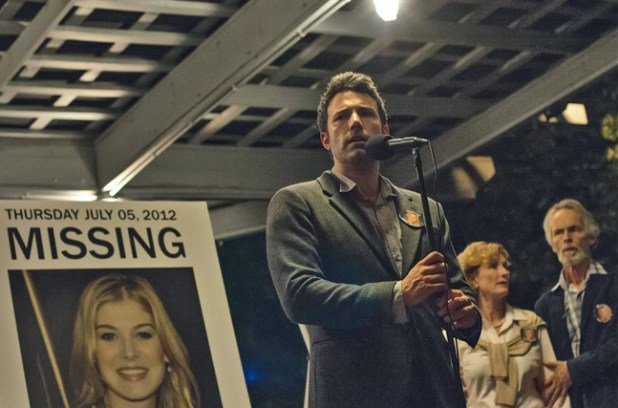
This weekend Ben Affleck returns to theatres as the star of the hotly anticipated Gone Girl, an adaptation of Gillian Flynn’s bestselling novel about a man whose life becomes a media circus when his wife (Rosamund Pike) disappears and he is the prime suspect.
It’s a welcome return for the star who once almost wore out his welcome on the big screen.
For a few years in the early 2000s, Affleck was the textbook definition of over-exposed. Between 2001 and 2004 he released a staggering 11 films, took a year off and dumped four more into theatres in 2006. Then (when the tabloids weren’t naming him Sexiest Man Alive, as People Magazine did in 2002), they were detailing the every move of the couple known as Bennifer, a mash-up of Ben and fiancée Jennifer Lopez’s high-wattage names.
You couldn’t go to a theatre, turn on a television or pick up a magazine without seeing his handsome face, and soon enough that ubiquity worked against him.
The Wall Street Journal did the math, reporting Affleck’s recognition factor jumped from 75 per cent to 82 per cent in 2003, but noted the percentage of folks who didn’t like him climbed from 12 per cent to 18 per cent.
In 2004 talent agent Patrick Whitesell told Los Angeles Times writer Kim Masters, “That kind of [media] coverage robs movie stars of their mystique.”
After that period of wild tabloid overexposure ruined his credibility with movie-goers and very nearly turned him into an industry in-joke, Affleck took some time for self reflection — “I was a little bit exhausted of myself,” he said — stopped saying ‘Yes!’ to every script that came his way and earned a second act.
In front of the camera — in movies like State of Play — and behind it, directing the critically acclaimed Gone Baby Gone, the man who had made four dozen movies since 1993 rebuilt his career, focusing on quality rather than quantity.
His next film saw him on both sides of the camera, directing, co-writing and starring in The Town, a crime drama that returned him to the scene of his first success, the Boston of Good Will Hunting. The Oscar-winning Argo followed and soon he’ll be seen as Batman in Batman v Superman: Dawn of Justice.
The days of overexposure have come and gone, and he survived to have a thriving career.
“Now I think I’m kind of seen as just sort of somebody in Hollywood who works,” he says.
Many critics have taken pot shots at movie Gigli. Not me. I think Gigli is an important movie. The kind of picture that should be studied at film schools as an example of what happens when well intentioned filmmakers go horribly, horribly off the rails.
Gigli (rhymes with “really”) is a train wreck all right, a movie so flawed it is hard not to poke fun at it. Rather than take the low road, (although I’m not sure I’ll be able to help myself), I thought I would have a look at why the movie is so deliciously awful.
Several pundits have proposed that the movie is taking such a drubbing in a hard-hearted reaction to Jennifer Lopez and her fiancée Ben Affleck’s newfound tabloid overexposure. I don’t agree. I wish them joy. I wish them a long marriage. I just wish they had made a good movie.
On Monday August 4 after the abysmal opening week-end tally had come in, Columbia spokesperson Steve Elzer announced, “We gave it our all, and it didn’t work. The filmmakers, the stars and the studio did everything we could to support this film.” No you didn’t Steve. You didn’t make a good movie. And that is what it boils down to.
So what’s wrong with Gigli?
Starting at the top we have Bennifer, known individually as J Lo and Ben Affleck. While the only awards that either of them are likely to win this year will be of the “Golden Raspberry” variety, both are competent actors. The kind of actor who has been helming Hollywood movies for decades, they are movie stars. For every Brando or DeNiro there are hundreds of others who job it is to simply look good and not bump into the furniture. Bennifer fits into this mold. In Gigli they look good, and seem to have their motor skills intact, but both seem in need of a Stella Adler refresher course.
Affleck, who shines when playing “Joe Average” roles, doesn’t bring any weight or believability to Larry Gigli. I didn’t buy him as a thug, and I certainly didn’t buy his accent which changed more often than his wardrobe.
J Lo doesn’t fare much better. As Ricki, a contract-killer lesbian with a suicidal girlfriend, she seems to be posing more than acting. It’s like watching one of her Glow ads come to life, only not as interesting.
Much of the blame here must rest directly on the shoulders of writer / director Martin Brest. The once solid director of films like Beverly Hills Cop and Midnight Run appears to be trying to test the endurance of his audience. Apparently anything he once knew about pacing or editing was thrown out the window sometime around the time he made Meet Joe Black. Mix the painful pacing with some ham fisted editing and you are left wondering if this film actually had a director. Gigli is easily half an hour too long, but feels much longer because of large dollops of repetitive dialogue and long “emotional” takes where it seems Lopez and Affleck are engaged in a staring contest. This might be a rare example of a film that could be radically shortened for DVD release and improved.
There isn’t much about Gigli that works. From the title that no one seems to be able to pronounce to the Archie Bunker-esque attitude regarding the mentally challenged and lesbians it is a failed exercise, and the only two people I could possibly imagine thoroughly enjoying it are the other media “it” couple Guy Ritchie and Madonna. Maybe now people will forget how appalling Swept Away was…
I have an early afternoon flight to Los Angeles and two good reasons to go there. Firstly, last weekend in Toronto it snowed. Wet, heavy, unpleasant snow. The weather in LA will be in the low 20s and as long as it doesn’t snow or hail I’ll be fine. Secondly—but of no less import—I’ll be interviewing Jane Fonda. That’s right… Barbarella. Catherine ‘Cat’ Ballou. Bree Daniel. Jane Harper. Do I need to mention the work-out videos? She is appearing in her first movie since Mikel Milken pled guilty to securities fraud, Bruce Willis still had hair and George Bush Senior was president.
Her last movie was 1990’s Stanley and Iris, the Martin Ritt film about an illiterate cook (Robert De Niro) at a company cafeteria tries for the attention of a newly widowed woman (Fonda). Soon after that movie tanked at the box office she announced that she was retiring from the screen and settling down with husband Ted Turner.
She told IMDB that she came out of retirement because she’s attracted by the idea of making a few more films to fund her charitable enterprise, the Georgia Campaign on Adolescent Pregnancy Prevention. She says, “I could use more money, I have to be honest. I’m 67, who knows what’s going to happen. I really believe in the work that I’m doing in Georgia with young girls and boys and you teach what you need to learn. I’m trying to help girls own their bodies, honour their bodies, respect themselves and help boys not be afraid of claiming their hearts… I want to be sure it keeps going after I go.”
I have just cracked her book, the newly minted autobiography My Life So Far and hope to glean as much info about her as I can on the five-and-a-half-hour flight. Of course, I know her movies, and how her mother’s suicide was kept from her—she found out about it when she read about it in a movie magazine—and that she suffered from bulimia from age 13 to age 37 but I’m hoping to get a little more insight for my interview on Saturday. I won’t have much time with her, but I like to feel prepared.
The book is much different than most celebrity biographies. She divides her life into three acts—writing about her childhood, first films, and marriage to French director Roger Vadim in act one; act two covers the emergence of her activism, the disastrous “Hanoi Jane” trip to North Vietnam, her career peaks and marriages to Tom Hayden and Ted Turner; in her third act, we learn of her philanthropic work and her plans for the future.
“I hope that other women might see something of their own experiences in what I have to say about how a girl can lose touch with herself, her body and have to struggle—hard—to get herself, her voice, back,” she writes in the book.
It’s an interesting book written by someone who has obviously spent some time coming to grips with the vagaries of her life. She writes movingly about her troubled relationship with her movie star father Henry, and is more emotionally open and honest than I expected from a book written by a movie star. There are some salacious details—her relationship with Vadim pushed her sexual boundaries—but his isn’t simply a tell-all book. It’s a conversationally written account of her life that doesn’t gloss over the bad or embarrassing stuff, and digs deep to help the reader understand what makes her tick.
I plough through ¾ of the book’s 584 pages of the book as we touch down at LAX. From there we make our way through the LA rush hour traffic—when is it not rush hour in this town—to the Four Seasons. I have just enough time to check-in and hang my clothes in the closet when it is time to board the bus that will take us to the screening of Monster-in-Law. The bus can’t leave until all the reporters are aboard—about twenty in all—and we get held up for half an hour by one genius who decides to dawdle.
The movie is at Grauman’s Chinese Theatre—an unusual version of a classical Chinese temple, complete with quasi-Chinese motifs and inverted dragon tails— on Hollywood Boulevard. We’re going to one of the smaller theatres next to the Kodac Theatre—where they hold the Academy Awards—but out in front we see a long line-up for the main theatre. There are over a hundred people and apparently they are waiting for the May 19th debut of Star Wars: Episode III— Revenge of the Sith. Most of the other Star Wars films have debuted there at the legendary theatre but this time 20th Century Fox has decided to open the film at the ArcLight, several blocks away. According to IMDB the fans who are braving the elements to be the first to see the film don’t believe the hype and are refusing to move. “This is Mecca for fans,” one said. “It’s been a tradition for decades.”
I have a line-waiting limit of five minutes, so I admire these stubborn—if maybe a little naïve—fans, but I also think they should move out of their parent’s basements, get jobs and stop dressing like Wookies.
Once inside we’re seated in the VIP balcony section. It’s nice, but I’ve been sitting in an airport lounge, a plane, then a cab and a bus for almost ten hours. I’m tired, and the chairs are almost too comfortable. My goal is too stay awake during the movie and not get seduced by the comfy chair that seems to be tenderly whispering in my ear, “Sleep… sleep in my peaceful arms, rest your head against my soft leather and you’ll feel better after the movie.” In my sleepy hallucination the chair’s voice sounds like Scarlett Johansson. I can feel my lids getting heavy but somehow I stay awake.
Monster-in-Law is pretty simple stuff. J-Lo—whoops, she doesn’t want to be called that anymore—plays Charlotte Honeywell, a free spirited young woman who meets the perfect man, a good looking doctor named Kevin (Alias’ Michael Vartan). After a whirlwind romance they decide to marry. His mother, Jane Fonda in an over-the-top comedic performance, however, has different ideas. For the next hour-and-a-half psychological warfare ensues, hair is pulled, faces slapped and crimes against fashion are committed. For a full review, tune into Reel to Real in May.
After the screening it’s back to the hotel for a Monster-in-Law themed poolside party. There is a giant wedding cake, appetisers and plenty of freeloading journalists soaking up as much free beer, wine and spirits as humanly possible.
I hear loads of gossip at the party. Typically the movie’s biggest star gets the biggest room on these junkets, but in this case you have a recent star verses a Hollywood legend. Who will get the larger suite? Apparently Jenny from the Block demanded and got the larger hotel room for her interviews. I guess Fonda didn’t need the extra room for her two Oscars, six Golden Globes, her Emmys, People’s Choice Awards or New York Film Critics Circle Awards. Perhaps the younger actress needed the extra space for her ego. Who knows?
I stay at the party until I can’t stand being around the juiced-up journalists anymore. It’s been a long day and I still have a hundred or so pages of the Fonda book to read.
SATURDAY, APRIL 9, 2005
As usual because of the time change I’m up pretty early. It doesn’t seem to matter what time I go to bed on the first night here, I’m always up with the sun in the morning. I have my usual Four Seasons breakfast—Heuvos Rancheros, a Jet Lag smoothie and a huge urn of tea.
I have a 3:15 flight this afternoon, so I should leave for the airport around 1:00. I’m scheduled to start at 9:30 so I should have lots of time. After breakfast I head upstairs to the hospitality suite to read over my notes and have more tea before I start. I only take two steps off the elevator before I am stopped by a security guard. He asks my name, and cross checks it with a list he has on a big official looking clipboard. He asks me spell, then re-spell my name, I point it out for him on the list and he nods. Apparently I will be allowed access to the fourteenth floor today. He hands me a glittery, bright pink wrist band which I’m told to wear at all times. It is my ID pass. I’m told that the security is there at the request of Ms. Lopez, who isn’t even scheduled to arrive until after I have left the building. As I walk away I hear others being given the bracelet to wear. “I can’t wear this,” I hear one complain, “I’m on camera!”
In the hospitality suite we’re watching a large flat screen television with clips from the film. I look closely to see if any of J-Lo’s co-stars in the movie were required to wear the pink security bracelets on set. I make a joke about Jane Fonda being required to wear the pink wristlet. The publicists do not smile. I have more tea and read the press notes.
There usually isn’t a whole lot of interest in press notes, just a bunch of generic, ‘Oh we loved working on this project…” quotes and some specs on the film. The Monster-in-Law notes are rather standard, but there are some unintentionally funny lines in there. Fonda thinks Lopez is “deeply talented,” while Lopez says Fonda is “the real thing.” So far nothing unusual. Press notes are usually filled with this kind of claptrap, but there is one line that made me laugh out loud.
The director’s notes are often the most fawning, but I never read anything like this before. Since their first meeting director Robert Luketic, apparently still can’t stop talking about J-Lo’s beauty and the way she smelled. The way she smelled. Not her great talent. Not her ability to light up a screen, but the way she smelled. It’s a shame he couldn’t have made the movie in Smell-O-Vision.
The interviews actually start on time. When I go down the hall to Jane Fonda’s room at 9:30 she’s already there, in make-up and ready to go. I’m her first interview of the day. I was told yesterday at the party that she was very easy to work with, and when she asked how many interviews she’d be doing today she was shocked to discover that she’d have to talk to 50 or more people. In her day, she said, they would only do ten or fifteen interviews a day.
She looks fabulous for 68. She looks fabulous for 58 or 48. Time has been kind to her. We sit and make small talk as they adjust the cameras. I tell her that I have read her book, and she wants to know what I thought about it. I give her a brief review (see above) and she seems to be very interested in how people are reacting to her work.
Once the cameras start to roll we turn the conversation to Monster-in-Law. Here’s a transcript of that conversation:
RICHARD: Congratulations on Monster in Law. In your book, you talk about being blinded by insecurities before stepping on set, and I’m thinking particularly of when you were making Klute and you actually even tried to convince Alan Pakula to fire you, or to replace you in the film because you just weren’t sure you could pull it off, and of course, history has shown us that you could. It’s been 15 years since you’ve made a movie, are there any of those feelings that bubbled up again before you walked on set for Monster in Law?
JANE FONDA: No, and I had a feeling that there wouldn’t be because I’m just so different than I was 15 years ago. When I decided to quit the business 15 years ago I was…It was agony for me. I felt very un-creative, very un-talented, I just didn’t want to be scared anymore, so…Now I thought, last year “You know, I’m so different. Let me see if I can have joy again in the process of making a movie,” and I did.
RICHARD: I wonder were you thinking—when you were on set and working on Monster in Law—were you thinking of some of the advice that maybe Katharine Hepburn had given you, because in your book you talk about her a great deal, and you talk about the difference between a movie legend and a movie star and how as a movie star, you felt that it was okay to have other jobs, whereas she just could not completely understand that.
JANE FONDA: Yeah, movie making has always been just a part of my life whereas for her, it was her whole life, and maybe that’s why she was a legend and I’m just a movie star—was a movie star. But are you asking that in reference to the character?
RICHARD: Yes…
JANE FONDA: Because the character that I play—I would be the monster… definitely somebody who like Katharine Hepburn, very self-conscious, very conscious of her image. I didn’t think so much about all that when I was trying to figure out how to play Viola you know, to tell you the truth, one of the things that helped me play Viola was my 10 years with Ted Turner, because he is also outrageous, over-the-top and at the same time lovable, and what makes someone like Ted lovable in spite of the outrageousness is that you sense underneath the pain that never entirely goes away, and the insecurity, and I think that that’s—I think that’s what I brought to Viola. She could have really been a monster, and certainly a lot of her behavior is despicable, but you always know of the pain of the pain underneath.
RICHARD: Well, I think once you recognize the core of humanity in a character, it doesn’t matter what they do, the audience will buy them if they can sense some insecurity, or if they can sense something that they can automatically relate to as a human trait.
JANE FONDA: Spoken like a true Canadian.
RICHARD: Exactly [laughter]. I met Ted Turner once, and I found that he filled the room and that was the thing that…It’s interesting that you said because Viola’s very much a room-filler. She’s a very big, very large commanding personality.
JANE FONDA: Yes and I think I might have been more scared to play her if I hadn’t gotten to know someone who filled the room as well as I got to know Ted.
RICHARD: Yes. Now, you talk in the film about how—in the book, rather—about how different emotions are sort of like muscle. I know how to flex the scared muscle; I know how to do this. You’re flexing the comedy muscle for the first time in a very long time. I mean it’s been a long since you’ve appeared in a film. It’s been since you’ve made a comedy. Tell me about that, because comedy’s tough…or can be, I think.
JANE FONDA: If I had to do this 15 years ago, it would have been really hard for me. Laughter comes much more easily to me now, so it was…I have a natural fondness for and proclivity to physical comedy, so I don’t know, it came real easy, it was a whole lot of fun. I love working with Wanda Sykes in particular. We had a lot of stuff together, and Jennifer is very good at physical stuff, she’s a dancer, she knows how to control herself, so it was very easy doing the physical stuff wither her.
RICHARD: Thank you so much. It’s been a pleasure to meet you.
I’m pleased with the interview. She actually seems like she thinks about each question and gives nice, well thought out answers. Later I’m talk to another reporter who says his interview didn’t go as well as mine. Apparently when he sat down across from her she was taking a sip of water. As he extended his hand to shake hers she spilled her water down her front and in her lap. It wasn’t his fault, and she wasn’t terribly troubled by it, but he felt the rhythm of the interview had been thrown off.
Next up for me is Michael Vartan. He’s been in a bunch of movies, but is best known as the co-star on Alias opposite Jennifer Gardner. He looks tired, and tells me that he was up until 4 am shooting the season finale of the action series. He is the male lead in the film, although he is quite comfortable admitting that it isn’t his movie. He is there to support the two female leads and look good while doing it. In that he succeeds.
From there I speak to Wanda Sykes, who plays Jane Fonda’s deadpan assistant in the film. She’s a stand-up comedian, who has appeared in everything form Crank Yankers to Curb Your Enthusiasm and her own short lived series called Wanda Does It. We talk about how her part seems so natural, like it was improvised. I ask her about performing comedy opposite Fonda, who earlier told me that doing comedy is “like riding a bicycle or having sex” you never forget how to do it. Wanda joked that if you read Fonda’s book you know how good she is at having sex, so she must be a pretty good comedian as well.
Last was director Robert Luketic. He is best known for directing light frothy comedies like Legally Blonde and Win a Date with Tad Hamilton. I refrain from asking him how J-Lo smells. Instead we talk about the challenge of directing a movie that blends so many different comedic styles—slapstick, deadpan, screwball and situational. For more on all these interviews, tune into Reel to Real in May.
That’s it. The interviews are done and it is only 10:30. I have a couple of hours to kill before I have to leave for the airport so I take a quick walk down to the Beverly Center, but some magazines for the flight home and generally soak up the sun. The flight home is uneventful. I run into Treed Murray and Foolproof director William Phillips who is travelling with his family. He offers me twenty bucks to sit with his three small children on the plane. I politely decline, even though they seem like lovely kids.
I arrive home late and check the newspapers that had piled up while I was gone. I see that it was almost as warm and sunny in Toronto as it had been in LA over the weekend. I guess for the next few months I won’t have to spend my weekends on the road to catch a few rays.
We are currently creating content for this section. In order to be able to keep up with our high standards of service, we need a little more time. Please stop by again. Thank you for your interest!
I’m sensing a trend. Last month “Think Like a Man,” an ensemble rom com based on Steve Harvey’s best selling book defied expectations and knocked “The Hunger Games” from the number one slot. This month “What to Expect When You’re Expecting” hits theatres hoping for the same kind of success.
Both are based on books, but that’s nothing new. What is new is that they are both based on self-help books. Hollywood has mined the genre before. “Everything You Always Wanted to Know About Sex* (*But Were Afraid to Ask)” and “Sex and the Single Girl” but it’s been years since the self-improvement aisle at the bookstore provided Hollywood with hits.
“What to Expect When You’re Expecting” follows several couples on their journey to the delivery room. Here’s the scorecard:
Couple Number One: Breast milk specialist Wendy (Elizabeth Banks) and husband Gary, (the dentist who does ‘Lil Wayne’s grillwork, played by Ben Falcone), have been trying for years to get pregnant but it doesn’t take until some hanky-panky after a screening of “Dirty Dancing.”
Couple Number Two: Gary’s dad, Ramsey (Dennis Quaid), an über competitive former race car driver is expecting twins with his trophy wife, the much younger practitioner of Pregerlates, Skylar (Brooklyn Decker).
Almost Couple Number Three: Marco (Chance Crawford), a chef who runs The Big Pig food truck (Slogan? “Have a porkgasm!”), makes bacon on a one-night stand with Rosie (Anna Kendrick) and must live with the consequences.
Couple Number Four: Photographer Holly (Jennifer Lopez) and boyfriend Alex (Rodrigo Santoro) adopt a child from Ethiopia.
Couple Number Five: Jules (Cameron Diaz), a reality show personal trainer and contestant on Celebrity Dance Factor has an affair with her dancing instructor Evan (Matthew Morrison) and gets morning sickness on the set of the show.
That’s a lot of characters, each representing a different aspect of pregnancy and the lead-up to childbirth. Add to that a Greek Chorus of dads (Thomas Lennon, Chris Rock and others) who provide comedic relief and advice like, “Babies can smell fear. Like bears and wives.”
I expect Cameron Diaz and JLo to pop up in this kind of rom com, but Anna Kendrick, who has chalked up great performances in “Up in the Air” and “50/50” has set the bar higher than this. Diaz does a twist on her often-used underwear dance and strips down to a frilly dance outfit to do her dance number but Kendrick seems to realize this material is beneath her and watching her drift through this material lessened my appreciation of the whole thing. Her scenes aren’t painful at all, she’s too good an actress for that, but my point is, she’s too good an actress to be in this.
As for its worth as a self-help movie, it does raise some questions—to circumcise or not to circumcise, that is the question—but for a movie based on an advise book it provides little in the way of helpful or useful information.
Aside from skirting around any real pregnancy advice, “What to Expect When You’re Expecting” is a comedy, although to be fair it is as funny as you might expect a comedy based on a self-help book to be. I might have enjoyed this movie more if I had been given an epidural first.
I’m trying my best to understand the romantic comedy. Since January I (and by extension, anyone else who went to the theatre and bought tickets) have been punished by a series of clichéd, hackneyed, tired, worn-out, stale, pedestrian, corny, banal, unoriginal… well, you get the idea… rom coms with titles like “Leap Year,” “When in Rome” and “The Bounty Hunter.” The latest one to come down the pike is “The Back Up Plan,” a movie that begs the question: When do romantic comedy traditions stop being funny, or romantic and become clichés?
Set in NYC (as all great rom coms are) but mostly shot in LA (I guess New York was busy that day) the Rom Com Script Generator ™ gives us Zoe, (Jennifer Lopez), a well-to-do, thirty-something pet store owner with a good apartment, a cute dog and a clothing budget that would bankrupt Ivanka Trump. What she doesn’t have is a child. With no husband or suitable boyfriend in the picture she turns to a fertility clinic but wouldn’t you know it, on the very day that sperm sample CRO104 becomes the baby daddy she meets the man of her dreams in the most NYC of ways—when he tries to scoop her cab. He’s Stan (Alex O’Loughlin) an eco friendly goat cheese vendor with a sculpted torso and a winning smile. She becomes his girlfriend and cheese muse, he becomes the de facto father to the child growing in her belly. They fall in love, fight, get back together again and rinse and repeat.
Structurally “The Back Up Plan” is so by-the-book it seems to transcend formula and almost work its way into heartfelt homage. By adhering so closely to the tried-and-true rom com playbook—unlikely couple meets, falls in love, breaks up and (SPOILER! but only if you’ve never seen a romantic comedy!) gets back to together—it becomes the latest entry in Hollywood’s ongoing exercise in seeing how many ways the same story can be slightly reshaped, recycled and recast before audiences revolt.
Not that “The Back Up Plan” is the worst of the crop. It may share a story skeleton with several other recent films, but nothing plumbs the depths of “Leap Year,” a film so bad even its star Matthew Goode has released a statement urging audiences not to see it. It’s even better than “The Bounty Hunter” but despite a few genuinely funny moments—a group for single mothers, or women without “penis partners” is a highpoint—it relies on the usual mix of slapstick and romance (often in the same scene) and does neither of them very convincingly.
It’s the kind of movie set in pregnant lady land where women are unable control their cravings and the Rom Com Script Generator ™ spits out dreaded exchanges like: “You’re not making any sense.” “No, all of a sudden everything makes sense.” It’s not that it’s bad exactly, it’s just that we’ve seen it all before.