A mix of fact and fiction, the real and the unreal, “The Last Vermeer” starring Guy Pearce and Claes Bang, now on VOD, is a cat-and-mouse game with a high-minded purpose.
Set just after World War II, the story involves Captain Joseph Piller (Claes Bang), a Jewish member of the Dutch Resistance who spent the war years working underground. Now, he works with the Allied reconstruction corps, following the money trail from big ticket art sales that may have funded espionage.
His investigation introduces him to artist Han van Meegeren (Guy Pearce), a painter and art dealer who admits making millions of dollars selling art to the Nazis. Of particular interest is “Christ and the Adulteress,” a Johannes Vermeer masterpiece he sold to Hermann Göring for 1.6 million guilder. “Which proves that pigs have good taste or too much money,” van Meegeren sxays.
The Netherland’s government see him as a war criminal. “He’s an honorary Nazi,” says one bureaucrats. “Let him swing with the rest of them.” But there’s a twist; van Meegeren claims the paintings were fakes, forgeries he painted to defraud the Nazis. “I believe every Fascist deserves to be swindled,” van Meegeren says. An ensuing court case puts not only van Meegeren on trial for collaborating with the enemy during war, but also the very idea of what makes good art great.
“The Last Vermeer” is a handsome, deliberately paced historical drama given life by a flamboyant performance from Pearce. He’s a bon vivant, quick with a line and a theatrical character who given to histrionic outbursts. “I am an artist,” says van Meegeren, “not a Nazi spy.” Pearce is clearly having fun—more so than anyone else in the film—but he’s reigned in just enough to prevent van Meegeren from becoming a caricature. It’s the spark that keeps our interest in an otherwise nicely made but occasionally lethargic movie.
Most interesting are the questions van Meegeren’s forgeries ask. If they are good enough to fool the experts and please the eye, why can’t they be considered on their own merits? Was the painter, who is based on a real artist who is considered the greatest forger of all time, touched by genius or simply an opportunist who wasted his talents to bilk the Nazis? The film stops shy of providing answers but provides food for thought.
Mr. Parker, my grade nine history teacher, believed in learning by rote. Once a day thirty schoolmates and I would assemble in his class and were invariably confronted with Mr. Parker in his black suit dusted with chalk from writing, in perfect script, three chalk boards worth of notes. “Write it down and learn it.” A mishmash of dates and names, his notes were detailed but ultimately did not bring the story to life.
Watching “Mary Queen of Scots,” a new historical drama starring Saoirse Ronan and Margot Robbie, I was immediately transported back to Mr. Parker’s class.
The convoluted tale begins in 1561 with Mary Stuart (Ronan) returning to Scotland being raised Catholic in France and widowed at age eighteen. She comes home to a world of intrigue. Her half-brother, the Earl of Moray (James McArdle) would seem to be an ally but holds resentment that he will lose his exalted place as King with her return. She also faces opposition from John Knox (David Tennant), a religious leader who brands the queen a harlot, unfit for the throne.
Meanwhile in England Mary’s twenty-five-year-old Protestant cousin Queen Elizabeth I (Robbie, under an inch of make-up) has a certain amount of sympathy for her long lost relative. The monarch understand what it means to be a woman ruler in a world of men but her advisers, including her chief council William Cecil (Guy Pearce) see Mary as a threat who must be dealt with.
Cue the intrigue and sharpen those axes.
There is a lot going on in “Mary Queen of Scots.” Political backbiting, betrayal, toxic patriarchy, romance, more betrayal and equal parts empathy and cruelty are all on display, making an already expansive story—it spans roughly twenty years—feel overstuffed. Locations, dates and motivations blur as the courtly manipulations pile atop one another, leaving behind a nicely acted film that feels weighted down by an excess of intrigue.
Robbie and Ronan, rivals for the Best Actress Oscar last year, share just one scene, an historically inaccurate meeting that features the film’s best moments. As Mary shifts from pleading for sisterhood to imperiously claiming the crown of England for herself—“I am a Stuart, the rightful queen.”—there is more drama in those few minutes than in the film’s entire middle section.
“Mary Queen of Scots” has some admirable, timely qualities. Colour-blind casting—most notably through the work of Gemma Chan and Adrian Lester—Mary’s attitude toward the gender-fluid minstrel David Rizzio (Ismael Cruz Cordova) and the portrayal of Mary and Elizabeth as strong willed women are thoroughly modern and to be commended. It’s too bad the narrative machinations bog down what otherwise is a fine tale of political manoeuvring.
You’d be forgiven for thinking that “Equals,” the new film starring Kristen Stewart and Nicholas Hoult, was a zombie movie. Characters roam around aimlessly, mumble dialogue and stare at one another as though they’d like to take a bite out of one another.
But it’s not a zombie flick, it’s a high-concept sci-fi love against-all-odds story set in a utopian society where emotions don’t exist. IE, it’s 101 minutes of whispered words and blank stares.
“Equals” is takes place in a place where human emotions have been eradicated. It has resulted in a peaceful, if somewhat dull world. Like small town Ontario, everyone dresses the same and is unfailingly polite. The only disease they have been unable to remedy is S.O.S., a virus that eats away at their icy demeanours and restores their pleasure centers. In other words, it allows people to feel again. Illustrator Silas (Hoult) is infected with feelings, developing romantic thoughts for co-worker Nia (Stewart). She is also sick but undiagnosed. They begin an affair but when a cure is found their new-found feelings and romance are threatened.
Director Drake Doremus has set up an almost impossible situation for himself and his actors. Flat and unaffected, “Equals” is icy in the extreme. The only heat on display comes from several hand-holding sessions which, I suppose, are meant to melt the screen but honestly, there are Amish love stories with more sexual tension.
What could have been an exploration of the very core of what makes us human, a kind of star-crossed sci fi “Romeo and Juliet,” is instead a plodding look at two people experiencing late puberty.
It’s a shame, but perhaps not a surprise, that a movie that aims to sap the emotion out of most of its characters, is a bit of a slog.
Near the beginning of “The Rover” there is what can only be described as an Anti-Michael Bay car chase. Slow speed with lots of brake action, it plays more like the OJ Bronco chase than anything we’ve come to expect from Hollywood. Like the rest of the movie it’s not pedal-to-the-metal, but it packs a primal punch.
The story of Eric (Guy Pearce), the proverbial man with nothing left to lose, plays like a recently discovered Michelangelo Antonioni 1970’s nihilistic thriller. Or maybe like the love child of “Mad Max” and “Dude, Where’s My Car.”
Eric makes Clint’s Man With No Name seem like an open book. He’s a dangerous man, a crack shot set into motion when three thieves steal his car. Determined to get it back he is relentless in his efforts as he combs the Australian outback. Along the way he picks up Rey (Robert Pattinson) the only person who knows the whereabouts of the thieves’ hideout and presumably the stolen car.
“The Rover” seems to take its narrative thrust from a single line of dialogue. “Not everything has to be about something.” It’s an action movie punctuated by occasional bursts of violence, but where most of the action is internal. Holy Antonioni! The real turmoil here is inside the heads of the leads, Pearce and Pattinson.
The edgy non-narrative works for most of the film, it’s only when the action becomes slightly more external that the bleak, existentialist atmosphere is broken. The more standard the movie becomes, the less interesting it becomes. Eric is searching for his car, but the last forty minutes of the film feels like director David “Animal Kingdom” Michod is searching for an end to the story. When it does come it feels tacked on, as though Michod felt compelled to provide some sort of reason for Eric’s violent behavior. Stopping the film about a minute before he actually wraps the story would have been more in line with the bleak approach established in the first hour instead of the lame coda provided here. Sometimes it’s best not to know why characters do the things they do.
Pearce underplays Eric, allowing the menace of the character to grow with every unanswered question and steely glare. It’s a terrific performance that allows him to use his considerable on-screen charisma to get the audience inside Eric’s coldblooded behavior.
Pattinson takes the route of many pretty boy actors before him and uglifies Rey as much as possible. With blackened teeth, sweat stains on his clothes and “Sling Blade-esque” accent, he’s moving away from heartthrobdom into the next phase of his career. Nothing about this movie or his performance will appeal to the teenage Twihards who crammed theatres to see him as Edward Cullen. And that’s a good thing. Leaves more room for the rest of us.
“The Rover” is a frustrating movie, and not because of its glacial pacing or taciturn characters, but because it fails to push its desolate, neo-noir Western themes all the way.
I had a good time at Lockout even though I’ll be the first to admit it isn’t a very good movie. The special effects look like rejects from 1997, the tough-guy dialogue sounds like Bruce Willis castoffs and it’s not nearly as violent as I would have expected it to be, but I sat there with a grin on my face. How is this possible? Perhaps it reminded me of those cheese-ball direct-to-DVD Dolph Lundgren movies I used to watch when I had rented everything at the video store.
Guy Pearce is Snow, a highly skilled mercenary wrongly accused of espionage. To earn his freedom he agrees to rescue the president’s daughter, Emilie Warnock (Maggie Grace), who is being held captive by rioting inmates at an outer space maximum-security prison. That’s right, the prison is in OUTER SPACE!
“Lockout” looks like it was done on the cheap, but that is part of its cheesy charm. Even the script seems cut rate. The movie is set in 2079, and yet John Wayne, Prince and global warming references abound, as if the script had been sitting on someone’s desk for a long time and they simply changed the setting and the date but not the content.
But somehow the old school-ness of it is appealing. It’s not a remake, or a reboot but it feels familiar nonetheless, like an assembly of elements from others movies tossed into the Script-O-Matic and squeezed out the other end to form something new-ish.
Guy Pearce impresses in an action role, however, and Joseph Gilgun is a suitably off-the-wall bad guy. Too bad I felt like I needed a translator to explain his HEAVY brogue to me. I certainly caught the gist of what he was saying but often the actual words were lost. Perhaps mumbled, accented dialogue is the new cool thing. Apparently Bane in “The Dark Knight Rises” is impossible to understand as well, but I like a bit more clarity from my villains.
“Lockout” is a good Saturday matinee movie with some low-rent but fun action scenes (like parachuting from space! Perhaps that’s what passes for extreme sports in 2079) and will leave you feeling like you’ve just been Dolphed. Or Lungrened… or whatever the adjective is.
Guy Pearce seems to be trying to single-handedly bring back the action-adventure genre. The release of The Count of Monte Cristo, quickly followed by The Time Machine shows a shift in his career toward good old fashioned Saturday matinee kind of movies. The Count of Monte Cristo worked on that level, unfortunately the same cannot be said for The Time Machine. While it has all the elements for success – a strong leading man, a compelling story and good special effects – the film cannot seem to make up its mind as to what it wants to be. Was Simon Wells (the great-grandson of author HG Wells) trying for an action film for kids, a la 20,000 Leagues Under the Sea or a sci fi / horror epic? It is hard to tell, and I wish he would have made up his mind. What is presented here is witlessly wishy-washy, despite some cool moments. It’s too scary for kids, not interesting enough for grown-up science fiction fans. Far superior is George Pal’s 1960 version of the same name.
Good old fashioned action / adventure that embodies the spirit of the swashbuckling movies of Errol Flynn. James Caviezel is dynamic as the Count, a man so set on revenge he can think of nothing else. Guy Pearce as Fernand Mondego, the morally corrupt aristocrat and object of the Count’s revenge is sleazy, shady and seedy, the kind of character you love to hate. The Count of Monte Cristo caters to its audience. Don’t look for deep meaning here, this is about keeping the audience busy. Director Kevin Reynolds gives us equal parts intrigue and revenge, then throws in some pretty girls, a few laughs, and some great action. It may not mean much, but it adds up to a rollicking good time at the movies.
This weekend a cast of Hollywood A-listers are going to try and do something magical. Literally.
In The Incredible Burt Wonderstone, Steve Carell and Steve Buscemi play down-and-out Las Vegas magicians, up-staged by hotshot Steve Gray (Jim Carrey). Adding more star power is Alan Arkin as a retired magician who still has a card or two up his sleeve.
With an advertising tagline like Abracatastic! you can expect lots of illusions, but Burt Wonderstone isn’t the first movie magician to pull a rabbit out of his hat on screen.
In Death Defying Acts Guy Pearce plays the best-known magician of all time — Harry Houdini. Set in 1926, 13 years after his mother’s death, the movie introduces him to a Scottish psychic and her daughter, played by Catherine Zeta-Jones and Saoirse Ronan, who try and con him into believing they can contact Mrs. Houdini from beyond the grave.
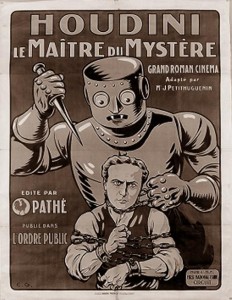
Houdini has been played by everyone from author Norman Mailer and Harvey Keitel to Tony Curtis and Emile Hirsch, but it’s also possible to catch a glimpse of the real deal. The prestidigitator began filming his magic act as early as 1906 and went on to star in a series of films with titles like The Master Mystery and Terror Island, all of which are available on the DVD set Houdini: The Movie Star.
Taking their lead from Houdini, Penn and Teller starred in Penn & Teller Get Killed, a 1989 black comedy featuring a classic sequence of Teller catching pigeons in the park with his bare hands.
Audiences could pick one of two magic movies from the deck in 2006.
First, The Prestige saw Christian Bale and Hugh Jackman abracadabra their way through this Christopher Nolan-directed film about tragic results of a rivalry between two 19th century stage magicians. Fans of the movie will notice the main characters’ initials spell ABRA — Alfred Borden Robert Angier — short for Abracadabra!
Released the same year, The Illusionist starred Edward Norton as a magician who uses his magical skills to win the love of Duchess Sophie (Jessica Biel). Norton’s character is loosely based on Erik Jan Hanussen, a magician and clairvoyant who was killed by Nazis in 1933 after a long and successful sage career.
The Mad Magician isn’t notable just because it starred Vincent Price as the murderous Gallico the Great. It’s best remembered as the first movie to be shown in 3D on television.