According to Genesis God said to Noah, “I am going to put an end to all people, for the earth is filled with violence because of them.”
Noah, a righteous man, was commanded to build an ark and stock it with “two of every kind of bird, of every kind of animal and of every kind of creature that moves along the ground will come to you to be kept alive.”
For forty days and forty nights Noah, his family and precious cargo withstood a flood so severe it submerged the tops of mountains until “every living thing on the face of the earth was wiped out.”
Once the flooding stopped and the Earth dried, God commanded Noah to come out of the ark and release the animals, “so they can multiply on the earth and be fruitful and increase in number on it.”
The story of Noah’s Ark and the flood is one of mankind’s most famous tales and Hollywood has retold it a number of times.
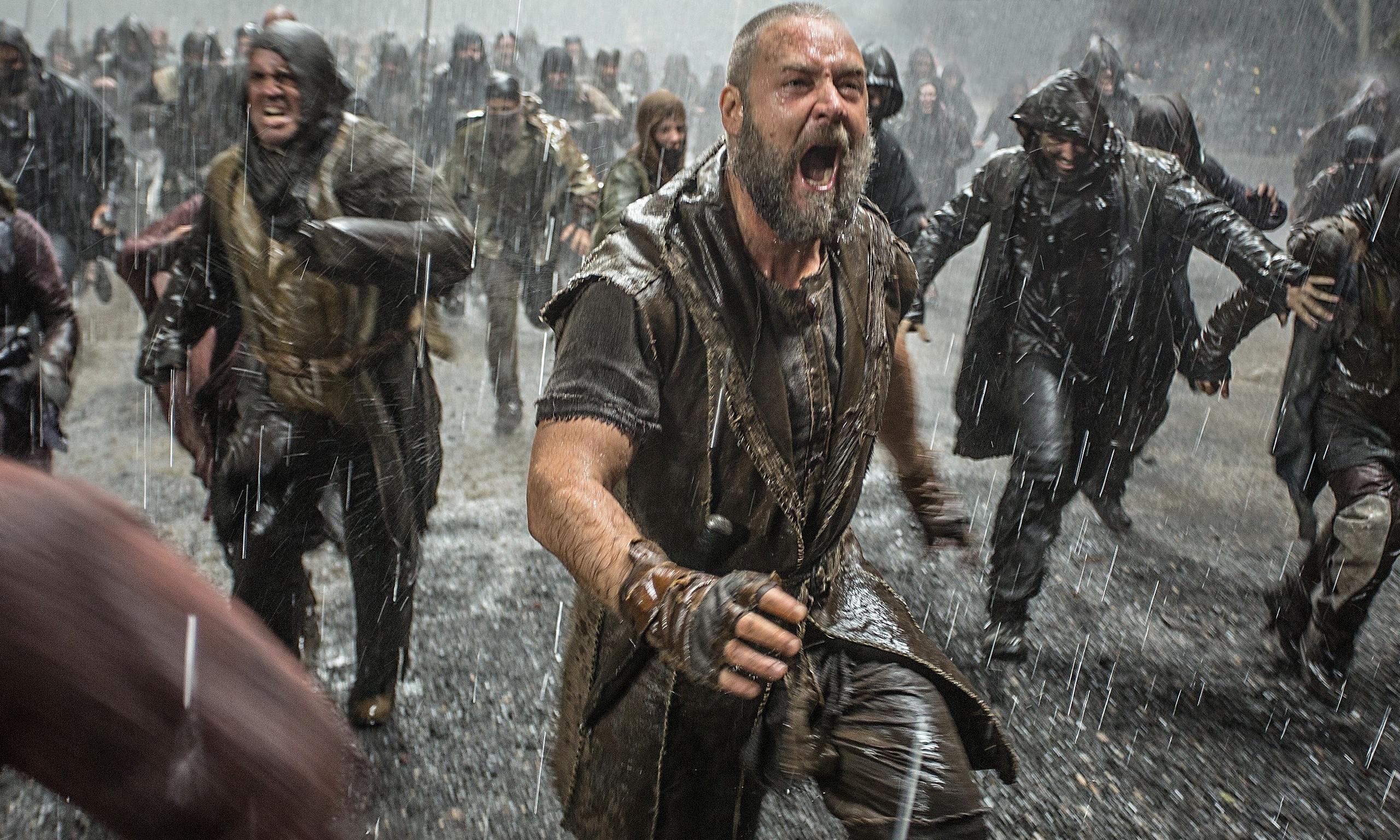
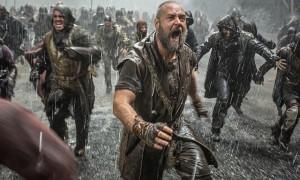
This weekend Russell Crowe plays the title role in Noah, co-starring with Jennifer Connelly, Anthony Hopkins and Emma Watson. Director Darren Aronofsky says he has been obsessed with the story since he was thirteen, calling it “the first apocalypse story.” Nonetheless, he has added his own spin to the tale.
“When we first started working on the project, we were very clear not to have sandals and robes and long white beards,” he told Rolling Stone. “The first thing I said to Russell Crowe was, ‘I’ll never shoot you on a houseboat with two giraffes standing behind you.’”
More traditional are two Disney short films. Father Noah’s Ark is a 1933 “Silly Symphony” for children that tells the narrative in song. Lively animation shows how the animals may have helped build the ship and why skunks almost didn’t make it on board.
In 1959 Disney released the twenty-minute Noah’s Ark, their first stop motion animated film. A jazzy score accompanies equally jazzy animation as pencils, pipe cleaners and other household items are inventively used to create the animals.
Shooting the flood scene in the 1928 version of Noah’s Ark endangered the life of a future Hollywood icon. John Wayne was a swimmer in the famous scene, and emerged unhurt, but other weren’t so lucky. Three extras drowned and a dozen others suffered broken limbs.
Finally, a 1977 documentary claims to shed some light on the real story. In Search of Noah’s Ark is an investigation into the speculation that Turkey’s Mt. Ararat in is the landing place of Noah’s Ark. “This may be the most incredible film you will ever see,” says narrator Brad Crandall, “but the facts that will be presented are true.”
“I was sitting in a dark theatre watching Aladdin,” he says. “Robin Williams is playing this insane genie character. I’m on the floor, as is the rest of the audience, and I looked over at my mom and said, ‘I want to do that one day,’ meaning, I want to be the comedic relief sidekick in one of these Disney films.”
Cut to a decade later.
“I was about three years out of college and I called my mom up and said, ‘I don’t think I want to do this anymore.’ She started crying. I said, ‘I’m going to go to law school.’ I thought my mother was going to celebrate that she wouldn’t have to worry about me anymore. But she was really disappointed. And I said, ‘Why are you disappointed?’
She said, ‘Because you’ve been dreaming about this for 15 years, but you are only allowing yourself to live out your dream for three years and I think that is unfair to yourself.’ It was very startling to hear her say that.”
“A week later I got my first big break on Broadway doing a show called The 25th Annual Putnam County Spelling Bee. I guess it was at that time I realized I was going to be OK.
“Book of Mormon was the point at which I realized I had reached a new level. That I had made it. I wasn’t a working actor anymore, I was an actor who was a part of something very special and that would allow and afford me more opportunities to do what I had dreamed of.”
Those opportunities include starring in TV shows like 1600 Penn and movies like Jobs, and, of course, making his dream from 1993 come true with Frozen.
“To get that phone call, saying, you are that guy,” he says, “I had to hold the phone down because I was sobbing with joy.”
Olaf, his comedic sidekick snowman, already has at least one fan — Gad’s young daughter.
“She was two-and-a-half when I took her to see her very first movie in a movie theatre, which was Monster’s University. The teaser for Frozen, which featured just my laugh [played before the movie].
“Off of that laugh she turned to me and said, ‘More dada. I want more dada.’ I had to turn away from her because I was embarrassed by the tears.”
A titan in Hollywood and one of the largest media conglomerates in the world, the Mouse House is looking back at their rich history in a very interesting way.
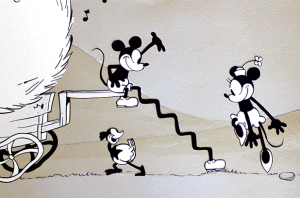
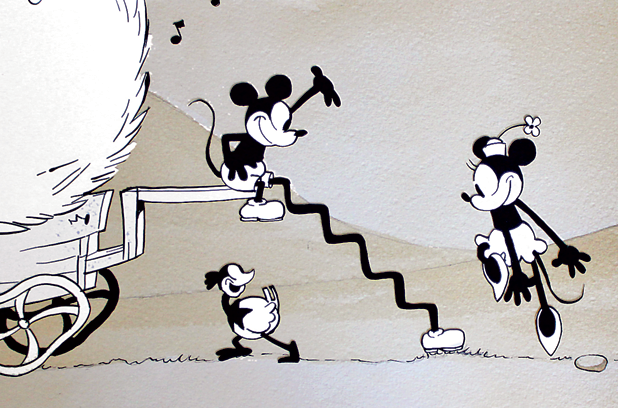
For instance, Get a Horse, the dazzling new short that plays before Frozen in theatres, is the first original Mickey Mouse theatrical cartoon in almost two decades.
But more than simply being a reintroduction to a beloved character, it’s also a deft marriage of old and new techniques that features, through some technical wizardry, the first vocal performance from Walt Disney since the 1960s.
In the live action roster there’s the Oscar hopeful Saving Mr. Banks, the story of the making of the classic Mary Poppins, and Tomorrowland, an epic sci-fi saga that was allegedly inspired by the contents of a mysterious box found in the Disney archives.
The ninety-year-old company has one eye on the past and the other very much on the future.
“We like to think of our legacy as a springboard to the future and not something that anchors us so you can’t move your feet,” says Walt Disney Animation Studios General Manager and Executive Vice President Andrew Millstein.
“There is a great wealth of characters and visual material but in its day the best of Disney was innovative and moved with audiences. We should do the same. Whether it is Get a Horse or Frozen or Big Hero Six, in terms of our approach to stories or animation or technology, we’re building on our legacy for our future.”
So what should audiences can anticipate from Disney in the next few years? Millstein says audiences should, “expect the unexpected.”
“We have to be fiercely original. We have to give audiences things they haven’t seen before. We want to surprise audiences. We want our stories to be compelling, the worlds to be great, the technology and the visuals to be stunning. If we do our jobs well, that is what’s going to happen.”
Millstein knows what he’s talking about. He’s been with Disney since 1997, when he started there as a production executive in the studio’s motion pictures group.
“It makes me feel very proud that I am part of a company that is creating content and films that you know are going to live for a long, long time,” he says. “We’re part of the zeitgeist of modern history.”
Don’t have time to see “Frozen,” the new animated Disney film, at the movies? Not to worry. The beautifully animated film takes Hans Christian Andersen’s The Snow Queen and turns it into a blueprint for a Broadway show or maybe even an all-skating Ice Capades extravaganza that will soon be playing at a theatre or rink near you soon!
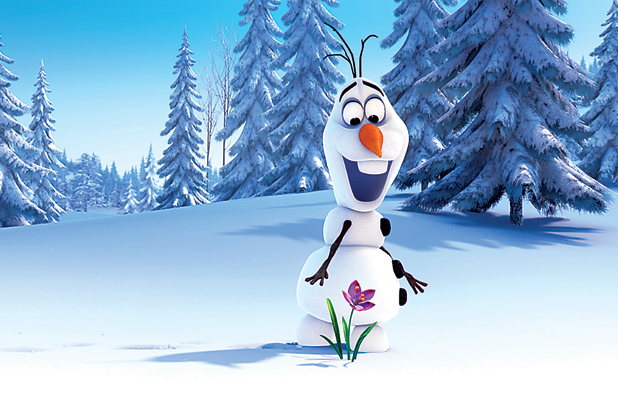
Frozen is the story of two royal sisters, the Princesses of Arendelle, Anna, a spirited adventurer (Kristen Bell) and Elsa, a cryokinetic queen (Idina Menzel) with the awesome power to manifest ice and snow. Like Carrie, but colder.
On the night of her coronation an emotional Elsa accidentally unveils her icy power, plunging her kingdom into an endless winter. Shunned by her people and called a “monster” by the haughty Duke of Weselton (Alan Tudyk) Elsa turns a cold shoulder and goes into hiding on the remote North Mountain.
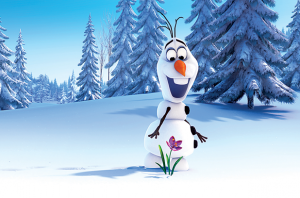
To save the realm from the eternal cold snap Anna sets off with mountain man Kristoff (Jonathan Groff), his reindeer and a sun-worshipping snowman named Olaf (Josh Gad). On the way the Elsa’s ice palace Anna discovers why her sister is cold-hearted, some magical trolls and the true meaning of love.
“Frozen” has all the elements of classic Disney. There are handsome princes, amusing animals, catchy songs and not one, but two princesses. All the fundamentals are in place and perhaps that’s part of the problem with the film. It feels like all these elements banged together to create one whole.
The music, by husband and wife team Robert Lopez and Kristen Anderson-Lopez (who also wrote “The Book of Mormon” and “Avenue Q”), are plentiful with Broadway style tunes popping up every couple of minutes. But the songs don’t feel like they fit together as a whole, almost as if they are from different shows. The Celine Dion style show-stopping pop of “Let It Go” is at odds with the goofy fun of “In Summer.”
The songs themselves are top notch, as is the animation and the most of the voice work—luckily Josh Gad spices things up with his unhinged Olaf voice—but the film as a whole doesn’t have the wit or the invention of “Get a Horse,” the short that is scheduled to precede “Frozen” in theatres. In this case the opening act freezes out the lukewarm main attraction.
I’m hard pressed to know whether the appeal of “Escape from Tomorrow,” the much talked about 2013 Sundance Film Festival hit, is that it is a surreal psychological drama about a man who loses it at The Happiest Place on Earth, or if it is simply a stunt film, destined to be best known as the first feature film shot at Disneyland without the permission of the Mouse House folks.
Jim’s (Roy Abramsohn) life disintegrates when he is fired form his job. Unfortunately the middle-aged father of two is on vacation at Disneyland when he gets the news.
What should be a fun filled final day at the park soon becomes a nightmarish journey into Jim’s heart of darkness. While trying to navigate his wife and kids through the park, he becomes overwhelmed by the sensory overload, the artificial fun and even some sexy tourists.
As he slowly becomes immersed in the fantasyland inside his head and the Disney fantasy surrounding him he loses his grip on reality.
Director/writer Randy Moore and cast spent ten days shooting at Disney World with another two weeks at Disneyland, filming surreptitiously on small digital cameras.
The result is a stylish black-and-white movie—a Disney noir—that doesn’t reveal its guerilla roots. It’s a slick looking slice of surrealism that benefits greatly from its iconic setting. The manufactured gaiety of the surroundings provides production value far beyond what a micro budgeted feature like this could afford and is a perfect dreamlike backdrop for the story of the deconstruction of Jim and his psyche.
But I have to wonder if we’d be talking about this movie at all if not for the audacious circumstances surrounding its production. The film’s wonky pacing and indulgence of male fantasy—Princess / Prostitutes anyone?—would suggest this is a feature film that may have benefitted from some story and picture editing.
There are some good ideas here about not being able to run away from your problems, even if you are at the Happiest Pace on Earth but the film changes tone midway through and becomes more self aware as the insanity mounts. Bleeping the word Disney is jarring (although I imagine it is meant to draw a laugh) and too much exposition drags things down in the final half.
“Escape from Tomorrow” is definitely a one-of-a-kind cinematic experience (and the strangest film to bear any Disney imprint, legal or not) but despite Moore’s obvious passion the film feels like it is straining to reach feature length.
All babies are adorable. Whether they walk on two legs or four, have fur all over, or wings, tusks or even a blow hole, there is something irresistible about the young of any species. The makers of the new Disney film Earth know this and the cute factor of this natural history documentary is dialed way up. Of course there is a strong environmental message mixed into the story of the migration paths of four animal families but my guess is kids will walk away with visions of baby polar bears dancing in their heads rather than concern about global warming.
Earth is a condensed version of the BBC series Planet Earth, a ninety minute trek from pole to pole. Shot over 4,500 days in 200 locations around the globe the combined budget of the television show and the movie is upwards of $40 million, making it the most expensive documentary ever, and every dime of it is on the screen. It’s a visually spectacular feast for the eyes. Beautiful time lapse photography and stunning aerial shots of Mount Everest are pure eye candy, but it is the intimate and thrilling shots of the animals that are truly memorable. From baby polar bears shakily taking their first steps to the preening, exotic Bird of Paradise and the spectacular humpback whale and calf hunting for plankton, the film gets us up close and personal with these creatures.
These images speak for themselves and as such don’t need the clumsy and overly simplistic narration. Voiced with booming gravitas by James Earl Jones (there are different narrators for different countries, including Patrick Stewart) the voice over is repetitive and lacks any new information or insight. Maybe bring an iPod and just enjoy the pictures.
Earth is a Disney release, so it is family friendly, but there are a couple of scenes involving the cruel realities of the animal kingdom that may be too intense for very young viewers. One little girl—maybe just three or four years old—at the screening I saw yelled, “Why! Daddy! Why!” during a scene where a wolf tracks and captures a caribou calf. It’s bloodless, the camera cuts away before nature really takes its toll, but is scary nonetheless.
Earth is a beautifully made film that errs on the side of cutesy a bit too often, but is a splendid experience nonetheless.
To really know the ocean, says narrator Pierce Brosnan, you have to see it, taste it and live it to feel its power. “Oceans,” the spectacular new Disney nature film doesn’t literally let you feel or taste the sea, but its beautiful and intimate photography will get you as close as possible to experiencing the ocean without actually getting wet.
Released just in time for Earth Day, “Oceans” is the evolution of “The Undersea World of Jacques Cousteau.” Technological advances allow “Winged Migration” co-directors Jacques Cluzaud and French star Jacques Perrin to go deeper and stay longer to capture a vivid portrait of life in the sea. Not strictly a documentary—some scenes are staged—it is more a travelogue of the earth’s oceans and their citizens.
It may not fit the traditional definition of documentary but it certainly is cinematic. With a minimum of narration—the weakest part of the film—they present a dazzling array of images from a spectacular ballet of dolphins, diving birds and a school of sardines to a spider crab showdown that looks like an underwater version of Michael Jackson’s “Bad” video. And there’s drama too. A scene with sea turtle hatchlings and a flock of hungry frigate birds wouldn’t be out of place in a Hitchcock film, but it’s bloodless. There’s nothing here that will upset the little ones.
It is a representation of life at its most basic. Sometimes it’s as brutal as a Tarantino revenge drama—a mantis shrimp pulls an arm off a crab and eats it in front of him. But often it’s eye-poppingly beautiful with close-ups of creatures that look like they sprung from the depths of H. R. Giger ‘s imagination—there are as many strange beasts here as in almost any sci fi movie—and impressive wide shots of cascading schools of fish and dolphins leaping in and out of the water.
It’ll entertain the eye, but it probably won’t engage the brain in the same way. There isn’t much in the sense of educational information—for instance, we’re told that the humpback whale is majestic and that penguins aren’t very good “figure skaters” and not much more—but it should spark kid’s interest in the ocean and will certainly fire their imaginations. If nothing else it’ll make adults crave sashimi.
The inevitable eco message about humans polluting the sea is effectively illustrated by a shot of a sea lion frolicking with a rusted shopping cart, but like the educational component of the film it’s more a starting point for conversation with the kids over fish sticks after the movie than a complete lesson in conservation.
Much of the pleasure of “Oceans” is derived from seeing it on the big screen. The scale of the screen pales compared to the size of the ocean, but it is as up-close-and-personal as most of us will ever get to these strange and often wonderful creatures.
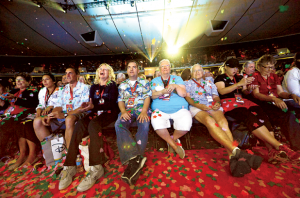
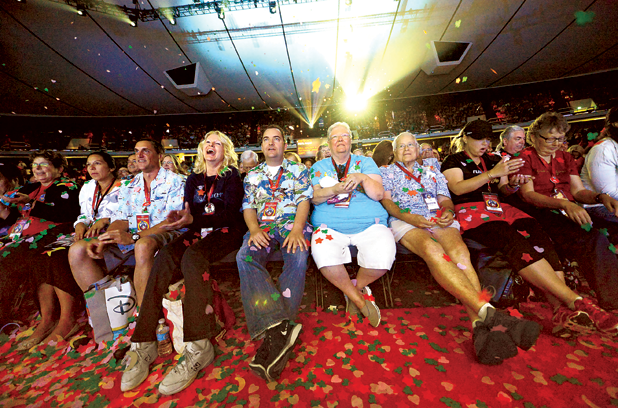
It snowed in Anaheim, California Friday afternoon but it wasn’t a freak storm, just a blast of Disney magic at D23, the Mouse House’s equivalent of Comic Con.
As Broadway star Indina Menzel sang Let it Go from the upcoming animated film Frozen, artificial flakes fluttered down from the rafters, gently covering the 5000 faithful fans who gathered for the first of two star-studded early-look previews.
The convention featured over 200 presentations, panels and concerts, but these sneak peek events, which focussed on Disney’s reverence for their past and their commitment to the future, were among the most highly anticipated.
At Friday’s event, Disney chairman and chief executive Bob Eiger and chief creative officer John Lasseter were greeted with the kind of audience response usually reserved for rock stars and royal babies.
They unveiled the new short film Get a Horse, which mixes 85 year-old Walt Disney Mickey Mouse sketches and state-of-the art 3D computer animation. It also features a vocal performance from Walt himself, pieced together from old tapes. “Someone has to update his IMDB page,” joked director Lauren MacMullan.
Advance looks at The Good Dinosaur, which imagines a world if dinosaurs had survived, Inside Out, a movie Lasseter described as “one of the most unique films I have ever been associated with,” and Finding Dory, the sequel to one of Pixar’s most loved films, were met with cheers.
Saturday’s presentation unveiled teases from Disney’s live action slate. Paying tribute to Disney’s past Kenneth Branagh will direct a live action Cinderella, and another film revisits one of Disney’s great villains. Maleficent stars Angelina Jolie as the Sleeping Beauty villain, a role she’s coveted since youth. “Since I was a little girl Maleficent was always my favorite,” she told the crowd. “I wanted to know more about her.”
Tomorrowland, a sci fi film starring George Clooney, was inspired by a box found in the Disney archives. Labelled simply 1952, the “dusty old box” contained a mysterious mishmash of items, including a copy of Amazing Stories magazine and a short animated documentary, that inspired Lost screenwriter Damon Lindelof to pen the speculative story.
The most obvious tribute to Disney’s legacy is Saving Mr. Banks, which brings the late visionary to life on the big screen. Tom Hanks stars as Walt attempting to buy the rights to Mary Poppins from writer P.L. Travers, played by Emma Thompson. Shot on location at the Burbank Studios where Walt worked, the film is timed to coincide with the 50th anniversary of Mary Poppins.
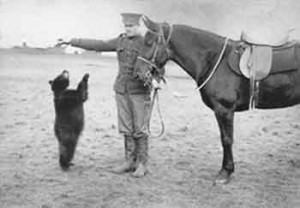
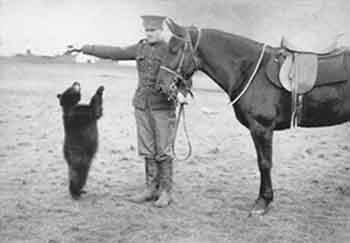
Winnie the Pooh has Canadian roots. The beloved A.A. Milne creation, a potbellied bear with a taste for “hunny,” was based on a real-life Canadian black bear that lived at the London Zoo.
Brought to the zoo by Lieutenant Harry Colebourn during the First World War, the bear was named Winnie after the soldier’s hometown of Winnipeg.
It’s fitting, then, that the new Disney Winnie the Pooh movie had many Canadians help bring it to the screen.
“It’s like winning the lottery having worked here,” says Alberta native Brian Ferguson of his 21 years working at the House of Mouse.
His first job after joining the company was animating the company’s mascot in Mickey Mouse’s Prince and the Pauper. “It’s such a simple design,” he says, “but if you get a pencil thickness off in the proportions, it looks wrong.” That’s a lesson he took with him when drawing the classic characters in Winnie the Pooh.
“The people who did the first Winnie the Poohs were masters and the stuff they did then, wow,” he says. “Even as an experienced animator I look at it and go, ‘Oh my goodness, I wouldn’t have thought of that.’ It’s subtle little things that make a character be just a little away from normal. It’s the subtle difference between, ‘I would never have done it that way,’ to ‘I would never have thought to do it that way.’”
Nik Ranieri, a Torontonian with 23 years at the studio, adds that while the classic look of Winnie the Pooh has been maintained in the movie, efforts have been made to update the feel of the film.
“When I watch the film there are some things in there I don’t think you’d see in the old ones,” he says. “Look at the character of Rabbit. Some of those poses and expressions are a little more manic, but it doesn’t take away from the charm of the original. It just adds a little bit of contemporary feel to it.”
For Vancouverite Clio Change, Winnie the Pooh marks a landmark — it’s her first Disney film. “I think I was four when I told my dad I wanted to work here,” she says. “He said, ‘OK, you can sell Coke in the parks in a mouse suit.’ Luckily it was animation instead.”
When I ask her if all the Disney Canucks have their own table in the cafeteria she nods and laughs, “We eat maple cookies and drink syrup.”
 By Richard Crouse – Metro In Focus