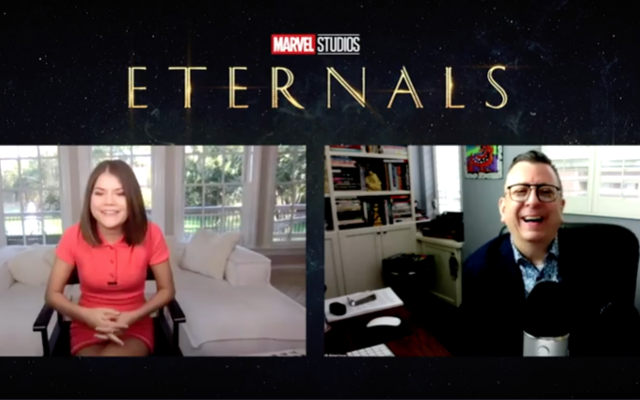
Richard Crouse and “Eternals” star Lia McHugh talk about her mother accidentally hanging up on a very important phone call, the influence of director Chloé Zhao on the story and cast and how she auditioned for the movie, even though she didn’t know what exactly what part she was trying out for.
The Marvel Cinematic Universe expands this weekend with the theatrical release of “Eternals,” a star-studded superhero film with thousands of years of backstory and 10 new-to-the-big-screen superheroes.
For the uninitiated, those who don’t know their Jack Kirby from their Bruno Kirby, the Eternals have existed in comic book form since 1976.
They are 10 immortals lead by matriarch Ajak (Salma Hayek) and Ikaris (Richard Madden). Rounding out the diverse cast (who are often lined up on-screen like they are posing for a 1980s album cover shoot) are matter manipulator Sersi (Gemma Chan), Thena (Angelina Jolie), a warrior with super strength and the ability to fly, strongman Gilgamesh (Don Lee), Makkari (Lauren Ridloff), the fastest woman in the universe, Bollywood star Kingo (Kumail Nanjiani) who can shoot fireballs from his palms, the childlike ancient Sprite (Lia McHugh), master inventor Phastos (Brian Tyree), mind control expert Druig (Barry Keoghan) and Sersi’s human (or is he?) boyfriend Dane Whitman (Kit Harington).
Pay attention. You may need a scorecard to keep track.
7000 years ago they were sent to Earth by the all-powerful Prime Celestial Arishem (voiced by David Kaye) to keep humans safe from evil killer creatures called Deviants. Over the years they have been present at many defining world events, from ancient battles to Hiroshima. They live by a strict set of rules, including one, a prime directive of a sort, that instructs them to only protect humans from Deviants. That means no man-on-man conflict. If they interfere with earthly concerns, Arishem says, humans will never figure out how to protect themselves.
When the Eternals vanquished the Deviants, they went undercover, blending in with the normies for eons.
Now, in present day, the Deviants are back and badder than they ever were—this time around they can heal themselves—but can the Eternals battle the deadly invaders while pondering the real reason Arishem put them on earth in the first place?
The 25th epic in the Marvel Cinematic Universe spans millennia but tackles many current issues. Themes of unity and the power of connection are woven into the story, topped with messages of self-awareness and being who you are. The ten new superheroes are more introspective than your run-of-the-mill superbeing, expressing their innermost feelings when they aren’t grappling with the existential threat posed by the Deviants. I mean, when was the last time you saw a superhero cry? The ideas expressed regarding sacrifice, interventionism and purpose of mission are endlessly replayed but never truly explored. It is pop psychology disguised as depth.
But, nonetheless, they take the time to pontificate. At two hours and thirty-seven minutes, “Eternals’” story doesn’t exactly feel like it takes an eternity to tell, but it does feel long, especially if you stay to the end to see the two post credit scenes.
Oscar winning director Chloé Zhao, who also co-wrote the script, brings humanity to these alien creatures, but the blockbuster style action, endless exposition and humanist musings sit uneasily beside one another. It’s ambitious, but tonal shifts abound and by the time the CGI orgy of the finale gets underway, “Eternals” simultaneously feels like too much and too little.
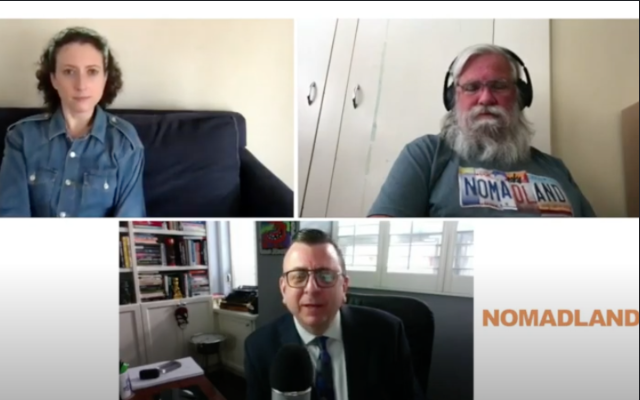
Let’s meet we meet Jessica Bruder, author of the 2017 book “Nomadland: Surviving America in the Twenty-First Century,” and Bob Wells, a real-life nomad and one of the stars of the Oscar nominated film “Nomadland.”
A blend of fiction and nonfiction, “Nomadland,” the melancholy new Frances McDormand drama, is a timely story of a woman who learns to adapt and survive after losing everything she held dear.
Just as Fern (McDormand) cuts herself off from the norms of regular society, “Nomadland” is not tied to traditional storytelling structures. Its unhurried 107-minute running time is leisurely, not plot driven but utterly compelling. Director Chloé Zhao follows the widowed Fern as she leaves Empire, Nevada, a small company town now bleeding residents after the closure of the U.S. Gypsum Corporation factory. So many people have fled to greener pastures that the post office discontinued the local zip code.
Leaving all that she has known behind, Fern loads up her beat-up old van and hits the road, crisscrossing America looking for seasonal work at every stop. She’s not homeless, just unencumbered, solo but not solitary. “I’m not homeless,” she says. I’m just houseless.”
Along the way she discovers a community of fellow nomads, people who teach her the ropes of life on the road. Here’s what I learned: If you have bad knees you need a taller bathroom bucket for your van.
Fern does what it takes to get by, working at an Amazon fulfillment center or taking on caretaker gigs at rec parks, but her iterant lifestyle isn’t about disconnection or colored by loneliness. Her journey is one of self-discovery, of survival, of serenity. She is gritty, but open and friendly, independent and generous. She’s not an exile from “The Grapes of Wrath,” she’s simply living life on her own terms without a drop of self-pity and McDormand never overplays her. There is an authenticity to the performance, aided by Zhao’s casting of real-life nomads like “van-dwelling evangelist” Bob Wells, and travelers Linda May and Charlene Swankie, that never feels less than real, sometimes almost uncomfortably so.
At times “Nomadland” feels like a documentary. Zhao and McDormand have created a beautiful character study about the flipside of the American Dream. As Fern makes her way from gig to gig Zhao decorates the screen with eye-popping visuals courtesy of Joshua James Richards’s cinematography of the landscapes that form the backdrop to Fern’s journey. The story is poetic but never cloying and always reaching for the horizon.
This week on the Richard Crouse Show Podcast: If you love records like Joshua Tree, Wrecking Ball, and Time out of Mind you know my guest’s work. Daniel Lanois has an incredible resume. His work as a producer for U2, Peter Gabriel, Emmylou Harris, Bob Dylan, the Neville Brothers, Robbie Robertson and Neil Young among many others led Rolling Stone Magazine to say, “His unmistakable fingerprints are all over an entire wing of the Rock and Roll Hall of Fame.”
Lanois has moved back to Canada and launched the brand new Maker Series imprint out of his Toronto-based recording studio. First up in the Maker Series is a solo record called Heavy Sun. A soulful, joyous album recorded in Los Angeles and Toronto that fuses classic gospel and modern electronics. He says the intent of the music is to “lift people’s spirits.”
Then, we meet Jessica Bruder, author of the 2017 book “Nomadland: Surviving America in the Twenty-First Century,” and Bob Wells, a real-life nomad and one of the stars of the Oscar nominated film “Nomadland.”
Then, the man, the myth, the legend William Shatner. His career is so epic it spans generations. Some will remember him as the iconic Capt. James T Kirk of the USS Enterprise. Others know him as the veteran police sergeant in T. J. Hooker. Still others think of him as the host of the reality-based television series Rescue 911 or the “Big Giant Head” from 3rd Rock from the Sun or as attorney Denny Crane both in the final season of the legal drama The Practice and in its spinoff series Boston Legal. He’s an actor, an author a singer and now the star of Senior Moment a new rom com on VOD this week.
The romantic comedy focuses on Shatner’s character Victor, a retired pilot whose life goes into a tailspin after he loses his driver’s license, but starts looking up when he finds love with a character played by Jean Smart.
Each week on the nationally syndicated Richard Crouse Show, Canada’s most recognized movie critic brings together some of the most interesting and opinionated people from the movies, television and music to put a fresh spin on news from the world of lifestyle and pop-culture. Tune into this show to hear in-depth interviews with actors and directors, to find out what’s going on behind the scenes of your favourite shows and movies and get a new take on current trends. Recent guests include Ethan Hawke, director Brad Bird, comedian Gilbert Gottfried, Eric Roberts, Brian Henson, Jonathan Goldsmith a.k.a. “The most interesting man in the world,” and best selling author Linwood Barclay.
Listen to the show live here:
C-FAX 1070 in Victoria
SAT 5:00 PM to 6:00 PM
SUN 10:00 AM to 11:00 AM
CJAD in Montreal
SAT 8 PM to 9:00 PM
CFRA in Ottawa
SAT 8 PM to 9:00 PM
NEWSTALK 610 CKTB in St. Catharines
Sat 8:00 PM to 9:00 PM
NEWSTALK 1010 in Toronto
SAT 8 PM to 9:00 PM
NEWSTALK 1290 CJBK
SAT 8 PM to 9:00 PM
AM 1150 in Kelowna
SAT 11 PM to Midnight
BNN BLOOMBERG RADIO 1410
SAT 8 PM to 9:00 PM
Click HERE to catch up on shows you might have missed!
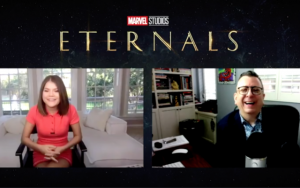 Richard Crouse and “Eternals” star Lia McHugh talk about her mother accidentally hanging up on a very important phone call, the influence of director Chloé Zhao on the story and cast and how she auditioned for the movie, even though she didn’t know what exactly what part she was trying out for.