Another franchise, another eccentric genius. Robert Downey Jr. laves Tony Stark behind to return to the big screen in a reboot of a remake of a classic story of a man who could talk to animals.
When we first meet Dr. John Dolittle (Downey) he’s at the Howard Hughes recluse stage of his life. The passing of his wife has left him despondent, unable to enjoy the company of humans so he lives in seclusion with only a menagerie of animals for company.
To pass the time he plays chess with a timid gorilla named Chee-Chee (voice of Rami Malek) and in conversation with the various animals who crowd his home, including his trusted macaw advisor Polynesia (voice of Emma Thompson) and Jip (voice of Tom Holland), a bespectacled dog.
“I don’t care about anyone, anywhere, anymore,” the doctor says.
Of course, that’s not true. When animal lover Tommy Stubbins (Harry Collett) shows up at Dolittle’s gate with an injured squirrel (voice of Craig Robinson)—“I’m too beautiful to die,” the squirrel says.—on the same day the doctor is summoned to Buckingham Palace to see the ailing Queen Victoria (Jessie Buckley), he is brought back into the human world. Her Majesty is gravely ill and if she dies the treasury will take the animal sanctuary Dr. Dolittle calls home. Worse, all his animals will be thrown out into the world during hunting season.
To save the Queen‘s life he must embark on a journey to find the Eden Tree and its magical, healing fruit. It’s trip fraught with danger and is the same journey that cost his beloved wife her life. Add to that some palace intrigue, an island of misfits and thieves, turbo boosting whales, a vengeful squirrel and even a dragon and you have a new chapter in the life of the man who can talk to animals.
Kids will likely find “Dolittle’s” chatty animals amusing but this isn’t simply a movie about wise cracking beasts. At its beating heart it is a movie about pain, but, as one character says, not the kind of hurt inflicted by a bullet or a knife. It’s about the agony of losing someone. Dolittle’s heart is broken by the death of his wife, and that ache is the engine that propels the entire movie. So, while the young’uns may giggle at the animals but the movie’s underlying downer vibe and generic approach suggests that Dolittle’s wife isn’t the only lifeless part of this movie.
Downey plays the character with a sense of bemused confusion, topped with a mealy-mouthed Billy Connolly impression that changes from scene to scene. It’s a pantomime performance that makes the best of his finely tuned comic timing but feels sloppy and needlessly mannered.
“Dolittle” contains some good pop psychology for children about working together—”Teamwork makes the dream work!”—and facing their fears but overall a movie featuring talking animals shouldn’t be this banal.
Based on “Secrecy World: Inside the Panama Papers Investigation of Illicit Money Networks and the Global Elite” by Jake Bernstein “The Laundromat” chronicles the rot that festers on the corrupt body of our financial institutions.
Divided into chapters with names like “Secret Number One: The Meek Are Screwed,” “The Laundromat” is a funny, star-studded portmanteau of thematically linked stories involving tax loopholes, exploitation and financial malfeasance. “All these stories are about money,” says Ramón Fonseca (Antonio Banderas), “the secret lives of money.” Like “The Big Short” it takes the spoonful-of-sugar-to-help-the-medicine-go-down approach to telling a story so dripping with bile you have to laugh to stop from crying.
Meryl Streep is at the helm of this cinematic op-ed playing Ellen Martin, a steely woman whose husband’s death leads her by the nose into the world of fake insurance policies and a shady Panama City law firm run by slicksters Jürgen Mossack (Gary Oldman) and Fonseca. The flamboyant represent “drug lords, sex traffickers and destroyers of the planet” and also colorfully narrate the action. “Tax avoidance and tax evasion,” says Mossack. “The line between them is as thin as a jailhouse wall.” They’re more interested in the shell companies they control that help line the pockets of their very wealthy clients than the regular Joes affected by their actions. “Bad is such a big word for such a small word.”
As the story splinters into chapters, cameos from Jeffrey Wright (as a secretive insurance broker), Nonso Anozie (as a billionaire who tries to buy his way out of trouble) and David Schwimmer (as a business person screwed by his insurance company) pile up, revealing personal aspects of the dirty business of money laundering. The story wanders here and there but Streep stays on course, lending this ragged movie a strong emotional core.
“The Laundromat” features lively performances—I’m looking at you Oldman and Banderas—timely commentary about whistleblowers and fraud and a rousing fourth-wall-breaking ending and yet, feels like less than the sum of its parts. Director Steven Soderbergh provides some well-crafted big moments but the stories are too far flung and too brief to inspire any real interest in the characters. They come and go with little development (save for Martin), often representing ideas rather than fully formed characters.
Streep plays a double role, an ill-advised choice that feels like a stunt and doesn’t lend much to the telling of the tale, but wraps things up with a wake-up call, asking basic questions—Who is accountable? Where and how do you get justice?—that put a period on this story but should be a starting point for more discussion and thought.
If the title itself didn’t give it away, fans of the sappy television hit “This is Us” will know what to expect from “Life Itself.” The new film from “This is Us” guru Dan Fogelman is a Xerox of his TV show. Grab some Kleenexes and cue the schmaltz.
Divided into chapters, Fogelman goes multigenerational in “Life Itself,” guiding us through the lives of a handful of people on a couple of continents. Anxious New Yorker Will (Oscar Isaac) bends his therapist’s (Annette Bening) ear, droning on about his failed marriage to Abby (Olivia Wilde) and Bob Dylan.
Cut to the future. There’s Will and Abby’s daughter Dylan (Olivia Cooke), an angry punk chanteuse who specializes in, SURPRISE, Bob Dylan songs.
Jump across the pond to Spain. There the wealthy Mr. Saccione (Antonio Banderas) promotes one of his workers, Javier (Sergio Peris-Mencheta). With the extra money is able to marry his girlfriend Isabel (Laia Costa), but later a tragedy, witnessed by their son Rodrigo (Àlex Monner), traumatizes the boy. Saccione pays for therapy and later, after some turmoil, pays for Rodrigo to go to school in New York, which co-incidentally is where the story comes full circle.
See how everything connects in the grand soap opera of life?
There’s more. Mandy Patinkin pops up as Will’s father, a cancer diagnosis rocks a family and don’t forget molestation. It’s a litany of tragedy—suicide, mental health issues, abandonment and family dysfunction—that feels like a sappy Afterschool Special written by Nikolai Gogol, coated in a fine dusting of schmaltz. It longs to be a rich, complex look at life, love, loss and olive oil but is instead a metaphorical Crock-Pot—a slow burn of the story that never comes to a boil—that, unlike the one on Fogelman’s TV show, never actually catches fire.
Director Hugh Hudson put some spring into the step of “Chariots of Fire,” his Oscar winning account of runners in the 1924 Olympics but fails to bring the story of the discovery of stone age cave paintings to vivid life.
Set in 1879, Antonio Banderas is amateur archaeologist Marcelino Sanz de Sautuola. A free thinker with an interest in Darwin and prehistory, he creates controversy in his community when he and his daughter uncover Maria (Allegra Allen) unearth cave paintings depicting life two million years ago. “This discovery in our province is of enormous significance in the history of mankind,” says Sautuola.
Not everyone agrees.
Although a university of Madrid archaeologist dates the etchings to the Palaeolithic Era other scholars disagree. “A vast fresco painted by a tribe of Palaeolithic Michelangelos,” says on mockingly. Church leaders fume at the suggestion of life beyond their historical parameters—“Monkeys with paint brushes!”—and even his own wife, Conchita (Golshifteh Farahani) has a hard time reconciling his science to her deeply held religious beliefs. “You have lost your faith and want to take mine,” she says. The discovery, a profound challenge to the entire country’s belief system, exacts a toll on Sautuola both personally and professionally.
“Finding Altamira” is a handsomely rendered movie. The period details add to the overall feel of the film, even the computer generated bisons that spring to life from the drawings don’t seem that out of place. Hudson shot on location—including inside the cave itself, now a Unesco site—but all the pretty pictures can’t make up for the mannered dialogue and reserved performances. Banderas and Farahani seem to have stepped out of a “Masterpiece Theatre” episode, handing in work that would have benefitted from fewer restraints. Only Rupert Everett as the villainous Monsignor seems to be having any fun.
The film documents an important discovery plus the intolerance and jealousies that it was met with. It’s just too bad the film isn’t more interesting. As it is “Finding Altamira” feels like the kind of movie your science teacher ran in class when they didn’t feel like lecturing.
The movies have looked to the news for inspiration almost since the first time film was projected on screens.
As far back as 1899, a film called Major Wilson’s Last Stand dramatized scenes from the First and Second Matabele Wars, including the death of Major Allan Wilson and his men in Rhodesia in 1893.
The trend of reel life emulating real life continues this weekend with The 33, an Antonio Banderas film based on a famous mining accident. In 2010, 33 men spent 69 days trapped underground in a copper-gold mine located near Copiapó, Chile when a rock the size of the Empire State Building blocked their exit.
“I can’t think of a better story than this one to bring to the screen,” says producer Mike Medavoy.
The trick is getting the story right. Director Patricia Riggins worked with the miners, Medavoy and screenwriters to create a story that, according to everyone involved, features more fact than fiction.
That isn’t always the case.
According to IMDb the Jim Sturgess movie 21 calls itself a “fact based” story about a group of MIT students who used a complicated card-counting system to fleece Las Vegas casinos for millions of dollars.
The bare bones of the story are true — blackjack was played and MIT students counted cards — but Hollywood diverged from reality when casting the leads. In truth the main players were mainly Asian-Americans, including ringleader Jeff Ma who consulted on the movie.
Ma called the controversy surrounding the casting of Sturgess and Kevin Spacey “over-blown,” adding “I would have been a lot more insulted if they had chosen someone who was Japanese or Korean, just to have an Asian playing me.”
The Michael Bay film Pain & Gain is listed as an action-comedy and stars Mark Wahlberg, Dwayne Johnson and Anthony Mackie certainly play up the jokes. Everyone laughed, except for Marc Schiller, the real-life inspiration for the film’s kidnap victim.
“It wasn’t that funny when they tried to kill me,” he said. “They did run me over with a car twice after trying to blow me up in the car. The way they tell it made it look like a comedy. You also gotta remember that not only I went through this, but certain people were killed, so making these guys look like nice guys is atrocious.”
Last year’s Oscar winner Whiplash saw Miles Teller as a young drummer driven to extremes by a fanatical music teacher played by J.K. Simmons.
The movie draws parallels to the famous story of Jo Jones and Charlie Parker. The legend goes that Jones threw a cymbal at Parker’s head after a lackluster solo, prompting the sax player to go away, practice for a year and return as one of the greatest musicians of the 20th century. Trouble is, the story isn’t true. A cymbal was let loose, but according to eyewitnesses it was dropped on the floor at Parker’s feet and not at his head.
“Not attempted murder,” wrote Richard Brody in the New York Times, “but rather musical snark.”
How does Hollywood get away playing fast and loose with the facts? Black Mass director Scott Cooper says, “I don’t think people come to narrative features for the facts, or for truth. I think you go to documentaries for that. What you do come to narrative features for is psychological truth, emotion and deep humanity.”
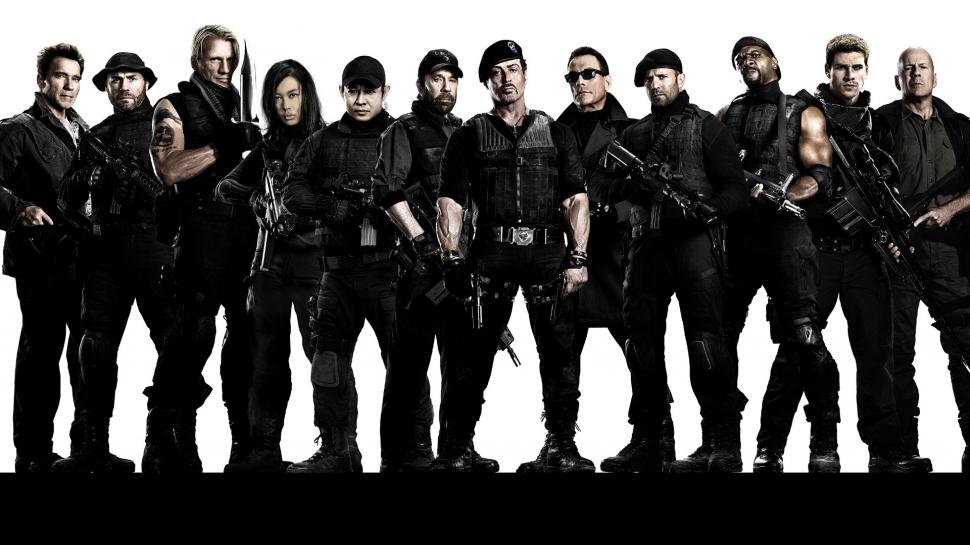
More people die in the first five minutes “The Expendables 3” movie than in any other two war movies combined. There is death by bullet, bazooka and bomb. It’s a wild but oddly bloodless beginning to the movie. Perhaps its because they have scaled back the rating to PG1the from the hard Rs the last two Expendables enjoyed, but removing most of the over-the-top violence leaves an absence of the over-the-top fun of the originals. Why arm Stallone and Company up the wazoo and then skimp on the fake blood and faux carnage?
A mission to stop a shipment of bombs brings grizzled mercenaries Barney Ross (Sylvester Stallone), Lee Christmas (Jason Statham), Gunner (Dolph Lundgren), Toll Road (Randy Couture) and Caesar (Terry Crews) face to face with their toughest adversary yet, arms dealer Conrad Stonebanks (Mel Gibson). Determined to bring down Stonebanks, Ross retires the oldtimers—“We aren’t the future anymore,” says Ross, “we’re part of the past.”— and recruits a fresh group of soldiers—Kellan Lutz, Ronda Rousey, Victor Ortiz and Glen Powell—but just may find that his old dogs have some new tricks.
“Great plan,” says Luna (MMA fighter Rousey) of Ross’s old-fashioned bulldozer approach to mercenary work, “if it was 1985,” and this might have been a great movie if it was 1985. Despite the lack of overly gratuitous blood and guts, it feels like one of those direct-to-video action movies from the Reagan years. With no sense of nuance and clichés aplenty, it ploughs ahead, relentlessly reveling in its own stupidity. Kind of the like everything, but especially the action movies, in the 1980s.
But for much of the movie, that’s OK. How could you not love Wesley Snipes saying that his character was put in jail for tax evasion? It’s art imitating life! Or something.
Most of the other performances aren’t so much performances as they are action star posturing. Kelsey Grammar, as a recruiter for a new batch of Expendables, stands out because he does some actual acting. So do many of the obvious stunt doubles. The rest are all bulked-up chunks of machismo floating in a sea of testosterone.
Still, as an old-school action movie, it works well enough, despite the lack of gallons of fake plasma. I liked the attempts of creating new catchphrases—which are a must in these kinds of films—like Crews yelling, “It’s time to mow the lawn,” before spraying thousands of bullets into a dock packed with baddies. Also, the action scenes are shot clearly and effectively, and unlike last week’s “Teenage Mutant Ninja Turtles,” you can actually see who is shooting-punching-blowing up-kicking-garroting-etc who. It makes it easier to cheer for the good guys when you can tell who the bad guys are.
For the most The Expendables movies have been met part with critical disdain. The New Yorker’s Anthony Lane christened the first film, “breathtakingly sleazy in its lack of imagination,” while reviewer James Kendrick said the second installment, was “a better concept than it is a movie.”
Both films star a who’s who of 1980s actions movies—Sylvester Stallone, Jason Statham, Dolph Lundgren, Chuck Norris, Jean-Claude Van Damme, Bruce Willis, Arnold Schwarzenegger and more—and have exterminated the competition, collecting an average of $289.9 million at the worldwide box office.
The new movie, inventively titled The Expendables 3, adds vintage action stars Wesley Snipes, Antonio Banderas, Mel Gibson and Harrison Ford to the mix and doubtless will add big bucks to the franchise’s overall gross, whether the critics embrace it or not.
The Expendables movies appear to be bulletproof to critical missiles but they aren’t the first films to be lambasted by reviewers and then clean up at the box office.
Meet the Spartans, a parody of sword and sandal epics from the creators of Scary Movie, currently sits at a 2% Tomatometer rating at Rotten Tomatoes, but that didn’t stop it from taking the top spot at the box office, narrowly edging out Stallone’s Rambo reboot, on its 2008 opening weekend. In the end it made $84,646,831 worldwide despite being called “one of the most painfully bad comedies I’ve ever had to endure,” by Garth Franklin of Dark Horizons.
Finally, Adam Sandler is a fan favorite, but finds little love from the critics. Jack and Jill, a 2011 comedy that saw him play twin brother and sister, earned a whopping $149,673,788 worldwide, but was dubbed “relentlessly witless” by the Daily Star while New Zealand critic Liam Maguren wrote, “Burn this. This cannot be seen. By anyone.”
Brian DePalma’s latest is steeped in his usual mythology – misogyny, double crosses, and voyeurism. Femme Fatale dips heavily into the film noirs of the 40s for inspiration, particularly Double Indemnity, a classic brew of duplicity, murder and adultery. But after a breathless first twenty minutes DePalma throws logic out the window and allows the movie to wander implausibly through Paris’s seedy underworld. Like the giant photo collage that the Antonio Banderas character constructs in his apartment, this movie feels like a collage of sexy (and or violent) scenes cobbled together to make a whole. It’s incomprehensible eye candy. Rebecca Romijn-Stamos as Laure the vampy thief who steals $10 million in jewels before taking off with another woman’s identity, however, is one of the best scoundrels to come along in a while. She’s a long legged bad girl who laughs with glee as two men beat each other up over her. She’s a nasty piece of work who really means it when she says, “I’m a bad, bad girl.” DePalma’s use of split screens and other visual tricks keeps Femme Fatale interesting to look at, making it a work-out for the eyes, but not the mind.
“Haywire,” a new action film from “Ocean’s 11” director Steven Soderbergh isn’t so much a movie as it is a showcase for the lithe athleticism of its star Gina Carano. Imagine an MMA match with a storyline and you get the idea.
Carano, the former champion mixed martial arts fighter, plays Mallory Kane, a mercenary who specializes in the dirty jobs that governments like to freelance out. Her idea of relaxation is “a glass of wine and gun maintenance.” Following a successful hostage rescue in Barcelona her handler Kenneth (Ewan McGregor) dispatches her to Dublin. There she teams with an MI5 operative (Michael Fassbender) only to discover she has been double-crossed. Angry, she Muay Thai’s herself back to the United States searching for clues and revenge.
Does the story mater? Nope. Not one bit. It’s the usual medium to complicated undercover spy tale—the kind that wraps up all the loose ends with a bit of exposition and some well chosen flashbacks at the end—but you don’t go to see “Haywire” for the story.
The movie is at it’s best when Carano is on the move, running, jumping, and kicking the snot out of her opponents. Soderbergh tosses in an action scene every ten minutes or so, but the violence here feels different. Sure necks get broken and people get shot in the face but unlike most action flicks Soderbergh doesn’t amp up the sound to go along with the punches, kicks and gunshots. Many films exaggerate the combat noises to add excitement, “Haywire” doesn’t. It trusts the fight choreography and because the violence isn’t particularly cartoony it doesn’t need to be juiced up.
The fights feel authentic—no CGI, few stunt people—a testament to Carano’s obvious fighting skills and Soderbergh’s wise decision to underplay the violence.
“Haywire” feels like a grrrl power version of a mid-80s Jean-Claude Van Damme movie. Of course it is elevated by the presence of actors like Fassbender, Antonio Banderas, Michael Douglas and Bill Paxton but at its heart it is a scrappy action movie that would play best in drive-ins and grindhouses.