LEVITICUS: 3 ½ STARS. “packs a punch with a mix of real life and supernatural horror.”
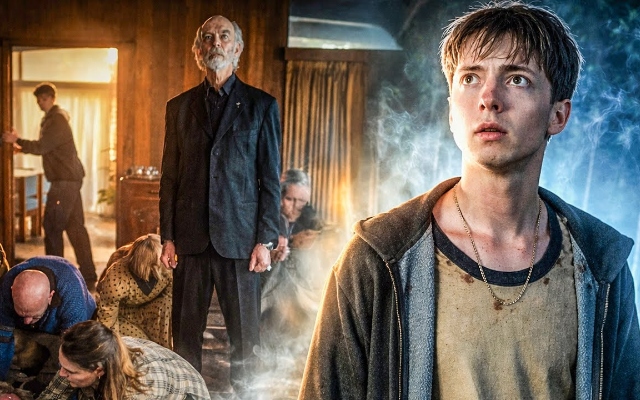 SYNOPSIS: In “Leviticus,” a new Australian supernatural horror film now playing in theatres, a church “exorcism” to “cure” two teenage boys of their queerness unleashes a violent entity. “This is what they wanted,” says Ryan (Stacy Clausen). “They wanted us to be scared.”
CAST: Joe Bird, Stacy Clausen, Jeremy Blewitt, Ewen Leslie, Davida McKenzie, Nicholas Hope, Zamira Newman, Mia Wasikowska. Written and directed by Adrian Chiarella.
REVIEW: A coming-of-age story with overtones of horror mixed in, “Leviticus” has emotional depth, and some genuinely creepy moments, as it expands and explores its story as a metaphor for the horror of conversion therapy and repression.
Set in a close-minded, drab industrial town in Victoria, Australia, the story focusses on two queer teenage boys Niam (Joe Bird) and Ryan (Stacy Clausen). When their romance is discovered, their “Bible belt” religious families submit them to an exorcism to rid them of their “sinful” urges.
“Indecency. Lust. Desire,” intones the Deliverance Healer (Nicholas Hope). “It has to go now. Look at the light.”
But instead of conversion, the ceremony summons a demon who launches a psychological and physical assault on the teens by manifesting itself as the person they most desire, each other.
“If you see anything that looks like me,” warns Ryan, “don’t go near it. It comes when no one else is around. Nothing can make it stop.”
Their fight for survival sees them question everything they know, their faith, families, and feelings.
At a bleak but quick 88 minutes “Leviticus” packs a punch with a mix of real life and supernatural horror as Niam and Ryan are literally demonized for their passion. Their story of young love is raw and resilient, enhanced by sensitive, natural performances courtesy of Joe Bird and Stacy Clausen. The effectiveness of them as a couple, two characters looking for happiness and acceptance, but denied both, drives and deepens the action, creating empathy in the face of evil.
The central idea of a demon who transfers from one person to another may be cribbed from the wonderfully weird “It Follows” but the film’s queer representation adds allegorical layers to the story and the effectiveness of the (sometimes grisly) horror.