“’Deadpool 2” is a family film,” says the main character, breaking the fourth wall, “and every family film begins with a murder. ‘Bambi.’ ‘Lion King.’ ‘Saw 7.” With the highest body count ever for a self-proclaimed family movie, it must be pointed out that it’s not for the family; it’s about family.
20th Century Fox has taken pains to keep the plot of the latest “Deadpool” under wraps. Their official synopsis mentions “a near fatal bovine attack,” the “dream of becoming Mayberry’s hottest bartender” and coping with “his lost sense of taste.” The only part of that which is true is the lost sense of taste. “Deadpool 2” is loud and proud, raunchy and profane and certainly lost any sense of taste (or decorum) in the planning stages.
There will be no spoilers here. I will tell you that between the fast n’ furious pop culture references is a story about a personal tragedy that leads Wade a.k.a. Deadpool a.k.a. the Merc with a Mouth (Ryan Reynolds) to try and off himself in spectacular fashion with a “cat nap on 1200 gallons of high-octane fuel.” Soon afterward, a troubled young mutant named Russell a.k.a. Firefist (Julian Dennison) enters his life. Unfortunately so does Cable (Josh Brolin), a time travelling cybernetic mutant soldier who refers to Deadpool as “an annoying clown dressed up as a sex toy.” He’s a handful determined to kill Russell. “You’re so dark,” Deadpool says to Cable, “are you sure you’re not from the DC universe?”
All this sets the stage for Deadpool’s great reckoning. With the help of a handful of X-Men, including Colossus (Stefan Kapičić) and Negasonic Teenage Warhead (Brianna Hildebrand), and his own team X-Force, he comes to understand the importance of family. “Family,” he says, “is not an f-word.”
Irreverence thy name is Deadpool. The Ryan Reynolds’ franchise is related to the Marvel and X-Men Universes but feels like he’s from a planet all his own. He talks directly to the audience, compares his box office to other movies and even comments on the action around him. “There’s a big CGI fight coming up,” he says, saving me the trouble of mentioning my least favourite aspect of the superhero genre. The jokes may not feel quite as fresh as they did the first time around but Reynolds, face covered under a mask 95% of the time, delivers the lines with pitch perfect delivery. Mixing one-liners with pop culture references—everything from “Yentl” to 007 to “Frozen”—he provides a running commentary that would be exhausting if not so gleefully delivered. Not all the jokes land and the Jared Kushner gag may age badly but Reynolds gets an A for effort.
“Deadpool 2” has all the elements of a summer superhero blockbuster. There’s action—directed by David Leitch, “one of the guys who killed the dog in John Wick.”—a conflicted villain—a territory Josh Brolin seems to be cornering—and some heavy franchise building. It also has something new, at least for the “Deadpool” movies and that’s humanity. It is the opposite of genteel but it gives the loudmouth lead an opportunity to grow as a character. It’s tough to follow up a movie as audacious as “Deadpool.” Fans have expectations and for the most part they are met. The jokes and the set pieces are bigger and badder but it’s the mushy stuff that prevents “Deadpool 2” from slipping solely into freak show mode. Add to that a credit scene (midway, not post credits) worth the price of admission and you’re left with a movie that works both as a superhero flick and as a twisted family drama.
For the Johnson family “Fifty Shades of Grey” is the gift that keeps on giving. First Dakota Johnson became a star playing the book’s lead character in the film adaptation. Now her father, Don Johnson, appears in “Book Club,” a tale of four women inspired by the erotic novel to spice up their sex lives.
Diane Keaton, Jane Fonda, Candice Bergen and Mary Steenburgen star as life long friends at different places in their lives. Diane (Keaton) is a recent widow, federal judge Sharon (Bergen) obsesses about her decades old divorce while sensualist Vivian (Fonda) plays the field and Carol (Steenburgen), a chef who wonders if her marriage is headed for the rocks.
The pals have been getting together for book club for forty years—starting with “Fear of Flying,” Erica Jong’s controversial 1973 portrayal of female sexuality. Their lives are shaken up when Vivian brings a new book over. “Ladies I’m not going to let us become those people who stop living before they stop living,” she says. “I would like to introduce you to Christian Grey.” “Fifty Shades of Grey,” the soft core look at hard core BDSM (bondage, discipline, sadism and masochism), becomes the hit of their chardonnay soaked book club—“It says for ‘mature audiences.’” “That certainly sounds like us.”—stirring up some long forgotten desires.
Like the classic rock on the soundtrack “Book Club” is not ashamed of what it is. Predictable in the extreme, it’s a movie that understands its audience and never over reaches. Like I well-worn joke it sets up the premise, delivers a punchline and waits for the laugh. It’s comfort food, a lightly raunchy sitcom about finding love later in life. Ripe with double entendres, it’s a genial boomer sex comedy about the pleasures of listening to vinyl, connecting and reconnecting, about a generation gap and living life to the fullest.
“We’re sure not spring flowers,” says Carol. “More like potpourri,” replies Vivian. They are women of a certain age but in an industry that often ignores older women it is fun to see this quartet front and centre. Bergen wields her wit and delivery like a sabre. Steenburgen’s journey is more about her husband Bruce (Craig T. Nelson) but she brings much charm to the role. Fonda is the vulnerable sexpot, never allowing anyone to get too close (“I don’t need anyone,” she says. “That’s the secret of my success.”) while Keaton’s trademarked fluster and flap is on full display. Together they evoke “Sex and the City” for a different generation.
The men of “Book Club” are fine—Andy Garcia, Don Johnson, Richard Dreyfuss and Nelson—but it is the women, their connection and their groove that makes this movie so enjoyable.
While “Disobedience” asks the same kind of questions that many romantic dramas have asked. Can love survive over years? Is any love forbidden? Does love change everything? The new Rachel Weisz and Rachel McAdams film, simply asks them in a different way.
Based on the novel by Naomi Alderman, “Disobedience” is the story of two women at odds with their upbringing. Rachel Weisz is Ronit, a New York based photographer, notified of her rabbi father’s (Anton Lesser) death. Travelling to London and the Orthodox Jewish area of her birth, she is met by derision by her former community. Most shun her, seeing her abandonment of their way of life as
rejection of their traditions. Everyone, that is, except childhood friends Dovid (Alessandro Nivola), who will soon take over as rabbi, and his wife Esti (Rachel McAdams). As Ronit settles her father’s estate the reason for her self-imposed exile becomes clear as she and Esti revive their teenage romance.
Chilean director Sebastian Lelio sets the stage, expertly creating the insular world of the British Orthodox Jewish enclave. Drawing us into a world ruled by cultural and spiritual customs he provides the background we need to contextualize the patriarchal world Ronit re-enters. That rich portrait gives Weisz and McAdams a canvas on which to paint two very different but very effective performances.
Both are strong-willed people who have spent years suppressing their feelings. Weisz’s Ronit straddles two worlds, her new life in America versus her old life in Britain, and with that comes introspection. Revisiting her past brings up a wellspring of emotions not just for Esti but for the life she left behind. Weisz embodies that push and pull with an internal performance that speaks volumes.
McAdams approaches Esti as a person frustrated with, but not trapped in, her ordered life. Ronit offers a kind of freedom and connection she rarely feels. It’s tremendous work, overlapping Esti’s devotedness with her natural inclinations.
“Disobedience” made the festival rounds where it was noted for its sex scenes but it is so much more than that. It’s a slow-burning character-driven study of passion that avoids judging its characters or the traditions it depicts.
The story of the Butterbox Babies resides in one of the darkest chapters of Canadian history. From 1928 to 1945 a home for unwed mothers on the South Shore of Nova Scotia sold and otherwise disposed of babies, allegedly burying the unwanted tots in “butter boxes” or wooden crates from the local grocery. The dastardly goings-on at the Ideal Maternity Home lie at the heart of a spooky new film from East Coast filmmaker Michael Melski.
The film sets the scene with a flashback to the horrible heyday of the Mersey Home for the Unwed. A young mother and her baby are separated and disposed of by the vicious proprietors of the home.
Cut to decades later. The house of horrors is now a charming country inn run by Monica (Shelley Thompson), the stern but welcoming owner. Checking in are journalist Rae (Suzanne Clément) and musician Liam (Alan Hawco), a husband and wife looking forward to celebrating her birthday. Immediately the pregnant Rae is uneasy, plagued by unsettling visions of a woman’s ghostly figure and a bloody door. Liam writes off the apparitions as PTSD, related to some of the hard-hitting work Rae does as a crime reporter. As spooky stuff continues to happen Rae’s curiosity kicks in. She begins an investigation that lead to places she could never have imagined in her wildest nightmares.
“The Child Remains” is a slow burn horror film that values atmosphere over action. Director Melski massages the gothic horror elements of the story, allowing the tension to build as the characters are subjected to mounting dread.
Aiding Melski are some nice genre performances from Thompson and Géza Kovács as henchman Talbot. As Monica, Thompson rides the line between matronly and malevolent while Kovács has a face made for genre movies.
Hawco and Clément create a believable family unit whose relationship drives the plot. As the going gets weird—and it does take a shift toward 1980s slasher conventions near the end—it is crucial the audience want the best for them, and we do.
“The Child Remains” takes an interesting approach to the psychodrama story. Blending genres to create a tale it requires more suspension of disbelief near the climax than I would have liked but nonetheless should send a chill up the spines of horror fans.
Jean-Michel Basquiat is one of the more documented artists of recent history. The work from his mid-1980s heyday decorates the background in many a movie scene, Jeffrey Wright played him in an autobiographical film, books, poems and songs have been penned about his short 27 year life and he himself appears in a laundry list of documentaries. “Boom For Real: The Late Teenage Years Of Jean-Michel Basquiat,” a new doc from New York scenester Sara Driver examines a lesser known facet of his life, the pre-fame years on NYC’s gritty streets.
Basquiat’s fame and magnetism make him a natural for this kind of up-close-and-personal treatment but Driver wisely takes time to place the artist in context. She paints a picture of late 1970s New York City as a crumbling mecca for underground artists. Deserted and dangerous streets, cheap rent and drugs attracted a cultural; elite to the Lower East Side of Manhattan. Among them, Basquiat and Al Diaz who began spray painting graffiti on buildings, working under the pseudonym SAMO. From there we learn of his charismatic appearances on Glenn O’Brien’s live public-access television show TV Party, his noise rock band Test Pattern and his unquenchable thirst to express himself. It is a journey from homelessness to the very centre of the art world, a trip that took mere years and was only cut short by a heroin overdose in 1988.
The story is told from first hand sources who provide colourful stories about the New York City’s nascent hip hop, punk, and street art movements and place them in context as to how they influenced Basquiat and vice versa. Archival footage and many never-before-seen artefacts from the Basquiat and contemporaries complete the picture.
“Boom For Real: The Late Teenage Years Of Jean-Michel Basquiat” ends before the end of the artist’s life. Here he is still a shining star, very much alive in the memories of his friends and colleagues.
They call her Notorious RBG. She’s 84 years-old and was one of only nine women at Harvard Law School in the 1950s. Kate McKinnon does a broad impression of her where she drops “Gins-burns” like a borscht belt comedian. Her name is Ruth Bader Ginsburg and a new documentary, “RBG” from directors Betsy West and Julie Cohen, details her ground breaking career from working for women’s rights in the 1970s to becoming only the second woman appointed to the Supreme Court of the United States to her unlikely status as a pop culture fixture in the 2000s. They call her Notorious RBG for a reason.
Despite an opening audio montage courtesy of Ginsburg’s detractors “RBG” is here to praise the judge, not bury her. A combination of archival footage, talking heads (including her personal friend but ideological foe Antonin Scalia) and interviews with Ginsburg herself form the backbone of the doc. We learn of her upbringing, the bond with her husband Marty (“The first boy I ever knew who cared that I had a brain.”) who launch the campaign that landed her on the Supreme Court, her love of opera and her illustrious career. “The law is something I deal with well,” she says.
Despite not being able to find a job when she graduated top of her class in 1959 she ultimately became a leading light of second wave feminism in court, challenging gender biases in all facets of her life. “I did see myself as kind of a kindergarten teacher in those days,” she says of arguing cases in front of the Supreme Court in the 1970s, “because the judges didn’t think sex discrimination existed.” Her work, then and now, led Gloria Steinem to call her “the closest thing to a superhero I know.”
Her continued influence, in pop culture and in court, is remarkable for anyone, let alone someone in her eighties. “Who is more disdained or told to go away,” says “Notorious RBG” author Irin Carmon, “than an older woman?”
“RBG” is a spirited look at an icon. Like so many docs about living people it is a tad on the starstruck side but it also works as an entertaining glimpse into an extraordinary, newsworthy life.
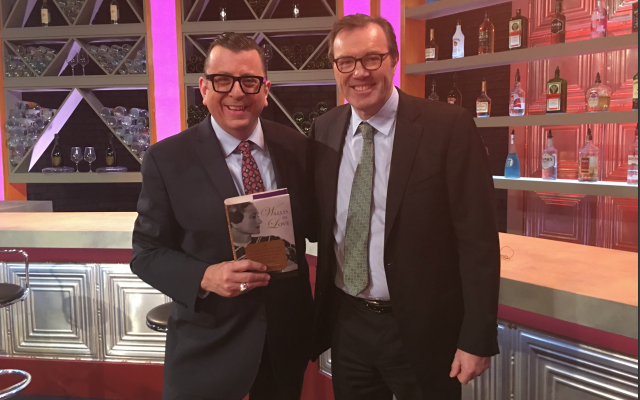
Andrew Morton, the royal biographer behind a revealing and bestselling portrait of Princess Diana swings by the “Pop Life” bar to chat up two books, “Wallis In Love,” his look at the romance that rocked the world and “Meghan: A Hollywood Princess” in which he describes the soon-to-be royal as someone who wants to be “Diana 2.0.” In this clip he discusses his books on royalty.
Film critic and pop culture historian Richard Crouse shares a toast with celebrity guests and entertainment pundits every week on CTV News Channel’s all-new talk show POP LIFE.
Featuring in-depth discussion and debate on pop culture and modern life, POP LIFE features sit-down interviews with celebrities from across the entertainment world, including superstar jazz musician Diana Krall, legendary rock star Meatloaf, stand-up comedian and CNN host W. Kamau Bell, actor and best-selling author Chris Colfer, celebrity chef Jeremiah Tower, and many more.
Watch all new shows every Saturday at 8:30 pm on Saturday or 2:30 pm on Sunday on the CTV NessChannel! (channel 1501 on Bell Fibe, 62 on Rogers) AND on CTV midnight on Saturday nights. Also, check your listings for airings on Bravo and Gusto.
An aggressive but damaged comedic persona goes back to school. It worked well when Rodney Dangerfield did it in 1986 but will it work as well a second time? Melissa McCarthy hopes to find out with this week’s release of “Life of the Party.”
The “Bridesmaid” star plays enthusiastic domestic engineer Deanna, devoted wife of Dan (Matt Walsh), mother of senior year university student Maddie (Molly Gordon). When Dan unexpectedly dumps her, abruptly ending their twenty-three year marriage, she takes control of her destiny. “What am I going to do?” she asks. “Take spin classes? Oh no. I don’t want to start a blog.” Instead of any of that it’s back to school for Deanna for the first time since Counting Crows topped the charts.
Enrolled at the same university as her daughter, Deanna blossoms. Embracing life around the quad she discovers everything she missed during her marriage. Her journey of self-discovery includes hanging out with Maddie’s friends and getting friendly with the campus frat boys.
Like “Back to School,” “Life of the Party” isn’t a particularly good movie. The first half is brutal, with so few laughs its hardtop even label it a comedy. The second half is much better but still, scenes end when it feels like they are just getting started or at least like there is one better joke to come. When it really goes for laughs between beyond Seanna’s sentimentality, self-help platitudes and momisms, however, it earns them. A mediation scene is laugh-out-loud, the relationships gel and Maya Rudolph needs to make the jump from supporting roles to the above the title star.
Mostly though, the film features the relentless likability of Melissa McCarthy. I’m not sure she elevates the material (which she co-wrote with her director husband Ben Falcone) but she brings some heart to it and in this story of a mother and daughter, that’s enough.
These days period piece don’t often burn up the box office but a new adaptation of Anton Chekhov’s petticoated romance “The Seagull” has a shot. With “Downton Abbey” a long distant memory and the heat surrounding a post-“Lady Bird” Saoirse Ronan, the 1886 could find an audience in the era of Kardashianana.
Ronan and Annette Bening headline a talented to cast to breathe life into the 132 year-old twisty-turny tale of desire to vivid life.
Love is in the air. Bening is past-her-prime actress Irina Arkadina. An aristocrat, she’s part of Russian intelligentsia and artistic elite and is judgmental of anyone who isn’t. Including her playwright son Konstantin (Billy Howle), whose avant-garde work she openly criticizes. Ignoring her son’s crush on free-spirited local actress Nina (Ronan), Irina introduces a famous writer, Boris Trigorin (Corey Stoll) to the impressionable young woman. Complicating the love rhombus are estate manager’s daughter Masha’s (Elisabeth Moss) crush on Konstantin and Irina’s jealousy at the amorous attention Boris showers on Nina.
Director Michael Mayer avoids the stodginess of previous film adaptations, casting actors with the chops to embrace Chekhov’s dialogue but bring it to life, mining the pathos and the often-neglected humour.
Bening is wonderfully cast, bringing a haughtiness to Irina that covers a wide vulnerable streak. As Nina, the star struck actress, Ronan is nails the transformation from wide-eyed ingénue to world-weary with ease but it is two supporting performances that threaten to steal the show from the leads.
As Irina’s brother Pjotr Sorin, Brian Dennehy wraps his tongue around Chekhov’s words in a way that sounds like music to the ears.
I suspect that it will be Elisabeth Moss’s Masha people will remember after the final credits roll. Melodramatic and miserable, Masha is tormented by her unrequited feelings for Konstantin and unfulfilled dreams. Moss plays her like a nineteenth century goth, draped in black. “I’m in mourning for my life,” she says. It is tremendous stuff, buoyed by Masha’s use of humour as a protective sword for her exposed feelings. “A lot of women drink,” she says, “just not as openly as I do.”
“The Seagull” doesn’t feel like a filmed version of a stage play. Mayer keeps the camera in constant motion, bringing an up-close-and-personal feel to the story of entangled attractions.