Adapted from the best-selling book of the same name by Norwegian crime writer Jo Nesbø “The Snowman” is a Scandinavian whodunit with a frosty storyline.
Someone is killing women in Oslo, leaving behind their dismembered bodies and creepy looking snowmen with grimaces made of coffee beans at the crime scenes. All the victims are mothers seemingly “punished” by the snowy sicko for extra martial affairs and terminated pregnancies. To add a macabre purity metaphor to the proceedings, each of their deaths happens during a new snowfall.
Into this grim situation comes alliteratively named detective Harry Hole (Michael Fassbender). “I need a case,” he wheezes at his boss. “I apologize for Oslo’s low-murder rate,” comes the reply.
When Hole is not drinking, chain-smoking or finding new ways to alienate the other members of the Oslo Crime Squad he’s reserving whatever humanity is tucked away inside for his ex Rakel (Charlotte Gainsbourg) and her teenage son.
Teamed with newbie Katrine Bratt (Rebecca Ferguson) he plods through a sea of red herrings to uncover the identity of Norway’s icy serial killer. “We studied your cases at the Academy,” she says. “You’re up there with the legends.”
We’ve seen this Nordic Noir before and better.
“The Snowman” ticks off all the cop movie clichés. There’s a detective bedevilled by seeing too much death, a protagonist with a personal stake in the case, a serial murderer with a deeply rooted reason for killing and senior cops too quick to try and close cases.
Fassbender’s Hole is a caricature, a once brilliant detective reduced to a bleary-eyed, brooding drunk. His scenes with Ferguson are underplayed to the point of flat lining the drama. Not that there is much drama.
Director Tomas Alfredson—whose films “Let the Right One In” and “Tinker Tailor Soldier Spy” are both four star movies—manages moments of tension but doesn’t sustain them. He continuously breaks up the tension with flashbacks and dour staring contests between the serious faced actors.
Add to that a curious lack of Oslo accents—the real mystery here is why these Norwegians speak as though they just graduated RADA—Val Kilmer in a Razzie worthy performance and you’re left with a movie that left me as cold as the snowman‘s grin.
Based on the play “Blackbird” by Scottish playwright David Harrower, “Una” is an uncomfortable look into an uncomfortable subject.
Rooney Mara is the title character, a twenty-something who takes action after seeing a picture of Ray (Ben Mendelsohn) in a magazine. The two have a past. Fifteen years earlier, when she was thirteen and Ray was a middle-aged man, he seduced her, a crime he paid for with four years in prison. “You wanted to be treated like an adult,” Ray says. “That’s what children say.”
Convinced his actions put her in a downward spiral, she goes to his place of work to confront him. He’s re-established himself with a new name, wife and job. She demands to know why he did what he did, and why he abandoned her when they were about to make a run for it and leave England to start a new life together.
What might have been a straightforward story of a search for answers defies preconceived audience expectations with the ethical landmines Harrower (who also wrote the script) plants along the way. In its most startling turn “Una” asks the audience to consider the interaction between Ray and Una, the abuser and the abused, as some kind of love story. Rooney and Mendelsohn, both very good in difficult roles, explore the thin lines the story draws between abuse and love, between right and wrong, between desire and guilt. It’s complicated and messy as Ray is forced to confront a past he’d rather subvert while Una looks for answers. “I don’t know anything about you except you abused me,” she says.
“Una” lurches headlong into controversial territory, unflinchingly presenting a painful story that offers no easy answers.
Laird Hamilton describes himself as “full of testosterone and just obnoxious.” That may have been true during his 1980s heyday as the world’s best big wave surfer, but these days he has channelled those qualities into an obsession with the ocean that drives him to grow and evolve, personally and professionally, with the sport.
In surfing circles Hamilton is a household. Less so on dry land. A new documentary from Rory Kennedy, “Take Every Wave: The Life of Laird Hamilton,” aims to rectify that. Laird didn’t make his name the way other professional surfers did; he made his name by being innovative, moving away from mainstream surfing into the early days of wind surfing and acrobatic surf moves. “We all thought he was crazy,” says big wave surfer Terry Chung.
He did things no one else thought of. He put Velcro on his board, which allowed him to go airborne. He invented foil-boarding, a technique that allows him to glide above the water, as if he’s flying over the waves. It’s beautiful to behold but we get it, he’s an innovator. We don’t need to be told over and over.
There’s something that feels a bit too authorized about “Take Every Wave.” It feels like an exercise in legend building more than an in depth portrait of Hamilton. His early years as a troubled youth are detailed but once he hits the water the movie turns into a hagiography. Hamilton is a likeable subject, if a bit egomaniacal, but instead of digging deep and showing the consequence of his actions we’re given a Biography Channel level glimpse into his psyche.
On the upside the photography—both from director Kennedy and Hamilton’s Strapped Crew—is breathtaking. The primal power of the sea juxtaposed with one man’s notions of how to conquer it make for impressive visuals.
Also entertaining is the colourful lingo. “The ride after the ride,” is what happens when you wipe out and plummet to the bottom. Even better is the self-explanatory “wave of heaviest consequence.”
“Take Every Wave: The Life of Laird Hamilton” has a few moments of intrigue, mostly from the first person tales of waves gone wrong. Other than that it’s a visually pleasing collection of Sport Illustrated style photography that offers little insight into Hamilton or the sport.
Freedom means different things to different people. “Freedom for the Wolf,” a new documentary from director Rupert Russell, takes a worldview on what liberty means for people in places where democracy is a new concept.
Drawing its name from philosopher Isaiah Berlin—“Freedom for the wolves has often meant death to the sheep.”—the film travels to Hong Kong, Tunisia, India and America to examine the reaction to the rise of a toxic mix of dictatorship and democracy called illiberal democracy. It’s an academic idea that comes to life once filtered through the experiences of Hong Kong’s Occupy Movement, #BlackLivesMatter in America, Tunisian rappers and Indian comedians.
Democracy, the film tells us, is experiencing an erosion of the freedoms that once were its cornerstones, freedom of the press, freedom of assembly and freedom of speech. We are shown how pro-Beijing forces in Hong Kong actively worked against the Occupy movement to squash the fundamentals of freedom. It’s a potent glimpse at how governments impose rules on freedom that erode the potency of the core idea.
“Freedom for the Wolf” takes large ideas and, by humanizing them, showing the people involved in the struggle for freedom, creates a vivid and thought provoking portrait of the struggle for the most basic of human rights.
Film critic and pop culture historian Richard Crouse shares a toast with celebrity guests and entertainment pundits every week on CTV News Channel’s all-new talk show POP LIFE.
Featuring in-depth discussion and debate on pop culture and modern life, POP LIFE features sit-down interviews with celebrities from across the entertainment world, including superstar jazz musician Diana Krall, legendary rock star Meatloaf, stand-up comedian and CNN host W. Kamau Bell, actor and best-selling author Chris Colfer, celebrity chef Jeremiah Tower, and many more.
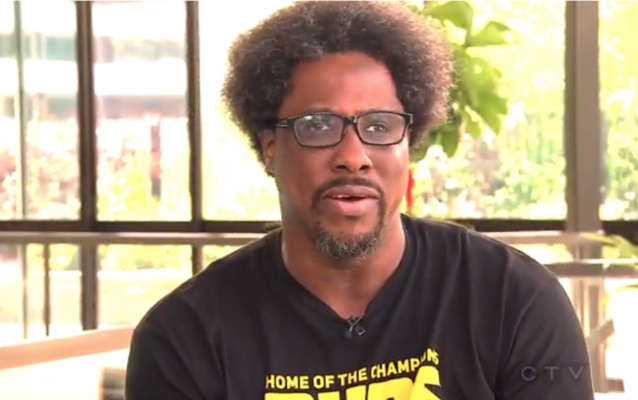
Watch the fifth episode with stand up comedian and host of CNN’s “United Shades of America” W. Kamau Bell and the Gender Wars Panel, broadcasting legend Jeanne Beker, NewsChannel anchor Beverly Thomson and music journalist Michael Williams! They wonder if things improved when it comes to gender disparity. Watch the whole show HERE!
Watch all new shows every Saturday at 8:30 pm on Saturday or 2:30 pm on Sunday on the CTV NessChannel! (channel 1501 on Bell Fibe, 62 on Rogers)
Have things improved when it comes to gender disparity? The “Pop Life” panel, broadcasting legend Jeanne Beker, NewsChannel anchor Beverly Thomson and music journalist Michael Williams, shares their responses to different challenges women are facing.
This week on POP LIFE find out the first lesson in race ever given to “The Untied Shades of America” host W. Kamau Bell and stay for the Gender panel, Beverly Thomson, who takes about the pay gap, Jeanne Beker and Michael Williams.
Watch Beverly Thomson on the pay gap between men and women HERE!
Film critic and pop culture historian Richard Crouse shares a toast with celebrity guests and entertainment pundits every week on CTV News Channel’s all-new talk show POP LIFE.
Featuring in-depth discussion and debate on pop culture and modern life, POP LIFE features sit-down interviews with celebrities from across the entertainment world, including superstar jazz musician Diana Krall, legendary rock star Meatloaf, stand-up comedian and CNN host W. Kamau Bell, actor and best-selling author Chris Colfer, celebrity chef Jeremiah Tower, and many more.
Watch Pop Life every Saturday at 8:30 pm and Sunday at 2:30 pm on the CTV NewsChannel, channel 1501 on Bell Fibe, 62 on Rogers.
Film critic and pop culture historian Richard Crouse shares a toast with celebrity guests and entertainment pundits every week on CTV News Channel’s all-new talk show POP LIFE.
Featuring in-depth discussion and debate on pop culture and modern life, POP LIFE features sit-down interviews with celebrities from across the entertainment world, including superstar jazz musician Diana Krall, legendary rock star Meatloaf, stand-up comedian and CNN host W. Kamau Bell, actor and best-selling author Chris Colfer, celebrity chef Jeremiah Tower, and many more.
Watch Pop Life every Saturday at 8:30 pm and Sunday at 2:30 pm on the CTV NewsChannel, channel 1501 on Bell Fibe, 62 on Rogers.
Happy Death Day’s advertising tagline sums up the entire plot in eight words. “Get Up. Live Your Day. Get Killed. Again.”
Like Groundhog Day with a terrifying twist, it’s the story of Tree Gelbman, a college student stabbed to death by a masked stranger at her own birthday party. Stuck in the twilight zone, she’s forced to relive the day of her murder again and again. The only way to save her life is to search for clues and solve her own murder. “I’ll keep dying until I figure out who my killer is,” she says.
The unlikely named Tree Gelbman is caught in a time loop, a Hollywood device screenwriters use to play with the linear nature of their plotlines. Bill Murray’s Groundhog Day role, a drunk, suicide-prone weatherman who discovers the beauty of life by living the same day endlessly, may be the granddaddy of all Hollywood déjà vu stories, but many other movie characters have been caught in cinematic time circles.
Run Lola Run sees crimson-haired Lola, played by Franka Potente, on a mission to help her boyfriend avoid a fate worse than death. He’s lost a bag with 100,000 deutschemarks and if he doesn’t find it in 20 minutes terrible things will happen. She rockets through Berlin looking for a solution, but each time she fails to find the loot and the 20-minute time loop starts again. Included in the 1001 Movies You Must See Before You Die, the film inspired an episode of The Simpsons and the music video for It’s My Life by Bon Jovi.
Before I Fall is a Young Adult time trip. Zoey Deutch stars as a woman trapped in her worst day ever. Like the time-travelling child of Groundhog Day and Mean Girls (but without Bill Murray or Rachel McAdams), it’s a study of teen angst magnified by a glitch in time. For its young adult audience the wild story raises questions about tolerance, bullying and behaviour.
The horror genre lends itself to time-bending tales as well. Camp Slaughter is a 2005 throwback to the slasher films of the 1980s. In this one, a group of modern teens stumble across Camp Hiawatha, a dangerous place where not-so-happy-campers are trapped in 1981 and forced to re-experience the night a maniacal murderer went on a killing spree. Labelled “Groundhog Day meets Friday the 13th (part 2,3,4,5,6,7,8… every one of them!)” by one critic, it’s gory good fun.
Not into gory? The Yuletide provides a less bloody backdrop for time-looping. The title Christmas Every Day is self-explanatory but 12 Dates of Christmas is better than the name suggests. Us Weekly called this Amy Smart romantic comedy about a woman stuck in an endless Christmas Eve, a sweet “nicely woven journey.”
Finally, the aptly named Repeaters is about a trio of recovering addicts who find themselves in “an impossible time labyrinth” after being electrocuted in a storm. Like most time-bending films, Repeaters is about learning from your mistakes. What sets it apart from some of the others are three unlikeable leads who use their situation to raise hell and break the law. It’s only when Kyle (Dustin Milligan) realizes they could be in big trouble if time suddenly unfreezes for them that familiar time-loop themes of redemption and self-reflection arise.