Welcome to the House of Crouse. It’s a special time around here as we celebrate 100 weeks of good conversation. This week we sip some bubbly and have a look at the yin and yang of movie promotion. The yin is Guy Ritchie, the yang is Charlie Hunnam. Click on the link for the whole story. Then we go long with photographer Chris Buck. His 30 year retrospective Uneasy is on bookshelves right now and he’s a fascinating interview with great stories about taking photos of everyone from Donald Trump to Ice T. It’s good stuff. C’mon in and sit a spell.
A new(ish) feature from from ctvnews.ca! The Crouse Review is a quick, hot take on the weekend’s biggest movies! This week Richard looks at “Snatched” with Amy Schumer and Goldie Hawn, “King Arthur: Legend of the Sword”and the sniper flick “The Wall.”
Richard and CP24 anchor Jamie Gutfreund have a look at the weekend’s new movies, “Snatched” with Amy Schumer and Goldie Hawn, “Bon Cop, Bad Cop 2” with Patrick Huard and Colm Feore, “King Arthur: Legend of the Sword”and the sniper flick “The Wall.”
Richard sits in with CTV NewsChannel anchor Marcia MacMillan to have a look at the big weekend movies, “Snatched” with Amy Schumer and Goldie Hawn, “Bon Cop, Bad Cop 2” with Patrick Huard and Colm Feore, “King Arthur: Legend of the Sword”and the sniper flick “The Wall.”
Guy Ritchie’s films have entertained me for years but I’m afraid he didn’t find me very interesting.
The incident happened during my press day with Ritchie and Charlie Hunnam, the director and star of King Arthur: Legend of the Sword. I first spoke with them for television. Hunnam answered my opening question about the film Excalibur, a precursor to their movie, enthusiastically. But I could feel Ritchie disengage. He sat back and went into autopilot, answering my questions by rote. The rest of the interview flew by in a flurry of quips and tossed off answers.
Half-an-hour later I sat with them again to do a longer interview for print.
“I’m glad we can make amends,” said Hunnam as I came in the room. “It seemed like you wanted to have a proper conversation and we were having a bit of a jolly up.”
The whole experience was an example of the yin and yang of movie promotion. The yin was Ritchie, an intense man who refers to the walking a red carpet as “a dog and pony show” before adding that’s not what he’s here for.
The yang is Hunnam, an engaging actor who said, “We don’t make these things to live on in obscurity, we make them with the hope that people will see them and this is one of the ways we can help manifest that.”
The duo have been all over the world talking to media people with perfectly coiffed hair and big smiles, answering the same questions on repeat. By the time I get them there’s nothing new to ask about their update of the Arthurian legend. But there is an unspoken contract between my interview subjects and me.
Whether it’s for television or for the paper you hold in your hands, the deal is the same. They say something interesting and I report it. They get publicity and I get a story that my audience will hopefully enjoy.
As Ritchie sat with his arms folded across his chest, I thought about our “contract” and the difference between the two men.
Despite his tabloid appeal — for a time the British press made a sport of reporting on him — Ritchie strikes me as a private person. He’s more interested in what he’ll be working on next than the film he spent years making and has now signed off on. Or perhaps it’s that, as a director, he’s used to being in control and in these situations he has to cede power to the interviewer.
“We both know why we’re doing it,” Ritchie says, “but the red carpet last night, I’ll tell you, I felt soulless after that. After ten minutes get me off there because it takes me hours to recover.”
Hunnam, the performer, is immediately warm and open. When Ritchie talks about losing patience on press days Hunnam jokes, “Guy Ritchie leaves the room and Johnny Nasty shows up.”
Luckily, Johnny Nasty never showed. By the end of our time together the ice broke, Ritchie’s arms unfolded and he smiled. I’m not sure what happened other than he seemed to warm up to me when we talked generally about film and not specifically about King Arthur.
We traded stories, discussed King Arthur, an actor’s connection to their director and not being imprisoned by fear. Maybe it was just me but for a moment it felt like we were talking over a beer in a bar and not fulfilling our respective contractual duties. It was, in his words, a little less of a dog and pony show.
“I feel more satisfied now,’ said Hunnam as I left and another press person walked into the room to repeat the process. “I really felt bad after the [television] interview [with you]. I thought, ‘Man, that’s a serious cat and we really just f–ed around for four minutes.’ I’m glad we got into some of the nitty-gritty.”
Terry Gilliam once told me a story about the making of his medieval epic “Monty Python and the Holy Grail.” He wanted Arthur, King of the Britons and his men to ride to the crest of a hill on horseback but couldn’t afford enough horses for everyone. Instead he put them on broomsticks with the clomp-clomp of the horses provided by trusty servant Patsy.
“You’ve got two empty halves of coconut and you’re bangin’ ’em together,” says a guard.
It is now the scene everyone remembers from the film but, Gilliam says, if he had the money he wouldn’t have had to use his imagination. Arthur would have been on horseback, no laughs, no memories.
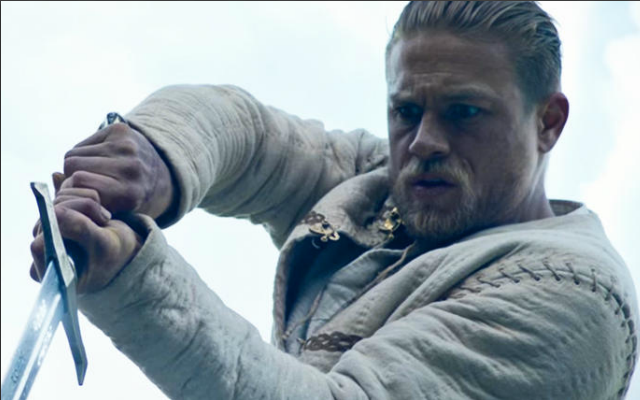
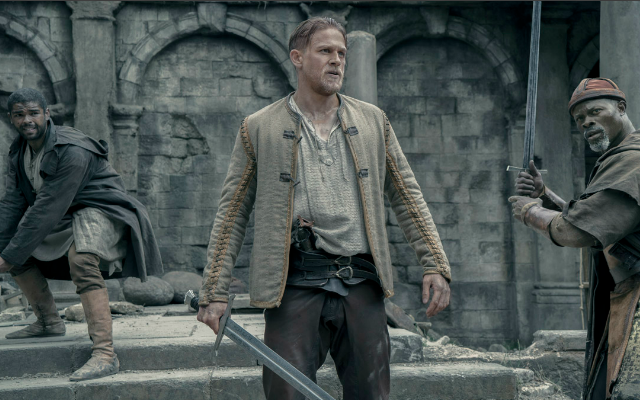
I thought of this while watching “King Arthur: Legend of the Sword,” a big budget retelling of the Camelot myth written and directed by Guy Ritchie. It’s a huge, no-expense-spared film with without an ounce of these vim and vigour that once made Guy Ritchie’s movies like “Lock, Stock and Two Smoking Barrels” and “Snatch” so much fun.
The story begins with a coup. King Uther Pendragon (Eric Bana), overthrown by his power mad brother Vortigern (Jude Law), is killed, his son Arthur a witness to the murder. The youngster escapes, shuttled off to the safety outside the castle. Raised in a brothel and unaware of his place as the “born King” Arthur grows up on Londinium’s scrappy streets as a pimp and practitioner of the ancient art of UFC battling.
Obsessed in finding and eliminating Arthur, Vortigern subjects every young male in the country to the Excalibur test. Only the “born King” can pull Pendragon’s magical sword Excalibur from the stone it is embedded in, and Vortigern wants to find him.
When it is Arthur’s turn to pull the sword no one is more surprised than he when Excalibur slides out of the stone like greased lightening. He is arrested and will soon be executed, thus cementing Vortigern’s power.
Escaping execution Arthur—with the help of his loyal followers and the anti- Vortigern Resistance—learns to harness the power of the sword and perhaps get revenge on his uncle.
I can only imagine the guy who made “Lock, Stock and Two Smoking Barrels” would look at the excesses of “King Arthur: Legend of the Sword” with wonderment. All the Ritchie trademarks are present and accounted for. There’s the cool English accents, stylish (for the time) clothing, interesting use of music, tricky slow-motion editing plus loads of violence but there’s also a giant kingdom crushing elephant. And that’s just the first five minutes. It is jam-packed but it’s not that interesting. It’s like Gilliam but with money. Instead of innovation we’re treated to a series of expensive set pieces that fill the screen but not our imaginations.
Ritchie takes some liberties with the story, but by-and-large that’s OK. People have been telling and re-telling the Arthurian legend for years. It could use a freshening up but like the “Sherlock Holmes” movies “King Arthur” is more a showcase for Ritchie’s stylistic flourishes then his storytelling ability.
“King Arthur: Legend of the Sword” isn’t your father’s “Camelot.” It’s a Guy Ritchie’s “Camelot,” a male fantasy—if it weren’t for prostitutes and witchy women there’d be no women here at all—with plenty of bluster but not enough Gilliam.
Richard sits in with CP24 anchor Nneka Elliott to review the “legendary adventures of awesomeness” of “Kung Fu Panda 3,” the watery historical drama “The Finest Hours” and “JeruZalem’s” found footage thrills.
Richard and “Canada AM” host Marci Ien chat about the found footage thrills of “JeruZalem,” the “legendary adventures of awesomeness” of “Kung Fu Panda 3” and the watery historical drama “The Finest Hours.”
Those only familiar with Holliday Grainger from her high profile appearance as the 1930s gangster Bonnie Parker in the much-hyped A&E miniseries Bonnie & Clyde could be forgiven for thinking she was born and raised on American soil. A perfect Texas drawl disguised her natural English accent.
“I’m from Manchester,” she said in our recent sit down, “northwest England.”
“Home of the Stone Roses,” I replied, mentioning the Mancunian hit makers of Love Spreads.
“I’m a bit too young for that but it’s a small town so the Stone Roses are never too far away,” she replied with a wicked laugh.
This weekend the twenty-seven year old brings a new accent to the maritime drama The Finest Hours. She plays Massachusetts native Miriam, a bride-to-be anxiously awaiting the return of her Coast Guard fiancée (Chris Pine) from a life and death mission during a brutal New England nor’easter.
“I think I’m quite good at adopting accents,” she says. “Once I started the Bonnie and Clyde Texas accent it was very easy. Within a day I was speaking in the accent all the time and I found it quite comfortable.”
She was so secure with the twang she’d often keep the accent going even when not on camera. The Finest Hours presented more of a challenge.
“I found this much harder. I actually stayed in my own accent on set for the first week or two because I didn’t feel comfortable enough in the accent to stay in it.”
To master the 1950s coastal Massachusetts brogue she worked with a dialect coach and tried, unsuccessfully, to get some real life input.
“I went to Chatham (Massachusetts] and spent an afternoon trying to record people but Chatham is now so affluent and touristy. I was going into bars and restaurants and talking to people. ‘Where are you from? Oh, you’re from New York. You’ve just moved here. Which pubs have young girls working in them who are from around here?’ I’d go and record some of them and they’d sound like they were from bloody Manhattan. Like bloody Valley Girls or something. It was not like the 1950s accent I needed to hear.”
Her character’s real life daughter Patty ended up helping out, introducing Grainger to a contemporary of Miriam’s who “had the right way of talking. The resonance.”
The actress nailed the New England burr and then refined it during production.
“In the middle of shooting the producers would say, ‘It’s too strong, bring it back.’ In my mind [I was thinking] has she been at work where she speaks quite well or is she angry? It’s fluid. People change their accents all the time.”
Ironically after all that work it’s likely Miriam didn’t have the usual regional accent.
“In actual fact Miriam’s first language wasn’t even English,” says Grainger, who will next be seen starring opposite Alicia Vikander and Judi Dench in Tulip Fever. “She was brought up speaking Finnish so she didn’t actually have the traditional accent but for the purposes of our movie we’re not going to play around with that. It’s too complicated.”
As for her own Mancunian lilt, don’t expect to hear it every time she opens her mouth.
“I change my accent all the time depending on whom I’m talking too,” she says. “If anyone had to characterise me they’d be bloody lost.”
THE FINEST HOURS SIDEBAR WITH JODY THOMAS, CANADIAN COAST GUARD COMMISSIONER
“We work very closely with the American Coast Guard, there is no mile of our coast line that we don’t share along the lower parallel. We do the same work they do. I’m watching them but I could be watching my own people. I feel enormous pride in what a Coast Guard does. To have a movie like this produced that talks about the kind of work we do, even if it’s not the Canadian Coast Guard is quite extraordinary.”
 Welcome to the House of Crouse. It’s a special time around here as we celebrate 100 weeks of good conversation. This week we sip some bubbly and have a look at the yin and yang of movie promotion. The yin is Guy Ritchie, the yang is Charlie Hunnam. Click on the link for the whole story. Then we go long with photographer Chris Buck. His 30 year retrospective Uneasy is on bookshelves right now and he’s a fascinating interview with great stories about taking photos of everyone from Donald Trump to Ice T. It’s good stuff. C’mon in and sit a spell.